Essay
God Over All Things, Including Evil
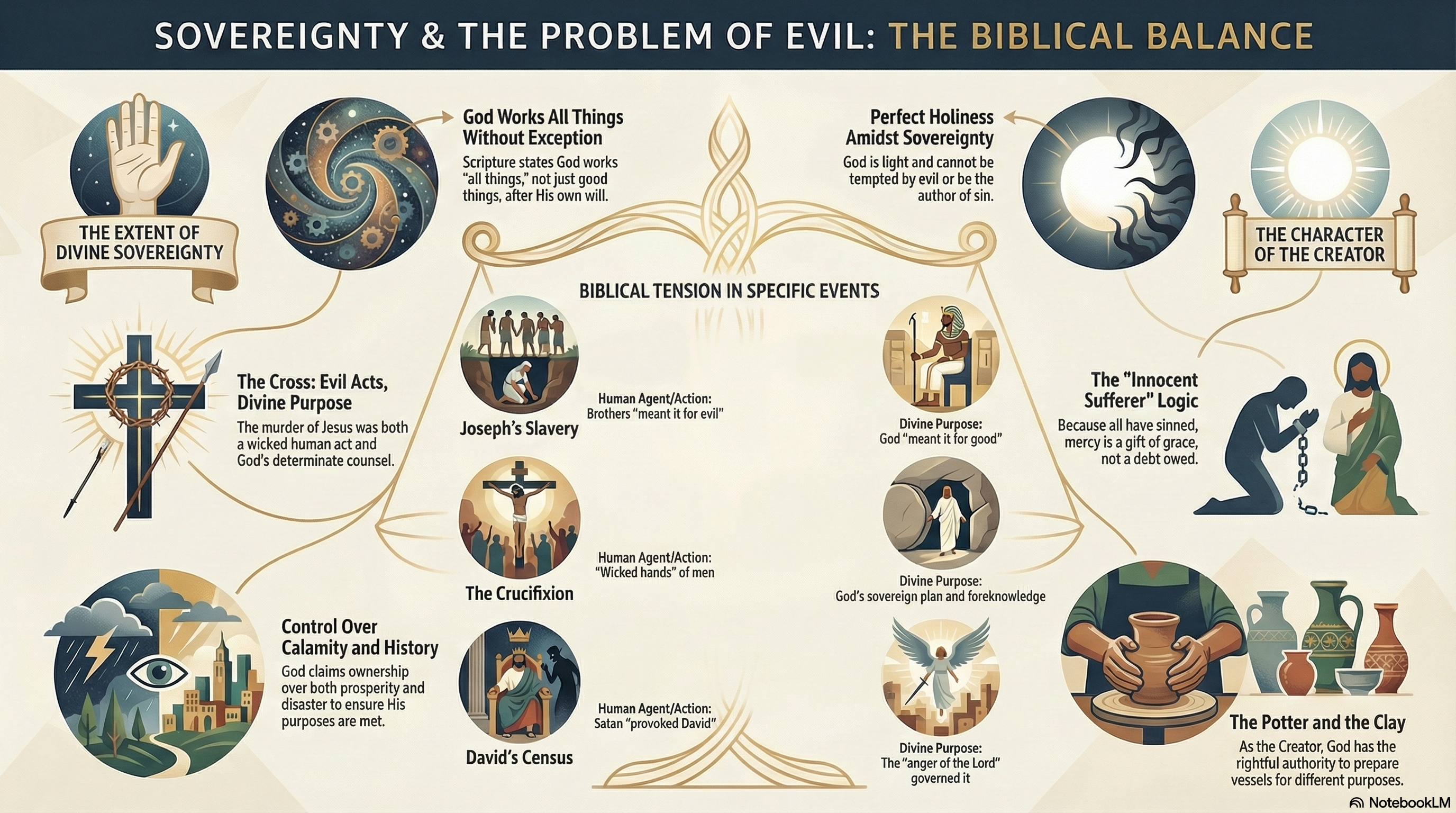
"The LORD hath made all things for himself: yea, even the wicked for the day of evil." (, KJV)
Thesis
I am grateful for every honest person who reads the doctrine of predestination and then asks the hardest question: If God chooses who will be saved, does that mean He is willing to allow innocent suffering and eternal separation?
That question deserves a real answer, not a deflection. And the Bible gives one—though the answer is not comfortable, and it will not leave human pride intact.
My convictions are those of classic Reformed covenant theology as summarized in the Westminster Standards. I hold that Scripture alone rules the conscience, that God is absolutely sovereign over all things without exception, and that He remains perfectly holy in the exercise of that sovereignty. The goal of this essay is to show that both truths stand together in the Bible without contradiction—and that the attempt to soften one always damages the other.
1) The Broadest Claim: God Works All Things After His Own Will
Before we reach the hard cases, we must let Scripture state the rule.
"In whom also we have obtained an inheritance, being predestinated according to the purpose of him who worketh all things after the counsel of his own will." (, KJV)
That is probably the most comprehensive sovereignty text in the entire Bible. Paul does not say God works most things, or good things, or things He merely foresees. He says all things—and not reluctantly, but "after the counsel of his own will."
"And we know that all things work together for good to them that love God, to them who are the called according to his purpose." (, KJV)
Not all things are good in themselves. Suffering is real. Sin is real. Loss is real. But God works through all of it for the good of His people. That claim is either the most arrogant sentence ever written, or it rests on the absolute sovereignty of the One who said it.
"For of him, and through him, and to him, are all things: to whom be glory for ever. Amen." (, KJV)
"For by him were all things created, that are in heaven, and that are in earth, visible and invisible... And he is before all things, and by him all things consist." (, KJV)
The God of the Bible is not a spectator hoping things turn out well. He is the origin, sustainer, and end of all things.
2) God Explicitly Claims Control Over Calamity
This is where the doctrine becomes uncomfortable. The Bible does not merely teach that God allows disaster in a general, passive sense. It teaches that He claims ownership of it.
"I form the light, and create darkness: I make peace, and create evil: I the LORD do all these things." (, KJV)
The word translated "evil" in the King James Version is the Hebrew ra, which in this context refers to calamity, disaster, and judgment—not moral wickedness in God Himself. The contrast is with peace. God is saying: I am the one who sends both prosperity and adversity. There is no rival power outside My rule.
"Shall there be evil in a city, and the LORD hath not done it?" (, KJV)
When calamity falls, the prophet says, it is not outside the Lord's doing.
"Who is he that saith, and it cometh to pass, when the Lord commandeth it not? Out of the mouth of the most High proceedeth not evil and good?" (, KJV)
"See now that I, even I, am he, and there is no god with me: I kill, and I make alive; I wound, and I heal: neither is there any that can deliver out of my hand." (, KJV)
"The LORD killeth, and maketh alive: he bringeth down to the grave, and bringeth up. The LORD maketh poor, and maketh rich: he bringeth low, and lifteth up." (, KJV)
These are not cautious theological abstractions. These are God's own words about Himself. He kills. He wounds. He impoverishes. He brings low. And He does all of it as Lord.
3) God Permits and Governs Wicked Acts for His Purposes
Here the doctrine tightens further. The Bible teaches not only that God controls natural calamity but that even the sinful acts of men do not fall outside His sovereign governance.
Joseph and His Brothers
"But as for you, ye thought evil against me; but God meant it unto good, to bring to pass, as it is this day, to save much people alive." (, KJV)
This is one of the most important verses in all of Scripture for this question. Joseph's brothers acted with genuine malice. Their sin was real. Yet Joseph does not say God merely used what they did after the fact. He says God meant it—the same event, the same act—unto good. Two intentions ran through the same history: one wicked, one holy.
Job and Satan
"And the LORD said unto Satan, Behold, all that he hath is in thy power; only upon himself put not forth thine hand." (, KJV)
"And the LORD said unto Satan, Behold, he is in thine hand; but save his life." (, KJV)
Satan could do nothing without divine permission and boundary. God did not become Satan. God did not commit the evil. But Satan was on a leash, and the length of that leash was set by God.
And at the end of the story, Job does not blame Satan. He says:
"The LORD gave, and the LORD hath taken away; blessed be the name of the LORD." (, KJV)
And the narrator adds: "In all this Job sinned not, nor charged God foolishly." (, KJV)
David's Census
"And again the anger of the LORD was kindled against Israel, and he moved David against them to say, Go, number Israel and Judah." (, KJV)
"And Satan stood up against Israel, and provoked David to number Israel." (, KJV)
The Bible is comfortable saying both things about the same event: Satan was the immediate agent, and God was sovereign over it. There is no embarrassment, no correction, no footnote. Both are true.
The Lying Spirit and Ahab
"Now therefore, behold, the LORD hath put a lying spirit in the mouth of all these thy prophets, and the LORD hath spoken evil concerning thee." (, KJV)
This is a judicial act of God. Ahab was already wicked. God did not make an innocent man sin. He gave a man over to the deception he had already chosen—and Scripture calls this the Lord's doing.
4) The Cross: The Supreme Proof
If there is one event that settles this question forever, it is the crucifixion of Jesus Christ.
The cross was the most evil act ever committed by human hands—the murder of the sinless, eternal Son of God. And it was, at the same time, the most glorious expression of God's sovereign purpose ever revealed.
"Him, being delivered by the determinate counsel and foreknowledge of God, ye have taken, and by wicked hands have crucified and slain." (, KJV)
Peter says both things in the same breath: God's determinate counsel and wicked hands. Not one or the other. Both.
"For of a truth against thy holy child Jesus, whom thou hast anointed, both Herod, and Pontius Pilate, with the Gentiles, and the people of Israel, were gathered together, For to do whatsoever thy hand and thy counsel determined before to be done." (, KJV)
The early church prayed this. They did not say Herod and Pilate thwarted God's plan and God cleaned up the mess afterward. They said Herod and Pilate did whatsoever God's hand and counsel determined before to be done.
If God is sovereign over the death of His own Son at the hands of wicked men, then there is no event in all of history that falls outside His rule.
5) God Hardens and Gives Over
The Bible goes further still. It teaches that God actively hardens sinners and judicially gives them over to their own rebellion. This is not passivity. It is righteous judgment.
Pharaoh
"And the LORD said unto Moses, When thou goest to return into Egypt, see that thou do all those wonders before Pharaoh, which I have put in thine hand: but I will harden his heart, that he shall not let the people go." (, KJV)
"And the LORD hardened the heart of Pharaoh." (, KJV)
Paul picks this up and draws the principle:
"For the scripture saith unto Pharaoh, Even for this same purpose have I raised thee up, that I might shew my power in thee, and that my name might be declared throughout all the earth. Therefore hath he mercy on whom he will have mercy, and whom he will he hardeneth." (, KJV)
The Gentile World
"Wherefore God also gave them up to uncleanness through the lusts of their own hearts." (, KJV)
"For this cause God gave them up unto vile affections." (, KJV)
"And even as they did not like to retain God in their knowledge, God gave them over to a reprobate mind." (, KJV)
Three times Paul says God gave them over. This is not God merely stepping back. It is God judicially handing sinners over to the consequences of what they have already chosen. He does not become sinful in doing so. He acts as Judge.
6) The Potter and the Clay
This is the passage that answers the objection directly. Paul knew that his teaching on sovereignty would provoke exactly the question every honest reader asks: If God chooses, then is He not unjust?
"Thou wilt say then unto me, Why doth he yet find fault? For who hath resisted his will?" (, KJV)
That is the objection stated plainly. If God hardens whom He wills and saves whom He wills, then how can He blame anyone?
And Paul's answer is devastating to human pride:
"Nay but, O man, who art thou that repliest against God? Shall the thing formed say to him that formed it, Why hast thou made me thus? Hath not the potter power over the clay, of the same lump to make one vessel unto honour, and another unto dishonour?" (, KJV)
Paul does not soften the doctrine. He does not retreat into human autonomy. He does not say, "Well, God merely foresaw who would choose Him." He says: You are the clay. God is the potter. The potter has power over the clay.
And then he continues:
"What if God, willing to shew his wrath, and to make his power known, endured with much longsuffering the vessels of wrath fitted to destruction: And that he might make known the riches of his glory on the vessels of mercy, which he had afore prepared unto glory." (, KJV)
God has purposes in both mercy and judgment. The vessels of wrath display His justice. The vessels of mercy display His grace. Both display His glory. And Paul does not apologize for this.
7) But Is God Then the Author of Sin?
No. And the Bible is equally clear about this.
"Let no man say when he is tempted, I am tempted of God: for God cannot be tempted with evil, neither tempteth he any man." (, KJV)
"Thou art of purer eyes than to behold evil, and canst not look on iniquity." (, KJV)
"This then is the message which we have heard of him, and declare unto you, that God is light, and in him is no darkness at all." (, KJV)
"He is the Rock, his work is perfect: for all his ways are judgment: a God of truth and without iniquity, just and right is he." (, KJV)
God is holy. God is light. God is without iniquity. He cannot be tempted with evil, and He tempts no man. The Westminster Confession states this with great care:
"God, from all eternity, did, by the most wise and holy counsel of his own will, freely and unchangeably ordain whatsoever comes to pass: yet so, as thereby neither is God the author of sin, nor is violence offered to the will of the creatures; nor is the liberty or contingency of second causes taken away, but rather established." (WCF 3.1)
That is the biblical balance. God ordains all things. God is not sinful. These are not contradictions. They are both taught by the same Scripture, and the creature does not have the standing to demand that God resolve the tension on human terms.
8) Answering the Hard Question: Innocent Death and Eternal Separation
Now we come to the question that drives all the others: If God is sovereign, does that mean He is willing to allow innocent suffering and eternal separation?
One clarification before the answer: Scripture's own picture of hell is not God's absence but His punitive presence. The lost are "tormented with fire and brimstone in the presence of the holy angels, and in the presence of the Lamb" (, KJV), and the "everlasting destruction from the presence of the Lord" (, KJV) is rightly understood as the everlasting loss of His favorable presence—His blessing withdrawn, His justice remaining—not a place where God is not.
First: No One Is Innocent
The premise of the question assumes innocence where the Bible denies it.
"For all have sinned, and come short of the glory of God." (, KJV)
"As it is written, There is none righteous, no, not one." (, KJV)
"Behold, I was shapen in iniquity; and in sin did my mother conceive me." (, KJV)
"The LORD looked down from heaven upon the children of men, to see if there were any that did understand, and seek God. They are all gone aside, they are all together become filthy: there is none that doeth good, no, not one." (, KJV)
Every human being who has ever lived, apart from the Lord Jesus Christ, is a guilty rebel against a holy God. The question is not Why does God allow innocent people to suffer? The question is Why does God allow any rebel to live another moment?
The wonder of the gospel is not that some perish. The wonder is that any are saved at all.
Yet honesty requires an acknowledgment. The hardest form of this question—suffering that strikes infants, or the righteous like Job—is not answered by guilt alone. There Scripture points to God's wise and holy purposes: Job's afflictions came not as punishment for his sin but within God's sovereign counsel (Job 1–2); the man born blind suffered "that the works of God should be made manifest in him" (, KJV); and the Westminster Confession holds that elect infants dying in infancy are regenerated and saved by Christ through the Spirit (WCF 10.3). And when Job demanded a full accounting, God gave him not an explanation but Himself—and Job's answer was worship (; 42:1–6).
Second: God Is Not Obligated to Save Everyone
This is where the potter-and-clay passage lands with its full weight. If all have sinned, and God is under no obligation to extend mercy to anyone, then the fact that He saves some is pure grace—and the fact that He passes over others is pure justice.
"Is it not lawful for me to do what I will with mine own? Is thine eye evil, because I am good?" (, KJV)
"O the depth of the riches both of the wisdom and knowledge of God! how unsearchable are his judgments, and his ways past finding out! For who hath known the mind of the Lord? or who hath been his counsellor?" (, KJV)
No creature is in a position to say God owes salvation to everyone. Grace that is owed is no longer grace.
Third: God's Purposes Are Larger Than Our Comfort
The Bible never promises that God's sovereignty will feel comfortable to fallen creatures. It promises that God's sovereignty is wise, holy, and good—and that one day every knee will bow and every tongue confess that He was right.
"For my thoughts are not your thoughts, neither are your ways my ways, saith the LORD. For as the heavens are higher than the earth, so are my ways higher than your ways, and my thoughts than your thoughts." (, KJV)
"As for God, his way is perfect: the word of the LORD is tried: he is a buckler to all those that trust in him." (, KJV)
The call of Scripture is not to understand every purpose of God before submitting to Him. The call is to trust the character of the God who has revealed Himself—and who proved His love on the cross.
9) The Cross Answers Every Objection
If anyone says, "A God who predestines cannot truly love," the cross says otherwise.
"But God commendeth his love toward us, in that, while we were yet sinners, Christ died for us." (, KJV)
"For God so loved the world, that he gave his only begotten Son, that whosoever believeth in him should not perish, but have everlasting life." (, KJV)
"Herein is love, not that we loved God, but that he loved us, and sent his Son to be the propitiation for our sins." (, KJV)
God did not predestine from a distance. He entered the suffering. He bore the penalty. He took the wrath that guilty sinners deserved upon Himself in the person of His Son. If that is not love, there is no love.
And the God who did that—the God who crushed His own Son for the sake of His elect—is the same God who hardens Pharaoh, gives sinners over, and makes vessels of wrath. He does not owe us an explanation that satisfies our sense of fairness. He has given us something far better: He has given us Himself.
10) How I Seek to Hold This Doctrine
- Affirm God's absolute sovereignty without flinching, because Scripture does not flinch. "He worketh all things after the counsel of his own will." (, KJV)
- Affirm God's perfect holiness without compromise, because Scripture does not compromise. "God is light, and in him is no darkness at all." (, KJV)
- Refuse to pit one truth against the other. The moment we say God is sovereign but perhaps not fully holy, or holy but perhaps not fully sovereign, we have abandoned the God of Scripture for an idol of our own reasoning.
- Rest in the cross as the ultimate demonstration that sovereignty and love are not enemies. The same decree that ordained the death of the Son ordained the salvation of every soul who trusts in Him.
- Humble the creature before the Creator. "Shall the thing formed say to him that formed it, Why hast thou made me thus?" (, KJV)
Conclusion
The Bible teaches that God is sovereign over all things—including evil, calamity, suffering, and the sinful acts of men. He permits, bounds, and overrules them for His own holy purposes. He hardens whom He wills and shows mercy to whom He wills. And He remains perfectly righteous in all of it.
This is not a comfortable doctrine for fallen creatures who want to sit in judgment over God. But it is the doctrine of Scripture. And when it is received in faith, it becomes the most comforting doctrine in the world—because it means nothing in all of creation can thwart the purposes of the God who loved us and gave Himself for us.
"Nay but, O man, who art thou that repliest against God? Shall the thing formed say to him that formed it, Why hast thou made me thus?" (, KJV)
"And we know that all things work together for good to them that love God, to them who are the called according to his purpose." (, KJV)
"What shall we then say to these things? If God be for us, who can be against us?" (, KJV)
The clay does not question the potter. The clay trusts the potter. And the potter has proved, at the cross, that His hands are good.
Where This Leads Next
One thread of this essay remains to be pulled. If God's decree governs all things, how should the words "predestination," "all," and "world" be defined and read in the texts where they appear — and how does a definite redemption stand together with a gospel offered to every creature? The next essay supplies that reference: Predestination, "All," and a Definite Gospel.
Suggested Next Steps
- Read , Job 1–2, , and ; 4:23–31 in one sitting, watching Scripture affirm divine sovereignty and human guilt in the same breath.
- Continue to Predestination, "All," and a Definite Gospel for careful definitions of the terms this essay has used.
- For the doctrine of the will that stands beneath compatibilism, revisit Sovereign Grace and the Bond Will.
- If you are presently suffering, take and pray it back to God, resting where Job rested: not in an explanation, but in the Lord Himself.
Essay Video
God Over All Things, Including Evil
Audio Discussion
God Over All Things, Including Evil
Infographic
God Over All Things, Including Evil