Essay
Section 1: The Bible in 66 Short Sections (KJV)
“And beginning at Moses and all the prophets, he expounded unto them in all the scriptures the things concerning himself.” (, KJV)
This is the first installment of a canon-overview series: the whole Bible in sixty-six short sections, beginning here with the five books of Moses and continuing in later installments through the Historical Books, Wisdom and Poetry, the Prophets, the Gospels and Acts, and the Letters and Revelation. The premise is simple: when you can see each book’s place in the one covenant story, you can read any chapter without losing the plot. And the plot, from Genesis forward, is Christ — the same Christ-centered reading the risen Lord taught His disciples on the road to Emmaus, and the reading this walkthrough has been teaching from the start.
Expanded Pentateuch Summaries
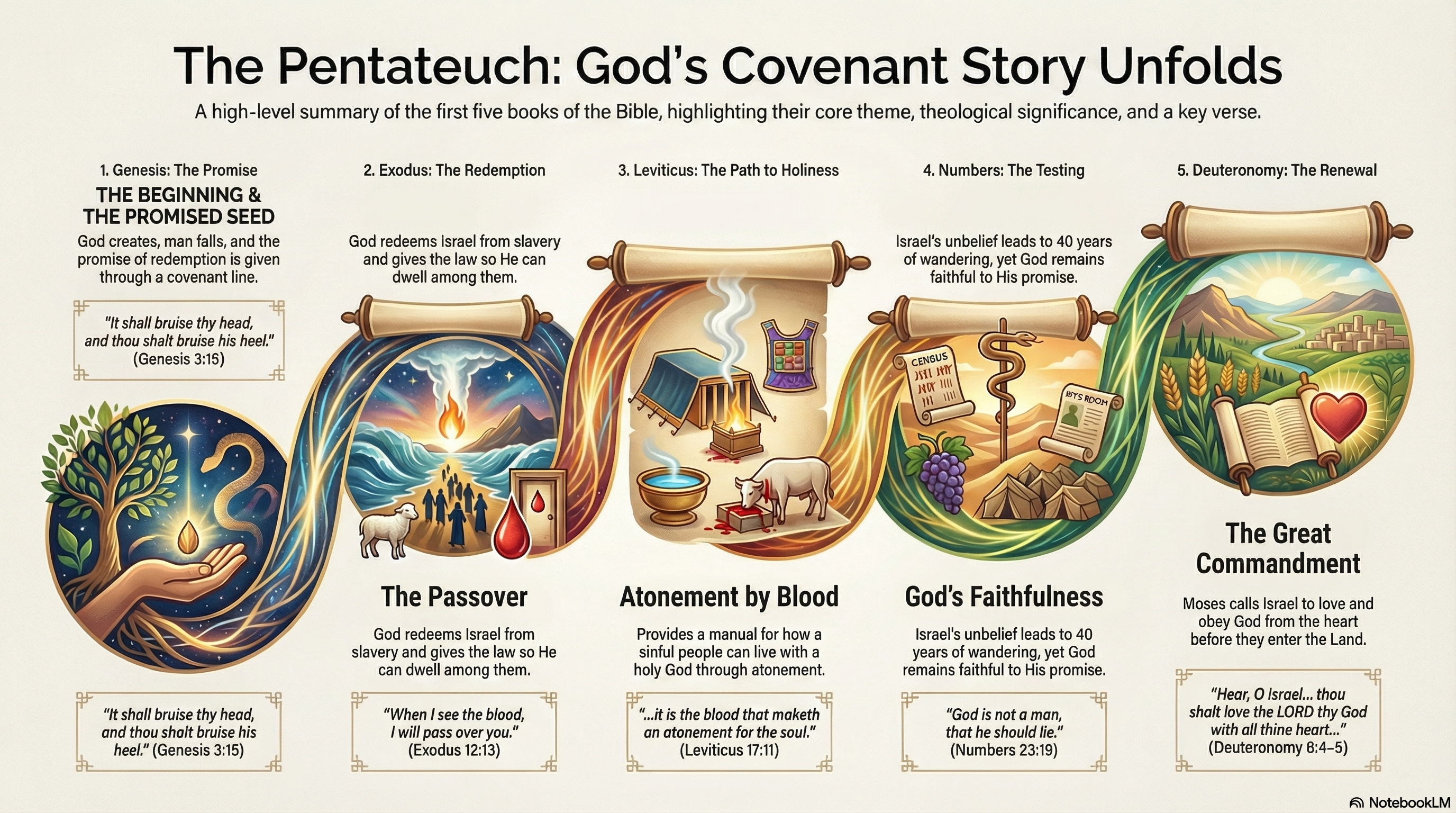
Genesis — Beginnings and the Promised Seed
What it is: The Bible’s foundation: God creates all things, makes man in His image, enters into the Covenant of Works with Adam, and after the Fall announces the Covenant of Grace (the promised “seed”). God preserves the covenant line through Noah, then calls Abram, binding Himself by oath to bless all nations through his seed. The book closes with God’s providence in Joseph, positioning Israel in Egypt for future redemption (50:20).
Why it matters: Genesis introduces the Creator/creature distinction, man’s federal headship in Adam, and the promise of the last Adam. The Abrahamic promises (land/seed/blessing) set the trajectory fulfilled in Christ, the true Seed.
Anchor verses (KJV): • Creation & image: “In the beginning God created the heaven and the earth.” (); “So God created man in his own image…” (1:27) • Fall & first gospel: “…it shall bruise thy head, and thou shalt bruise his heel.” (3:15) • Abrahamic promise: “…in thee shall all families of the earth be blessed.” (12:3; cf. 15:5–6) • Providence: “But as for you, ye thought evil against me; but God meant it unto good…” (50:20)
Exodus — Redemption and God With Us
What it is: God hears Israel’s groaning, judges Egypt with plagues, and redeems His people by the Passover blood and the parted sea. At Sinai He takes them as His treasured possession, giving His law and the tabernacle pattern so that He may dwell among them. Even Israel’s golden-calf failure highlights the need for a mediator and the miracle of mercy.
Why it matters: Exodus is the gospel in seed form—redemption by blood, deliverance by power, law for a redeemed people, and God’s presence in their midst. It foreshadows Christ our Passover and the true tabernacle.
Anchor verses (KJV): • Compassion & call: “I have surely seen the affliction of my people…” () • Passover: “…when I see the blood, I will pass over you…” (12:13) • Deliverance: “…stand still, and see the salvation of the LORD… The LORD shall fight for you…” (14:13–14) • Covenant vocation: “…a kingdom of priests, and an holy nation.” (19:4–6) • Presence: “And let them make me a sanctuary; that I may dwell among them.” (25:8)
Leviticus — Holiness, Sacrifice, and Access by Blood
What it is: A priestly manual that teaches Israel how a holy God dwells with a sinful people. Sacrifices, priesthood, clean/unclean laws, and feasts all instruct the conscience and point to a better Priest and once-for-all sacrifice. The refrain is holiness—belonging wholly to the LORD in worship and life.
Why it matters: Leviticus shows substitution, atonement, and consecration. Its shadows terminate in Christ (Hebrews 8–10), yet its call to holiness abides for the covenant people.
Anchor verses (KJV): • Holiness: “…ye shall therefore be holy, for I am holy.” (; cf. 19:2) • Atonement: “For the life of the flesh is in the blood… it is the blood that maketh an atonement for the soul.” (17:11) • Feasts (redemptive calendar): Leviticus 23 (Sabbath; Passover/Unleavened Bread; Firstfruits; Pentecost; Trumpets; Day of Atonement; Tabernacles)
Numbers — Wilderness Testing and God’s Faithful Leading
What it is: From Sinai to the borders of Canaan, Israel’s unbelief sparks forty years of wandering. You meet the grumbling generation, the bronze serpent lifted up, priestly blessing, and Balaam’s oracles that confirm God’s irrevocable word. Despite failure, God keeps guiding His people to the Land.
Why it matters: Numbers is a mirror for pilgrims—warning against unbelief and magnifying God’s immutability and grace. The bronze serpent becomes a type of Christ lifted up for sinners (cf. ).
Anchor verses (KJV): • Wilderness sentence: “And your children shall wander in the wilderness forty years…” () • Healing look: Those who looked to the serpent “lived.” (21:4–9) • God’s faithfulness: “God is not a man, that he should lie.” (23:19) • Priestly blessing (pilgrim identity): “The LORD bless thee, and keep thee…” (6:24–26)
Deuteronomy — Covenant Renewal for the Next Generation
What it is: Moses’ farewell sermons apply the law to hearts on the threshold of the Land. Israel is summoned to love the LORD exclusively, warned with blessings and curses, assured that life is found in clinging to Him, and taught to hope for a heart circumcised by God and a coming Prophet like Moses. Moses dies; Joshua will lead—but the word remains central.
Why it matters: Deuteronomy frames life as covenant faithfulness from the heart. It promises the inward work later expounded in the New Covenant (Jeremiah 31; Hebrews 8) and points to Christ the Prophet who speaks God’s final word.
Anchor verses (KJV): • Shema & discipleship: “Hear, O Israel: The LORD our God is one LORD: And thou shalt love the LORD thy God…” (; cf. 6:6–9) • Blessing/curse: “…if thou shalt hearken… all these blessings shall come… but… if thou wilt not hearken…” (28:1–2, 15) • New-heart promise: “And the LORD thy God will circumcise thine heart…” (30:6) • Choose life: “…I have set before you life and death… therefore choose life…” (30:19–20) • The Prophet to come: “…a Prophet… like unto me; unto him ye shall hearken.” (18:15–19) • Moses’ death:
How to use this (practically)
- Read each book with these anchors open; 2) memorize one short line per book (e.g., ; ; ; ; ); 3) trace how each book advances the covenant story toward Christ (). Keep your heart engaged—“But be ye doers of the word, and not hearers only…” (, KJV).
A Reformed note on reading the Pentateuch
Read these five books covenantally: under the law, the one covenant of grace was administered by promises, prophecies, sacrifices, and types, all foresignifying Christ to come, and it was sufficient to save the elect of that age through faith in the promised Messiah (WCF 7.5). There are not two covenants of grace differing in substance, but one and the same under various dispensations (WCF 7.6) — so the Pentateuch is not a rival religion of works that the gospel later replaced, but the opening administration of the same salvation.
Conclusion and handoff
The Pentateuch closes with Moses dead outside the Land and the promise still open — the rest of Scripture leans forward from here toward the Prophet like unto Moses. Before continuing to the Historical Books, read One Gospel Before and After the Cross to see why the salvation these five books foreshadow is the very gospel believed today: same grace, same faith, same Christ.
Essay Video
Section 1: The Bible in 66 Short Sections (KJV)
Audio Discussion
Section 1: The Bible in 66 Short Sections (KJV)
Infographic
Section 1: The Bible in 66 Short Sections (KJV)