Quick navigation
Essay
Why I Am Not a Preterist
“Which also said, Ye men of Galilee, why stand ye gazing up into heaven? this same Jesus, which is taken up from you into heaven, shall so come in like manner as ye have seen him go into heaven.” (, KJV)
I do not write this to be harsh, but to be clear. I understand why preterist arguments attract serious Bible readers. They often begin with things that are genuinely true: Scripture does contain real time texts, Jesus really did warn of coming judgment upon Jerusalem, and many Christians have read prophecy too woodenly or too carelessly. In that sense, preterism often gains a hearing because it stands close to something real.
That is exactly why it must be answered carefully.
The most dangerous error is often not the one that denies everything, but the one that takes a true insight and stretches it beyond the bounds of Scripture. That, in my judgment, is what full preterism does. It notices the Bible’s first-century urgency—rightly—but then uses that urgency to dissolve the church’s future hope: the visible return of Jesus Christ, the resurrection of the body, the final judgment, and the consummation of the new creation.
I cannot follow it there.
Thesis
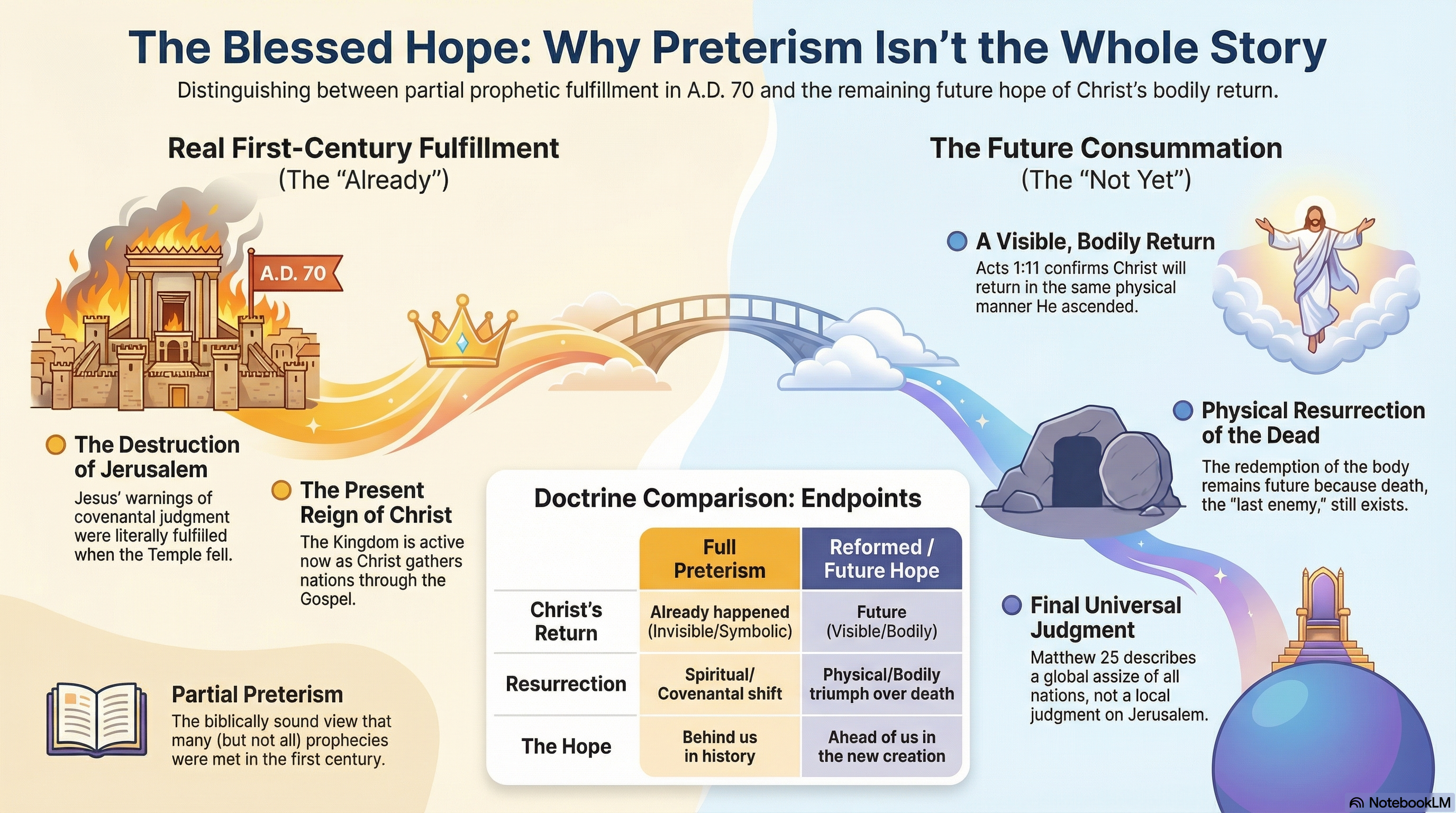
I am not a preterist because Scripture, read by the apostolic method and within the covenantal unity of redemptive history, teaches that while some prophecies were fulfilled in the first century, the climactic promises of Christ’s future, visible, bodily return, the general resurrection, and the final judgment remain future. The kingdom is present now in Christ’s reign, but it is not yet consummated. Jerusalem was judged; Christ was vindicated; the old order passed away. But the Lord Jesus has not yet returned in the full and final sense promised in Holy Scripture.
1) I must begin by defining the issue carefully
The word preterist is used in more than one way.
Some use it in a partial sense, meaning that many passages about judgment and tribulation were fulfilled in the events surrounding the destruction of Jerusalem in A.D. 70. Others use it in a full sense, meaning that the Lord’s coming, the resurrection, and the judgment are already past.
That distinction matters.
I gladly grant that the New Testament contains real first-century fulfillment. Our Lord did warn of Jerusalem’s destruction. He did speak of covenantal judgment falling within that generation. The old covenant age did reach its decisive close in history. I do not need to deny any of that.
But once preterism goes beyond that and says that the parousia, the resurrection of the dead, and the last judgment are already fulfilled, it ceases to be a mere timing proposal. It becomes a redefinition of Christian hope.
And that is where I must part company with it.
Let me also state my own relation to the partial position plainly. I affirm substantial A.D. 70 fulfillment—the judgment on Jerusalem within that generation (), the end of the old covenant order, the vindication of Christ’s prophetic word—and in that sense I hold much of what partial preterists hold. I decline the label itself because it increasingly denotes a system, and the system’s gravity pulls toward drawing the blessed hope itself into the past. What I affirm needs no such name: it is simply the historic Reformed reading of the Olivet Discourse.
2) My method is not “system first,” but exegesis first
The issue is not what feels urgent, nor what fits a modern timeline best. The issue is how the apostles teach us to read the Bible.
Jesus Himself gives us the pattern:
“And beginning at Moses and all the prophets, he expounded unto them in all the scriptures the things concerning himself.” ()
And again:
“Then opened he their understanding, that they might understand the scriptures.” ()
The apostles do not teach us to read prophecy as a flat chart. They teach us to read it Christologically, covenantally, and with Scripture interpreting Scripture.
That means several things.
First, we do not build doctrine on one difficult phrase while ignoring clearer passages.
Second, we allow shadow to yield to substance:
“Which are a shadow of things to come; but the body is of Christ.” ()
Third, we distinguish what is already fulfilled from what is not yet consummated.
Christ reigns now. The kingdom is present now. The nations are being gathered now. But not every promise has reached its final form. Scripture itself teaches this “already / not yet” pattern.
“For he must reign, till he hath put all enemies under his feet.” ()
That one word—till—matters. Christ reigns now, and yet the story is not finished.
3) I do not deny A.D. 70; I deny that A.D. 70 was the final consummation
This is where preterism often sounds strongest. It points to passages like :
“Verily I say unto you, This generation shall not pass, till all these things be fulfilled.” ()
I do not explain that verse away. I believe Jesus meant what He said. Jerusalem was judged. The temple fell. The old covenant order was brought to its public ruin. Those things matter deeply.
But the mistake is to assume that because some things in the discourse are near, all things in the discourse must therefore be reduced to A.D. 70.
The passage itself resists that flattening.
Later in the discourse our Lord says:
“But of that day and hour knoweth no man, no, not the angels of heaven, but my Father only.” ()
And in Matthew 25 He speaks of the Son of man coming in glory, all nations being gathered before Him, and an everlasting separation between the righteous and the wicked.
“When the Son of man shall come in his glory, and all the holy angels with him, then shall he sit upon the throne of his glory:” ()
“And before him shall be gathered all nations.” ()
“And these shall go away into everlasting punishment: but the righteous into life eternal.” ()
That is not a local judgment on Jerusalem only. That is the final assize.
So I do not deny near fulfillment. I deny the collapse of all fulfillment into one event.
4) Christ’s return is still future because Acts 1 says what kind of return it will be
If I had to choose one text that most directly blocks full preterism, it would be Acts 1.
The disciples watch the ascended Christ go bodily into heaven. Then the angels speak:
“Ye men of Galilee, why stand ye gazing up into heaven? this same Jesus, which is taken up from you into heaven, shall so come in like manner as ye have seen him go into heaven.” ()
That text is devastating to every attempt to make the final coming of Christ merely invisible, merely covenantal, or merely symbolic.
Notice what it says.
This same Jesus—not merely His influence, not merely His judgment, not merely a covenantal transition.
Shall so come—not in a wholly different way, but in continuity with the ascension they just witnessed.
In like manner—the manner matters.
Full preterism must reduce that into something far less concrete than the text itself gives. But the text will not cooperate.
Christ certainly does come in providential judgments within history. Scripture can speak that way. But Acts 1 is not merely talking about providential judgment. It is speaking of the return of the ascended Lord Himself.
That has not yet happened.
5) I am not a preterist because the resurrection of the dead is still future
This is the decisive issue.
The New Testament does not present resurrection as merely a covenantal shift, a transition of ages, or a change in redemptive administration. It presents resurrection as the embodied triumph of Christ over death.
Jesus says:
“Marvel not at this: for the hour is coming, in the which all that are in the graves shall hear his voice,” ()
“And shall come forth; they that have done good, unto the resurrection of life; and they that have done evil, unto the resurrection of damnation.” ()
“All that are in the graves” is not naturally read as a metaphor for covenantal relocation.
Paul says the same kind of thing in Romans 8:
“And not only they, but ourselves also, which have the firstfruits of the Spirit, even we ourselves groan within ourselves, waiting for the adoption, to wit, the redemption of our body.” ()
If the body is not finally redeemed yet, then the consummation is not yet past.
And Philippians is just as plain:
“For our conversation is in heaven; from whence also we look for the Saviour, the Lord Jesus Christ:” ()
“Who shall change our vile body, that it may be fashioned like unto his glorious body.” ()
We still look for Him. We still await the change of the body. Therefore I cannot say the resurrection is already accomplished.
The great chapter is 1 Corinthians 15. There Paul ties our resurrection to Christ’s resurrection:
“But now is Christ risen from the dead, and become the firstfruits of them that slept.” ()
“For as in Adam all die, even so in Christ shall all be made alive.” ()
“But every man in his own order: Christ the firstfruits; afterward they that are Christ’s at his coming.” ()
That phrase is enough: they that are Christ’s at his coming.
Then Paul adds:
“The last enemy that shall be destroyed is death.” ()
Death is still here. Graves still fill. Bodies still decay. Therefore the resurrection of which Paul speaks is still future.
And the apostle gives a direct warning that presses painfully against full preterism:
“Who concerning the truth have erred, saying that the resurrection is past already; and overthrow the faith of some.” ()
That is not a minor interpretive disagreement. Paul says it overthrows faith.
I cannot step into a system that makes that apostolic warning sound like an overreaction.
6) The church’s comfort in 1 Thessalonians 4 is still future comfort
Full preterism must spiritualize Paul’s teaching on the coming of the Lord. But Paul wrote that passage to comfort grieving Christians about dead believers.
“For the Lord himself shall descend from heaven with a shout, with the voice of the archangel, and with the trump of God: and the dead in Christ shall rise first:” ()
“Then we which are alive and remain shall be caught up together with them in the clouds, to meet the Lord in the air: and so shall we ever be with the Lord.” ()
“Wherefore comfort one another with these words.” ()
The comfort is future because the event is future.
Paul does not say, “Do not grieve, because this already happened invisibly in covenantal form.” He points them forward to the Lord’s own descent, the resurrection of the dead, and everlasting communion with Christ.
That is still the church’s comfort.
If full preterism is right, then Paul’s pastoral logic is strangely emptied. The passage no longer points mourning saints to their future hope, but to an already-completed event they did not and could not witness.
That is not how the apostle uses it.
7) still means what it says
Yes, Revelation is apocalyptic. Yes, it uses symbols. But apocalyptic symbolism does not nullify clear affirmations.
“Behold, he cometh with clouds; and every eye shall see him, and they also which pierced him: and all kindreds of the earth shall wail because of him. Even so, Amen.” ()
Full preterism must render that into something effectively non-public or already exhausted in first-century judgment. Some orthodox partial preterists, it should be said, do read of the judgment on Jerusalem while affirming the future visible coming from other texts; that position does not deny the blessed hope, and I do not treat it as if it did. But the verse itself presses beyond Jerusalem.
Every eye shall see him. All kindreds of the earth.
That scope is wider than one city and one generation. The burden of proof is not on the ordinary Christian who reads this as a public, manifest coming. The burden is on the system that must reduce that language so drastically that the church has been waiting for a visible return that, in fact, already happened invisibly.
I cannot accept that.
8) The “time texts” are real, but they are not the whole story
This is where a careful Reformed path matters.
I do not deny the force of the time texts. I do not deny that some events were near. I do not deny that covenantal judgments were imminent. I do not deny that first-century believers lived in a real sense of eschatological crisis.
But the presence of nearness language does not by itself tell you which event is in view, nor does it permit you to redefine clearer passages.
The New Testament has a layered eschatology.
Some things were near:
-
the judgment on Jerusalem,
-
the passing of the old order,
-
the vindication of Christ’s prophetic word.
Other things remain future:
-
the bodily return of Christ,
-
the resurrection of the dead,
-
the last judgment,
-
the new heavens and the new earth in consummate fullness.
A sound reading must let all of Scripture speak.
That includes the much-discussed Greek word μέλλω. Yes, it can sometimes mean “about to.” But lexical range is not theological proof. Words gain force from context, not from one preferred gloss forced into every verse. Even if a particular use of mellō strengthens imminence, that still would not prove that every eschatological reference must be collapsed into A.D. 70.
A single Greek verb cannot overturn Acts 1, John 5, Romans 8, 1 Corinthians 15, Philippians 3, and 1 Thessalonians 4.
9) I am Reformed, so I must distinguish the kingdom’s presence from its consummation
One reason I am not a preterist is that I do believe the kingdom is present now.
Christ is reigning now.
“Who hath delivered us from the power of darkness, and hath translated us into the kingdom of his dear Son.” ()
He is seated now.
“The LORD said unto my Lord, Sit thou at my right hand, until I make thine enemies thy footstool.” ()
Peter applies that to the present reign of Christ in Acts 2. Paul applies it in 1 Corinthians 15.
So I do not need a future earthly millennium to make Christ King.
But neither may I say that because the kingdom is present, its consummation is therefore past.
Reformed amillennialism gives a better account.
Christ reigns now.
The nations are being discipled now.
The saints who die reign with Him now.
The church suffers and conquers by Word and Spirit now.
But the final appearing, resurrection, judgment, and renewal of all things remain future.
That is a far more biblical balance than either dispensational postponement on the one hand or preterist overrealization on the other.
10) The visible and invisible church also help keep our bearings
Preterism often promises interpretive sharpness, but it can subtly destabilize the ordinary Christian’s place in the church.
The Reformed distinction between the visible and invisible church is helpful here.
The invisible church is the whole number of the elect united to Christ. The visible church is the outward covenant community in history, where the Word is preached, the sacraments administered, and the saints gathered.
That visible church still confesses:
-
“He shall come again.”
-
“The resurrection of the body.”
-
“The life everlasting.”
Those are not disposable formulas. They express the church’s public hope.
The Supper itself teaches us to look forward:
“For as often as ye eat this bread, and drink this cup, ye do shew the Lord’s death till he come.” ()
Till He come.
The church still waits.
11) I am not a preterist because the creeds and confessions are right here
The creeds are not above Scripture. The Westminster Confession is not above Scripture. But they are faithful summaries of what the church has seen in Scripture.
The Apostles’ Creed confesses “the resurrection of the body.”
The Nicene Creed confesses that Christ “shall come again.”
The Reformed confessions do the same.
That is not accidental.
It is not because the whole church simply missed the obvious for centuries. It is because the church read Scripture and concluded that Christian hope is still future in these essential respects.
To deny that Christ will come again bodily and visibly, and to deny that the dead will rise bodily, is not a harmless refinement. It cuts against the church’s confessed faith.
That matters to me because I am not trying to invent a private eschatology. I want to stand where the church, under Scripture, has stood.
12) The pastoral danger is real
This is not only an exegetical issue. It is pastoral.
If full preterism were true, then the church’s future hope would already be behind us.
But the New Testament teaches us to live otherwise.
“Looking for that blessed hope, and the glorious appearing of the great God and our Saviour Jesus Christ;” ()
“Beloved, now are we the sons of God, and it doth not yet appear what we shall be: but we know that, when he shall appear, we shall be like him; for we shall see him as he is.” ()
“For our conversation is in heaven; from whence also we look for the Saviour, the Lord Jesus Christ:” ()
The church still looks.
The church still waits.
The church still hopes.
The church still groans.
The church still buries her dead in faith.
That is not a defect in our theology. That is the very shape of New Testament Christianity.
13) Objections and replies
The strongest preterist rejoinders deserve to be stated at full strength and answered directly.
Objection 1: “Paul said ‘we shall not all sleep.’ He expected the coming within his own generation — so either he erred, or it happened.”
“Behold, I shew you a mystery; We shall not all sleep, but we shall all be changed,” ()
“In a moment, in the twinkling of an eye, at the last trump: for the trumpet shall sound, and the dead shall be raised incorruptible, and we shall be changed.” ()
The objection runs: Paul includes himself among those alive at the change. If the coming did not occur in that generation, an inspired apostle was mistaken; preterism, by placing the event in A.D. 70, is the reading that rescues inspiration.
Reply: The “we” is not Paul’s private timetable; it is the class of the living at His coming, and it is the standard apostolic idiom of watchfulness. Paul writes so that every generation of the church stands inside that “we” until the Lord comes — the same idiom as “we which are alive and remain” in , written in the very passage that refuses to date the event: “For yourselves know perfectly that the day of the Lord so cometh as a thief in the night.” () And Paul deliberately frames the comfort so that it holds whichever side of death a believer stands on: “Who died for us, that, whether we wake or sleep, we should live together with him.” () Nor did Paul assume he would personally survive to the parousia. He reckons openly with his own death: “For I am in a strait betwixt two, having a desire to depart, and to be with Christ; which is far better:” () And at the end: “For I am now ready to be offered, and the time of my departure is at hand.” () A man who believed he must live to see the coming does not write that. So the dilemma is false. Paul neither erred nor dated the event; he taught the church — his generation and ours — to watch.
Objection 2: “2 Peter 3 answers scoffers mocking a delayed coming. That answer only works if the coming were still due in that generation.”
The scoffers ask, “Where is the promise of his coming? for since the fathers fell asleep, all things continue as they were from the beginning of the creation.” () The objection runs: if the coming were still outstanding two thousand years later, the scoffers would effectively be right, and Peter’s reply would fail — so the coming he defends must have arrived in A.D. 70.
Reply: This reverses Peter’s actual argument. Peter does not answer the scoffers by shortening the horizon to his readers’ lifetime; he answers them by taking the timetable out of human reckoning altogether: “But, beloved, be not ignorant of this one thing, that one day is with the Lord as a thousand years, and a thousand years as one day.” () The delay is not slackness but patience: “The Lord is not slack concerning his promise, as some men count slackness; but is longsuffering to us-ward, not willing that any should perish, but that all should come to repentance.” () Peter’s whole point is that the Lord’s timetable is not generational — which is precisely why the scoffers’ argument from elapsed time fails in every century, including ours. And look at what the awaited day brings in that chapter: the heavens passing away, the elements melting, and then — “Nevertheless we, according to his promise, look for new heavens and a new earth, wherein dwelleth righteousness.” () That is the consummation of creation, not the fall of a city. The chapter preterism leans on for nearness is the chapter that most plainly detaches the promise from any one generation’s clock.
Objection 3: “Revelation says ‘shortly’ and ‘quickly.’ The book brackets itself with nearness, and honesty requires first-century fulfillment.”
“The Revelation of Jesus Christ, which God gave unto him, to shew unto his servants things which must shortly come to pass;” ()
And at the close: “He which testifieth these things saith, Surely I come quickly.” () The objection runs: the book’s own frame is imminence, and every non-preterist reading must quietly explain that frame away.
Reply: Take the book’s own horizon seriously and the objection collapses. Revelation’s contents include the general resurrection and the last judgment — the sea giving up its dead, the books opened, death and hell cast into the lake of fire () — and the new heaven and new earth in which God wipes away all tears and death is no more (Revelation 21–22). No sober reader claims those things are behind us. So the nearness language cannot mean that everything in the book was exhausted by A.D. 70; it governs the inaugurated sequence — the things begin at once, press forward without pause, and stand always at hand for a church commanded to watch. That is the same lesson section 8 drew about mellō: lexical nearness cannot be forced into one gloss and then used to overturn the book’s own contents. And the church’s answer to “Surely I come quickly” has never been past tense. It is a prayer: “Amen. Even so, come, Lord Jesus.” () The last prayer of the Bible is unintelligible if the coming it begs for is already behind us.
Conclusion
I am not a preterist because I believe the Bible means what it says about Christ’s future coming, the resurrection of the body, and the final judgment.
I gladly affirm first-century fulfillment where Scripture places it. I gladly affirm that Jerusalem was judged. I gladly affirm that the kingdom is already present in Christ. I gladly affirm that some prophetic texts are better read covenantally than carnally.
But I cannot follow preterism when it crosses the line from recognizing near judgment to denying future consummation.
The same Jesus who ascended will return.
The dead will be raised.
Death will be destroyed.
All nations will stand before the Judge.
The church’s hope is not behind her.
It is still before her.
“And if I go and prepare a place for you, I will come again, and receive you unto myself; that where I am, there ye may be also.” ()
“So Christ was once offered to bear the sins of many; and unto them that look for him shall he appear the second time without sin unto salvation.” ()
That is why I am not a preterist.
Not because I deny fulfillment.
Not because I deny the force of difficult texts.
Not because I want a sensational end-times chart.
But because I believe the apostles teach me to read prophecy in a way that preserves both truths at once:
Christ reigns now. Christ will come again.
Closing the walkthrough
This is the final essay of the walkthrough, and it ends where the whole series has been pointing. Every essay in this collection — on Scripture, on the church, on worship, on the errors declined along the way — has served one end: that you would know the God who saves and wait for His Son from heaven.
So let me close pastorally rather than polemically. The doctrine defended here is not a debating point; it is the comfort Christians are commanded to give one another at gravesides. If Christ is not coming again, the church has nothing to say to the widow and nothing to sing over the coffin. But He is coming. “Unto them that look for him shall he appear the second time without sin unto salvation.” The question the whole walkthrough leaves with you is simply whether you are among them that look for Him.
If you are not — or if you are not sure — do not begin with eschatology. Begin with the gospel itself: The Way of Salvation. The blessed hope belongs to those who belong to Christ, and Christ receives all who come to Him. Settle that first, and the return of the Lord stops being a puzzle to solve and becomes what the New Testament calls it: your hope.
And if you are His: watch, work, and comfort one another with these words. The church still waits — but she does not wait in the dark.
Suggested next steps
- Read Corinthians 15, :11, and 2 Peter 3 in one sitting, noting how each text holds real nearness and real futurity together.
- If the gospel itself is the open question, read The Way of Salvation before returning to any eschatological debate.
- Revisit Why I Am Not a Messianic Jew to see the same method — fulfilled promises honored as fulfilled, future promises kept future — applied to the law rather than to prophecy.
- As a practical exercise, memorize , and at the next Lord’s Supper attend to the words “till he come” () — the church’s standing confession that her hope is still before her.
Audio Discussion
Why I Am Not a Preterist
Audio Discussion
Why I Am Not a Preterist
Infographic
Why I Am Not a Preterist
Infographic
Why I Am Not a Preterist