Essay
Revelation 20 and the Millennium: Why Christ Reigns Now
"I am he that liveth, and was dead; and, behold, I am alive for evermore, Amen; and have the keys of hell and of death." (, KJV)
Thesis
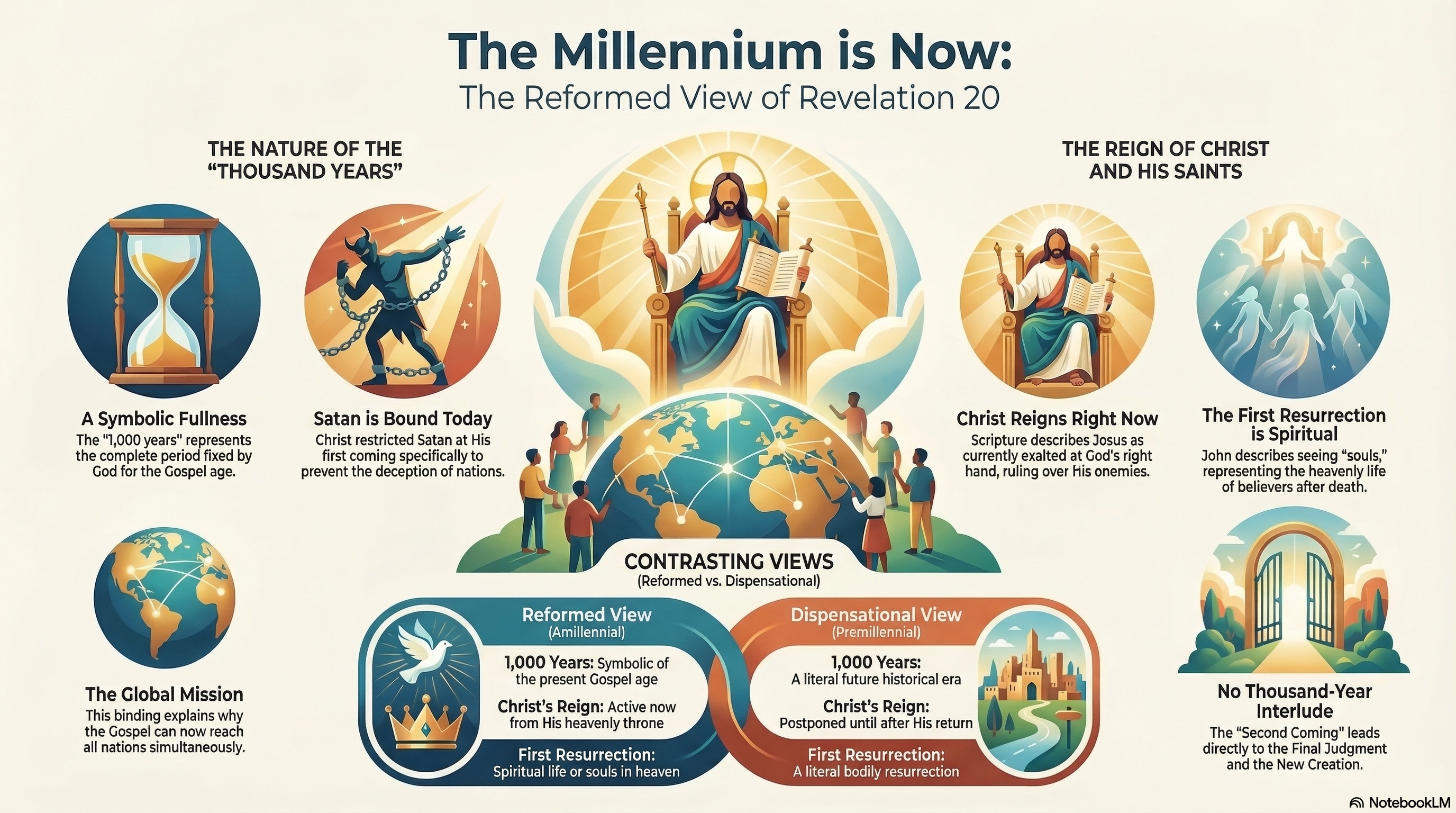
Revelation 20 describes the present gospel age from Christ's victory at His first coming to the final crisis and judgment. Satan is bound in a real but qualified sense. The saints reign with Christ now. The "first resurrection" is not the bodily resurrection of all believers before a literal earthly millennium. And the chapter ends with the final judgment, not with a further age of ordinary history.
Revelation 20 stands at the center of the millennium debate. For Dispensational premillennialism, it is the decisive proof that Christ must return before a literal thousand-year earthly kingdom centered on restored Israel. For the Reformed amillennial reading, Revelation 20 does not introduce a new Jewish age after Christ’s return. It recapitulates the present reign of Christ and the ultimate defeat of Satan, culminating in the final judgment.
The question is not whether Revelation 20 matters. It matters enormously. The question is how it should be read. And because Revelation is apocalyptic literature, it must be interpreted in harmony with clearer, didactic passages rather than used to overturn them.
1. Revelation Is Symbolic and Recapitulative
Before reading chapter 20, we must remember how Revelation opens:
(KJV)
"The Revelation of Jesus Christ, which God gave unto him, to shew unto his servants things which must shortly come to pass; and he sent and signified it by his angel unto his servant John:"
John says the message was "signified." The book is filled with symbols, patterns, recapitulations, and visionary images.
This matters because Dispensationalism often insists on literal chronology at the very point where Revelation itself signals symbolic communication.
Also, Revelation does not move in a simple straight line from chapter 1 to chapter 22. It repeatedly circles the same age from different angles, pressing toward the same final consummation. That is why judgments and endings appear more than once.
So when we come to Revelation 20, we should not assume by default that John has introduced an entirely new post-advent historical era.
And the seam between chapters 19 and 20 shows why recapitulation is not merely asserted here. Three observations converge.
First, Revelation has already shown the end more than once. The sixth seal brings the great day of wrath with sky and mountains collapsing (); the seventh trumpet announces that the kingdoms of this world are become our Lord's, with the dead judged (); the harvest of the earth is reaped (); Armageddon gathers the kings (); and chapter 19 shows the beast destroyed. If the book ran in one strict line, the world would end several times over. The visions circle the same age and press repeatedly to the same conclusion.
Second, reads most naturally as the same judgment scene resumed, not a new one a thousand years later:
"And the devil that deceived them was cast into the lake of fire and brimstone, where the beast and the false prophet are, and shall be tormented day and night for ever and ever." (, KJV)
The beast and the false prophet "are" there — cast in at . The devil's doom completes the judgment of the dragon–beast–false prophet triad in a single scene, exactly as a resumed vision would show it.
Third, the nations create a real problem for a strict sequence. Chapter 19 ends in total destruction: "And the remnant were slain with the sword of him that sat upon the horse, which sword proceeded out of his mouth." (, KJV). Yet in 20:3 there are nations who must be kept from deception, and in 20:8 nations "in the four quarters of the earth," numerous "as the sand of the sea," available to be deceived. If chapter 20 follows chapter 19 in time, these nations have no origin. The sequence reading generates its own tension; recapitulation resolves it. Chapter 20 circles back and retells the age between the two comings from the vantage of Satan's career — bound at Christ's victory, loosed at the end, destroyed at the same last battle chapter 19 depicted from the vantage of Christ's.
2. Satan Was Bound by Christ’s First Coming
John writes:
(KJV)
"And I saw an angel come down from heaven, having the key of the bottomless pit and a great chain in his hand.
And he laid hold on the dragon, that old serpent, which is the Devil, and Satan, and bound him a thousand years,
And cast him into the bottomless pit, and shut him up, and set a seal upon him, that he should deceive the nations no more, till the thousand years should be fulfilled..."
The question is not whether Satan is active at all during the thousand years. The text tells us the purpose of the binding: "that he should deceive the nations no more."
That fits the first coming of Christ remarkably well.
Jesus says:
(KJV)
"But if I cast out devils by the Spirit of God, then the kingdom of God is come unto you.
Or else how can one enter into a strong man's house, and spoil his goods, except he first bind the strong man? and then he will spoil his house."
Christ explicitly speaks of binding the strong man in connection with His own kingdom ministry.
He also says:
(KJV)
"Now is the judgment of this world: now shall the prince of this world be cast out.
And I, if I be lifted up from the earth, will draw all men unto me."
And Paul says:
(KJV)
"Blotting out the handwriting of ordinances that was against us... nailing it to his cross;
And having spoiled principalities and powers, he made a shew of them openly, triumphing over them in it."
The New Testament repeatedly teaches that Satan has been decisively judged and curtailed through Christ’s death, resurrection, and exaltation.
That does not mean Satan is inactive. It means he is bound with respect to the purpose named in Revelation 20: he can no longer keep the nations in the old darkness so as to prevent their gospel ingathering.
This explains the worldwide missionary age:
(KJV)
"And Jesus came and spake unto them, saying, All power is given unto me in heaven and in earth.
Go ye therefore, and teach all nations...
And, lo, I am with you alway, even unto the end of the world."
(KJV)
"Who hath delivered us from the power of darkness, and hath translated us into the kingdom of his dear Son:"
The binding, understood in this qualified sense, explains what the New Testament era actually shows: the nations are no longer sealed in darkness, and the gospel now gathers the elect from all peoples — the strong man bound, his house spoiled (), sinners turned "from darkness to light, and from the power of Satan unto God" (, KJV).
3. The Thousand Years Need Not Be Literal
Revelation’s symbolic use of numbers is constant. Seven, twelve, ten, and multiples of these carry theological force. A thousand often signifies fullness or completeness.
Scripture uses thousand-language this way elsewhere:
(KJV)
"For every beast of the forest is mine, and the cattle upon a thousand hills."
(KJV)
"But, beloved, be not ignorant of this one thing, that one day is with the Lord as a thousand years, and a thousand years as one day."
The point is not arithmetic literalism but divinely determined fullness.
In Revelation 20, the thousand years symbolize the complete period fixed by God between Christ’s first coming victory and the final crisis.
That reading also harmonizes better with the rest of the New Testament, which repeatedly teaches Christ reigns now.
(KJV)
"This Jesus hath God raised up...
Therefore being by the right hand of God exalted...
For David is not ascended into the heavens: but he saith himself, The LORD said unto my Lord, Sit thou on my right hand,
Until I make thy foes thy footstool.
Therefore let all the house of Israel know assuredly, that God hath made that same Jesus, whom ye have crucified, both Lord and Christ."
(KJV)
"For he must reign, till he hath put all enemies under his feet.
The last enemy that shall be destroyed is death."
Christ is not waiting to begin reigning after His second coming. He reigns now.
4. The Saints Reign With Christ Now
John says:
(KJV)
"And I saw thrones, and they sat upon them, and judgment was given unto them: and I saw the souls of them that were beheaded for the witness of Jesus... and they lived and reigned with Christ a thousand years.
But the rest of the dead lived not again until the thousand years were finished. This is the first resurrection.
Blessed and holy is he that hath part in the first resurrection: on such the second death hath no power..."
Notice carefully what John says he saw: "the souls" of the martyrs. The scene is not first described as embodied saints walking around a renewed earthly order. It is a heavenly vision of the souls of the faithful reigning with Christ.
This fits the wider New Testament witness about believers after death:
(KJV)
"For I am in a strait betwixt two, having a desire to depart, and to be with Christ; which is far better:"
(KJV)
"We are confident, I say, and willing rather to be absent from the body, and to be present with the Lord."
The souls of believers are with Christ and reign with Him. That is not a second-best state. It is blessedness in union with the exalted King while awaiting the bodily resurrection.
5. What Is the First Resurrection?
Reformed interpreters have explained the first resurrection in two closely related ways:
- as the heavenly entrance and vindicated life of believers who die in Christ
- or more broadly as the spiritual resurrection life believers have in union with Christ, issuing in heavenly reign
Whichever nuance one prefers, the key point is the same: the first resurrection is not the final bodily resurrection of all believers before a literal earthly millennium.
The chapter itself supports this by contrasting the first resurrection with the "second death":
(KJV)
"Blessed and holy is he that hath part in the first resurrection: on such the second death hath no power..."
This is covenantal and soteriological language. It speaks of the secure life of those united to Christ.
Jesus Himself teaches that believers already possess resurrection life:
(KJV)
"Verily, verily, I say unto you, He that heareth my word, and believeth on him that sent me, hath everlasting life...
Verily, verily, I say unto you, The hour is coming, and now is, when the dead shall hear the voice of the Son of God: and they that hear shall live."
Paul says:
(KJV)
"But God, who is rich in mercy...
Even when we were dead in sins, hath quickened us together with Christ...
And hath raised us up together, and made us sit together in heavenly places in Christ Jesus:"
Believers already share resurrection life and heavenly session in Christ. Revelation 20 is perfectly at home in that theological world.
6. The Final Crisis and Final Judgment Come at the End of the Thousand Years
At the close of the thousand years:
(KJV)
"And when the thousand years are expired, Satan shall be loosed out of his prison,
And shall go out to deceive the nations which are in the four quarters of the earth, Gog, and Magog...
And they went up on the breadth of the earth, and compassed the camp of the saints about, and the beloved city: and fire came down from God out of heaven, and devoured them.
And the devil... was cast into the lake of fire..."
Then comes the judgment:
(KJV)
"And I saw a great white throne, and him that sat on it...
And I saw the dead, small and great, stand before God...
And the sea gave up the dead which were in it; and death and hell delivered up the dead which were in them...
And death and hell were cast into the lake of fire. This is the second death."
This is final judgment language. It is not the introduction to another long ordinary age.
That matches Jesus:
(KJV)
"Marvel not at this: for the hour is coming, in the which all that are in the graves shall hear his voice,
And shall come forth; they that have done good, unto the resurrection of life; and they that have done evil, unto the resurrection of damnation."
And Paul:
(KJV)
"I charge thee therefore before God, and the Lord Jesus Christ, who shall judge the quick and the dead at his appearing and his kingdom;"
The appearing of Christ and the judgment of all do not require a thousand-year earthly interlude after His return. Revelation 20 ends where the rest of the New Testament says the story ends: with judgment and final separation.
7. Objections and Replies
Before the strongest objections are answered in form, it is worth stating plainly why the Dispensational reading struggles.
First, it makes Revelation 20 overturn the plain teaching of texts that present Christ reigning now.
Second, it reads the thousand years as literal while often admitting symbolism throughout the rest of the chapter.
Third, it tends to treat the first resurrection as bodily even though John explicitly sees "souls."
Fourth, it inserts a complex multi-stage resurrection scheme into a chapter that naturally moves from present reign to final crisis to final judgment.
Fifth, it often pushes the church’s present heavenly life and Christ’s present kingship to the margins.
The premillennial reading, however, has real arguments of its own — including forms held by careful interpreters far removed from Dispensationalism — and the strongest of them deserve direct answers.
1. "The same verb must mean the same resurrection."
The same Greek verb (ezēsan, "they lived") appears in consecutive verses: "and they lived and reigned with Christ a thousand years" (), and "But the rest of the dead lived not again until the thousand years were finished" (). Henry Alford famously insisted that if the second refers to bodily resurrection, the first must as well. The observation is fair, but the inference does not hold, because John himself uses "live" in both spiritual and bodily senses within a single discourse: an hour "now is, when the dead shall hear the voice of the Son of God: and they that hear shall live" (), and an hour "is coming" when "all that are in the graves shall hear his voice, And shall come forth" (). describes "souls" seen in heaven during the thousand years, while verse 5's "lived not again" anticipates the general resurrection of verses 12-13, where all the dead stand before the great white throne. The verb is the same; the referents, as in John 5, are not.
2. "'And I saw' links chapter 20 to chapter 19 — the natural reading is sequential."
The formula kai eidon ("and I saw") marks a new vision, not a next event. John "saw" the woman of chapter 12 give birth to the Son who, by the time of the vision, was already ascended and enthroned () — a vision reaching back behind the visions around it. The formula tells us what John saw next, not what happens next in history. And the seam itself resists sequence, as section 1 showed: the beast and false prophet already in the lake when the devil arrives (20:10), and nations still present to be deceived after 19:21 has slain "the remnant."
3. "If Satan is bound, why does the New Testament call him the god of this world, who walketh about as a roaring lion (; )?"
Because the binding is defined by its stated purpose: "that he should deceive the nations no more" (). The nations-blinding dominion of the pre-Christian age — when God "suffered all nations to walk in their own ways" () — is broken; within that limit, Satan remains active and dangerous. Both truths are apostolic: the same Peter who describes the roaring lion also declares that Christ is "gone into heaven... angels and authorities and powers being made subject unto him" (, KJV). A chained dog is deadly within the radius of the chain. The objection would only stand if Revelation 20 claimed Satan was rendered inactive; it claims something narrower and more specific, and that narrower claim is exactly what the missionary age exhibits.
The Reformed reading avoids all of this by allowing Revelation 20 to harmonize with the rest of Scripture.
8. The Reformed Logic Is Coherent Across the Canon
The same pattern appears everywhere:
- Christ binds the strong man and plunders his house.
- Christ reigns now at the Father’s right hand.
- the gospel goes to the nations because Satan’s deceiving dominion has been curbed.
- believers who die are with Christ and reign with Him.
- at the end Satan is allowed a final outbreak of deception and hostility.
- God destroys the enemies.
- the final judgment occurs.
- the new creation dawns.
That is not an artificial imposition. It is the most coherent way to read Revelation 20 with Matthew 12, John 12, Acts 2, 1 Corinthians 15, John 5, and Revelation 21–22 together.
A Reformed Note on Method
The Westminster Standards never use the word "millennium," and this essay does not claim confessional force for every exegetical judgment in it. But the Standards do confess the shape this reading yields: one appointed "day, wherein he will judge the world in righteousness by Jesus Christ" (WCF 33.1), the dead raised and all men judged at Christ's coming, and no intervening earthly age between His return and the eternal state. The method, likewise, is the confession's own: apocalyptic vision read in harmony with the clear, didactic word, because "the infallible rule of interpretation of Scripture is the Scripture itself" (WCF 1.9). Brothers who hold a premillennial hope hold it in good faith; the argument here is that the text itself, read whole, teaches something better — a Christ who is not waiting to reign.
Conclusion
Revelation 20 does not teach that Christ must return before beginning His reign. The New Testament declares that He reigns now.
It does not require a literal thousand-year geopolitical kingdom centered on restored Israel. The number can and should be read in apocalyptic context as symbolic of the full interadvent age.
It does not plainly teach a bodily resurrection of believers before a separate earthly era. John sees the souls of the saints reigning with Christ, and the rest of the New Testament teaches the blessedness of departed believers in His presence.
And it does not postpone final judgment beyond another age of ordinary history. The chapter itself ends in the great white throne and the second death.
So the Reformed conclusion is sound:
Christ reigns now.
Satan is bound in a real but qualified sense now.
The saints reign with Christ now.
The final crisis, judgment, and new creation still lie ahead.
That is not a reduction of hope. It is the hope of the reigning Christ in full biblical proportion.
Revelation 20 ends at the great white throne and the second death — and Scripture does not leave those words abstract. The final essay in this section turns to what judgment means, what hell is, and how a believer can face that day with settled assurance: Hell, Separation from God, Perseverance, and Assurance in Christ.
Suggested Next Steps
- Read :10 and mark where the beast, the false prophet, the nations, and the devil each appear in the sequence.
- Read and — the New Testament's own grammar for the "first resurrection."
- Read and and ask when the strong man was bound.
- Continue to Hell, Separation from God, Perseverance, and Assurance in Christ for the doctrine of final judgment and the believer's assurance.
Essay Video
Revelation 20 and the Millennium: Why Christ Reigns Now
Audio Discussion
Revelation 20 and the Millennium: Why Christ Reigns Now
Infographic
Revelation 20 and the Millennium: Why Christ Reigns Now