Essay
Gog and Magog: Why Ezekiel 38–39 Must Not Be Read Through Modern Headlines
"Son of man, set thy face against Gog, the land of Magog, the chief prince of Meshech and Tubal, and prophesy against him, And say, Thus saith the Lord GOD; Behold, I am against thee, O Gog, the chief prince of Meshech and Tubal." (, KJV)
Thesis
Gog and Magog in Ezekiel 38–39 depict the climactic assault of the nations against the restored people of God, and God's total victory over it for the glory of His own name. That is how the oracle sits in Ezekiel's own book — after the restoration and everlasting Davidic reign of chapter 37, before the temple vision of chapters 40–48 — and it is how reads it: the final rebellion at the end of the age. Therefore Christians must not reduce Gog and Magog to a current geopolitical code word or use it to sanctify modern war policy. This essay is the exegetical treatment of the oracle itself; for the application to present-day war rhetoric and the modern state of Israel, see Jerusalem Fulfilled in Christ.
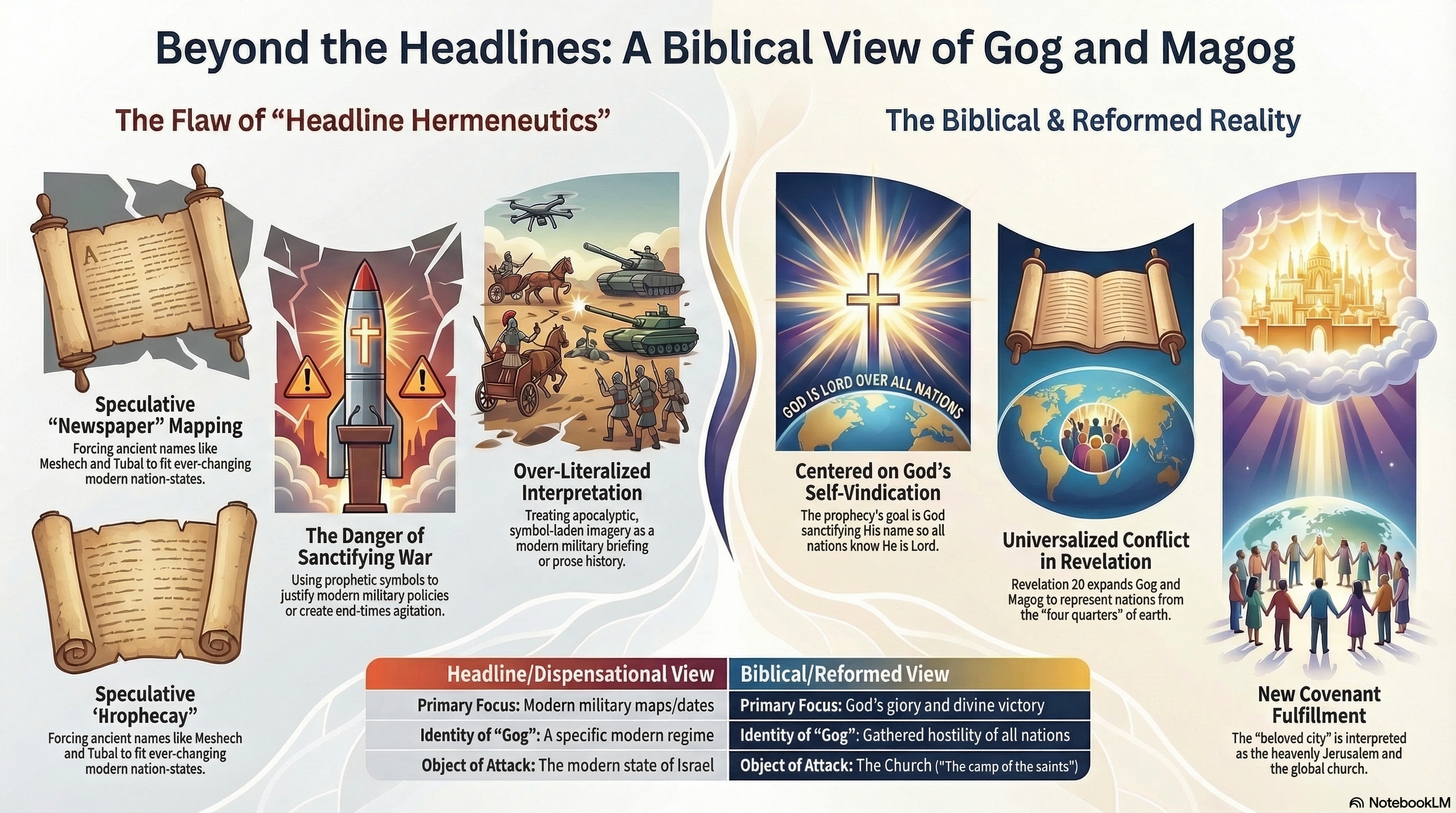
Ezekiel 38–39 has become one of the most abused sections of Scripture in modern prophecy preaching. Whole systems of interpretation have been built on the assumption that Gog and Magog must name identifiable modern nation-states, contemporary military coalitions, or current wars in the Middle East. In popular preaching this often becomes a revolving cast of enemies: first one empire, then another, then whichever present adversary seems to fit a newspaper headline.
From a Reformed perspective, this is exactly the kind of headline hermeneutic the church must reject. Ezekiel 38–39 is not meaningless, vague, or unreal. But its meaning is not unlocked by cable news, military maps, or political speculation. Its meaning must be governed by Scripture itself, above all by the way Revelation takes up Gog and Magog.
1. The Point of Ezekiel 38–39 Is God’s Glory, Not Our Speculation
Ezekiel says:
(KJV)
"Therefore, son of man, prophesy and say unto Gog, Thus saith the Lord GOD; In that day when my people of Israel dwelleth safely, shalt thou not know it?
And thou shalt come from thy place out of the north parts, thou, and many people with thee, all of them riding upon horses, a great company, and a mighty army:
And thou shalt come up against my people of Israel, as a cloud to cover the land; it shall be in the latter days, and I will bring thee against my land, that the heathen may know me, when I shall be sanctified in thee, O Gog, before their eyes."
The emphasis here is not "figure out the names on the modern map." The emphasis is:
- God brings this enemy against His people
- God defeats this enemy
- God sanctifies His own great name
- the nations know that He is the LORD
The same thing appears again and again:
(KJV)
"Thus will I magnify myself, and sanctify myself; and I will be known in the eyes of many nations, and they shall know that I am the LORD."
(KJV)
"And I will set my glory among the heathen, and all the heathen shall see my judgment that I have executed, and my hand that I have laid upon them.
So the house of Israel shall know that I am the LORD their God from that day and forward."
The center of the passage is not our prophetic detective work. The center is God’s self-vindication.
2. The Passage Is Apocalyptic and Symbol-Laden
Readers often treat Ezekiel 38–39 as though it were a modern military briefing. But the passage itself is highly stylized.
It gathers nations from the edges of the world:
(KJV)
"Son of man, set thy face against Gog, the land of Magog, the chief prince of Meshech and Tubal, and prophesy against him,
And say, Thus saith the Lord GOD; Behold, I am against thee, O Gog, the chief prince of Meshech and Tubal:
And I will turn thee back, and put hooks into thy jaws, and I will bring thee forth, and all thine army...
Persia, Ethiopia, and Libya with them...
Gomer, and all his bands; the house of Togarmah of the north quarters, and all his bands: and many people with thee."
The picture is of a vast, many-nation confederacy. Then the imagery becomes cosmic:
(KJV)
"For in my jealousy and in the fire of my wrath have I spoken, Surely in that day there shall be a great shaking in the land of Israel;
So that the fishes of the sea, and the fowls of the heaven, and the beasts of the field, and all creeping things that creep upon the earth, and all the men that are upon the face of the earth, shall shake at my presence..."
Then the defeat becomes almost liturgical and archetypal:
(KJV)
"And, thou son of man, thus saith the Lord GOD; Speak unto every feathered fowl, and to every beast of the field, Assemble yourselves, and come...
Ye shall eat the flesh of the mighty, and drink the blood of the princes of the earth...
Thus ye shall be filled at my table with horses and chariots, with mighty men, and with all men of war..."
This is not ordinary prose historiography. It is prophetic-apocalyptic depiction of the total overthrow of God’s enemies.
That alone should make Christians cautious about over-literalized newspaper matching.
3. What the Oracle Is: Read Ezekiel 38–39 Where Ezekiel Put It
It is not enough to say what Gog and Magog is not. Ezekiel tells us what it is — by where he placed it.
The oracle does not float free. It stands immediately after chapter 37, where God raises the dry bones into a living army, makes the two sticks one nation, and promises:
"And David my servant shall be king over them; and they all shall have one shepherd: they shall also walk in my judgments, and observe my statutes, and do them." (, KJV)
"Moreover I will make a covenant of peace with them; it shall be an everlasting covenant with them: and I will place them, and multiply them, and will set my sanctuary in the midst of them for evermore." (, KJV)
And it stands immediately before chapters 40–48, the great visionary temple, where the glory returns and the river of life flows out from the sanctuary.
That placement is the interpretation. After the covenant people have been raised from death, gathered into one, and set under the everlasting reign of David's Son — and before God's dwelling with His people reaches its final form — comes one last, all-out assault by the far nations against a people "at rest" and "dwelling safely" (), which God Himself crushes without any human deliverer, so that His name is sanctified before all nations. The oracle depicts the last great convulsion of the world's hostility against the restored people of God, and God's total, unshared victory over it.
Read that way, is not borrowing a decorative name. John places Ezekiel's battle exactly where Ezekiel placed it: after the restoration — the saints raised to life and reigning with the Son of David through the thousand years — and before the descent of the true temple-city, the new Jerusalem of Revelation 21–22, which itself draws its measured gates, its river, and its trees of healing from Ezekiel 40–48. The final rebellion at the end of the millennium is Gog and Magog, and Gog and Magog is the final rebellion. The sequence — restoration, last assault, fire from heaven, God dwelling with His people for ever — is Ezekiel's sequence and John's alike.
4. Revelation Interprets Gog and Magog for the Church
The strongest canonical control comes from Revelation:
(KJV)
"And when the thousand years are expired, Satan shall be loosed out of his prison,
And shall go out to deceive the nations which are in the four quarters of the earth, Gog, and Magog, to gather them together to battle: the number of whom is as the sand of the sea.
And they went up on the breadth of the earth, and compassed the camp of the saints about, and the beloved city: and fire came down from God out of heaven, and devoured them."
This is decisive for several reasons.
First, Revelation does not restrict Gog and Magog to one present nation. It says "the nations which are in the four quarters of the earth."
Second, Gog and Magog become a way of speaking about the gathered hostility of the nations under satanic deception.
Third, the object of attack is "the camp of the saints" and "the beloved city," which already pushes the language beyond a merely secular geopolitical reading. The conflict is covenantal and eschatological.
Fourth, God Himself destroys the enemy. The emphasis remains divine victory, not human manipulation of events.
In other words, Revelation takes Ezekiel’s imagery and applies it on a universal scale. That alone should prevent Christians from reducing Gog and Magog to whatever current regime or alliance happens to dominate the news cycle.
5. The People of God Must Be Read Through the New Covenant
A Dispensational reading assumes the attacked people in Ezekiel must finally be equivalent to the modern state of Israel. But the New Testament repeatedly warns us against that simplification.
(KJV)
"For they are not all Israel, which are of Israel:
Neither, because they are the seed of Abraham, are they all children...
That is, They which are the children of the flesh, these are not the children of God: but the children of the promise are counted for the seed."
(KJV)
"For he is our peace, who hath made both one, and hath broken down the middle wall of partition between us...
For to make in himself of twain one new man...
And that he might reconcile both unto God in one body by the cross..."
(KJV)
"But ye are a chosen generation, a royal priesthood, an holy nation, a peculiar people...
Which in time past were not a people, but are now the people of God..."
If the New Testament defines the covenant people in Christological and new-covenant terms, then Christians may not assume that every Old Testament national conflict prophecy maps directly onto the modern state of Israel as such.
That does not mean the Jewish people are unimportant. It means prophecy must be interpreted through Christ and the apostolic explanation of the people of God.
6. The "Beloved City" Is Not a Blank Check for Modern Geopolitics
Revelation’s language of "the beloved city" often gets pulled back into an earthly-Jerusalem-only reading. But Revelation itself repeatedly lifts city language into consummative, covenantal categories.
(KJV)
"But ye are come unto mount Sion, and unto the city of the living God, the heavenly Jerusalem...
And to Jesus the mediator of the new covenant..."
(KJV)
"But Jerusalem which is above is free, which is the mother of us all."
(KJV)
"And I John saw the holy city, new Jerusalem, coming down from God out of heaven, prepared as a bride adorned for her husband.
And I heard a great voice out of heaven saying, Behold, the tabernacle of God is with men..."
The New Testament does not permit a simple equation:
- biblical city language = modern state policy
Instead, city language is fulfilled and deepened in Christ and His people.
That is why using Gog and Magog to justify present military agendas is so dangerous. It turns covenantal, Christ-centered, apocalyptic imagery into a tool of partisan mobilization.
7. Gog and Magog Must Not Be Used to Sanctify War
Once Gog and Magog becomes a contemporary slogan, the result is usually not theological sobriety but agitation. Christians are told that current enemies must be Gog and Magog, that current wars are prophetically required, and that resistance to escalation is resistance to God’s plan.
That is a profound error.
The Lord never commands the church to engineer Gog and Magog. He announces that He will defeat the gathered enemies of His people.
Nor does Scripture teach that believers should welcome war because it appears to fit a chart. Christ tells the church to be watchful, faithful, and sober:
(KJV)
"And ye shall hear of wars and rumours of wars: see that ye be not troubled..."
(KJV)
"Teaching us that, denying ungodliness and worldly lusts, we should live soberly, righteously, and godly, in this present world;
Looking for that blessed hope, and the glorious appearing of the great God and our Saviour Jesus Christ."
The church waits for Christ. It does not manufacture apocalyptic scenarios.
8. The Reformed Reading Better Fits the Canon
The Reformed reading of Gog and Magog is stronger because it honors all the evidence at once:
- Ezekiel’s emphasis on God’s self-vindicating judgment
- the apocalyptic texture of the prophecy
- Revelation’s explicit reuse of Gog and Magog for the nations in the four corners of the earth
- the new-covenant redefinition of the people of God in Christ
- the New Testament’s heavenly and consummative treatment of Jerusalem/city imagery
That means Gog and Magog is best read as the climactic, worldwide hostility of the nations against the people of God, culminating in God’s decisive overthrow of evil. It is not a stable newspaper cipher for current alliances.
This reading is not evasive. It is more biblical, because it refuses to let current politics govern the meaning of prophetic Scripture.
9. Objections and Replies
1. "Ezekiel names real nations — Persia, Ethiopia, Libya, Togarmah — and gives concrete details: seven years of weapon-burning, seven months of burial. Specifics mean literal modern referents."
This is the strongest literalist argument, and it deserves a direct answer. The named nations are Ezekiel's sixth-century compass points — the far peoples at the edges of the map his exiled hearers knew: Persia to the east, Ethiopia (Cush) and Libya (Put) to the south and west, Gomer and Togarmah to the far north. Together with Meshech and Tubal they sketch a world-circle of remote powers converging on the covenant people — which is precisely how Revelation reads them: "the nations which are in the four quarters of the earth" (). The sevens are covenant numbers of completeness — the cleansing total, the victory entire — as sevens function throughout Scripture and throughout Ezekiel's own visions. And the concrete details cut against the modern literalist, not for him. The invaders come "all of them riding upon horses" (), armed with "the shields and the bucklers, the bows and the arrows, and the handstaves, and the spears" (, KJV) — weapons that burn as firewood for seven years. A consistently literal reading freezes the prophecy in Iron Age technology; the popular literalist quietly modernizes the horses into tanks and the arrows into missiles — thereby conceding that the description is idiom, and forfeiting the objection.
2. "'The chief prince' is really 'Rosh' — Russia — and Meshech and Tubal are Moscow and Tobolsk."
The KJV translates rosh in its ordinary Hebrew sense: "chief" — "the chief prince of Meshech and Tubal." Even taken as a proper name, a sixth-century-BC Rosh has no connection to "Russia," a name of medieval origin; and Meshech and Tubal are well-attested Anatolian peoples — the Mushki and Tabal of the Assyrian records, in what is now Turkey — not Moscow and Tobolsk. Sound-alike etymology is not exegesis. The identifications also shift with each generation's enemies, which is itself the refutation: a reading that must be reissued with every news cycle was never anchored in the text.
3. "Ezekiel says 'in the latter days' (38:16) — so this must be about our own time."
"The latter days" in the prophets is the messianic era, and the New Testament declares that era began at Christ's first coming: "And it shall come to pass in the last days, saith God, I will pour out of my Spirit upon all flesh." (, KJV); God "Hath in these last days spoken unto us by his Son" (, KJV). Every generation of the church lives in the latter days. Revelation 20 locates the Gog assault at the far end of that era — the final rebellion before the judgment. So the oracle is indeed future in its consummation; what it is not is datable, decodable, or attachable to the present week's enemies.
A Reformed Note on Method
The Westminster Confession's rule — "The infallible rule of interpretation of Scripture is the Scripture itself" (WCF 1.9) — has carried the whole argument: Revelation's use of Gog and Magog, not any headline, fixes the oracle's horizon. The quarrel here is with a method, not with the people who use it; many who read Ezekiel through the news love Scripture and long for Christ's appearing. But love for prophecy is shown by submitting to its actual shape — canonical placement, apocalyptic genre, and apostolic reuse — rather than by supplying it with a fresh cast of villains every decade.
Conclusion
Ezekiel 38–39 is not a divine invitation to prophetic sensationalism. It is a revelation of God’s glory in the final overthrow of His enemies. Revelation 20 confirms this by applying Gog and Magog to the deceived nations from the four corners of the earth gathered against the saints.
Christians therefore must not read Gog and Magog through modern headlines, attach it simplistically to current military opponents, or use it to baptize war policy.
The point of the prophecy is not that believers become end-times cartographers. The point is that the Lord will defend His people, vindicate His name, and utterly destroy His enemies.
That is meant to produce faith, not frenzy.
Revelation 20 does not merely borrow Ezekiel's names; it locates his battle at the end of the thousand years. What those thousand years are — and why Christ's reign in them is present, not postponed — is the subject of the next essay: Revelation 20 and the Millennium: Why Christ Reigns Now.
Suggested Next Steps
- Read Ezekiel 37, 38–39, and 40:1–5 in sequence, watching what the oracle follows and what it precedes.
- Read and 21:9–22:5 beside Ezekiel 38–39 and 40–48, noting how John reuses Ezekiel's order.
- Trace the refrain "shall know that I am the LORD" through Ezekiel 38–39 and ask what the oracle is for.
- Continue to Revelation 20 and the Millennium: Why Christ Reigns Now for the thousand years themselves.
Essay Video
Gog and Magog: Why Ezekiel 38–39 Must Not Be Read Through Modern Headlines
Audio Discussion
Gog and Magog: Why Ezekiel 38–39 Must Not Be Read Through Modern Headlines
Infographic
Gog and Magog: Why Ezekiel 38–39 Must Not Be Read Through Modern Headlines