Essay
Jerusalem Fulfilled in Christ: Why Christians Must Not Turn War Into Prophecy
"But Jerusalem which is above is free, which is the mother of us all." (, KJV)
Thesis
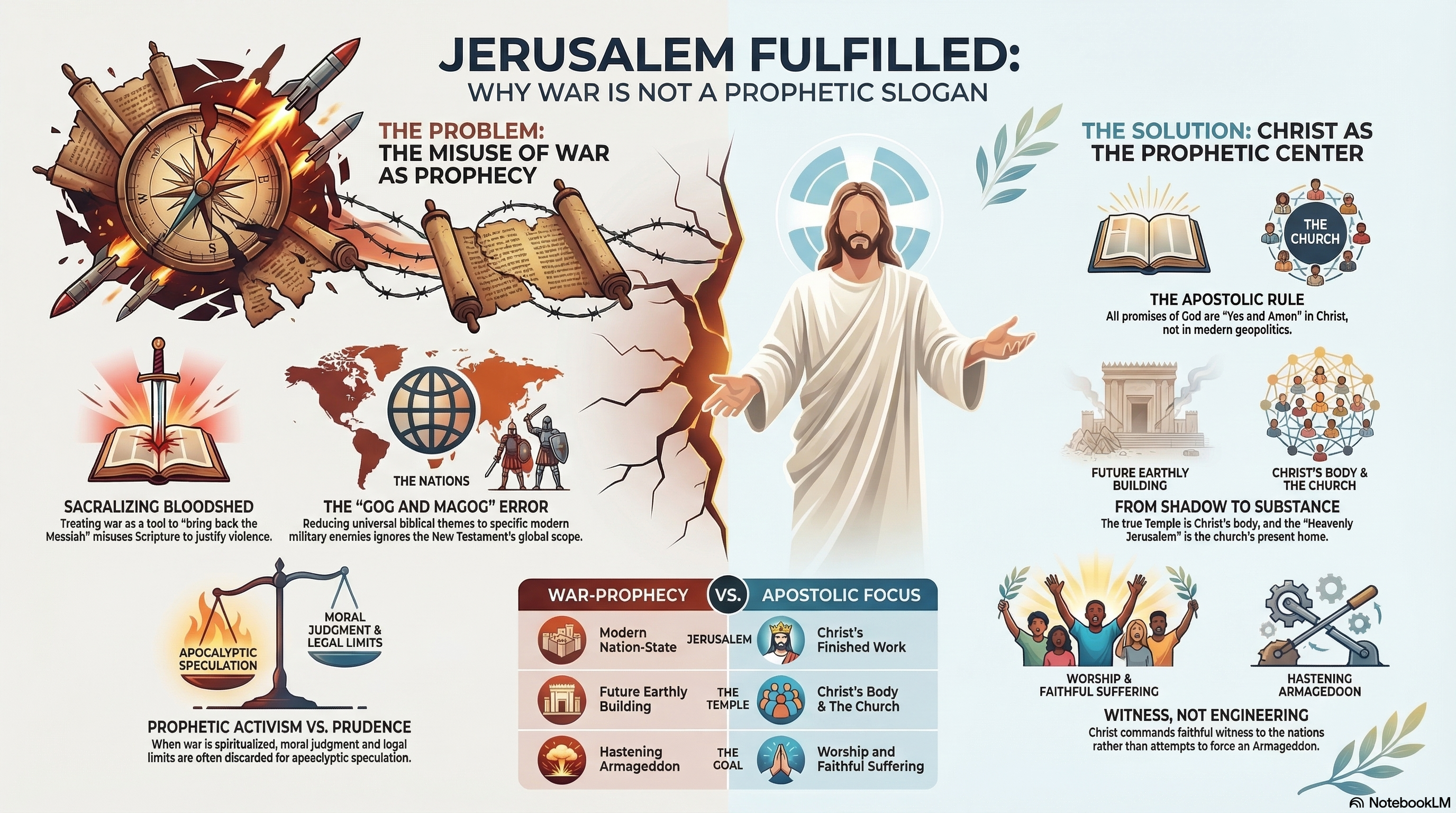
Jerusalem's decisive prophetic fulfillment is in Christ and His finished work: there He was pierced as Zechariah foretold, there He rose, and from there the Spirit was poured out toward all nations. The New Testament therefore reads Jerusalem, Zion, and temple covenantally — through Christ — not geopolitically. It follows that Christians must not treat modern wars as sacred mechanisms for completing prophecy or "bringing back the Messiah." That claim is defended below on hermeneutical grounds first, and then on moral ones.
In every generation there are voices urging Christians to read the newspaper as though it were the true key to the prophets. In our own moment, some have gone further. They have treated war involving Israel and Iran as though it were a sacred mechanism for bringing about Armageddon, defeating Gog and Magog, or "bringing back the Messiah." That is not reverence for Scripture. It is a profound misuse of Scripture.
This matters pastorally, morally, and politically. It is one thing to hold a mistaken eschatology in the abstract. It is another thing to use that eschatology to sanctify bloodshed, to pressure Christians into supporting reckless war, or to suggest that national sacrifice is spiritually necessary because prophecy must be forced along. Recent reporting has shown that some public Christian voices have interpreted the expanding Iran war in explicitly prophetic terms, and that support for Israel among many evangelicals is often grounded not merely in prudence or sympathy, but in an expectation that modern events must fulfill a particular end-times scenario. The legality of the U.S. attacks on Iran has itself been a matter of serious public dispute, under both domestic war-powers limits and international law. But whatever the legal verdict on any particular strike — a question this essay does not adjudicate — the theological argument stands on its own: even if every legal and prudential question were resolved in the war's favor, the prophetic case for it would still be badly mistaken. AP on prophecy rhetoric around the Iran war, AP on evangelical support for Israel as prophecy-driven, Reuters on the disputed legality of the attacks, Christianity Today warning against reading Iran through prophecy charts.
From a confessional Reformed standpoint, the deepest error is hermeneutical. Scripture must interpret Scripture. The clearer revelation of Christ and His apostles must govern our reading of the prophets. The Westminster Confession states the principle plainly: "The infallible rule of interpretation of Scripture is the Scripture itself" (WCF I.9). That means Jerusalem, Zion, temple, land, and kingdom may not be detached from Christ's finished work and reassigned to a modern geopolitical program as though the New Testament had said little or nothing about them.
The Reformed claim is not that Jerusalem was unreal, unimportant, or "merely symbolic." Quite the opposite. Jerusalem was the pivotal city of redemptive history because there the Lord brought the old order to its climax and fulfilled His saving work in His Son. The great mistake of modern war-prophecy preaching is not that it takes Jerusalem too seriously. It is that it does not take Christ's accomplishment in Jerusalem seriously enough.
1. The Reformed Rule: Read Jerusalem Through Christ and the Apostles
The risen Lord did not permit His disciples to interpret the Scriptures by speculation. He taught them to read all things through Himself:
(KJV)
"And beginning at Moses and all the prophets, he expounded unto them in all the scriptures the things concerning himself."
(KJV)
"And he said unto them, These are the words which I spake unto you, while I was yet with you, that all things must be fulfilled, which were written in the law of Moses, and in the prophets, and in the psalms, concerning me."
Paul gives the same rule:
(KJV)
"For all the promises of God in him are yea, and in him Amen, unto the glory of God by us."
That principle is fatal to every scheme that treats prophecy as if its real terminus were modern geopolitics rather than Christ Himself. If all the promises are yes and amen in Him, then Jerusalem in prophecy cannot be treated as though its final significance remained suspended until a twentieth- or twenty-first-century state.
2. Jerusalem Was the Place of Christ's Climactic Work
Jerusalem matters because there the Messiah was rejected, crucified, vindicated, and publicly declared Lord. The city was not a dispensable background detail. It was the God-appointed stage on which the old age reached its crisis and the new covenant was inaugurated.
Zechariah's great prophecy of mourning over the pierced One is not left dangling by the New Testament. John applies it directly to the cross:
(KJV)
"And I will pour upon the house of David, and upon the inhabitants of Jerusalem, the spirit of grace and of supplications: and they shall look upon me whom they have pierced, and they shall mourn for him, as one mourneth for his only son, and shall be in bitterness for him, as one that is in bitterness for his firstborn."
(KJV)
"But when they came to Jesus, and saw that he was dead already, they brake not his legs:
But one of the soldiers with a spear pierced his side, and forthwith came there out blood and water.
And he that saw it bare record, and his record is true: and he knoweth that he saith true, that ye might believe.
For these things were done, that the scripture should be fulfilled, A bone of him shall not be broken.
And again another scripture saith, They shall look on him whom they pierced."
This is decisive. John does not say awaits its true meaning in a later military crisis. He says it is fulfilled in Christ crucified.
It should be added that the New Testament takes up Zechariah's words a second time, with a future-facing horizon: "Behold, he cometh with clouds; and every eye shall see him, and they also which pierced him: and all kindreds of the earth shall wail because of him" (, KJV). The two uses are not in tension. The fulfillment is inaugurated at the cross, where the piercing occurred and the mourning of grace began, and it is consummated at His coming, when every eye shall see Him. What neither text does is defer Zechariah's meaning to a modern military crisis.
Nor does the matter stop at Golgotha. In Jerusalem itself Peter preaches the crucified and risen Christ to Israel:
(KJV)
"Therefore let all the house of Israel know assuredly, that God hath made that same Jesus, whom ye have crucified, both Lord and Christ.
Now when they heard this, they were pricked in their heart, and said unto Peter and to the rest of the apostles, Men and brethren, what shall we do?
Then Peter said unto them, Repent, and be baptized every one of you in the name of Jesus Christ for the remission of sins, and ye shall receive the gift of the Holy Ghost.
For the promise is unto you, and to your children, and to all that are afar off, even as many as the Lord our God shall call.
And with many other words did he testify and exhort, saying, Save yourselves from this untoward generation.
Then they that gladly received his word were baptized: and the same day there were added unto them about three thousand souls."
The pattern is plain: pierced Messiah, mourning, repentance, Spirit, ingathering. The pivotal fulfillment occurs in Jerusalem through Christ's death and the Spirit's outpouring, not through a later war-machine built around ethnic nationalism.
3. Christ Also Ended the Place-Bound Worship System
One of the most important errors in modern Jerusalem-centered eschatology is the assumption that redemptive history still turns on a uniquely sacred earthly site in the old-covenant sense. But Christ explicitly dismantles that assumption.
(KJV)
"Jesus saith unto her, Woman, believe me, the hour cometh, when ye shall neither in this mountain, nor yet at Jerusalem, worship the Father.
Ye worship ye know not what: we know what we worship: for salvation is of the Jews.
But the hour cometh, and now is, when the true worshippers shall worship the Father in spirit and in truth: for the Father seeketh such to worship him.
God is a Spirit: and they that worship him must worship him in spirit and in truth."
Jesus does not erase redemptive history. He fulfills it. Salvation is of the Jews; the promises are real; the temple and city mattered. But with His coming, worship is no longer tethered to geographic Jerusalem as a covenant necessity. To continue treating earthly Jerusalem as the indispensable center of God's kingdom purposes is to ignore Christ's own words.
That same fulfillment appears in His teaching about the temple:
(KJV)
"Jesus answered and said unto them, Destroy this temple, and in three days I will raise it up.
Then said the Jews, Forty and six years was this temple in building, and wilt thou rear it up in three days?
But he spake of the temple of his body."
The true temple is Christ. And in union with Him, His people become the temple:
(KJV)
"Now therefore ye are no more strangers and foreigners, but fellowcitizens with the saints, and of the household of God;
And are built upon the foundation of the apostles and prophets, Jesus Christ himself being the chief corner stone;
In whom all the building fitly framed together groweth unto an holy temple in the Lord:
In whom ye also are builded together for an habitation of God through the Spirit."
Any eschatology that effectively recenters God's purposes on an earthly shrine, a political capital, or a sacralized nation-state is moving backward from substance to shadow.
4. The New Testament Reinterprets Jerusalem Covenantly, Not Geopolitically
Paul and the writer to the Hebrews are especially clear that Jerusalem must now be read in light of the new covenant.
(KJV)
"Which things are an allegory: for these are the two covenants; the one from the mount Sinai, which gendereth to bondage, which is Agar.
For this Agar is mount Sinai in Arabia, and answereth to Jerusalem which now is, and is in bondage with her children.
But Jerusalem which is above is free, which is the mother of us all."
Paul distinguishes "Jerusalem which now is" from "Jerusalem which is above." That is not dispensational language. It is apostolic language. And it means that simply invoking "Jerusalem" does not settle the matter in favor of an earthly political reading.
Hebrews presses the point further:
(KJV)
"But ye are come unto mount Sion, and unto the city of the living God, the heavenly Jerusalem, and to an innumerable company of angels,
To the general assembly and church of the firstborn, which are written in heaven, and to God the Judge of all, and to the spirits of just men made perfect,
And to Jesus the mediator of the new covenant, and to the blood of sprinkling, that speaketh better things than that of Abel."
Notice the tense: "ye are come." Believers already come, in Christ, to the heavenly Jerusalem. This is present covenant reality. The writer does not direct Christians to await the restoration of a geopolitically central earthly Jerusalem as the true climax of redemption.
At the consummation, the same movement holds:
(KJV)
"And I saw a new heaven and a new earth: for the first heaven and the first earth were passed away; and there was no more sea.
And I John saw the holy city, new Jerusalem, coming down from God out of heaven, prepared as a bride adorned for her husband.
And I heard a great voice out of heaven saying, Behold, the tabernacle of God is with men, and he will dwell with them, and they shall be his people, and God himself shall be with them, and be their God.
...
And I saw no temple therein: for the Lord God Almighty and the Lamb are the temple of it."
The final Jerusalem is not a modern nation-state. It is the consummated dwelling of God with His redeemed people in Christ.
5. Zechariah 14 Does Not Require a Modern Nation-State
At this point many readers object: "But Zechariah 14 names Jerusalem and the Mount of Olives. Surely that proves a future geopolitical fulfillment centered on the modern state of Israel."
No. It proves only that Zechariah uses real covenant-historical geography. It does not prove that a twentieth-century state must exist in order for the prophecy to have meaning, nor does it prove that Christians are duty-bound to support wars in order to activate it.
Zechariah 14 speaks in prophetic and apocalyptic categories:
(KJV)
"Then shall the LORD go forth, and fight against those nations, as when he fought in the day of battle.
And his feet shall stand in that day upon the mount of Olives, which is before Jerusalem on the east, and the mount of Olives shall cleave in the midst thereof toward the east and toward the west, and there shall be a very great valley; and half of the mountain shall remove toward the north, and half of it toward the south.
...
And it shall be in that day, that living waters shall go out from Jerusalem; half of them toward the former sea, and half of them toward the hinder sea: in summer and in winter shall it be.
And the LORD shall be king over all the earth: in that day shall there be one LORD, and his name one."
The Reformed reading does not deny the text. It asks how the apostles teach us to read such language. Christ has already come. He has already been pierced. He has already poured out the Spirit. He already reigns. The gospel already flows outward to the nations like living waters. The kingdom is already universal in principle and will be universal in manifestation at the last day. The text therefore belongs within the one redemptive arc from Christ's first advent to His final appearing. Nothing in the chapter demands that Christians must identify a present secular state as the hermeneutical key.
The error of war-prophecy preaching is not simply that it is overconfident. It adds what the text does not say. It smuggles in a modern nation-state as a hidden prerequisite for fulfillment. That is not exegesis. It is system-protection by importation.
6. Gog and Magog Must Not Be Used as a War Slogan
The same error appears when modern teachers seize on "Gog and Magog" and attach the phrase directly to current military enemies, as though the church had been given a prophetic roster for present wars. But the New Testament itself uses Gog and Magog in a universalized, climactic sense:
(KJV)
"And when the thousand years are expired, Satan shall be loosed out of his prison,
And shall go out to deceive the nations which are in the four quarters of the earth, Gog, and Magog, to gather them together to battle: the number of whom is as the sand of the sea.
And they went up on the breadth of the earth, and compassed the camp of the saints about, and the beloved city: and fire came down from God out of heaven, and devoured them."
Revelation does not reduce Gog and Magog to one contemporary nation or one Middle Eastern military campaign. It uses the language to describe the gathered hostility of the nations against God's people at the end. That is why responsible Reformed interpretation has resisted the temptation to map Gog and Magog directly onto current headline enemies in a simplistic way.
This matters because once Christians are taught that a present war is "Gog and Magog," the pressure to support escalation becomes spiritualized. Prudence is denounced as unbelief. Calls for restraint are treated as resistance to God's plan. That is a grave abuse of biblical prophecy.
7. Christ Returns by the Father's Decree, Not by Human War-Making
At the heart of this entire controversy is a claim that comes perilously close to taking God's name in vain: the idea that Christians may help "bring back the Messiah" by cooperating with an apocalyptic war sequence. Scripture says no such thing.
(KJV)
"When they therefore were come together, they asked of him, saying, Lord, wilt thou at this time restore again the kingdom to Israel?
And he said unto them, It is not for you to know the times or the seasons, which the Father hath put in his own power.
But ye shall receive power, after that the Holy Ghost is come upon you: and ye shall be witnesses unto me both in Jerusalem, and in all Judaea, and in Samaria, and unto the uttermost part of the earth."
The disciples themselves asked an Israel-restoration question. Christ did not tell them to engineer events. He redirected them to Spirit-empowered witness.
Jesus also warns against prophetic panic and speculative overreach:
(KJV)
"And ye shall hear of wars and rumours of wars: see that ye be not troubled: for all these things must come to pass, but the end is not yet.
...
Then if any man shall say unto you, Lo, here is Christ, or there; believe it not.
For there shall arise false Christs, and false prophets, and shall shew great signs and wonders; insomuch that, if it were possible, they shall deceive the very elect.
Behold, I have told you before.
Wherefore if they shall say unto you, Behold, he is in the desert; go not forth: behold, he is in the secret chambers; believe it not.
For as the lightning cometh out of the east, and shineth even unto the west; so shall also the coming of the Son of man be."
Christ does not need believers to ignite a war so that He can return. He commands faithfulness, not prophetic activism.
8. Christians Must Not Sacralize Dubious Wars
A Reformed response must also say something moral. Christians can debate foreign policy, military strategy, deterrence, and statecraft. But they may not baptize war simply because they imagine it might hasten an eschatological timetable.
The state does bear the sword lawfully:
(KJV)
"For rulers are not a terror to good works, but to the evil. Wilt thou then not be afraid of the power? do that which is good, and thou shalt have praise of the same:
For he is the minister of God to thee for good. But if thou do that which is evil, be afraid; for he beareth not the sword in vain: for he is the minister of God, a revenger to execute wrath upon him that doeth evil."
But this text does not authorize prophetic frenzy, nor does it turn every military action backed by religious slogans into a righteous cause. Where the legality of a war is disputed, where prudence is contested, where evidence is partial, Christians must think soberly. To support bloodshed because one believes it may trigger Armageddon is not just poor exegesis. It treats bloodshed as a means of grace, which no Christian theology may do.
In fact, Scripture repeatedly condemns those who cry peace where there is no peace, or who treat grave matters lightly:
(KJV)
"For from the least of them even unto the greatest of them every one is given to covetousness; and from the prophet even unto the priest every one dealeth falsely.
They have healed also the hurt of the daughter of my people slightly, saying, Peace, peace; when there is no peace."
Our generation has its own version of this lie: "War, war; prophecy, prophecy; Armageddon is necessary." The rhetoric is different, but the spiritual carelessness is similar.
9. The True Christian Hope Is Not Armageddon by Policy but Christ's Appearing
The Reformed Christian hope is neither escapist nor militarized. Christ reigns now from heaven, gathers His church by Word and Spirit, and will return visibly at the Father's appointed time.
(KJV)
"This Jesus hath God raised up, whereof we all are witnesses.
Therefore being by the right hand of God exalted, and having received of the Father the promise of the Holy Ghost, he hath shed forth this, which ye now see and hear.
For David is not ascended into the heavens: but he saith himself, The LORD said unto my Lord, Sit thou on my right hand,
Until I make thy foes thy footstool.
Therefore let all the house of Israel know assuredly, that God hath made that same Jesus, whom ye have crucified, both Lord and Christ."
(KJV)
"Then cometh the end, when he shall have delivered up the kingdom to God, even the Father; when he shall have put down all rule and all authority and power.
For he must reign, till he hath put all enemies under his feet."
Christ is not waiting for modern statesmen, television preachers, or military coalitions to prepare His throne. He already reigns.
The church's calling therefore is not to agitate for apocalyptic war, but to preach Christ crucified, call all nations to repentance, pray for rulers, and await the blessed hope:
(KJV)
"For the grace of God that bringeth salvation hath appeared to all men,
Teaching us that, denying ungodliness and worldly lusts, we should live soberly, righteously, and godly, in this present world;
Looking for that blessed hope, and the glorious appearing of the great God and our Saviour Jesus Christ."
10. Objections and Replies
1. "Zechariah 14 is too specific to be about Christ — living waters, the feast of tabernacles, the Mount of Olives. Specifics demand a geopolitical fulfillment."
The specifics deserve better than denial; they deserve reading. Zechariah 14 is a day-of-the-LORD oracle, and its concrete images are the prophet's sanctuary language for realities the New Testament identifies by name. Take the living waters:
"And it shall be in that day, that living waters shall go out from Jerusalem; half of them toward the former sea, and half of them toward the hinder sea: in summer and in winter shall it be." (, KJV)
Jesus stood up in that very city, at the feast of tabernacles, and claimed the image:
"In the last day, that great day of the feast, Jesus stood and cried, saying, If any man thirst, let him come unto me, and drink. He that believeth on me, as the scripture hath said, out of his belly shall flow rivers of living water. (But this spake he of the Spirit, which they that believe on him should receive: for the Holy Ghost was not yet given; because that Jesus was not yet glorified.)" (, KJV)
The living waters are the Spirit, flowing from the true temple to the world — "in summer and in winter," unfailing. And the nations going up "to worship the King, the LORD of hosts, and to keep the feast of tabernacles" (, KJV) is the prophet's picture of what the church now watches happening: worshippers gathered from all nations into the covenant feast of God. Revelation completes the image with the river of water of life proceeding from the throne of God and of the Lamb (). This is not an evasion of Zechariah's specifics. It is their cash value.
2. "Romans 11 shows God still has purposes for the Jewish people — so supporting Israel's wars is supporting God's plan."
Romans 11 does promise a future for Israel, and covenant theology affirms it gladly. But look at what the promised future is: branches grafted back into the one olive tree "if they abide not still in unbelief" () — salvation by faith in the Deliverer, through the gospel, into the one body. The instruments God appoints for that hope are the preaching of Christ and the prayers of the church, not munitions. A Christian who longs for Romans 11's fulfillment should be first in evangelism and intercession for the Jewish people — and, precisely for that reason, last to treat their wars as a prophetic mechanism.
3. "Isn't this replacement theology — the church replacing Israel?"
No. Nothing is replaced; everything promised is fulfilled and enlarged. Believing Israel was never cast off: the apostles, the three thousand at Pentecost, and Paul himself were Israelites who received Israel's promises in Israel's Messiah. Gentiles are grafted into Israel's olive tree () and made "fellowcitizens with the saints" (); the tree is not cut down and another planted. What is rejected is not Israel but the two-peoples scheme — the re-erection of the wall Christ demolished (). One flock and one shepherd () is not replacement. It is the promise kept.
A Reformed Note on Method
This essay has cited news reporting for one purpose only: to establish that war-prophecy rhetoric exists and carries real-world weight. The argument itself rests on Scripture read by Scripture — "The infallible rule of interpretation of Scripture is the Scripture itself" (WCF 1.9) — the apostles' own use of Zechariah, the Lord's own words about worship and the temple, and the New Testament's covenantal reading of Jerusalem. External evidence describes the moment; Scripture judges it.
Conclusion
Jerusalem is not insignificant in biblical prophecy. It is far more significant than modern prophecy teachers often allow. It is the city where the Son of God was condemned, where He was pierced according to the prophets, where He bore the curse, where He rose in victory, where He was proclaimed Lord, where the Spirit was poured out, and where the old covenant order moved toward its judgment. That is why Jerusalem is pivotal.
But once that is understood, the modern misuse of prophecy is exposed. Christians must not identify the modern nation-state of Israel with the full redemptive meaning of Jerusalem. They must not treat current wars as sacred countdown mechanisms. They must not encourage citizens or soldiers to believe that supporting bloodshed is a way of ushering in the Messiah.
The prophets do not teach that Christ needs our wars in order to reign. The apostles teach that He reigns now. The prophets do not teach that modern geopolitics is the true center of redemption. The apostles teach that Christ crucified and risen is the center. The prophets do not teach us to force Armageddon. The apostles teach us to witness, worship, suffer faithfully, and wait.
So the Reformed answer must be firm:
Jerusalem finds its decisive prophetic fulfillment in Christ and His completed work, not in modern war rhetoric. Any theology that turns present conflict into a sacred mechanism for "bringing back the Messiah" has abandoned the apostolic rule of interpretation and obscured the glory of the gospel itself.
The same headline hermeneutic that misreads Jerusalem also misreads Ezekiel's most spectacular oracle. The next essay gives that text the exegetical treatment it deserves: Gog and Magog: Why Ezekiel 38–39 Must Not Be Read Through Modern Headlines.
Suggested Next Steps
- Read and ask what rule the risen Christ gives for reading the prophets.
- Read and , noting how the apostles handle "Jerusalem" after the cross.
- Read Zechariah 14 alongside and Revelation 21–22, tracing the living waters from the city to the throne.
- Continue to Gog and Magog: Why Ezekiel 38–39 Must Not Be Read Through Modern Headlines for the exegesis of Ezekiel's oracle.
Essay Video
Jerusalem Fulfilled in Christ: Why Christians Must Not Turn War Into Prophecy
Audio Discussion
Jerusalem Fulfilled in Christ: Why Christians Must Not Turn War Into Prophecy
Infographic
Jerusalem Fulfilled in Christ: Why Christians Must Not Turn War Into Prophecy