Essay
The Olivet Discourse: Jerusalem, Judgment, and the End Without Dispensational Timelines
"Verily I say unto you, This generation shall not pass, till all these things be fulfilled. Heaven and earth shall pass away, but my words shall not pass away. But of that day and hour knoweth no man, no, not the angels of heaven, but my Father only." (, KJV)
Thesis
Much of the Olivet Discourse directly addresses the destruction of Jerusalem and the temple in the first century, while the discourse also stretches forward to the final coming of Christ and the end of the age. The key is to let the text's own markers govern the transitions, not to import a seven-year tribulation system into it. The decisive marker is the turn at : everything through verse 34 is bound to "this generation," while everything from verse 36 concerns "that day and hour," which no man knows.
Few passages have done more work in Dispensationalism than the Olivet Discourse. Matthew 24–25, Mark 13, and Luke 21 are often treated as the master key to a future tribulation timeline, a rebuilt temple order, a distinctly Jewish prophetic program, and a set of signs to decode the immediate approach of the end. Yet the result is often confusion, sensationalism, and a reading that ignores the very things Jesus emphasizes most clearly.
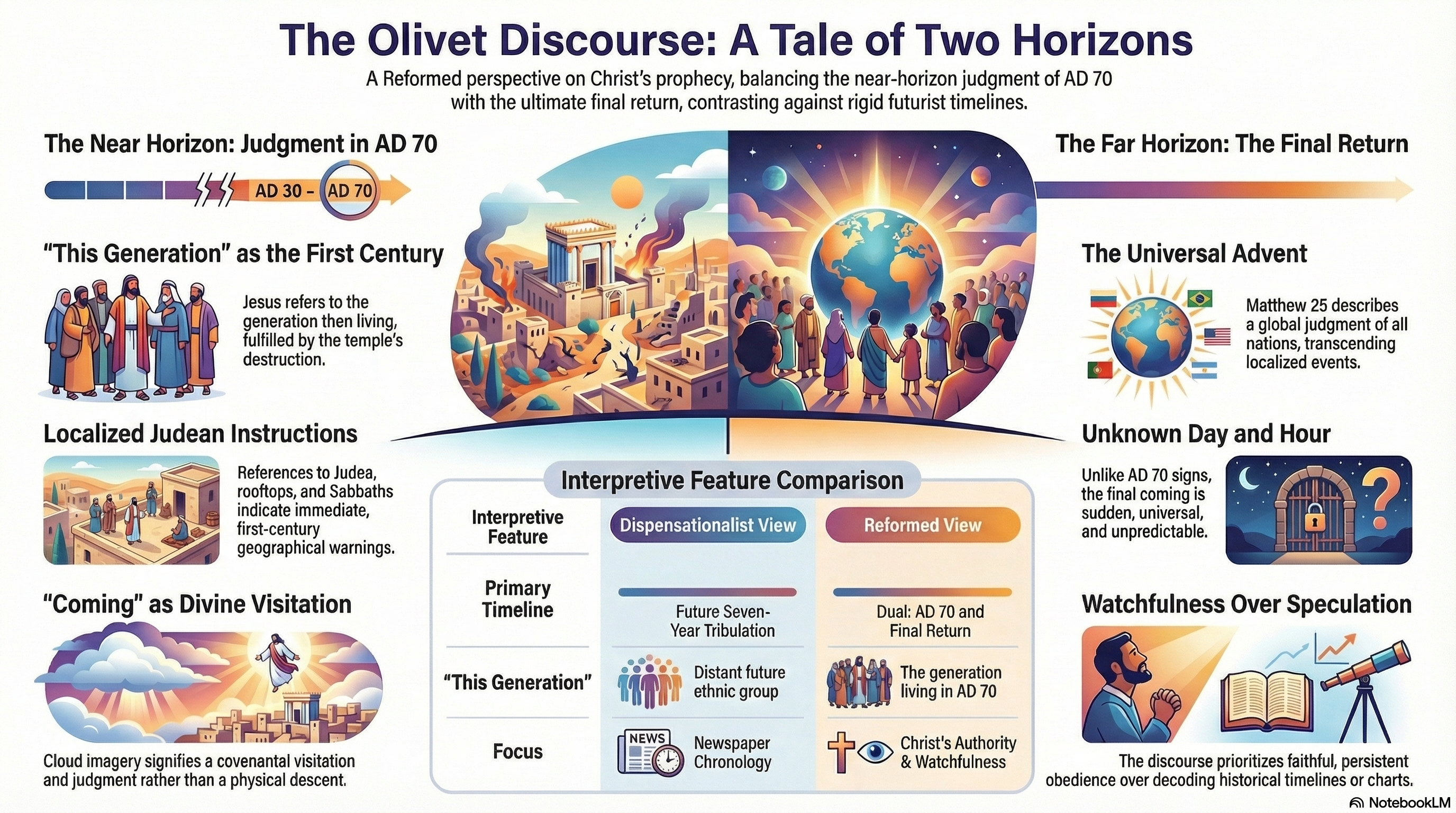
From a Reformed perspective, the great strength of the Olivet Discourse is not that it supplies a newspaper chronology. Its strength is that it reveals Christ as the true Prophet who foretells both the coming judgment upon Jerusalem and the certainty of His final return. The discourse includes both near-horizon judgment and ultimate consummation. It therefore must not be flattened into a single futurist timetable.
1. The Context Begins With the Temple, Not a Future Prophecy Chart
Jesus’ discourse arises from a concrete historical setting:
(KJV)
"O Jerusalem, Jerusalem, thou that killest the prophets, and stonest them which are sent unto thee, how often would I have gathered thy children together, even as a hen gathereth her chickens under her wings, and ye would not!
Behold, your house is left unto you desolate."
Then immediately:
(KJV)
"And Jesus went out, and departed from the temple: and his disciples came to him for to shew him the buildings of the temple.
And Jesus said unto them, See ye not all these things? verily I say unto you, There shall not be left here one stone upon another, that shall not be thrown down.
And as he sat upon the mount of Olives, the disciples came unto him privately, saying, Tell us, when shall these things be? and what shall be the sign of thy coming, and of the end of the world?"
The disciples’ questions are provoked by Jesus’ prophecy of temple destruction. That matters. The discourse is not a free-floating end-times seminar detached from Jerusalem. It begins with the announced desolation of the temple.
Dispensational readings often leap immediately to the far future. But Jesus’ first concern is the judgment soon to fall upon the city and sanctuary that rejected Him.
2. Jesus Gives Clear First-Century Markers
Much of the discourse uses local, immediate, and historically bounded language:
(KJV)
"When ye therefore shall see the abomination of desolation, spoken of by Daniel the prophet, stand in the holy place, (whoso readeth, let him understand:)
Then let them which be in Judaea flee into the mountains:
Let him which is on the housetop not come down to take any thing out of his house:
Neither let him which is in the field return back to take his clothes.
And woe unto them that are with child, and to them that give suck in those days!
But pray ye that your flight be not in the winter, neither on the sabbath day:"
These are not generic instructions for believers everywhere across the globe. They are intensely Judean instructions:
- "let them which be in Judaea flee"
- housetops
- fields
- winter
- sabbath
Luke makes the Jerusalem reference even more explicit:
(KJV)
"And when ye shall see Jerusalem compassed with armies, then know that the desolation thereof is nigh.
Then let them which are in Judaea flee to the mountains; and let them which are in the midst of it depart out; and let not them that are in the countries enter thereinto.
For these be the days of vengeance, that all things which are written may be fulfilled.
But woe unto them that are with child, and to them that give suck, in those days! for there shall be great distress in the land, and wrath upon this people.
And they shall fall by the edge of the sword, and shall be led away captive into all nations: and Jerusalem shall be trodden down of the Gentiles, until the times of the Gentiles be fulfilled."
Luke does not leave the "abomination" floating in abstraction. He points to Jerusalem surrounded by armies. That pushes us strongly toward the first-century destruction of the city.
This is one of the greatest weaknesses in the Dispensational reading. It must relocate or defer language that Jesus gives in plainly local and covenant-historical terms.
3. "This Generation" Cannot Be Evaded Easily
Jesus says:
(KJV)
"Verily I say unto you, This generation shall not pass, till all these things be fulfilled."
(KJV)
"Verily I say unto you, that this generation shall not pass, till all these things be done."
(KJV)
"Verily I say unto you, This generation shall not pass away, till all be fulfilled."
The plainest reading of "this generation" is the generation then living. That is how Jesus uses the phrase elsewhere:
(KJV)
"That upon you may come all the righteous blood shed upon the earth, from the blood of righteous Abel unto the blood of Zacharias son of Barachias, whom ye slew between the temple and the altar.
Verily I say unto you, All these things shall come upon this generation."
There is no good exegetical reason to make "this generation" suddenly mean a distant future ethnic category or end-times people-group in Matthew 24 while taking it normally in Matthew 23.
Reformed interpreters therefore insist that Jesus really did mean what He said. The destruction of Jerusalem in AD 70 is not a minor side note. It is a major element in the fulfillment horizon of the discourse.
4. The "Coming" Language Includes Judgment and Vindication
One reason readers force the whole passage into the distant future is that they assume every reference to Christ "coming" must refer only to the final visible advent. But biblical prophecy often speaks of divine comings in judgment as covenantal visitations.
Consider Isaiah:
(KJV)
"The burden of Egypt. Behold, the LORD rideth upon a swift cloud, and shall come into Egypt: and the idols of Egypt shall be moved at his presence, and the heart of Egypt shall melt in the midst of it."
The Lord "comes" in judgment imagery there, yet this is not the final consummation.
That helps us understand Jesus’ language in Matthew 24:
(KJV)
"Immediately after the tribulation of those days shall the sun be darkened, and the moon shall not give her light, and the stars shall fall from heaven, and the powers of the heavens shall be shaken:
And then shall appear the sign of the Son of man in heaven: and then shall all the tribes of the earth mourn, and they shall see the Son of man coming in the clouds of heaven with power and great glory."
The darkened sun, failing moon, and falling stars of verse 29 are themselves stock prophetic idiom. The prophets used exactly this de-creation language for the fall of nations within history:
"For the stars of heaven and the constellations thereof shall not give their light: the sun shall be darkened in his going forth, and the moon shall not cause her light to shine." (, KJV)
That is Isaiah's oracle against Babylon — fulfilled when Babylon fell, though no star left the sky.
"And all the host of heaven shall be dissolved, and the heavens shall be rolled together as a scroll: and all their host shall fall down, as the leaf falleth off from the vine, and as a falling fig from the fig tree." (, KJV)
That is the oracle against Edom. When a nation under God's judgment falls, the prophets describe its world collapsing — lights out, heavens shaken. Jesus, announcing the fall of Jerusalem's temple order, speaks the language of the judgment oracles His hearers knew.
This language also echoes Daniel:
(KJV)
"I saw in the night visions, and, behold, one like the Son of man came with the clouds of heaven, and came to the Ancient of days, and they brought him near before him.
And there was given him dominion, and glory, and a kingdom, that all people, nations, and languages, should serve him..."
In Daniel 7 the Son of man comes to the Ancient of Days to receive dominion. The image is enthronement and vindication, not descent to earth in the first instance.
So when Jerusalem falls under the judgment Jesus foretold, that destruction also functions as a historical vindication of the enthroned Son. The city that rejected Him experiences covenant wrath, and His prophetic word is proven true.
That does not eliminate the final coming. It means the discourse is richer than a one-layer futurist chart.
5. The Final Coming Is Still Present in the Discourse
A Reformed reading does not reduce everything in Matthew 24–25 to AD 70. That would be an overcorrection. The discourse clearly reaches beyond Jerusalem’s fall.
Jesus says:
(KJV)
"But of that day and hour knoweth no man, no, not the angels of heaven, but my Father only.
But as the days of Noe were, so shall also the coming of the Son of man be.
For as in the days that were before the flood they were eating and drinking, marrying and giving in marriage, until the day that Noe entered into the ark,
And knew not until the flood came, and took them all away; so shall also the coming of the Son of man be.
Then shall two be in the field; the one shall be taken, and the other left.
Two women shall be grinding at the mill; the one shall be taken, and the other left.
Watch therefore: for ye know not what hour your Lord doth come."
This has a broader, universal, final character. It moves beyond localized Judean flight to the suddenness of the last coming.
The Hinge: Why Verse 36 Marks the Turn
The whole reading defended in this collection leans on the pivot between verse 34 and verse 36, so the pivot must be argued, not merely assumed. Three textual markers converge.
First, the demonstratives shift. Through verse 34 Jesus speaks of "all these things" — the near demonstrative, the things the disciples will see, the signs on which a generation can act. At verse 36 He speaks of "that day and hour" — the far demonstrative, a day held at a distance from everything just described. "These things" are near enough to touch; "that day" is not.
Second, verse 36 opens with a turn in the Greek — peri de, "but concerning" — the same topic-shift formula Paul uses when he changes subjects ("But of the times and the seasons, brethren...", ; cf. ; 8:1). It is transition language: having answered when "these things" will be, Jesus takes up a different matter.
Third, the character of the teaching changes. Before verse 34, the discourse is datable by design: watch for the abomination, see the armies, then flee — signs given precisely so that hearers can act on them, and bounded by "this generation shall not pass." From verse 36, the teaching is undatable by design: no man knows, not the angels; it comes as in the days of Noah, as a thief in the night — no signs to watch for, only readiness. A discourse cannot coherently say "when ye shall see all these things, know that it is near" (24:33) and "of that day and hour knoweth no man" (24:36) about the same event. It can say both about two events: the judgment of Jerusalem, which had signs and a deadline, and the final coming, which has neither.
Paul takes up this very language when he teaches the Thessalonians about the resurrection and the gathering of the saints: "the day of the Lord so cometh as a thief in the night" (). That is why this collection reads 1 Thessalonians 4–5 and this portion of the discourse as describing the same final day (see The Rapture and the Day of the Lord).
Then in Matthew 25:
(KJV)
"When the Son of man shall come in his glory, and all the holy angels with him, then shall he sit upon the throne of his glory:
And before him shall be gathered all nations...
And these shall go away into everlasting punishment: but the righteous into life eternal."
That is unmistakably final judgment.
So the Reformed reading is not:
- "all first century"
but rather:
- much of the discourse concerns Jerusalem and the temple’s destruction
- the discourse also telescopes forward to the final advent and judgment
That is far more faithful to the texture of the text than a rigid Dispensational timeline.
6. The Great Tribulation Is Not a Dispensational Chart by Default
Jesus says:
(KJV)
"For then shall be great tribulation, such as was not since the beginning of the world to this time, no, nor ever shall be.
And except those days should be shortened, there should no flesh be saved: but for the elect's sake those days shall be shortened."
Dispensational teachers commonly jump from this to a future seven-year period for ethnic Israel. But the text itself does not say seven years. It does not separate Israel from the church. And Luke’s parallel ties the distress directly to Jerusalem’s desolation.
Indeed, Luke says:
(KJV)
"For these be the days of vengeance, that all things which are written may be fulfilled."
That is judgment language concerning Jerusalem. It is covenantal, not merely geopolitical.
Nor should the language "one taken and the other left" be assumed to favor a secret rapture. In the flood analogy, those "taken" in judgment were the wicked swept away:
(KJV)
"For as in the days that were before the flood they were eating and drinking...
And knew not until the flood came, and took them all away; so shall also the coming of the Son of man be."
The point is sudden separation under divine judgment, not a coded pretribulational removal of the church.
7. The Discourse Actually Supports Reformed Themes
When read carefully, the Olivet Discourse supports several core Reformed convictions.
First, Christ is the true Prophet whose word governs history. Jerusalem falls exactly as He said.
Second, the old covenant order centered on the temple is judged. That accords with everything Hebrews later teaches about the passing of shadows.
(KJV)
"In that he saith, A new covenant, he hath made the first old. Now that which decayeth and waxeth old is ready to vanish away."
Third, the church must not live by speculative date-setting but by watchfulness and obedience.
(KJV)
"Watch therefore: for ye know not what hour your Lord doth come."
(KJV)
"Who then is a faithful and wise servant, whom his lord hath made ruler over his household, to give them meat in due season?
Blessed is that servant, whom his lord when he cometh shall find so doing."
Fourth, Christ’s kingdom is not postponed. The destruction of Jerusalem itself is part of the historical proof that the rejected Son has been enthroned and that the old order has been judged.
8. Why This Matters Against Dispensationalism
If the Olivet Discourse is misread, several errors follow:
- Jerusalem’s first-century judgment is minimized.
- the temple’s destruction loses theological force.
- "this generation" is evacuated of its natural meaning.
- the church is trained to scan headlines rather than heed Christ’s plain warnings.
- prophecy becomes a timeline hobby rather than a call to endurance and faithfulness.
But if the discourse is read in a Reformed way, the logic becomes coherent:
- Jesus foretells the destruction of Jerusalem and the temple.
- that judgment vindicates Him as the enthroned Son of man.
- the discourse then stretches to His final appearing and judgment of all nations.
- the church’s task is not speculation, but watchfulness, fidelity, and persevering obedience.
That is Christ-centered, covenantally coherent, and pastorally sound.
9. Objections and Replies
1. "Luke 21 describes AD 70, but Matthew 24's abomination of desolation is future — and 2 Thessalonians 2."
This is the standard Dispensational harmonization, and it should be stated fairly: Luke's "Jerusalem compassed with armies" looks first-century, while Matthew's "abomination of desolation... in the holy place" is referred to a future antichrist in a rebuilt temple. The difficulty is that Matthew, Mark, and Luke report the same discourse, delivered on the same evening, answering the same question about the same temple — and all three bind the same events to the same clock: "this generation shall not pass" (; ; ). Matthew's "abomination of desolation, spoken of by Daniel the prophet" and Luke's besieging armies sit at the identical point in the discourse and are followed by the identical instruction: flee Judaea. Luke is not preaching a different sermon; he is giving inspired commentary on the same Danielic sign, telling Gentile readers what the abomination would look like on the ground. To split the sign into two events centuries apart, one must first split one discourse into two — and none of the evangelists does.
2. "'This generation' means the Jewish race, or the future generation that sees the signs."
The word rendered "generation" in Matthew consistently means the people then living ("this generation" — ; 12:41–42; 23:36), and uses the identical formula, moments before the discourse, for judgment falling on Jesus' contemporaries. If "this generation" meant "the Jewish race," the saying would be nearly empty — no one expected Israel to vanish before the end. And "the generation that sees the signs shall not pass until the signs are complete" is circular. The plain reading is also the one history vindicated: within forty years, not one stone was left upon another.
3. "'Immediately after the tribulation' (24:29) puts cosmic collapse and the Son of man's coming right after the siege — which did not visibly happen."
It did, in the sense the prophets trained Israel to expect. Sun, moon, and stars going dark is judgment-oracle idiom — over Babylon, over Edom (see section 4) — and the Son of man "coming in the clouds" is Daniel 7's enthronement scene: vindication before the Ancient of days, not descent to earth. The temple's destruction was the public, historical proof that the Son whom Jerusalem rejected had received the kingdom. The visible, bodily return remains fully real — but Jesus places it after the turn at verse 36, on "that day" no man knows.
4. "The gospel had not been 'preached in all the world' (24:14) by AD 70."
Paul, writing before Jerusalem fell, uses exactly that scale of language for the apostolic mission: the gospel "was preached to every creature which is under heaven" (), and its sound "went into all the earth" (). The idiom is the inhabited Roman world, the horizon of the apostles' commission — and in that sense the condition was met within the generation, as Jesus said. This does not retire the church's ongoing mission to every nation; it means cannot be used as a stopwatch proving the discourse leapfrogs the first century.
A Reformed Note on Method
The reading offered here rests on one stated principle, applied consistently across this section: audience-referenced time-markers ("this generation," "at hand") are taken at face value, exactly as the first hearers would have taken them, while prophetic and apocalyptic idiom (darkened sun, falling stars, symbolic numbers) is read by its genre, as the prophets themselves used it. That is not literalism-when-convenient; it is the Westminster rule that "the infallible rule of interpretation of Scripture is the Scripture itself" (WCF 1.9) — Scripture's own usage fixing Scripture's meaning. Many who read the discourse differently love the same Lord and await the same appearing; the disagreement is exegetical, not spiritual.
Conclusion
The Olivet Discourse does not function as a Dispensational timeline chart. It begins with the announced desolation of Jerusalem and the temple. It includes clear first-century markers, localized Judean instructions, and the solemn declaration that "this generation shall not pass" until these things are fulfilled. At the same time, it also reaches forward to the final, glorious return of Christ and the judgment of all nations.
That means the discourse must be read in layers, not flattened into a single futurist scheme.
The Reformed reading honors both horizons. It takes Jesus’ words about Jerusalem seriously. It takes His words about the final coming seriously. And it refuses to import a system that turns the Lord’s prophecy into a coded chronology for modern speculation.
Christ’s aim is not to make the church obsessed with charts. His aim is to make the church watchful, faithful, and ready.
If the discourse's first horizon is Jerusalem's judgment, a further question follows: what has become of Jerusalem in the purposes of God — and what should Christians make of those who read modern wars over that city as prophecy? The next essay takes this up: Jerusalem Fulfilled in Christ.
Suggested Next Steps
- Read :51 in one sitting, watching how the woes, the "this generation" of 23:36, and the discourse connect.
- Read beside and note where the two accounts run parallel.
- Read and ask: in the vision itself, which direction is the Son of man traveling?
- Continue to Jerusalem Fulfilled in Christ for what the New Testament makes of the city itself.
Audio Discussion
The Olivet Discourse: Jerusalem, Judgment, and the End Without Dispensational Timelines
Audio Discussion
The Olivet Discourse: Jerusalem, Judgment, and the End Without Dispensational Timelines
Infographic
The Olivet Discourse: Jerusalem, Judgment, and the End Without Dispensational Timelines
Infographic
The Olivet Discourse: Jerusalem, Judgment, and the End Without Dispensational Timelines