Essay
The Rapture and the Day of the Lord: Why 1 Thessalonians 4 Does Not Teach a Secret Removal
"For the Lord himself shall descend from heaven with a shout, with the voice of the archangel, and with the trump of God: and the dead in Christ shall rise first: Then we which are alive and remain shall be caught up together with them in the clouds, to meet the Lord in the air: and so shall we ever be with the Lord." (, KJV)
Thesis
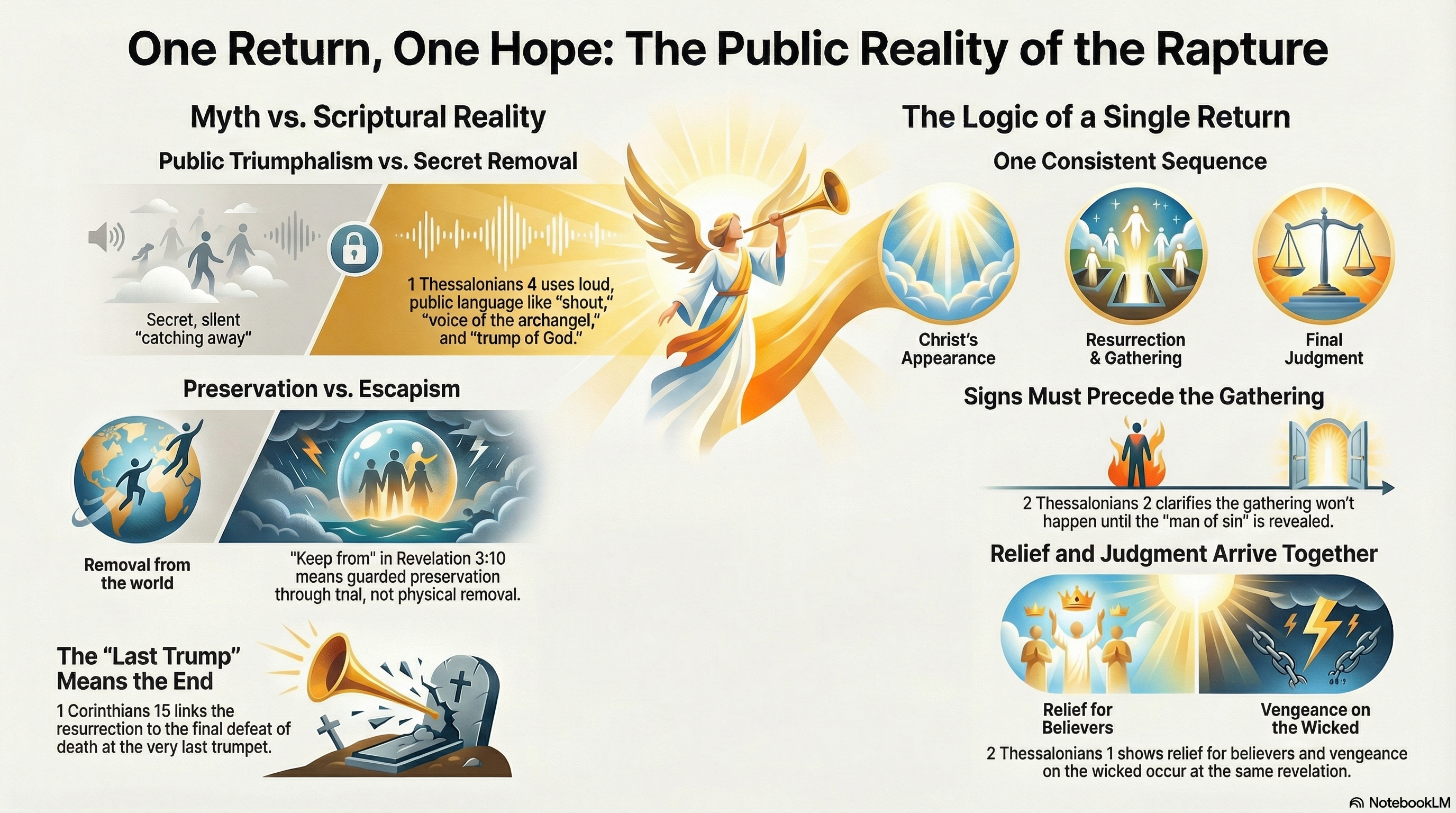
1 Thessalonians 4, 1 Corinthians 15, Matthew 24–25, and 2 Thessalonians 1–2 all speak consistently of one public return of Christ, one resurrection complex, one gathering of the saints, and one final judgment. There is no exegetical need for a two-stage coming — and no secret one. The "catching up" of is the church going out to meet her arriving King, not a hidden removal of believers before a seven-year tribulation.
Among the most persuasive features of popular Dispensationalism is its handling of the "rapture" texts. Many believers are told that 1 Thessalonians 4 teaches a secret removal of the church before a seven-year tribulation, that 1 Corinthians 15 describes a different coming from the visible return of Christ, and that guarantees an escape from tribulation rather than preservation through trial. For many readers, this feels obvious because the passages are often quoted in isolation and then slotted into a ready-made chart.
From a Reformed perspective, the problem is not that these passages are unimportant. The problem is that they are being detached from the wider biblical witness. Scripture interprets Scripture. The clear governs the less clear. Didactic texts govern symbolic texts. And all prophecy must be read in light of Christ’s finished work and the apostles’ teaching. Once that rule is followed, the secret-pretribulational reading collapses.
1. What Dispensationalism Commonly Claims
The classic Dispensational outline usually argues the following:
- teaches a secret catching away of the church.
- describes the same secret event.
- Matthew 24 concerns Israel, not the church, and therefore should not govern the rapture question.
- 2 Thessalonians 2 concerns events after the church is gone.
- promises removal from the tribulation rather than preservation through it.
The effect is a split return of Christ: first for His saints in secret, then later with His saints in visible glory.
The difficulty is that the texts themselves do not naturally say this. The system has to import it.
2. 1 Thessalonians 4 Describes a Public, Triumphal Coming
Paul writes:
(KJV)
"But I would not have you to be ignorant, brethren, concerning them which are asleep, that ye sorrow not, even as others which have no hope.
For if we believe that Jesus died and rose again, even so them also which sleep in Jesus will God bring with him.
For this we say unto you by the word of the Lord, that we which are alive and remain unto the coming of the Lord shall not prevent them which are asleep.
For the Lord himself shall descend from heaven with a shout, with the voice of the archangel, and with the trump of God: and the dead in Christ shall rise first:
Then we which are alive and remain shall be caught up together with them in the clouds, to meet the Lord in the air: and so shall we ever be with the Lord.
Wherefore comfort one another with these words."
Nothing here is secret. Paul piles up public language:
- "the Lord himself shall descend from heaven"
- "with a shout"
- "with the voice of the archangel"
- "with the trump of God"
- "the dead in Christ shall rise first"
That is not hidden, silent, or invisible. It is revelatory, royal, and cosmic.
The text also does not say Christ returns to heaven with the saints for seven years. It says the saints are caught up "to meet the Lord in the air: and so shall we ever be with the Lord." The image is one of meeting the arriving King, not escaping from Him or disappearing into a secret heavenly interval.
This harmonizes naturally with the biblical pattern of saints greeting the Lord at His appearing. Jesus paints the same picture in the parable of the virgins, in the portion of the Olivet Discourse that concerns "that day" of His final coming:
(KJV)
"And at midnight there was a cry made, Behold, the bridegroom cometh; go ye out to meet him."
The word Paul uses for "to meet the Lord" in is the same word used here of the virgins going out to meet the bridegroom. In both scenes the meeting is a welcome, not a disappearance: the waiting company goes out to receive the One who is arriving.
A note on is in order, because that passage is often paired with 1 Thessalonians 4 on both sides of this debate. In the reading of the Olivet Discourse defended in this collection (see The Olivet Discourse: Jerusalem, Judgment, and the End), speaks in the first instance to the judgment of Jerusalem within "this generation" — the Daniel 7 enthronement of the Son of man vindicated in history, with the elect gathered from the four winds as the gospel goes out to the nations (cf. ; ). The discourse then turns at 24:36 ("But of that day and hour knoweth no man") to the final coming. For that reason this essay does not rest its case on , and it does not need to. The final-advent portions of the same discourse — the thief in the night (), the bridegroom's arrival (), and the Son of man on His throne with all nations gathered before Him () — supply the same public pattern. And even for readers who take directly of the final advent, as many Reformed interpreters do, the passage describes a visible coming "with power and great glory" and "a great sound of a trumpet" — the opposite of a secret removal. On either reading, nothing in the discourse is hidden.
3. 1 Corinthians 15 Also Points to One Final Resurrection Event
Paul writes:
(KJV)
"Behold, I shew you a mystery; We shall not all sleep, but we shall all be changed,
In a moment, in the twinkling of an eye, at the last trump: for the trumpet shall sound, and the dead shall be raised incorruptible, and we shall be changed.
For this corruptible must put on incorruption, and this mortal must put on immortality.
So when this corruptible shall have put on incorruption, and this mortal shall have put on immortality, then shall be brought to pass the saying that is written, Death is swallowed up in victory."
Three things matter here.
First, this happens "at the last trump." The most natural reading of "last" is final, not penultimate. The burden of proof lies on anyone who says Paul means a secret trumpet before later prophetic trumpets.
Second, this event defeats death. "Death is swallowed up in victory" is consummation language, not merely a preliminary removal of believers before history continues in ordinary fashion.
Third, Paul ties resurrection and transformation together. The dead are raised incorruptible and the living are changed. This is the consummate victory of Christ over death itself.
This fits perfectly with Jesus’ teaching:
(KJV)
"And this is the Father's will which hath sent me, that of all which he hath given me I should lose nothing, but should raise it up again at the last day.
And this is the will of him that sent me, that every one which seeth the Son, and believeth on him, may have everlasting life: and I will raise him up at the last day."
(KJV)
"No man can come to me, except the Father which hath sent me draw him: and I will raise him up at the last day."
(KJV)
"Whoso eateth my flesh, and drinketh my blood, hath eternal life; and I will raise him up at the last day."
Jesus does not speak of multiple resurrections for believers separated by years within a dispensational scheme. He speaks of the resurrection of His people at the last day.
He says the same again:
(KJV)
"Marvel not at this: for the hour is coming, in the which all that are in the graves shall hear his voice,
And shall come forth; they that have done good, unto the resurrection of life; and they that have done evil, unto the resurrection of damnation."
That is not the language of a many-stage resurrection drama. It is the language of climactic finality.
4. 2 Thessalonians Rules Out an Any-Moment Secret Removal
One of the most damaging texts for classic pretribulationalism is 2 Thessalonians 2, because Paul explicitly discusses "the coming of our Lord Jesus Christ" and "our gathering together unto him" and then tells the church not to think the Day has arrived yet.
(KJV)
"Now we beseech you, brethren, by the coming of our Lord Jesus Christ, and by our gathering together unto him,
That ye be not soon shaken in mind, or be troubled, neither by spirit, nor by word, nor by letter as from us, as that the day of Christ is at hand.
Let no man deceive you by any means: for that day shall not come, except there come a falling away first, and that man of sin be revealed, the son of perdition;
Who opposeth and exalteth himself above all that is called God, or that is worshipped; so that he as God sitteth in the temple of God, shewing himself that he is God."
Paul links together:
- "the coming of our Lord Jesus Christ"
- "our gathering together unto him"
- "that day"
He does not separate them into radically different phases. And he says "that day shall not come" until certain events precede it.
That fact alone is hard to reconcile with the claim that the gathering of the church is a signless event totally distinct from the public Day of the Lord.
Later in the same passage, Paul says the man of sin is destroyed:
(KJV)
"And then shall that Wicked be revealed, whom the Lord shall consume with the spirit of his mouth, and shall destroy with the brightness of his coming:"
Again, the coming of Christ is public and destructive toward evil. It is not a secret extraction followed by a later true appearing.
The same pattern appears in 2 Thessalonians 1:
(KJV)
"And to you who are troubled rest with us, when the Lord Jesus shall be revealed from heaven with his mighty angels,
In flaming fire taking vengeance on them that know not God, and that obey not the gospel of our Lord Jesus Christ:
Who shall be punished with everlasting destruction from the presence of the Lord, and from the glory of his power;
When he shall come to be glorified in his saints, and to be admired in all them that believe..."
There is no room here for a secret coming for believers detached from judgment on unbelievers. Relief for the church and judgment on the wicked arrive together at the revelation of Christ.
5. Does Not Promise Escape by Removal
One of the standard pretribulational proof texts is:
(KJV)
"Because thou hast kept the word of my patience, I also will keep thee from the hour of temptation, which shall come upon all the world, to try them that dwell upon the earth."
Dispensational readers often assume "keep thee from" must mean remove before. But Scripture does not force that meaning. Christ can keep His people from trial by preserving them through it.
In John 17 Jesus uses similar language:
(KJV)
"I pray not that thou shouldest take them out of the world, but that thou shouldest keep them from the evil."
That is crucial. Christ explicitly distinguishes:
- not taking them out of the world
- keeping them from evil
So "keep from" does not automatically mean physical removal. It can mean guarded preservation.
That reading also fits the wider New Testament pattern. The church is repeatedly told to expect tribulation, not exemption from it:
(KJV)
"Confirming the souls of the disciples, and exhorting them to continue in the faith, and that we must through much tribulation enter into the kingdom of God."
(KJV)
"These things I have spoken unto you, that in me ye might have peace. In the world ye shall have tribulation: but be of good cheer; I have overcome the world."
(KJV)
"And one of the elders answered, saying unto me, What are these which are arrayed in white robes? and whence came they?
And I said unto him, Sir, thou knowest. And he said to me, These are they which came out of great tribulation, and have washed their robes, and made them white in the blood of the Lamb."
The biblical pattern is not escapism but preservation, endurance, and ultimate vindication.
6. The Day of the Lord Is One Complex Event, Not Two Separate Comings
Paul continues directly from 1 Thessalonians 4 into 1 Thessalonians 5 without inserting a new age or separate coming:
(KJV)
"But of the times and the seasons, brethren, ye have no need that I write unto you.
For yourselves know perfectly that the day of the Lord so cometh as a thief in the night.
For when they shall say, Peace and safety; then sudden destruction cometh upon them, as travail upon a woman with child; and they shall not escape.
But ye, brethren, are not in darkness, that that day should overtake you as a thief."
The flow is obvious:
- 4:13-18 = resurrection and gathering
- 5:1-4 = the Day of the Lord, sudden destruction, no escape for the wicked
Paul does not signal a change of subject from a secret coming to a later public one. He is unfolding one great Day from two angles: comfort for believers, destruction for the ungodly.
Notice also where Paul's "thief in the night" language comes from. It is Jesus' own teaching about "that day" in the final-advent portion of the Olivet Discourse: "Watch therefore: for ye know not what hour your Lord doth come... if the goodman of the house had known in what watch the thief would come, he would have watched" (). Paul is expounding the very section of Jesus' teaching that concerns the last day — which confirms that the gathering of 1 Thessalonians 4 and the Day of the Lord in 1 Thessalonians 5 belong to that same day, not to a secret event years before it.
Peter teaches the same pattern:
(KJV)
"But the day of the Lord will come as a thief in the night; in the which the heavens shall pass away with a great noise, and the elements shall melt with fervent heat, the earth also and the works that are therein shall be burned up.
Seeing then that all these things shall be dissolved, what manner of persons ought ye to be in all holy conversation and godliness,
Looking for and hasting unto the coming of the day of God...
Nevertheless we, according to his promise, look for new heavens and a new earth, wherein dwelleth righteousness."
The Day of the Lord is not a temporary pause in history before the true end. It is the arrival of final cosmic transformation.
7. The Reformed Logic: One Return, One Resurrection, One Judgment
The strength of the Reformed reading is not merely that it avoids complications. It is that it lets the major texts govern.
The pattern looks like this:
- Christ appears publicly and gloriously.
- The dead are raised.
- The living saints are transformed.
- The church is gathered to Christ.
- The wicked are judged.
- The final state dawns.
This is exactly how Scripture repeatedly speaks.
(KJV)
"When the Son of man shall come in his glory, and all the holy angels with him, then shall he sit upon the throne of his glory:
And before him shall be gathered all nations...
And these shall go away into everlasting punishment: but the righteous into life eternal."
(KJV)
"But every man in his own order: Christ the firstfruits; afterward they that are Christ's at his coming.
Then cometh the end, when he shall have delivered up the kingdom to God, even the Father; when he shall have put down all rule and all authority and power.
For he must reign, till he hath put all enemies under his feet.
The last enemy that shall be destroyed is death."
Notice the sequence:
- those who are Christ’s are raised "at his coming"
- "then cometh the end"
- death is destroyed
That is not the architecture of a secret pretrib removal followed by a long chain of intervening stages before the real end.
8. What Comfort Does the Text Actually Offer?
Pretribulational teaching often sells itself as comforting because it promises escape from trouble. But Paul’s actual comfort is not escapism. It is Christ.
The comfort of 1 Thessalonians 4 is:
- dead believers are not lost
- Christ will bring them with Him
- they will be raised
- living believers will be transformed
- all the saints will be together
- "so shall we ever be with the Lord"
That comfort is stronger than timetable speculation because it rests on union with Christ, not on the hope of avoiding every trial.
The New Testament’s pastoral logic is consistent:
(KJV)
"Who shall separate us from the love of Christ? shall tribulation, or distress, or persecution, or famine, or nakedness, or peril, or sword?
...
Nay, in all these things we are more than conquerors through him that loved us.
For I am persuaded, that neither death, nor life, nor angels, nor principalities, nor powers, nor things present, nor things to come... shall be able to separate us from the love of God, which is in Christ Jesus our Lord."
Reformed eschatology comforts believers not by promising a hidden exit from suffering, but by proclaiming the absolute security of the saints in a reigning and returning Christ.
9. Objections and Replies
The pretribulational system does not rest only on the passages treated above. Its strongest remaining arguments deserve to be named and answered directly.
1. "God hath not appointed us to wrath () — so the church must be removed before the tribulation."
"For God hath not appointed us to wrath, but to obtain salvation by our Lord Jesus Christ, Who died for us, that, whether we wake or sleep, we should live together with him." (, KJV)
The verse names the instrument of the exemption, and it is not an evacuation: believers escape wrath "by our Lord Jesus Christ, who died for us." The deliverance is substitutionary, not geographical — "being now justified by his blood, we shall be saved from wrath through him" (, KJV). And in the immediate context, what distinguishes believers when the Day comes as a thief is their state, not their location: "ye, brethren, are not in darkness, that that day should overtake you as a thief" (). Exemption from wrath has never required absence from the scene of judgment; Israel stood in Goshen while the plagues fell on Egypt.
2. "Christ's coming is imminent — it could happen at any moment — so no prophesied events can precede it."
This is the system's real backbone, and it deserves a direct answer. Scripture commands watchfulness because the hour is unknown, not because nothing precedes it. Paul — who wrote "let us watch and be sober" () — also wrote, to the same church, "that day shall not come, except there come a falling away first, and that man of sin be revealed" (). If naming antecedent events destroyed watchfulness, Paul destroyed it himself. It does not: the servant watches because he knows not when his lord comes (), and that moral readiness is fully compatible with knowing that some things come first.
3. " promises to keep the church from the hour of temptation."
This is the strongest remaining proof text, and section 5 above gives it the full answer: "keep thee from" does not mean "remove before," as Jesus' own parallel usage shows — "I pray not that thou shouldest take them out of the world, but that thou shouldest keep them from the evil." (, KJV). Christ keeps His people from the hour of trial the way He keeps them from the evil one: by preservation through it, not extraction before it.
4. "The church is never mentioned in Revelation 4–19, so it must already be in heaven."
An argument from a word's absence is weaker than the presence of the thing itself. The saints fill those chapters: they pray (), they overcome the accuser "by the blood of the Lamb" (), the beast makes "war with the saints" (, KJV), and their patience and faith are the point of the whole vision (; 14:12). If the saints on earth in Revelation 4–19 are not the church, Scripture nowhere explains who this second body of blood-bought, persevering believers could be — the system that requires them has added a people the text never names.
A Reformed Note on Method
Nothing in this essay depends on a novel principle. The method is the one the Westminster Confession states: "The infallible rule of interpretation of Scripture is the Scripture itself" (WCF 1.9). The clear governs the less clear; didactic texts govern symbolic ones; and no system — however venerable its charts — may sit in judgment over the plain flow of 1 Thessalonians 4–5 or 2 Thessalonians 1–2. Where this essay has opposed Dispensational readings, the quarrel is with the system's imports, not with the brothers and sisters who hold it; many who differ here love the same Lord and long for the same appearing.
Conclusion
1 Thessalonians 4 does not teach a secret pretribulational removal of the church. It teaches the public coming of Christ, the resurrection of the dead, the transformation of the living, and the everlasting communion of all the saints with their Lord.
1 Corinthians 15 reinforces that reading by placing resurrection and transformation at the last trumpet and tying them to the final defeat of death. 2 Thessalonians 1–2 joins the coming of Christ, the gathering of the saints, relief for believers, and judgment on the wicked into one public complex. does not overturn this pattern, because Christ can keep His people through trial without taking them out of the world.
The Reformed conclusion is therefore simple and scriptural:
Christ comes once, visibly and gloriously.
The dead are raised.
The saints are gathered.
The wicked are judged.
And the church is forever with the Lord.
That is not a diminished hope. It is the blessed hope in its full apostolic clarity.
Paul's teaching on the Day of the Lord did not arise in a vacuum; he was expounding his Master's own words about "that day and hour." The next essay turns to the source: The Olivet Discourse: Jerusalem, Judgment, and the End — what Jesus foretold on the Mount of Olives, which parts were fulfilled within a generation, and where the discourse turns to the final coming.
Suggested Next Steps
- Read :11 in one sitting, without pausing at the chapter break, and ask whether Paul signals one Day or two comings.
- Read and note what Paul says must come before "the coming of our Lord Jesus Christ, and... our gathering together unto him."
- Compare with — the same Lord, the same construction, and His own explanation of what "keep from" means.
- Continue to The Olivet Discourse: Jerusalem, Judgment, and the End for the source of Paul's thief-in-the-night teaching.
Essay Video
The Rapture and the Day of the Lord: Why 1 Thessalonians 4 Does Not Teach a Secret Removal
Audio Discussion
The Rapture and the Day of the Lord: Why 1 Thessalonians 4 Does Not Teach a Secret Removal
Audio Discussion
The Rapture and the Day of the Lord: Why 1 Thessalonians 4 Does Not Teach a Secret Removal
Infographic
The Rapture and the Day of the Lord: Why 1 Thessalonians 4 Does Not Teach a Secret Removal
Infographic
The Rapture and the Day of the Lord: Why 1 Thessalonians 4 Does Not Teach a Secret Removal