Essay
Covenant Theology and the End Times
Christ Reigns Now, and His Kingdom Will Be Consummated at His Return
By Adam Malin Date: March 25, 2026
"For he must reign, till he hath put all enemies under his feet. The last enemy that shall be destroyed is death." (, KJV)
"He which testifieth these things saith, Surely I come quickly. Amen. Even so, come, Lord Jesus." (, KJV)
Thesis
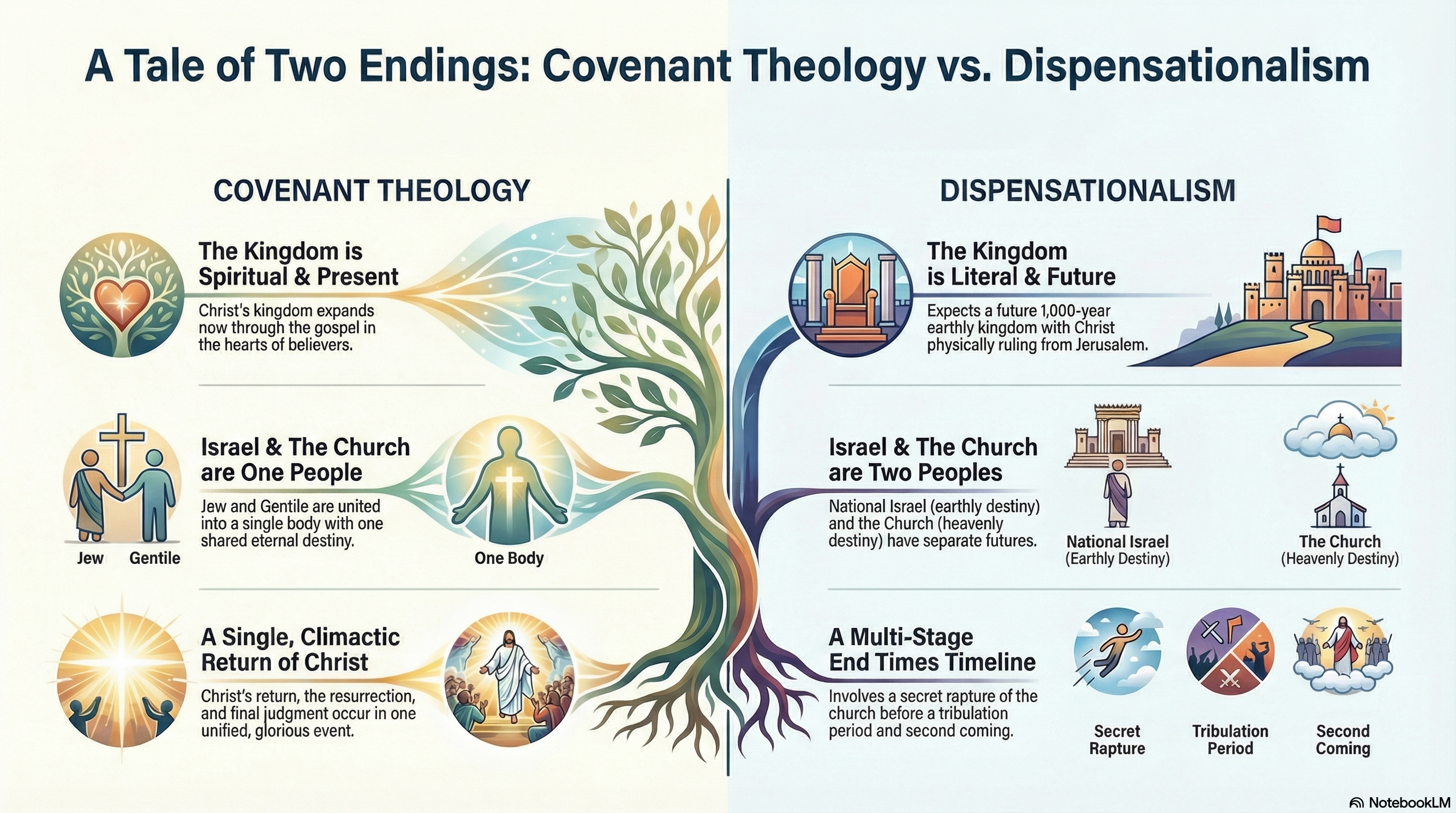
The Bible teaches that Christ's kingdom is inaugurated — present and real now — and that it will be consummated at His visible return. Between the ascension and the Second Coming, Christ reigns at the Father's right hand with all authority in heaven and on earth (; ). He is subduing His enemies, gathering His people from every nation, and building His church against which the gates of hell shall not prevail (). At His return — a single, public, glorious appearing — the dead will be raised, all nations will be judged, and the new heavens and new earth will be revealed (; ; ).
This is not a speculative timeline. It is the plain teaching of the New Testament, read through the apostolic hermeneutic of promise and fulfillment. Covenant theology holds that the Old Testament's kingdom, temple, land, and people-of-God promises find their yes and amen in Christ () — not in a future geopolitical program, not in a rebuilt temple with restored sacrifices, and not in a two-track plan that separates Israel from the church. The eschatological vision of covenant theology is Christ-centered, covenantally unified, and scripturally simple: one King, one people, one return, one judgment, one eternal glory.
This essay lays out the framework. The essays that follow in this section apply it to specific texts and controversies: the rapture, the Olivet Discourse, Jerusalem in prophecy, Gog and Magog, the millennium, and the doctrine of final judgment.
1. The Kingdom Is Present: Christ Reigns Now
The eschatological question begins with Christology. If Christ is enthroned now — and Scripture is emphatic that He is — then the kingdom is not postponed to a future dispensation. It is here, and it is growing.
The Enthronement Texts
The New Testament proclaims Christ's present reign with unmistakable clarity:
"The LORD said unto my Lord, Sit thou at my right hand, until I make thine enemies thy footstool." (, KJV)
This is the most-quoted Old Testament verse in the New Testament. Peter applies it to the ascension at Pentecost:
"Therefore being by the right hand of God exalted, and having received of the Father the promise of the Holy Ghost, he hath shed forth this, which ye now see and hear. For David is not ascended into the heavens: but he saith himself, The LORD said unto my Lord, Sit thou on my right hand, Until I make thy foes thy footstool. Therefore let all the house of Israel know assuredly, that God hath made that same Jesus, whom ye have crucified, both Lord and Christ." (, KJV)
Peter's argument is precise: David prophesied the Messiah's enthronement on David's throne (). That enthronement has occurred — not at some future date, but at the ascension. Jesus is now seated on the throne David was promised. The kingdom is now operative.
Paul reinforces this across his letters:
"Which he wrought in Christ, when he raised him from the dead, and set him at his own right hand in the heavenly places, Far above all principality, and power, and might, and dominion, and every name that is named, not only in this world, but also in that which is to come: And hath put all things under his feet, and gave him to be the head over all things to the church." (, KJV)
"Who hath delivered us from the power of darkness, and hath translated us into the kingdom of his dear Son." (, KJV)
"Wherefore God also hath highly exalted him, and given him a name which is above every name: That at the name of Jesus every knee should bow, of things in heaven, and things in earth, and things under the earth; And that every tongue should confess that Jesus Christ is Lord, to the glory of God the Father." (, KJV)
"All power is given unto me in heaven and in earth." (, KJV)
The cumulative force is overwhelming. Christ is not waiting to reign. He reigns now. All authority is His now. He is far above every principality and power now. His enemies are being made His footstool now.
The Kingdom Is "Not of This World" — But It Is Real
Jesus told Pilate:
"My kingdom is not of this world: if my kingdom were of this world, then would my servants fight, that I should not be delivered to the Jews: but now is my kingdom not from hence." (, KJV)
This text is often misread. Jesus does not say His kingdom is not in this world. He says it is not of this world — its origin and character are heavenly, not earthly. It does not advance by sword and political power. But it is real, it is present, and it exercises authority over the earth through the Word, the Spirit, and the church's witness.
The Already and Not Yet
The apostolic witness locates the church between accomplishment and consummation. This is the "already and not yet" structure of New Testament eschatology:
Already: Christ has been enthroned (). All authority is His (). Believers have been translated into His kingdom (). Satan has been bound in a decisive sense (; ). The Spirit has been poured out as the "earnest" — the down payment — of the inheritance (). The last days have begun (; ).
Not yet: Death has not been destroyed (). The creation still groans (). We see not yet all things put under Him (). The final resurrection, judgment, and new creation remain future (; ; ). Christ Himself will return visibly and bodily (; ).
This is the eschatological framework. Everything that follows in this essay — the millennium, Israel and the church, the return of Christ, the fulfillment of prophecy — fits within this already/not-yet structure.
2. The Millennium: Christ's Present Reign in Symbolic Language
The millennium question turns on how to read . Dispensational premillennialism reads it as a literal thousand-year earthly kingdom following Christ's return. The Reformed amillennial reading — held by the mainstream of confessional Reformed theology — reads it as a symbolic description of Christ's present reign during the gospel age.
What Revelation 20 Says
"And I saw an angel come down from heaven, having the key of the bottomless pit and a great chain in his hand. And he laid hold on the dragon, that old serpent, which is the Devil, and Satan, and bound him a thousand years, And cast him into the bottomless pit, and shut him up, and set a seal upon him, that he should deceive the nations no more, till the thousand years should be fulfilled." (, KJV)
"And I saw thrones, and they sat upon them, and judgment was given unto them: and I saw the souls of them that were beheaded for the witness of Jesus, and for the word of God… and they lived and reigned with Christ a thousand years." (, KJV)
Why "Thousand" Is Symbolic
The book of Revelation opens by declaring that its message was "signified" — communicated through signs and symbols (). The number thousand is used throughout Scripture to denote fullness and completeness, not a literal count:
"For every beast of the forest is mine, and the cattle upon a thousand hills." (, KJV)
God does not own cattle on exactly one thousand hills and none on the rest. The number means "all."
"Know therefore that the LORD thy God, he is God, the faithful God, which keepeth covenant and mercy with them that love him and keep his commandments to a thousand generations." (, KJV)
Not literally one thousand generations and then the covenant expires. The number means "without end."
"But, beloved, be not ignorant of this one thing, that one day is with the Lord as a thousand years, and a thousand years as one day." (, KJV)
Peter explicitly warns against wooden literalism about divine time-references in an eschatological context.
Satan Was Bound at Christ's First Coming
The binding of Satan described in Revelation 20 corresponds to what Jesus Himself announced during His earthly ministry:
"But if I cast out devils by the Spirit of God, then the kingdom of God is come unto you. Or else how can one enter into a strong man's house, and spoil his goods, except he first bind the strong man? and then he will spoil his house." (, KJV)
"Now is the judgment of this world: now shall the prince of this world be cast out. And I, if I be lifted up from the earth, will draw all men unto me." (, KJV)
"And he said unto them, I beheld Satan as lightning fall from heaven." (, KJV)
The strong man has been bound. The prince of this world has been cast out. This is not a future event; it is accomplished in Christ's victory at the cross and confirmed in His resurrection and ascension. The binding is real but qualified — Satan is restrained from "deceiving the nations" as he did before the gospel went forth to all peoples (), but he remains active within the limits God permits (). At the end of the age, he will be released for a brief final assault before his total destruction ().
The Saints Reign with Christ Now
describes "the souls of them that were beheaded for the witness of Jesus" reigning with Christ. This is a vision of departed saints in heaven, not resurrected saints on earth. The "first resurrection" () refers to the spiritual resurrection of those who have passed from death to life in Christ:
"Verily, verily, I say unto you, The hour is coming, and now is, when the dead shall hear the voice of the Son of God: and they that hear shall live." (, KJV)
"And you hath he quickened, who were dead in trespasses and sins." (, KJV)
"If ye then be risen with Christ, seek those things which are above, where Christ sitteth on the right hand of God." (, KJV)
The "second death" — the lake of fire — has no power over those who share in the first resurrection (). That is precisely the condition of every believer who has been born again: death has lost its sting, and the second death holds no terror ().
For a detailed exegetical treatment of Revelation 20 and the millennium, see Revelation 20 and the Millennium: Why Christ Reigns Now in this collection.
3. The Church and Israel: One People, One Olive Tree, One Destiny
One of the sharpest differences between Dispensationalism and covenant theology concerns the relationship between Israel and the church. Dispensationalism maintains two distinct peoples with two distinct destinies — Israel as an earthly nation with earthly promises, the church as a heavenly people with heavenly promises. Covenant theology, following the apostles, teaches that Christ has united Jew and Gentile into one people of God with one eternal destiny.
The Apostolic Testimony
Paul's argument in Ephesians 2 is decisive:
"For he is our peace, who hath made both one, and hath broken down the middle wall of partition between us; Having abolished in his flesh the enmity, even the law of commandments contained in ordinances; for to make in himself of twain one new man, so making peace; And that he might reconcile both unto God in one body by the cross, having slain the enmity thereby." (, KJV)
"Now therefore ye are no more strangers and foreigners, but fellowcitizens with the saints, and of the household of God; And are built upon the foundation of the apostles and prophets, Jesus Christ himself being the chief corner stone; In whom all the building fitly framed together groweth unto an holy temple in the Lord: In whom ye also are builded together for an habitation of God through the Spirit." (, KJV)
The wall is down. The two have become one. The result is not two peoples living side by side, but one new man, one body, one household, one temple. Any eschatological scheme that re-erects the wall Christ demolished is moving backward through redemptive history.
"They Are Not All Israel, Which Are of Israel"
Paul addresses the question directly in Romans 9:
"Not as though the word of God hath taken none effect. For they are not all Israel, which are of Israel: Neither, because they are the seed of Abraham, are they all children: but, In Isaac shall thy seed be called. That is, They which are the children of the flesh, these are not the children of God: but the children of the promise are counted for the seed." (, KJV)
The saving people of God have never been defined by ethnicity. They have always been defined by election and promise. Abraham himself was justified by faith before circumcision (). The true children of Abraham are those who share Abraham's faith:
"Know ye therefore that they which are of faith, the same are the children of Abraham." (, KJV)
"And if ye be Christ's, then are ye Abraham's seed, and heirs according to the promise." (, KJV)
"There is neither Jew nor Greek, there is neither bond nor free, there is neither male nor female: for ye are all one in Christ Jesus." (, KJV)
The One Olive Tree (Romans 11)
Romans 11 is often cited as proof of a separate future for ethnic Israel. But Paul's controlling image tells the opposite story:
"And if some of the branches be broken off, and thou, being a wild olive tree, wert graffed in among them, and with them partakest of the root and fatness of the olive tree; Boast not against the branches… Thou wilt say then, The branches were broken off, that I might be graffed in. Well; because of unbelief they were broken off, and thou standest by faith… And they also, if they abide not still in unbelief, shall be graffed in: for God is able to graff them in again." (, KJV)
There is one olive tree — not two. Jewish branches were broken off for unbelief. Gentile branches were grafted in by faith. Jewish branches will be grafted back in — by faith, through the gospel, into the same tree. The future salvation Paul anticipates for Israel () is incorporation into Christ and His church, not a separate redemptive track.
Paul confirms this when he says: "And so all Israel shall be saved: as it is written, There shall come out of Sion the Deliverer, and shall turn away ungodliness from Jacob" (, KJV). The Deliverer is Christ. The salvation is by grace through faith. The destiny is the same for Jew and Gentile: the new heavens and the new earth.
The Westminster Confession (25.2) teaches: "The visible church… consists of all those throughout the world that profess the true religion; and of their children: and is the kingdom of the Lord Jesus Christ." There is no second kingdom for a second people. There is one King and one kingdom.
For the full treatment of how election — not race — defines God's people, see God's Chosen People: Election, Not Race in this collection. For the exegetical transition from Dispensational to covenantal reading, see From Dispensationalism to Reformed Covenant Theology.
4. One Return, One Resurrection, One Judgment
Dispensationalism typically outlines multiple stages in Christ's return: a secret rapture, a seven-year tribulation, a visible second coming, a millennial kingdom, and then a final judgment. The result is a complex, multi-phase eschatological calendar. Covenant theology reads Scripture as teaching something far simpler and more unified: one return, one resurrection, one judgment, one eternal state.
The Return Is Public, Visible, and Final
"For the Lord himself shall descend from heaven with a shout, with the voice of the archangel, and with the trump of God: and the dead in Christ shall rise first: Then we which are alive and remain shall be caught up together with them in the clouds, to meet the Lord in the air: and so shall we ever be with the Lord." (, KJV)
Nothing here is secret. A shout. The archangel's voice. The trumpet of God. The dead rising. The living caught up. This is the most public event in human history.
"Behold, he cometh with clouds; and every eye shall see him, and they also which pierced him: and all kindreds of the earth shall wail because of him." (, KJV)
Every eye shall see Him. This is not a hidden removal of the church. It is the visible, glorious appearing of the King.
The Resurrection Is General
Jesus teaches a single resurrection of all the dead — not two resurrections separated by a thousand years:
"Marvel not at this: for the hour is coming, in the which all that are in the graves shall hear his voice, And shall come forth; they that have done good, unto the resurrection of life; and they that have done evil, unto the resurrection of damnation." (, KJV)
"The hour is coming" — one hour. "All that are in the graves" — every human being. "Shall come forth" — at the same time. The righteous and the wicked rise together in the same "hour." There is no thousand-year gap between them in Jesus' teaching.
Daniel confirms the same pattern:
"And many of them that sleep in the dust of the earth shall awake, some to everlasting life, and some to shame and everlasting contempt." (, KJV)
One awakening. Two destinies. No interval. Nor does "many" leave room for a partial or staged awakening: it is a Hebraism of multitude — the idiom by which the Servant "justified many" () — and Jesus, taking up this very verse in , renders its scope as "all that are in the graves." Scripture interprets Scripture.
The Judgment Is Universal and Simultaneous
"When the Son of man shall come in his glory, and all the holy angels with him, then shall he sit upon the throne of his glory: And before him shall be gathered all nations: and he shall separate them one from another, as a shepherd divideth his sheep from the goats." (, KJV)
Christ comes in glory. All nations are gathered. The separation occurs at the same event. The verdict is rendered immediately: "And these shall go away into everlasting punishment: but the righteous into life eternal" (, KJV).
Paul describes the same event:
"For we must all appear before the judgment seat of Christ; that every one may receive the things done in his body, according to that he hath done, whether it be good or bad." (, KJV)
"In the day when God shall judge the secrets of men by Jesus Christ according to my gospel." (, KJV)
The Eternal State Follows Immediately
After the judgment, there is no further historical epoch. The eternal state begins:
"But the day of the Lord will come as a thief in the night; in the which the heavens shall pass away with a great noise, and the elements shall melt with fervent heat, the earth also and the works that are therein shall be burned up. Seeing then that all these things shall be dissolved, what manner of persons ought ye to be in all holy conversation and godliness, Looking for and hasting unto the coming of the day of God, wherein the heavens being on fire shall be dissolved, and the elements shall melt with fervent heat? Nevertheless we, according to his promise, look for new heavens and a new earth, wherein dwelleth righteousness." (, KJV)
"And I saw a new heaven and a new earth: for the first heaven and the first earth were passed away; and there was no more sea. And I John saw the holy city, new Jerusalem, coming down from God out of heaven, prepared as a bride adorned for her husband. And I heard a great voice out of heaven saying, Behold, the tabernacle of God is with men, and he will dwell with them, and they shall be his people, and God himself shall be with them, and be their God. And God shall wipe away all tears from their eyes; and there shall be no more death, neither sorrow, nor crying, neither shall there be any more pain: for the former things are passed away." (, KJV)
This is the blessed hope. Not a thousand-year interim kingdom, but the eternal dwelling of God with His people — all tears wiped away, death destroyed, righteousness dwelling in a renewed creation.
For the detailed exegetical case that 1 Thessalonians 4 does not teach a secret rapture, see The Rapture and the Day of the Lord. For the treatment of Matthew 24–25, see The Olivet Discourse: Jerusalem, Judgment, and the End.
5. Prophecy Fulfilled in Christ: From Shadow to Substance
The final piece of the eschatological framework concerns how Old Testament prophecy is fulfilled. Dispensationalism insists on "literal" fulfillment — a rebuilt temple in Jerusalem, restored animal sacrifices, a geopolitical restoration of national Israel. Covenant theology follows the New Testament's own hermeneutic: the shadows find their substance in Christ. The types give way to the reality they were designed to anticipate.
The Temple
Jesus identified Himself as the true temple:
"Destroy this temple, and in three days I will raise it up… But he spake of the temple of his body." (, KJV)
The church, in union with Christ, is now the temple of God:
"Know ye not that ye are the temple of God, and that the Spirit of God dwelleth in you?" (, KJV)
"In whom all the building fitly framed together groweth unto an holy temple in the Lord: In whom ye also are builded together for an habitation of God through the Spirit." (, KJV)
And at the consummation, there is no temple building at all — because God Himself is the temple:
"And I saw no temple therein: for the Lord God Almighty and the Lamb are the temple of it." (, KJV)
The trajectory is clear: from a building made with hands, to Christ's body, to the Spirit-indwelt church, to God dwelling directly with His people. At no point does the trajectory reverse back to a physical temple.
The Sacrificial System
The author of Hebrews closes the sacrificial ledger with finality:
"For by one offering he hath perfected for ever them that are sanctified." (, KJV)
"Now where remission of these is, there is no more offering for sin." (, KJV)
"In that he saith, A new covenant, he hath made the first old. Now that which decayeth and waxeth old is ready to vanish away." (, KJV)
"For Christ is not entered into the holy places made with hands, which are the figures of the true; but into heaven itself, now to appear in the presence of God for us." (, KJV)
The earthly holy places were "figures" — copies, shadows — of the heavenly reality. Christ entered the true holy place. His sacrifice was once for all. There is no more offering for sin. Any eschatological system that reintroduces animal sacrifices — whether called "memorial" or otherwise — contradicts the finality declared in Hebrews.
The Land
The Abrahamic land promise, like the temple and sacrifice, is fulfilled and enlarged in Christ. Paul reads the inheritance as expanding beyond Canaan to encompass the world:
"For the promise, that he should be the heir of the world, was not to Abraham, or to his seed, through the law, but through the righteousness of faith." (, KJV)
The author of Hebrews describes Abraham himself as looking past the earthly land to something greater:
"By faith he sojourned in the land of promise, as in a strange country, dwelling in tabernacles with Isaac and Jacob, the heirs with him of the same promise: For he looked for a city which hath foundations, whose builder and maker is God." (, KJV)
"But now they desire a better country, that is, an heavenly: wherefore God is not ashamed to be called their God: for he hath prepared for them a city." (, KJV)
Abraham's hope was never limited to a strip of eastern Mediterranean coastline. He looked for a city whose builder is God — the new Jerusalem, coming down from heaven (). The land promise reaches its fulfillment in the new heavens and the new earth, where righteousness dwells ().
The Hermeneutical Principle
The Westminster Confession (7.5–6) teaches that the Covenant of Grace was administered under the law by "promises, prophecies, sacrifices, circumcision" and other types — all "fore-signifying Christ to come" — and that under the gospel, the same covenant is now administered "in the preaching of the Word, and the administration of the sacraments of Baptism and the Lord's Supper." The movement is always from shadow to substance. Covenant theology does not deny the historical reality of Old Testament institutions. It affirms that they were real, divinely appointed, and genuinely revelatory — and that they pointed beyond themselves to Christ, in whom they find their fulfillment.
The principle is stated most concisely by Paul:
"Which are a shadow of things to come; but the body is of Christ." (, KJV)
A second principle governs the reading of prophetic time-language, and since every essay in this section leans on it, it should be stated once, plainly. When Scripture addresses nearness to its first hearers — "this generation shall not pass," "the time is at hand," "things which must shortly come to pass" — those words are taken at face value, as the original audience would have heard them. When apocalyptic literature deploys symbol-laden quantities and cosmic imagery — a thousand years, stars falling from heaven, a city measured as a perfect cube — those are read according to their genre, as the visions themselves signal (, "signified"). This is not literalism-when-convenient. It is one stated rule, applied consistently: audience-referenced time-markers are prosaic and binding; apocalyptic numbers and images are symbolic and theological. The reader will find the rule at work, without exception, from the Olivet Discourse to Revelation 20.
For the detailed application of this principle to specific prophecy texts, see Shadow to Substance: Reading Israel's Prophecies in Light of Christ, Jerusalem Fulfilled in Christ, and Gog and Magog: Why Ezekiel 38–39 Must Not Be Read Through Modern Headlines in this collection.
6. Common Objections
1. "This spiritualizes the Bible and doesn't take prophecy literally."
The covenant reading does not "spiritualize" in the sense of denying historical reality. It follows the New Testament's own interpretive method. When Peter says Jesus is seated on David's throne (), that is not spiritualizing — it is apostolic exegesis. When Paul says the land promise is enlarged to "the world" (), he is not allegorizing — he is tracing promise to fulfillment. When the author of Hebrews says the old covenant sacrifices were "shadows" and Christ's offering is the "body" (), he is not diminishing the Old Testament — he is honoring its design. The types were always meant to give way to the reality. Treating them as the final word rather than the preparatory word is actually the less faithful reading.
2. "Jesus promised a literal kingdom on earth."
He did — and He delivered it. "All power is given unto me in heaven and in earth" (). His kingdom is real, it exercises authority over the earth, and it is present now. What Jesus denied was that His kingdom is of this world in origin or method (). It does not advance by sword and political power. It advances by Word and Spirit. The consummation — the new heavens and new earth — is the ultimate "kingdom on earth," and it comes not by human effort but by divine act ().
3. "Romans 11 teaches a separate future for Israel."
Romans 11 holds out real mercy — and covenant theology gladly affirms it. But Paul's imagery is one olive tree, not two. Jewish branches broken off for unbelief are grafted back in by faith (). The "fullness of the Gentiles" comes in, and "all Israel shall be saved" () — which this collection reads as the Israel of God, the completed elect (), though many Reformed interpreters expect a large ingathering of Jewish people. On either reading the salvation is the same: by the Deliverer who comes out of Zion, by the same gospel, into the same body. It is a glorious hope, but it is not a separate redemptive program. It is the one covenant of grace reaching its appointed end.
4. "A thousand years must be literal because the text says it."
Revelation says many things that are not woodenly literal: a seven-headed beast, a woman clothed with the sun, a city measured at 12,000 furlongs in each direction. The book opens by declaring that its message was "signified" (). The thousand years in Revelation 20 function like the "thousand hills" in and the "thousand generations" in — as a number of fullness and completeness. It should be acknowledged that this objection comes in a stronger form than the Dispensational one: historic (non-dispensational) premillennialism — held by some of the early fathers — affirms one people of God and no secret rapture, yet still reads Revelation 20 as an earthly reign following Christ's return, and it is the strongest version of the literal-millennium case. Even in that form, however, the reading requires two bodily resurrections separated by a thousand years and a rebellion of nations after Christ has visibly returned — complications that the clearer, didactic passages of Scripture — , Peter 3:10–13 — do not admit, for they describe one return, one resurrection, one judgment, and immediate entrance into the eternal state. Revelation 20, as apocalyptic vision, should be read in harmony with those texts, not used to overrule them.
5. "Doesn't this view rob Christians of hope?"
On the contrary, it clarifies hope. The blessed hope of the church is not a secret removal or an earthly millennium. It is the appearing of Christ Himself:
"Looking for that blessed hope, and the glorious appearing of the great God and our Saviour Jesus Christ." (, KJV)
"Beloved, now are we the sons of God, and it doth not yet appear what we shall be: but we know that, when he shall appear, we shall be like him; for we shall see him as he is. And every man that hath this hope in him purifieth himself, even as he is pure." (, KJV)
The hope is not a geopolitical program. It is the face of Christ. And that hope purifies — it produces holy living, not speculative chart-making.
6. "You read 'hour' as an era in but as a literal hour in . Isn't that inconsistent?"
It would be, if the difference were imposed on the text. It is not; it is signaled by the text. In verse 25 Jesus Himself marks the hour's extension: "The hour is coming, and now is" — an hour that has already begun and continues as He speaks, which no sixty-minute hour can be. Verse 28 carries no such marker, and its referent is fixed by its content: "all that are in the graves shall hear his voice, and shall come forth" — bodies emerging from tombs, an event, not an era. The same speaker uses the same word in two senses within four verses and tells us which is which: the first hour is dated "now is" and concerns the spiritually dead hearing and living; the second is future and concerns the graves opening. The covenant reading does not toggle between senses for convenience. It follows the toggles Jesus supplied.
7. "Isn't this just amillennialism? What about postmillennialism?"
This essay presents the framework common to all Reformed eschatological positions: Christ reigns now, the Old Testament promises are fulfilled in Him, and His return is the single consummation of all things. Within that framework, amillennialism and postmillennialism differ on the degree of visible gospel success to expect before Christ's return. Amillennialists expect the church to be faithful but not necessarily culturally dominant; postmillennialists expect a widespread Christianization of the nations before the end. Both reject premillennialism's two-stage return and both affirm the already/not-yet structure of the kingdom. The Westminster Standards do not adjudicate between them. What matters is that both hold the framework: Christ reigns, prophecy finds its yes in Him, and the blessed hope is His appearing.
Confessional Summary
The eschatological vision of covenant theology is not a speculative timeline. It is the plain implication of confessional Reformed orthodoxy:
- Westminster Confession 8.1: Christ was appointed Mediator "to whom He did, from all eternity, give a people, to be His seed."
- Westminster Confession 25.2: The visible church "consists of all those throughout the world that profess the true religion; and of their children: and is the kingdom of the Lord Jesus Christ."
- Westminster Confession 32.1: "The bodies of men, after death, return to dust… but their souls… immediately return to God… The souls of the righteous… are received into the highest heavens… and the souls of the wicked are cast into hell."
- Westminster Confession 33.1: "God hath appointed a day, wherein He will judge the world in righteousness by Jesus Christ."
- Westminster Larger Catechism Q87: "At the day of judgment, the righteous… shall be openly acknowledged and acquitted… and made perfectly blessed in the full enjoying of God to all eternity."
One people. One kingdom. One judgment day. One eternal glory.
Conclusion
The eschatological vision of covenant theology is Christ-centered, scripturally simple, and pastorally sustaining. Christ reigns now. His kingdom is present now. His people — Jew and Gentile together — are one body in Him now. The promises of temple, land, sacrifice, and kingdom have found their yes in Him. And the blessed hope that sustains the church through suffering, persecution, and the long patience of the gospel age is not a chart or a timeline or a geopolitical expectation. It is the face of Christ, seen at last without a veil:
"For now we see through a glass, darkly; but then face to face: now I know in part; but then shall I know even as also I am known." (, KJV)
"Even so, come, Lord Jesus." (, KJV)
Suggested Next Steps
- Read alongside and . Ask: is Christ reigning now, or is His reign entirely future?
- Read and together. Ask: does the New Testament support two peoples with two destinies, or one people in Christ?
- Read and . Ask: does Jesus describe one general resurrection and judgment, or two events separated by a thousand years?
- Proceed to The Rapture and the Day of the Lord for the detailed exegetical case on 1 Thessalonians 4.
- Read Revelation 20 and the Millennium: Why Christ Reigns Now for the full treatment of the millennium question.
- For the broader hermeneutical shift from Dispensational to covenantal reading, see From Dispensationalism to Reformed Covenant Theology in the Covenant Theology section of this collection.
Essay Video
Covenant Theology and the End Times
Audio Discussion
Covenant Theology and the End Times
Infographic
Covenant Theology and the End Times