Essay
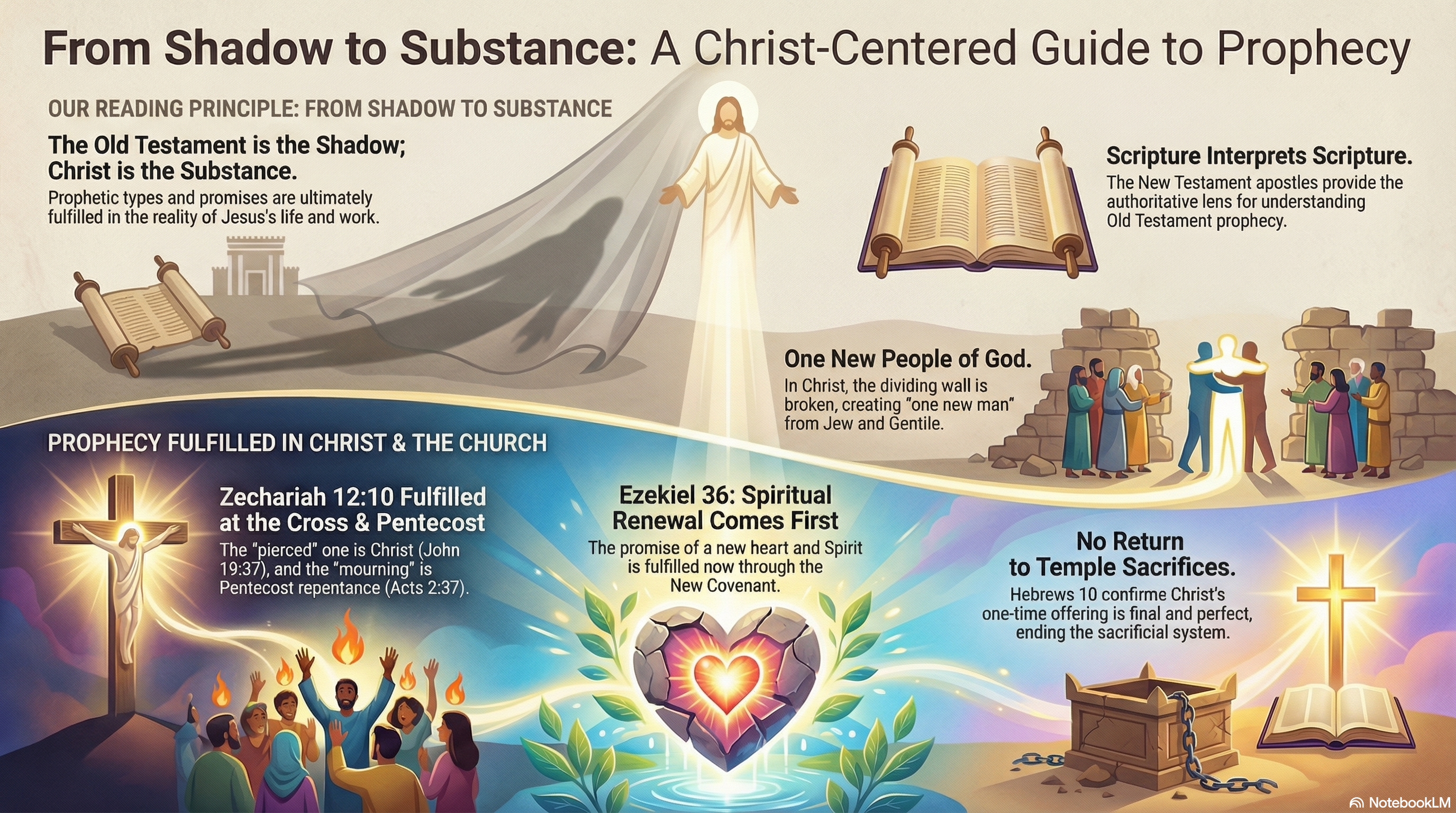
From Shadow to Substance: Reading Israel’s Prophecies in Light of Christ
“And he said unto them, These are the words which I spake unto you, while I was yet with you, that all things must be fulfilled, which were written in the law of Moses, and in the prophets, and in the psalms, concerning me.” (, KJV) “For all the promises of God in him are yea, and in him Amen, unto the glory of God by us.” (, KJV)
Thesis
The promises God made to Israel are not canceled, postponed, or reassigned. They are kept — in Christ. The apostles’ own rule for reading the prophets is that promise moves from shadow to substance in Him, and that in the new covenant God makes of Jew and Gentile “one new man… in one body by the cross” (). This essay applies that rule to three passages most often claimed for a separate future national program — , Ezekiel 36–37, and Zechariah 14 — and shows that in each case the New Testament locates the fulfillment in the cross, Pentecost, and the church, with consummation still to come at Christ’s appearing. Nothing promised is lost in this reading. Everything promised is enlarged.
How We Read
The method is the apostles’ own, stated fully in Apostolic Hermeneutic and applied case by case in Exegesis First. In brief:
- Scripture interprets Scripture; the clear governs the hard. The Spirit teaches by “comparing spiritual things with spiritual” (, KJV), and the workman is to be “rightly dividing the word of truth” (, KJV).
- Shadow gives way to substance. “Which are a shadow of things to come; but the body is of Christ.” (, KJV)
- One covenant of grace, now in new-covenant clarity and power. “I will put my law in their inward parts, and write it in their hearts… for I will forgive their iniquity, and I will remember their sin no more.” (, KJV)
- One new people. “For he is our peace, who hath made both one… for to make in himself of twain one new man, so making peace; And that he might reconcile both unto God in one body by the cross.” (, KJV)
The question for every prophecy of Israel’s restoration is therefore not whether God keeps it — He does — but where the New Testament says He keeps it.
Case Study 1 — : Pierced, Mourned, Preached at Pentecost
“And I will pour upon the house of David, and upon the inhabitants of Jerusalem, the spirit of grace and of supplications: and they shall look upon me whom they have pierced, and they shall mourn for him, as one mourneth for his only son, and shall be in bitterness for him, as one that is in bitterness for his firstborn.” (, KJV)
The prophecy contains three elements: an outpoured spirit of grace, a pierced One who is somehow the LORD Himself (“look upon me”) and yet distinct (“mourn for him”), and a mourning that turns toward God rather than away from Him. The New Testament identifies all three.
John applies the piercing directly to the crucifixion:
“And again another scripture saith, They shall look on him whom they pierced.” (, KJV)
And Peter’s Pentecost sermon supplies the looking and the mourning. He confronts the very generation that pierced Him:
“Therefore let all the house of Israel know assuredly, that God hath made that same Jesus, whom ye have crucified, both Lord and Christ.” (, KJV) “Now when they heard this, they were pricked in their heart, and said unto Peter and to the rest of the apostles, Men and brethren, what shall we do?” (, KJV) “Then they that gladly received his word were baptized: and the same day there were added unto them about three thousand souls.” (, KJV)
Here is the spirit of grace and supplications poured on the house of David and the inhabitants of Jerusalem: conviction, mourning, repentance, and baptism — three thousand souls in a day. The prophecy’s decisive realization is the cross and the Spirit’s outpouring, not a postponed temple regime.
Yet the fulfillment is inaugurated, not exhausted. Revelation takes up the same text with a future-facing horizon:
“Behold, he cometh with clouds; and every eye shall see him, and they also which pierced him: and all kindreds of the earth shall wail because of him. Even so, Amen.” (, KJV)
The looking-and-mourning begins at the cross and Pentecost and is consummated at His coming, when every eye shall see Him. This is the ordinary shape of prophetic fulfillment in the New Testament: already inaugurated, not yet consummated — and at no point routed through a restored national cultus.
Case Study 2 — Ezekiel 36–37: Gathering, Cleansing, New Heart, Spirit
“For I will take you from among the heathen, and gather you out of all countries, and will bring you into your own land. Then will I sprinkle clean water upon you, and ye shall be clean: from all your filthiness, and from all your idols, will I cleanse you. A new heart also will I give you, and a new spirit will I put within you: and I will take away the stony heart out of your flesh, and I will give you an heart of flesh. And I will put my spirit within you, and cause you to walk in my statutes, and ye shall keep my judgments, and do them.” (, KJV)
Read the order honestly
In Ezekiel’s own sequence, God first promises to gather Israel “into your own land” (36:24), and then to cleanse them, give the new heart, and put His Spirit within them (36:25–27). An honest reading concedes that order rather than rearranging it. To exiles in Babylon, the promise meant exactly what it said: return from captivity, then covenant renewal. The post-exilic return under Zerubbabel and Ezra began that restoration in history.
But the decisive question is not the sequence; it is the substance. Where does the New Testament locate the fulfillment of the cleansing, the new heart, and the indwelling Spirit? At the cross and at Pentecost:
“Let us draw near with a true heart in full assurance of faith, having our hearts sprinkled from an evil conscience, and our bodies washed with pure water.” (, KJV) “And when he had said this, he breathed on them, and saith unto them, Receive ye the Holy Ghost:” (, KJV) “Therefore being by the right hand of God exalted, and having received of the Father the promise of the Holy Ghost, he hath shed forth this, which ye now see and hear.” (, KJV)
Hebrews echoes Ezekiel’s sprinkling; the risen Christ breathes the Spirit on His disciples; Peter declares the last-days outpouring present (). The new-covenant heart of the promise is at work now in Christ’s church.
Dry bones and the one Shepherd
Ezekiel 37’s valley of dry bones pictures this same Spirit-wrought resurrection life — “And shall put my spirit in you, and ye shall live” (, KJV) — and the vision resolves into a united people under a single Davidic king:
“And David my servant shall be king over them; and they all shall have one shepherd…” (, KJV)
Jesus claims that role in terms that widen the flock:
“And other sheep I have, which are not of this fold: them also I must bring, and they shall hear my voice; and there shall be one fold, and one shepherd.” (, KJV)
The one Shepherd of Ezekiel 37 gathers not a re-partitioned nation but one fold of Jew and Gentile together — precisely Paul’s “one new man” ().
Land and dwelling: where the substance lands
What of the land itself? Ezekiel’s vision climaxes not in geography but in presence:
“Moreover I will make a covenant of peace with them; it shall be an everlasting covenant with them: and I will place them, and multiply them, and will set my sanctuary in the midst of them for evermore. My tabernacle also shall be with them: yea, I will be their God, and they shall be my people.” (, KJV)
Paul quotes that very promise of the indwelt sanctuary and locates it in the church: “for ye are the temple of the living God; as God hath said, I will dwell in them, and walk in them; and I will be their God, and they shall be my people” (, KJV). The church is “builded together for an habitation of God through the Spirit” (, KJV). And the inheritance does not shrink to a strip of the eastern Mediterranean; it enlarges to what the land always typified — “the promise, that he should be the heir of the world” (, KJV) — consummated when “the tabernacle of God is with men, and he will dwell with them” (, KJV). Union with Christ is where the dwelling-promise finds its substance now; the new creation is where it finds its substance forever.
Case Study 3 — Zechariah 14: The Day of the LORD, the Living Waters, and the Feast
Zechariah 14 is the passage most often quoted against the covenantal reading, so it deserves a positive reading, not merely a denial. Taken on its own terms, the chapter is a day-of-the-LORD oracle, and it preaches Christ.
The Lord comes to His mountain
“And his feet shall stand in that day upon the mount of Olives, which is before Jerusalem on the east, and the mount of Olives shall cleave in the midst thereof toward the east and toward the west, and there shall be a very great valley…” (, KJV)
The imagery belongs to a recognized prophetic genre. When the LORD comes down in judgment and deliverance, the mountains themselves give way before Him:
“For, behold, the LORD cometh forth out of his place, and will come down, and tread upon the high places of the earth. And the mountains shall be molten under him, and the valleys shall be cleft, as wax before the fire…” (, KJV)
Micah’s oracle was fulfilled in the historical judgments on Samaria and Jerusalem — no one waits for literal wax mountains. Day-of-the-LORD geography serves theophany: the point is that God Himself arrives to judge His enemies and open a way of escape for His people (). Read in that genre, Zechariah 14 announces the LORD’s own coming in judgment and salvation — which the New Testament identifies with the comings of Christ, first in humiliation and judgment on the old order, finally in glory ().
Living waters from Jerusalem
“And it shall be in that day, that living waters shall go out from Jerusalem; half of them toward the former sea, and half of them toward the hinder sea: in summer and in winter shall it be.” (, KJV)
This is Ezekiel’s river from the sanctuary, flowing east to heal the sea so that “every thing shall live whither the river cometh” (, KJV). Jesus stands up on the last day of the feast of tabernacles — the very feast Zechariah 14 names — and claims the promise:
“In the last day, that great day of the feast, Jesus stood and cried, saying, If any man thirst, let him come unto me, and drink. He that believeth on me, as the scripture hath said, out of his belly shall flow rivers of living water. (But this spake he of the Spirit, which they that believe on him should receive: for the Holy Ghost was not yet given; because that Jesus was not yet glorified.)” (, KJV)
John tells us plainly what the living water is: the Spirit, given when Jesus was glorified. The water flows from the true temple — Christ’s risen body and, in Him, His church — out to the nations, and the picture is consummated in “a pure river of water of life, clear as crystal, proceeding out of the throne of God and of the Lamb,” with leaves “for the healing of the nations” (, KJV). From sanctuary, to Savior, to Spirit, to new creation: that is the canonical path of Zechariah’s river.
The nations keep the feast
“And it shall come to pass, that every one that is left of all the nations which came against Jerusalem shall even go up from year to year to worship the King, the LORD of hosts, and to keep the feast of tabernacles.” (, KJV)
Former enemies streaming up to worship the King — this is the prophetic picture of the ingathering of worshippers from all nations, the same hope as . And Jesus tells us how that worship is now rendered:
“Woman, believe me, the hour cometh, when ye shall neither in this mountain, nor yet at Jerusalem, worship the Father… But the hour cometh, and now is, when the true worshippers shall worship the Father in spirit and in truth: for the Father seeketh such to worship him.” (, KJV)
The nations do come to worship the King — “And the LORD shall be king over all the earth” (, KJV) — but they come by faith and the Spirit, not by annual pilgrimage to a geographic shrine. The chapter’s closing note, holiness inscribed on common pots and horse-bells (), points the same direction: the end of the sacred-common divide, everything holy to the LORD — the new-covenant world.
Where interpreters honestly divide
Reformed interpreters do not read every verse of Zechariah 14 identically. Some take the chapter primarily of the first advent and the gospel age; others take portions — especially the LORD’s coming with all His saints (14:5) — of the final advent, when the same feet-on-Olives imagery answers to : “this same Jesus… shall so come in like manner as ye have seen him go into heaven” (, KJV). That difference is a family discussion, and this essay does not need to settle it. The claim here is narrower and firmer: nothing in Zechariah 14 — on any of these readings — requires a twentieth-century nation-state, a rebuilt temple, or renewed sacrifices as a precondition of fulfillment. To insist on those is to import extra-biblical context into the text, which is the very eisegesis the apostolic method forbids.
No Return to the Shadows
One boundary marker governs all three case studies: whatever future consummation we await, it cannot include a return to sacrificial blood.
“For by one offering he hath perfected for ever them that are sanctified.” (, KJV) “Now where remission of these is, there is no more offering for sin.” (, KJV)
Any scheme that reintroduces altar blood — “memorial” or otherwise — contradicts the finality of the cross. The full argument from Hebrews 7–10, including why Ezekiel’s temple vision cannot be pressed into a literal re-sacralization of animal offerings, is made in Exegesis First and is not repeated here. It is enough to say: the New Covenant fulfills the types; we must not turn back to shadows.
A Pastoral Caution Against Contempt
Nothing in this essay licenses contempt for the Jewish people, and the church’s history of antisemitism is a sin to be repented of, not repeated. We must not speak in ways that blame “all Jews” for Christ’s death across all time; that is neither apostolic nor charitable. Peter addressed a particular audience — “whom ye have crucified” () — and in the same breath preached repentance, promise, and life to them: “For the promise is unto you, and to your children, and to all that are afar off, even as many as the Lord our God shall call” (, KJV). Thousands believed that day. The gospel obliterates boasting and prejudice alike:
“For there is no difference between the Jew and the Greek: for the same Lord over all is rich unto all that call upon him.” (, KJV)
Objections and Replies
Objection 1: “Ezekiel’s land promise is geographic, and it has never been fulfilled as stated. Only a future national restoration can keep God’s word.”
The objection understates what has happened and misreads where the promise goes. Historically, God did return Israel to the land after the exile, just as He returned them under Joshua, of whom Scripture says “there failed not ought of any good thing which the LORD had spoken unto the house of Israel; all came to pass” (, KJV). Canonically, Ezekiel’s own vision moves past geography to its climax: God’s sanctuary set in the midst of His people for evermore () — the promise Paul declares fulfilled in the church as the temple of the living God () and Revelation consummates in the new creation (). And the apostles read the inheritance as enlarged, not revoked: “heir of the world” (, KJV); “a better country, that is, an heavenly” () — a reading Hebrews attributes to Abraham himself, who dwelt “in the land of promise, as in a strange country” (, KJV), still seeking the city while standing on the soil. Paul even quotes the fifth commandment’s land clause to Gentile children in Ephesus as “that it may be well with thee, and thou mayest live long on the earth” (, KJV) — Canaan’s promise, universalized to the earth, applied to Gentiles, by an apostle, in passing. And Ezekiel’s own land oracle already breaks the ethnic fence: the stranger “shall be unto you as born in the country,” and “they shall have inheritance with you among the tribes of Israel” (, KJV). A reading that keeps the acreage but misses the sanctuary keeps the shadow and misses the substance.
Objection 2: “Zechariah 14’s geography is too specific to spiritualize — a named mountain that splits east to west. Specificity demands literalism.”
Specificity is a feature of the genre, not a hermeneutical trump card. Micah names the LORD treading on the high places while mountains melt like wax (); Habakkuk 3 and Psalm 18 describe theophanies with equally concrete geography; none of these requires a literal topographic event to be truly fulfilled. Moreover, the covenantal reading does not “spiritualize away” Zechariah 14 — it follows the chapter’s own contents to their stated New Testament destinations: the living waters to the Spirit (), the feast-keeping nations to worship in spirit and in truth (), the universal kingship to the enthroned Christ (; ). And as noted above, some Reformed interpreters do refer parts of the chapter to the final advent — a position fully compatible with everything argued here. What the text nowhere requires is the one thing the objection needs: a modern nation-state precondition.
Objection 3: “Romans 11 promises a future for ethnic Israel. Doesn’t this essay explain that away?”
No — Romans 11 is affirmed, not explained away. Paul teaches that Israel’s hardening is partial and purposeful, that natural branches can be grafted in again by faith, and that “all Israel shall be saved: as it is written, There shall come out of Sion the Deliverer, and shall turn away ungodliness from Jacob” — for “the gifts and calling of God are without repentance” (, KJV). As I read it, “all Israel” names the Israel of God — the whole elect, gathered in the manner Paul has just traced — for “they are not all Israel, which are of Israel” (): the term was never finally about bloodline. Other Reformed interpreters expect a large ingathering of Jewish people, and that hope is welcome. On either reading, Paul locates every promised mercy within the one olive tree: the same root, the same Redeemer, the same condition of faith, the same grafting (). What Romans 11 promises is salvation in Christ, not a separate national program alongside the church. This is the same conclusion argued at length in From Dispensationalism to Classic Reformed Covenant Theology and God’s Chosen People: Election, Not Race.
Objection 4: “This is replacement theology — the church stealing Israel’s promises.”
The charge inverts the claim. Nothing is taken from Israel; everything promised to Israel is given — in Israel’s Messiah. The church did not replace Israel; the church is Israel’s promises kept, gathered around Israel’s King, with believing Jews as the natural branches and believing Gentiles grafted in among them (). Paul commands the Gentile believer, “Boast not against the branches. But if thou boast, thou bearest not the root, but the root thee” (, KJV). Fulfillment is not replacement; it is the promise arriving. The alternative — a promise that bypasses the Messiah in whom all the promises are “yea, and… Amen” () — would be the real dispossession.
Reformed Note on Method
“The infallible rule of interpretation of Scripture is the Scripture itself: and therefore, when there is a question about the true and full sense of any Scripture… it must be searched and known by other places that speak more clearly” (WCF 1.9). This essay has done nothing other than apply that rule: Zechariah 12 searched by John 19, Acts 2, and Revelation 1; Ezekiel 36–37 by Hebrews 10, John 20, Acts 2, John 10, and 2 Corinthians 6; Zechariah 14 by John 4, John 7, and Revelation 22. The apostles’ use of the Old Testament is not one interpretive option among several; it is inspired interpretation, and therefore normative for the church. Where their readings and a modern prophetic system conflict, the system must yield.
Conclusion
Read Israel’s prophecies the way the apostles read them, and the result is not loss but wonder. The pierced One has been looked upon, and the mourning has already turned three thousand hearts in a single day. The clean water has been sprinkled, the stony heart exchanged, the Spirit poured out. The living waters are flowing from the true temple to the ends of the earth, and the nations are keeping the feast — worshipping the King in spirit and in truth. And the same Jesus will come again, every eye shall see Him, and the tabernacle of God will be with men.
If your hope has been anchored to headlines — to borders, treaties, and building projects — let it be re-anchored to the Savior who already reigns. Nothing in the prophets is waiting on a government. Everything in the prophets was waiting on Christ, and He has come, and He will come. Hold fast the sufficiency of His cross and the clarity of His covenant, and walk in the ordinary means of grace — Word, prayer, Lord’s Day worship, sacraments — until faith gives way to sight. “Even so, come, Lord Jesus.” (, KJV)
The next essay in the walkthrough turns from reading prophecy to reading providence: The Two Books: Reading Scripture and Creation Together — how the same exegesis-first discipline governs the relationship between Scripture and God’s other book, creation.
Suggested Next Steps
- Read the three fulfillment chains in one sitting, KJV: → → → ; → → → ; → → → . Watch the shadow give way to substance in each.
- Revisit Exegesis First for the Hebrews 7–10 argument that closes the sacrificial economy, and Apostolic Hermeneutic for the full statement of the method.
- Read Romans 11 whole, noting every occurrence of the one tree, the one root, and the condition of faith — and pray earnestly for the salvation of Israel, as Paul did ().
- Continue the walkthrough with The Two Books: Reading Scripture and Creation Together.
Essay Video
From Shadow to Substance: Reading Israel’s Prophecies in Light of Christ
Audio Discussion
From Shadow to Substance: Reading Israel’s Prophecies in Light of Christ
Infographic
From Shadow to Substance: Reading Israel’s Prophecies in Light of Christ