Essay
From Dispensationalism to Reformed Covenant Theology: A Biblical Pathway
"And if ye be Christ's, then are ye Abraham's seed, and heirs according to the promise." (, KJV) "In that he saith, A new covenant, he hath made the first old. Now that which decayeth and waxeth old is ready to vanish away." (, KJV)
Thesis
Claim. Covenant Theology, in the Westminster sense, confesses one Covenant of Grace throughout redemptive history, "differently administered" under the law (by promises, sacrifices, circumcision, and other ordinances foreshadowing Christ) and under the gospel (in Word and sacraments), all centering on Christ (WCF 7.5–6).
Method. Read the Old Testament through the apostles' Christ-centered lens: let shadow → substance govern (temple, priesthood, sacrifice) and recognize that ceremonial laws are now abrogated while the moral law abides (WCF 19.3–5; Hebrews 8–10).
Payoff. The promises to Abraham reach their fulfillment in Christ and His body; the visible church under the gospel consists of professors and their children; baptism admits both believers and the infants of one or both believing parents; and we await one climactic appearing of Christ — not a return to temple blood (WCF 28; 32–33; ).
1) Dispensationalism: What I Appreciate (and Where I Have Come to Differ)
Before I begin, a word of honor. Many of us learned to love the Bible, long for Christ's appearing, and evangelize boldly because of Dispensational teachers and churches. That gratitude remains.
Shared strengths we affirm
- A high view of Scripture's authority and inerrancy.
- Careful grammatical-historical exegesis and attention to authorial intent.
- Confidence that God keeps His promises; seriousness about prophecy.
- Evangelistic urgency and watchful hope for Christ's return.
A spectrum worth recognizing. Classical → Revised → Progressive. This essay interacts mainly with progressive Dispensationalism as the strongest contemporary form. I appreciate its already/not-yet instincts and its effort to take New Testament fulfillment seriously. My difference is that the apostles' own use of the Old Testament takes us further — from shadow to substance in Christ — without requiring renewed temple sacrifices or a separate geopolitical program for Israel.
Where Covenant Theology overlaps, and where it differs
- Overlap: We share grammatical-historical method, original audience context, and progressive revelation.
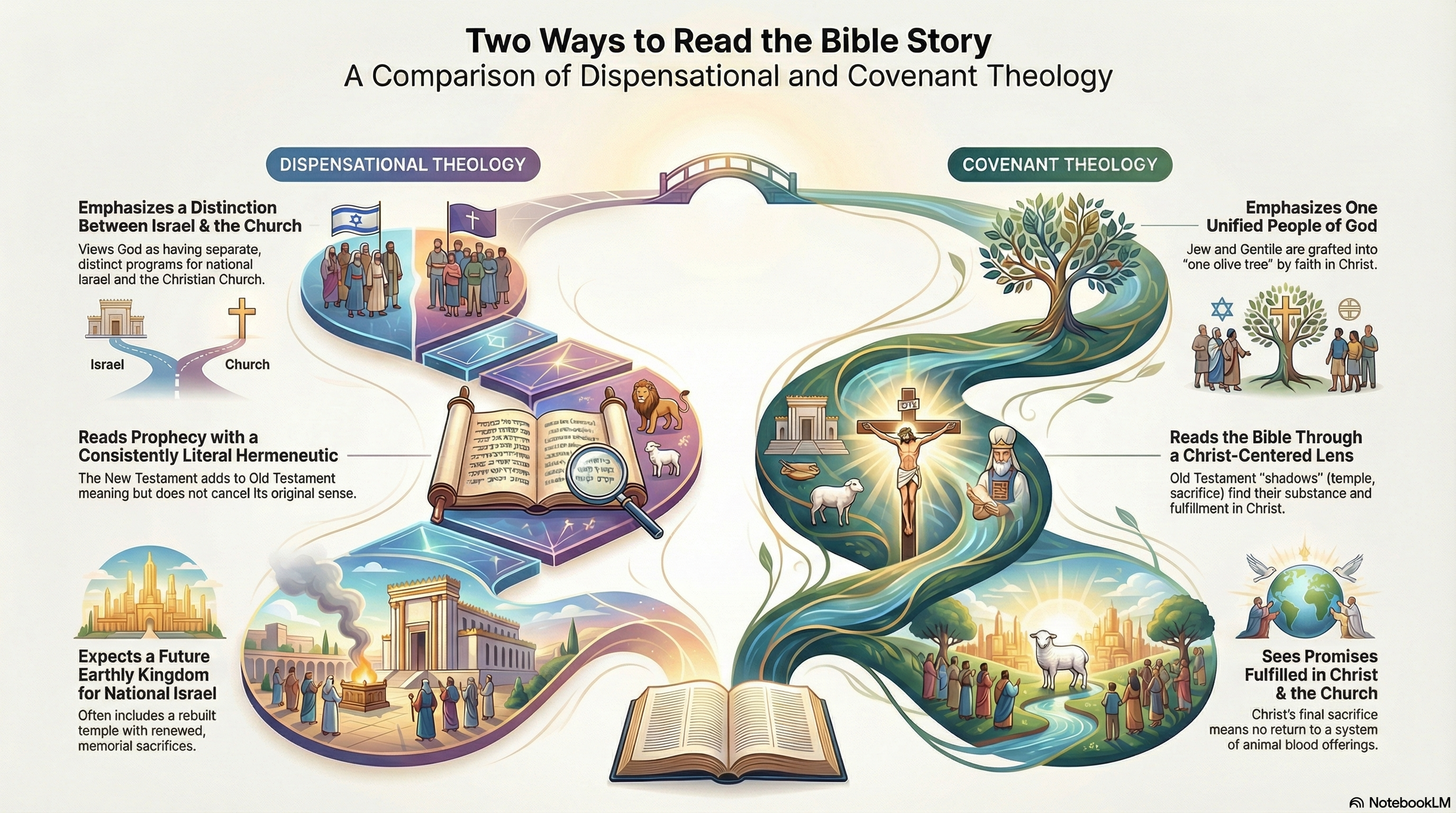
- Difference: We follow the New Testament's Christ-centered reading of the Old Testament such that inspired, canonical fulfillment enlarges earlier horizons without contradicting them (shadow → substance). This is typology, not free allegory.
Bottom line: I aim for maximum fairness to Dispensationalism while arguing that the apostolic, Christ-centered reading best explains the whole canon.
2) How We Read: A Christ-Centered Hermeneutic
"And beginning at Moses and all the prophets, he expounded unto them in all the scriptures the things concerning himself." (, KJV) "For the law having a shadow of good things to come, and not the very image of the things, can never with those sacrifices which they offered year by year continually make the comers thereunto perfect." (, KJV)
Dispensationalism prioritizes grammatical-historical exegesis — an important strength for objectivity. Progressive Dispensationalism often speaks of complementary hermeneutics (Craig Blaising and Darrell Bock): the New Testament adds further, non-contradictory meaning that preserves the Old Testament's original sense. In fairness, progressive Dispensationalism already concedes several of the points argued below — an already/not-yet inaugurated kingdom and one people of salvation across the ages — so the case studies that follow press hardest on the classic and revised forms most common in popular teaching, while the remaining disagreement, a distinct national program for Israel, is addressed where it arises.
Covenant Theology agrees on context, genre, and authorial intent, but insists on the apostolic pattern: the New Testament reads the Old Testament through Jesus Christ, treating Old Testament realities as types fulfilled by Him.
Typology vs. allegory (clear definitions).
- Typology recognizes God-designed correspondences from Old Testament persons, institutions, and events (shadows) to their New Testament fulfillments in Jesus Christ (substance). It builds on literal history.
- Allegory, strictly, reads beyond the text without firm canonical controls; the New Testament authors do typology, not free allegory. ( uses "allegory" in KJV for a Spirit-guided, canonical use.)
Criteria we will use when reading Old Testament through the New Testament:
- Explicit New Testament fulfillment or reshape signals — for example, Acts 2 for Joel 2; using ; Hebrews 8–10 on priesthood, temple, sacrifice.
- Shadow → Substance logic (; ; 10:1): the greater reality in Jesus Christ reframes the lesser without denying its historicity.
- Temple, Land, People re-signification: Jesus Christ as true temple (), the Spirit-indwelt people as temple (), Abraham's inheritance expanded ().
Bottom line: The New Testament provides the key to the Old Testament, and that key is Jesus Christ. All the promises are "Yea" and "Amen" in Him (). For a fuller treatment of the apostolic reading method with detailed case studies, see the Apostolic Hermeneutic and Exegesis First essays in the Reading Scripture section; for the specific pattern of shadow-to-substance fulfillment, see Shadow to Substance.
3) Exegetical Case Studies
3.1 — Kingdom Nature and Timing
"Lord, wilt thou at this time restore again the kingdom to Israel? … But ye shall receive power, after that the Holy Ghost is come upon you: and ye shall be witnesses unto me both in Jerusalem, and in all Judaea, and in Samaria, and unto the uttermost part of the earth." (, KJV)
- The disciples ask about timing and a national restoration. Jesus redirects to mission and Spirit-power. He neither scolds their hope nor affirms a geopolitical program; He reframes kingship as the Spirit-driven advance of the gospel (see also ; ).
- Luke's narrative shows the kingdom going outward ( → Acts 28), not backward to a temple regime.
Bottom line: Jesus crowns the kingdom's present, missionary advance rather than mapping a return to sacrificial worship.
3.2 — "All Israel" and the Olive Tree
"Blindness in part is happened to Israel, until the fulness of the Gentiles be come in. And so all Israel shall be saved: as it is written, There shall come out of Sion the Deliverer, and shall turn away ungodliness from Jacob." (, KJV)
- Mystērion = revealed plan: the hardening is partial and temporary.
- already guards the category: "they are not all Israel, which are of Israel," so the promise cannot be reduced to bare ethnicity.
- Houtōs ("and so / in this manner"): salvation comes in the manner Paul has argued — grafting by faith into the one olive tree (), not by ethnicity.
- "And they also, if they abide not still in unbelief, shall be grafted in" (, KJV). Future Jewish inclusion is real and welcomed, by grace through faith in Jesus Christ, within the one people of God.
- keeps the argument covenantal: God's gifts and calling are irrevocable, yet the mercy promised comes through Christ into the same olive tree, not along a parallel covenant path.
Bottom line: "All Israel" is fulfilled as Jewish people (at any point God pleases) are grafted into the one covenant community by faith, alongside Gentiles — one tree, one Savior. For an extended treatment of election, covenant identity, and the olive-tree argument, see God's Chosen People: Election, Not Race in the Covenant Theology section.
3.3 Ezekiel 40–48 and Hebrews 8–10 — The Sacrifice Question
"For the priesthood being changed, there is made of necessity a change also of the law." (, KJV) "In that he saith, A new covenant, he hath made the first old." (, KJV) "Now where remission of these is, there is no more offering for sin." (, KJV)
- Some Dispensationalists read Ezekiel's temple literally, with memorial sacrifices. Covenant Theology notes that Hebrews joins three claims: the priesthood has changed (), the former covenant is obsolete (), and Christ's sacrifice is once for all (). Even "memorial blood" sits uneasily with an argument that says the former order is old and that no further offerings remain.
- Christ Himself instituted the remembrance ordinance — bread and wine (; ). Returning to animal blood, even ceremonially, functionally undermines the sufficiency of the cross.
- Ethical coherence: In the age of renewed creation, must worship involve renewed animal death? Before the cross, animal death pointed forward to the Innocent One. After the cross, the substance has come.
Bottom line: Hebrews closes the sacrificial system. The temple and altar language is fulfilled in Jesus Christ and His church, not in a reinstated blood economy. For more on the once-for-all sacrifice and the cessation of shadows, see Covenant Theology and the End Times in the Creation and Last Things section.
3.4 — A Brief Word
"Seventy weeks are determined upon thy people and upon thy holy city, to finish the transgression, and to make an end of sins, and to make reconciliation for iniquity, and to bring in everlasting righteousness, and to seal up the vision and prophecy, and to anoint the most Holy." (, KJV)
- The six purposes listed — finishing transgression, ending sins, making reconciliation, bringing everlasting righteousness, sealing prophecy, and anointing the Most Holy — read as a summary of Messiah's atoning work, not a future geopolitical program.
- Covenant Theology readings see the seventy weeks climaxing in that work, with the "decreed end" falling on the desolator without requiring an isolated, future seventieth week after a long gap.
- However one reads the details, Covenant Theology does not require a rebuilt sacrificial system to make sense of New Testament eschatology.
Bottom line: The center of Daniel's timeline is Christ's atoning work, not a future return to temple sacrifices. For a fuller guide to the interpretive options, see Appendix B (Daniel 9 Mini-Guide) below.
4) One People of God: Grafted into One Olive Tree
"Now therefore ye are no more strangers and foreigners, but fellowcitizens with the saints, and of the household of God." (, KJV) "But ye are a chosen generation, a royal priesthood, an holy nation, a peculiar people … Which in time past were not a people, but are now the people of God." (, KJV)
One church, many nations. In Christ, Jew and Gentile are made one new man and gathered into a single "household of God" (). Peter applies Israel's covenant titles to the multi-ethnic church (). This matches the Westminster Confession's teaching that Christ has one catholic (universal) church under Him as Head (WCF 25).
"And if some of the branches be broken off, and thou, being a wild olive tree, wert graffed in among them, and with them partakest of the root and fatness of the olive tree." (, KJV)
Olive-tree logic. Paul pictures one root, one tree: unbelieving branches are cut off; believing Jews and Gentiles are grafted in by faith. Future Jewish mercy comes this same way — through union with the Redeemer — not by a separate redemptive track.
The visible church (Westminster). According to the Confession, the visible church "consists of all those throughout the world that profess the true religion, together with their children" (WCF 25.2). This summarizes how God ordinarily marks out His people in history.
"And I will establish my covenant between me and thee and thy seed after thee in their generations for an everlasting covenant." (, KJV) "And he received the sign of circumcision, a seal of the righteousness of the faith." (, KJV) "For the promise is unto you, and to your children, and to all that are afar off, even as many as the Lord our God shall call." (, KJV)
Membership and signs. Because God gathers a visible people by profession and their children, and because the Abrahamic sign-seal pattern is carried forward and fulfilled in Christ, baptism is to be administered to believers and to the infants of one or both believing parents (WCF 28; WLC 166). The Supper then nourishes baptized communicants who "examine" themselves (). For the full biblical case on baptism, the Table, and covenant membership, see Westminster Covenant Theology: Covenants, Baptism, and the Table in the Church and Christian Life section.
Bottom line. Scripture and the Westminster standards speak with one voice: one Redeemer, one olive tree, one household — a visible church made up of professors and their children, gathered from every nation, with salvation received the same way for all: by grace through faith in Jesus Christ.
5) Covenants: One Covenant of Grace — Administered Under Law and Gospel
"And if ye be Christ's, then are ye Abraham's seed, and heirs according to the promise." (, KJV)
Definition (Westminster). Scripture reveals one Covenant of Grace through all ages, "differently administered" before and after Christ's coming. Under the law it was administered by promises, prophecies, sacrifices, circumcision, the Passover, and other ordinances that foreshadowed Christ; under the gospel it is administered with greater simplicity and fullness in Word and sacraments (WCF 7.5–6).
What matters here. Abraham, Moses, and the New Covenant are not rival ways of salvation. They are administrations of one gracious covenant centered on Christ. That means the land promise is historically kept and eschatologically enlarged, the temple is fulfilled in Christ and His church, and the sacrificial system is finished at the cross.
How the administration changes. Under the law, the covenant was sealed by circumcision — a sign applied to Abraham and his household, marking them as God's people (). Under the gospel, baptism succeeds circumcision as the covenant sign and seal (; ), applied to believers and their children on the same household principle (; ). Likewise, the Passover lamb — eaten by households on the night of deliverance (Exodus 12) — gives way to the Lord's Supper, where Christ our Passover is remembered in bread and wine (; 11:23–26). The signs change; the substance — Christ and His grace — remains.
Bottom line (Westminster). One gracious covenant, many administrations. The Old Testament truly administered saving grace in shadow; the New Testament administers it in fullness.
6) Kingdom and Mission: The Now of Jesus' Reign
"Who hath delivered us from the power of darkness, and hath translated us into the kingdom of his dear Son." (, KJV) "My kingdom is not of this world … but now is my kingdom not from hence." (, KJV) "But ye are come unto mount Sion, and unto the city of the living God, the heavenly Jerusalem … and to Jesus the mediator of the new covenant." (, KJV)
Kingdom now, mission now. Christ's reign is present and heavenly in source; He advances it by His Spirit through the church's witness "unto the uttermost part of the earth" (, KJV). The Westminster Confession says Christ has given to His church "the ministry, oracles, and ordinances of God, for the gathering and perfecting of the saints … unto the end of the world" (WCF 25.3).
Word, sacraments, prayer — according to God's rule. Worship is only as God appoints; we are not to invent or add to His ordinances (the regulative principle, WCF 21.1). Under the gospel this ministry is carried on with "more simplicity, and less outward glory," yet with greater efficacy, by Word and sacraments (WCF 25.3).
Law and Lord's Day. The moral law abides as a rule of life; the ceremonial laws are "now abrogated," and the judicial laws expired, except for their general equity (WCF 19.3–5). The Sabbath command stands morally, and by Christ's resurrection the day has been changed to the first day of the week, the Lord's Day, to be kept holy in public and private worship "till the end of the world" (WCF 21.7–8; cf. , KJV).
Bottom line. Christ reigns now; His church carries the gospel to the nations by the means He ordained, worships as He commands, delights in His Day, and walks by His moral law — until He returns in glory. For more on the present reign and its eschatological consummation, see Covenant Theology and the End Times and the Rapture and the Day of the Lord essays in the Creation and Last Things section.
7) Eschatology: Clarity with Charity
"But, beloved, be not ignorant of this one thing, that one day is with the Lord as a thousand years, and a thousand years as one day." (, KJV) "For the Lord himself shall descend from heaven with a shout, with the voice of the archangel, and with the trump of God: and the dead in Christ shall rise first: Then we which are alive and remain shall be caught up together with them in the clouds, to meet the Lord in the air: and so shall we ever be with the Lord." (, KJV) "But of that day and hour knoweth no man, no, not the angels of heaven, but my Father only." (, KJV)
We confess one climactic appearing of Christ, with a general resurrection and last judgment. Westminster summarizes: the righteous and wicked shall be raised (WCF 32) and "God hath appointed a day, wherein he will judge the world, in righteousness, by Jesus Christ" (WCF 33).
Amillennial frame. Reading apocalyptic numbers symbolically, the Church has long understood the "thousand years" as the present gospel age of Christ's reign, to be consummated at His return (no interposed earthly kingdom required). Augustine's City of God (Book 20) shaped this mainstream reading, and the Reformers largely continued it. This amillennial framing is compatible with Westminster, though not mandated by it.
Watchfulness, not date-setting. Because the day is unknown, Scripture binds us to sobriety, prayer, and mission — never speculation (; ).
7.1 The Rapture: One Appearing, Not Two
"… the dead in Christ shall rise first: Then we which are alive and remain shall be caught up together with them in the clouds, to meet the Lord in the air: and so shall we ever be with the Lord." (, KJV)
We gladly affirm the rapture — the catching up of the saints — but as part of one public, royal appearing of Christ, not a separate secret event. The New Testament's "meeting" imagery coheres with texts where people go out to meet a coming king and accompany him (cf. ; ).
About . Pre-tribulational writers take "I … will keep thee from the hour of temptation" to imply removal (tēreō ek), while others note uses the same construction for guarding in the midst of evil ("keep them from the evil"). The grammar does not require a two-stage return; Revelation's pastoral thrust is perseverance.
Confessional fit. This single-appearing, single-judgment pattern accords with WCF 32–33: one resurrection, one last day, one public judgment by the Lord Jesus.
Bottom line. Christ reigns now and will visibly return once to raise, judge, and renew. Our task is steadfast faith and witness until that day (; ). For a detailed exegesis of the rapture passages and the Day of the Lord, see The Rapture and the Day of the Lord in the Creation and Last Things section.
7.2 The Millennium: Christ's Present Reign
Revelation 20's "thousand years" is symbolic for the church age — Christ's present reign from His ascension until His return. Numbers in apocalyptic literature often symbolize completeness rather than literal counts (see ). During this period, Satan is bound from deceiving the nations (missionary expansion), saints reign with Christ in heaven, and the gospel spreads to all peoples.
Bottom line: We live in the "millennium" now. The final judgment and resurrection occur when Christ returns; no earthly-reign "gap" is needed. For a full treatment of Revelation 20 and the symbolic-reign reading, see Revelation 20 and the Millennium in the Creation and Last Things section.
7.3 Israel in the Last Days: Fulfilled and Enlarged
Dispensationalism often expects a future earthly kingdom centered on national Israel, with a rebuilt temple and renewed sacrifices. Covenant Theology affirms God's irrevocable call (), but understands the promises as fulfilled in Christ and extended to all who believe, Jewish or Gentile (; ).
The "salvation of all Israel" () happens through faith in Messiah, as Jews are grafted back into the one olive tree (). The temple is now Christ () and His people (). , and 10:18 leave no room for a return to animal blood, even as memorial, because the priesthood has changed, the former order is old, and the once-for-all sacrifice is complete.
Important Note: This argument explicitly rejects any form of antisemitism. I pray for and welcome Jewish faith in Jesus as Messiah and honor the Jewish roots of the gospel (; 11:18–24).
Bottom line: God's promises to Israel are not abandoned — they are gloriously kept in Christ, the true Seed of Abraham, and shared with all who are His.
7.4 The Modern State of Israel: Providence, Not Prophetic Fulfillment
"For I will take you from among the heathen, and gather you out of all countries, and will bring you into your own land. Then will I sprinkle clean water upon you, and ye shall be clean … A new heart also will I give you, and a new spirit will I put within you." (, KJV)
Dispensationalism often points to the 1948 establishment of modern Israel as a literal fulfillment of Old Testament prophecies like the "dry bones" vision (), a second regathering (), or an unbreakable planting in the land (). This is seen as evidence of God's distinct program for ethnic Israel, signaling the nearness of end-times events.
Covenant Theology appreciates God's providential hand in history, including the return of Jewish people to their ancestral land after centuries of diaspora and suffering. Yet we argue that these events, while remarkable, do not constitute the biblical fulfillment of restoration promises. Scripture ties regathering inextricably to spiritual renewal through the Messiah — a heart transformation under the New Covenant, not a geopolitical return in unbelief.
- Contextual unity in Ezekiel 36–37: The physical regathering (; 37:21) is followed immediately by spiritual cleansing, a new heart, and the indwelling Spirit (), echoing . This is fulfilled in Christ's atonement and Pentecost (; ), where Jews and Gentiles receive new life by faith.
- New Testament reframing: The apostles apply restoration language to the church's ingathering (, citing as fulfilled in the Gentile mission; , applying Hosea 1–2 to believers). True Israel is defined by promise and faith, not ethnicity (; ).
- Enlargement to the new creation: Promises of land and security (; ) were historically fulfilled under Joshua () and are eschatologically expanded in Christ to a "better country" (), the renewed heavens and earth (), not a modern nation-state.
- Caution against headline exegesis: While 1948 may reflect God's common grace and care for the Jewish people (), tying it to prophecy risks misinterpretation, as the modern state remains largely secular and without Messianic recognition (contrast ). Future Jewish inclusion comes by faith in Christ (), within the one people of God.
Bottom line: Old Testament regathering prophecies find their substance in Christ's spiritual restoration of believers, Jewish and Gentile, into His kingdom — not in a physical return apart from faith. God's providence in history magnifies His faithfulness, but fulfillment remains Christ-centered. For a fuller examination of how Old Testament land, city, and temple promises find their New-Covenant fulfillment, see Jerusalem Fulfilled in Christ in the Creation and Last Things section.
8) What This Essay Is Not Claiming
- That Jewish people are "replaced." I affirm future Jewish inclusion by faith within the one olive tree.
- That the Old Testament meant nothing to its first hearers. I affirm original context and then apostolic expansion in Christ.
- That genre or prophecy is never literal. I affirm literal history with canonical typological fulfillment.
- That imminency is meaningless without a pre-tribulation rapture. I affirm biblical watchfulness because the day is unknown.
9) Objections and Replies
Objection 1: Covenant Theology erases ethnic promises.
Reply: No. In the Westminster frame there is one Covenant of Grace through all ages, administered under law and gospel; the promises are kept and enlarged in Christ and shared with all who believe, Jew and Gentile (Romans 11; Ephesians 2). WCF 7 says the covenant was truly present under the law by promises, sacrifices, and types, and now under the gospel in greater clarity and power.
Objection 2: "Israel of God" () is debated — you cannot rest a system on it.
Reply: Agreed. So we center unity on the clear one-people images: one olive tree (Romans 11), one household/temple (Ephesians 2), and the church bearing covenant titles (1 Peter 2). That is fully consonant with WCF's single gracious covenant across the canon.
Objection 3: Are Abraham and Moses really "administrations of the Covenant of Grace"?
Reply: Yes (Westminster). Under the law the covenant was administered by "promises, prophecies, sacrifices, circumcision, the paschal lamb, and other types and ordinances" that foreshadowed Christ and really conveyed grace by the Spirit to the elect; under the gospel the same covenant is administered with greater simplicity and fullness (WCF 7.5–6).
Objection 4: Why include believers' children in the visible church?
Reply: Because Westminster sees one covenant of grace administered across the canon, it keeps the covenant-household pattern under the gospel as well. That issue matters, but this essay treats it only in summary; the fuller argument belongs in the dedicated Westminster Covenant Theology: Covenants, Baptism, and the Table essay.
Objection 5: Do you deny a kingdom for Israel?
Reply: No. Christ is Israel's King; His kingdom is present now and will be consummated at His appearing. What Westminster denies is any return to abrogated ceremonies (temple blood, etc.), since the old administration's types are fulfilled and ceased in Christ (WCF 7; 19; 27–29; Hebrews 8–10).
Objection 6: Is Covenant Theology anti-literal?
Reply: No. It is historically literal and canonically governed: real history → real fulfillment in Christ, with shadows giving way to substance. That is exactly the Confession's "differently administered" covenantal logic.
Objection 7: — does "keep from" (tēreō ek) prove a pre-trib rapture?
Reply: Not necessarily. The same construction appears in ("keep them from the evil"), where it clearly means guard in the midst of, not remove out of. Classical commentators flag the parallel. This text does not require two distinct "second comings."
Objection 8: "Not appointed to wrath" () — does this prove pre-trib removal?
Reply: In context () "wrath" contrasts with final judgment at the Day of the Lord; the passage exhorts sober hope, not a timetable for a two-stage return.
Objection 9: Who is the "restrainer" in 2 Thessalonians 2?
Reply: It is debated. Serious proposals include the Holy Spirit, civil authority, an angelic agent (e.g., Michael), the proclaimed word, or God's decree. Colin Nicholl's monograph From Hope to Despair in Thessalonica (Cambridge University Press) defends the "Michael" view; the broader scholarly discussion acknowledges no consensus — so it is a weak pillar for constructing a pre-trib schema.
Objection 10: Do you call memorial sacrifices heresy?
Reply: We keep irenic language, but the theology matters: Hebrews concludes that, where remission is given through Christ, there is "no more offering for sin" (). Memorial blood sits poorly with that finality. The New Testament remembrance is the Lord's Supper — bread and wine (; ), not renewed animal blood.
10) A Note on History
- Dispensationalism as a full system was articulated in the nineteenth century (esp. J. N. Darby and the Plymouth Brethren); earlier Christians held various premillennial expectations, but not the modern Dispensational framework in full.
- Covenant Theology is a seventeenth-century systematization of strands long present in Christian reflection: one redemptive storyline culminating in Christ.
- Early witnesses to a robust Christ-centered reading include Irenaeus (Against Heresies 5.32–36), Justin Martyr (Dialogue with Trypho 80–81), and the Papias tradition reported by Eusebius (Ecclesiastical History 3.39). I cite them to show trajectory, not to elevate them over Scripture.
(Some readers do not weigh patristic evidence highly. That is fine — the case here stands on exegesis.)
11) Voices from the Journey
Personal stories can relieve the isolation some feel when reconsidering long-held views. These brief summaries are anecdotal; Scripture remains the final authority.
- John P. Davis, Th.M. (Westminster): While researching the Abrahamic covenant, he concluded that the promise flowers in Christ and unites one people by faith (). Gracious mentors pressed him to read Old Testament promises in light of the apostolic use of the Old Testament.
- Pastor formed by Master's-style Dispensationalism: After a 2017 Ligonier round-table and a close reading of , he embraced a historic, single-coming view and eventually ministered within a confessional Reformed framework.
- "TryingToLearn" (lay reader): After G. K. Beale and a fresh look at Romans 11, he came to see promises to ethnic Israel fulfilled in Christ and shared within the one olive tree.
Bottom line: Many who move toward Covenant Theology testify less to abandoning Scripture and more to seeing it with apostolic lenses — Christ at the center.
12) Conclusion: An Invitation to Continue the Journey
Covenant Theology seeks to let the New Testament teach us how to read the Old Testament. If the case here holds, then in Christ the shadows have found their substance: one people by faith, one covenantal storyline of grace, one blessed hope.
If you are processing these things:
- Read the passages in Appendix A: Biblical Verses Pathway below with a friend or elder.
- Bring your best objections; test everything by Scripture ().
- Ask the Lord for wisdom and unity in your local church.
"Even so, come, Lord Jesus." (, KJV)
13) Appendix A: Biblical Verses Pathway
A guided sequence of passages, organized thematically to demonstrate Covenant Theology. Use the questions to spark reflection or group discussion.
1. Christ-Centered Hermeneutics
(See ; ; ; ; with .) Question: How do the apostles treat Old Testament texts — as prediction, typology, or both — and what does that say about their hermeneutic?
2. Unity of God's People
(See ; ; ; .) Question: What word-pictures (olive tree, new temple, royal priesthood) communicate a single people of God?
3. Covenant Continuity
(See ; ; ; ; ; ; ; ; ; ; .) Question: How does Scripture portray earlier promises as fulfilled yet simultaneously enlarged in Christ?
Assurances of Fulfilled Promises to Abraham
These passages explicitly affirm that God kept all His promises to Abraham and Israel historically, providing rest, land possession, and prosperity under leaders like Joshua and Solomon — while setting the stage for ultimate enlargement in Christ:
- "And the LORD gave unto Israel all the land which he sware to give unto their fathers; and they possessed it, and dwelt therein. And the LORD gave them rest round about, according to all that he sware unto their fathers: and there stood not a man of all their enemies before them; the LORD delivered all their enemies into their hand. There failed not ought of any good thing which the LORD had spoken unto the house of Israel; all came to pass." (, KJV)
- "And, behold, this day I am going the way of all the earth: and ye know in all your hearts and in all your souls, that not one thing hath failed of all the good things which the LORD your God spake concerning you; all are come to pass unto you, and not one thing hath failed thereof." (, KJV)
- "Judah and Israel were many, as the sand which is by the sea in multitude, eating and drinking, and making merry. And Solomon reigned over all kingdoms from the river unto the land of the Philistines, and unto the border of Egypt." (, KJV)
- "Blessed be the LORD, that hath given rest unto his people Israel, according to all that he promised: there hath not failed one word of all his good promise, which he promised by the hand of Moses his servant." (, KJV)
- "Thou art the LORD the God, who didst choose Abram … and madest a covenant with him to give the land … to his seed, and hast performed thy words; for thou art righteous." (, KJV)
Reflection: These assurances show God's faithfulness in history (e.g., land from Egypt to Euphrates under Solomon), yet the New Testament enlarges them to a global inheritance through Christ (; ), not requiring a future geopolitical replay.
4. Kingdom Fulfillment
(See ; ; ; ; .) Question: In what sense is the kingdom "already" present and how does that shape mission?
5. Salvation of "All Israel"
(See ; ; ; .) Question: How does Paul define "Israel" within Romans 9–11, and what future hope remains for ethnic Jewish people?
6. Prophetic Typology
(See ; ; ; ; ; ; ; .) Question: Which temple-and-city images are literal, which are symbolic, and how does the New Testament signal the shift?
7. Eschatological Hope
(See ; ; ; ; ; ; ; .) Question: How do these passages balance imminent expectation with "already/not-yet" realities?
Progression tip: Work through the seven themes in order; each builds on the previous to form a cohesive biblical-theological argument.
14) Appendix B: — A Mini-Guide to the Debates
To help readers see why Covenant Theology centers this prophecy on Christ without requiring a future temple-sacrifice regime, here are the main questions and options:
- What is the overall scope? Messianic fulfillment now (many Reformed and amillennial readers) vs. primarily future national-Israel program (classic Dispensationalism). For a concise Reformed treatment, see Meredith G. Kline, "The Covenant of the Seventieth Week."
- Is there a "gap" between the sixty-ninth and seventieth week? No gap (continuous, climaxing in Messiah's ministry and the destruction of Jerusalem) vs. yes, a long inter-advent gap before a future seventieth week (a key Dispensational distinctive).
- Who is the "he" who confirms a covenant (verse 27)? Messiah confirming the New Covenant with "the many" (linked to the Lord's Supper language) vs. a future antichrist making a treaty.
- How do the New Testament writers lean? The New Testament consistently centers fulfillment language on Jesus Christ's once-for-all atonement and the New Covenant (Hebrews 8–10), which weighs against any necessity for renewed temple blood.
- So what? However you parse some details, Daniel 9 does not require a reinstated sacrificial system; the New Testament's hermeneutic resolves the shadows in Christ.
15) New Covenant Membership and Baptism
This essay has argued the covenantal framework; it does not need to re-argue the sacramental case at full length. In Westminster's language, the visible church includes those who profess the true religion together with their children, baptism is the sacrament of admission, and the Lord's Supper is for baptized communicants who can examine themselves. The fuller biblical case — Genesis 17, Romans 4, , Colossians 2, 1 Corinthians 7, and Table practice — is handled in the dedicated Westminster Covenant Theology: Covenants, Baptism, and the Table essay in the Church and Christian Life section.
Bottom line (Westminster). One gracious covenant, now administered in gospel clarity. The visible church embraces believers and their children; baptism marks entry; the Supper nourishes baptized communicants who discern the Lord's body.
Suggested Next Steps
- Read the Biblical Verses Pathway (Appendix A) with a friend, working through one theme per sitting with KJV open.
- Read WCF chapters 7, 19, 25, 28, and 32–33 alongside the Scripture proofs — these are the backbone of the covenantal framework.
- Continue through the Covenant Theology section of the roadmap: God's Chosen People, Theology Proper & Christology, Salvation Is of the LORD, Sovereign Grace and the Bond Will, and God Over All Things.
- For the eschatological case in detail, work through the Creation and Last Things section: Covenant Theology and the End Times, The Rapture and the Day of the Lord, The Olivet Discourse, Jerusalem Fulfilled in Christ, Gog and Magog, and Revelation 20.
- For baptism and the Table, see Westminster Covenant Theology: Covenants, Baptism, and the Table in Church and Christian Life.
- Test everything by Scripture (). Bring your best objections to an elder or pastor who holds to the Westminster Standards.
Essay Video
From Dispensationalism to Reformed Covenant Theology: A Biblical Pathway
Audio Discussion
From Dispensationalism to Reformed Covenant Theology: A Biblical Pathway
Infographic
From Dispensationalism to Reformed Covenant Theology: A Biblical Pathway