Essay
Westminster Covenant Theology: Covenants, Baptism, and the Table
“And I will establish my covenant between me and thee and thy seed after thee in their generations for an everlasting covenant, to be a God unto thee, and to thy seed after thee.” (, KJV)
“For the promise is unto you, and to your children, and to all that are afar off, even as many as the Lord our God shall call.” (, KJV)
Thesis
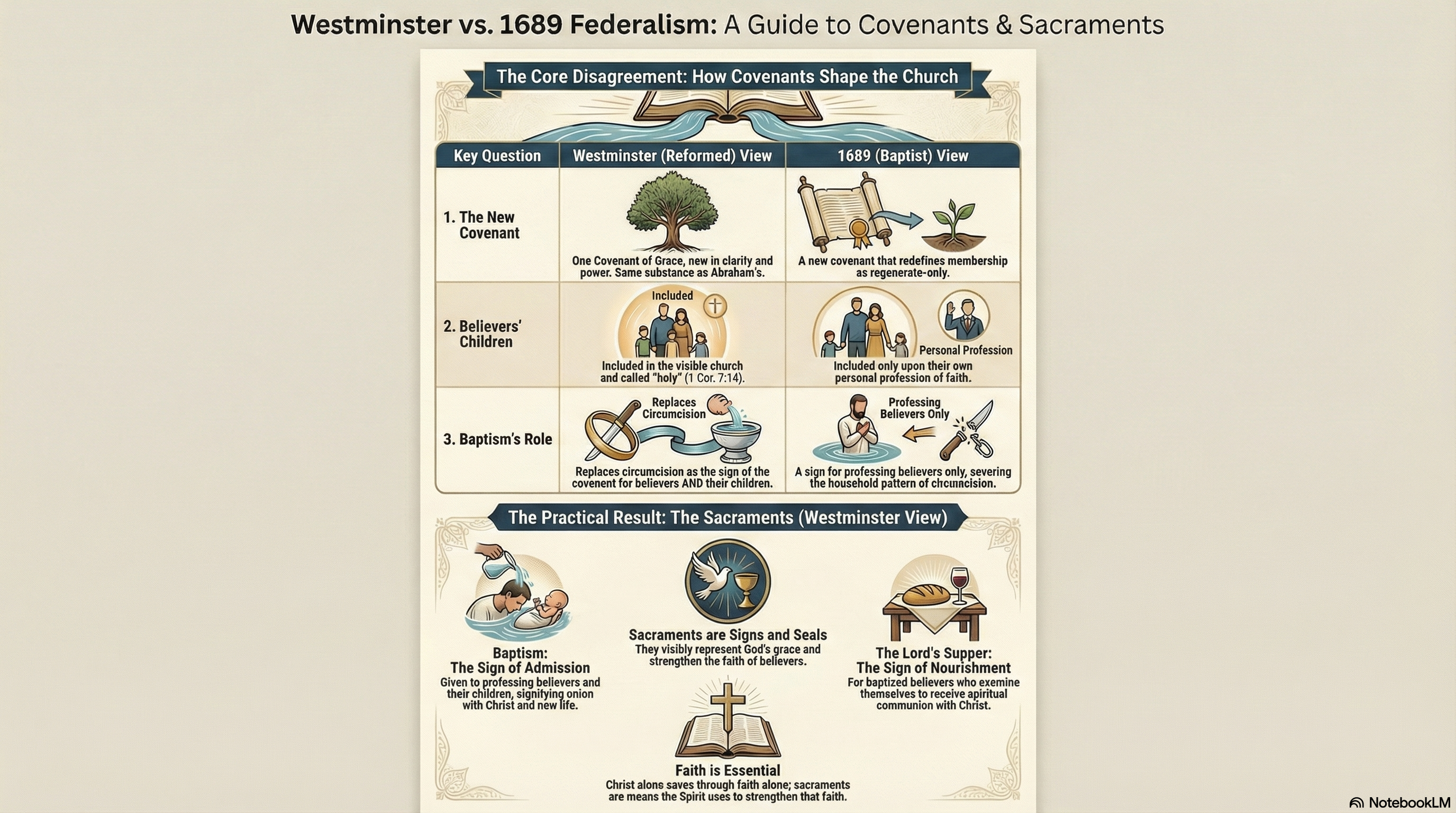
There is one Covenant of Grace across redemptive history — administered differently before and after Christ, but one in substance, so that Abraham's way of salvation is ours: grace through faith in the promised Christ. Because the covenant promise still runs to believers and their children, the visible church keeps its family shape under the gospel, and baptism succeeds circumcision as the covenant sign for both. The sacraments, rightly understood, are God's signs and seals — not magic, and not mere memorials — and they profit only by faith in Christ.
This essay does one job: it takes the broader covenant case already argued in From Dispensationalism to Reformed Covenant Theology and applies it to baptism and the Lord’s Supper. The three questions below are meant to keep the logic simple and testable from Scripture.
1) Is the New Covenant new in form and clarity while one in substance with Abraham?
Classic Reformed covenant theology says there is one Covenant of Grace across redemptive history, administered differently before and after Christ, but always the same in substance. That is why Paul can argue that Abraham’s way of justification is ours too: by faith.
Galatians 3 (key lines)
(KJV) 7 Know ye therefore that they which are of faith, the same are the children of Abraham. 8 And the scripture, foreseeing that God would justify the heathen through faith, preached before the gospel unto Abraham, saying, In thee shall all nations be blessed. 9 So then they which be of faith are blessed with faithful Abraham. 14 That the blessing of Abraham might come on the Gentiles through Jesus Christ; that we might receive the promise of the Spirit through faith. 16 Now to Abraham and his seed were the promises made. He saith not, And to seeds, as of many; but as of one, And to thy seed, which is Christ. 29 And if ye be Christ’s, then are ye Abraham’s seed, and heirs according to the promise.
Romans 4 (key lines)
(KJV) 1 What shall we say then that Abraham our father, as pertaining to the flesh, hath found? 2 For if Abraham were justified by works, he hath whereof to glory; but not before God. 3 For what saith the scripture? Abraham believed God, and it was counted unto him for righteousness. 4 Now to him that worketh is the reward not reckoned of grace, but of debt. 5 But to him that worketh not, but believeth on him that justifieth the ungodly, his faith is counted for righteousness.
(KJV) 9 Cometh this blessedness then upon the circumcision only, or upon the uncircumcision also? for we say that faith was reckoned to Abraham for righteousness. 10 How was it then reckoned? when he was in circumcision, or in uncircumcision? Not in circumcision, but in uncircumcision. 11 And he received the sign of circumcision, a seal of the righteousness of the faith which he had yet being uncircumcised: that he might be the father of all them that believe, though they be not circumcised; that righteousness might be imputed unto them also: 12 And the father of circumcision to them who are not of the circumcision only, but who also walk in the steps of that faith of our father Abraham, which he had being yet uncircumcised.
Takeaway: The substance has not changed: grace through faith in Christ. The administration has changed: from shadow to fullness.
Jeremiah 31 / Hebrews 8 (key lines)
(KJV) 33 But this shall be the covenant that I will make with the house of Israel; After those days, saith the LORD, I will put my law in their inward parts, and write it in their hearts; and will be their God, and they shall be my people. 34 And they shall teach no more every man his neighbour, and every man his brother, saying, Know the LORD: for they shall all know me, from the least of them unto the greatest of them, saith the LORD: for I will forgive their iniquity, and I will remember their sin no more.
(KJV) 10 For this is the covenant that I will make with the house of Israel after those days, saith the Lord; I will put my laws into their mind, and write them in their hearts: and I will be to them a God, and they shall be to me a people: 11 And they shall not teach every man his neighbour, and every man his brother, saying, Know the Lord: for all shall know me, from the least to the greatest. 12 For I will be merciful to their unrighteousness, and their sins and their iniquities will I remember no more.
Westminster reading: These promises are certainly and effectually true for the elect (the “invisible church”). But until glory, the visible church remains a mixed body (wheat and tares, a net with good and bad). So the New Covenant is new in efficacy and clarity, not a total redefinition of visible membership.
2) Do Genesis 17, Romans 4, , and place believers’ children within the visible church’s orbit?
Classic Reformed covenant theology says yes: God’s ordinary way is to gather households, and the visible church therefore includes believers and their children.
(KJV) And I will establish my covenant between me and thee and thy seed after thee in their generations for an everlasting covenant, to be a God unto thee, and to thy seed after thee.
(KJV) And he received the sign of circumcision, a seal of the righteousness of the faith which he had yet being uncircumcised...
(KJV) For the promise is unto you, and to your children, and to all that are afar off, even as many as the Lord our God shall call.
(KJV) For the unbelieving husband is sanctified by the wife, and the unbelieving wife is sanctified by the husband: else were your children unclean; but now are they holy.
Takeaway: Genesis 17 establishes the household pattern; Romans 4 identifies circumcision as a covenant sign and seal; carries the promise forward; and calls believers’ children holy. Westminster therefore keeps the family shape of the visible church under the gospel.
3) Do Romans 4 and support sign continuity (circumcision → baptism)?
Westminster argues that Romans 4 identifies circumcision as a covenant sign and seal, and Colossians 2 then links that fulfilled sign-language to baptism. So the subjects (believers and their children) remain the same in the visible community, even as the sign changes from blood to water.
(KJV) 11 In whom also ye are circumcised with the circumcision made without hands, in putting off the body of the sins of the flesh by the circumcision of Christ: 12 Buried with him in baptism, wherein also ye are risen with him through the faith of the operation of God, who hath raised him from the dead.
Takeaway: The meaning is fulfilled in Christ; the sign changes; the covenantal logic continues.
Putting it together
Answer these three questions from the classic Reformed compass and you land with Westminster:
- Continuity of substance: Salvation has always been by grace through faith in the promised Christ (Galatians 3; Romans 4). The New Covenant is “new” in clarity and power, not a different way of salvation.
- Covenant family: The promise pattern runs from Abraham to the nations as you / your children / the nations (; ), and believers’ children are still called holy (), so they belong within the visible church’s orbit.
- Sign continuity: Circumcision was a covenant sign and seal (), and baptism succeeds it as the New-Covenant sign (). The sign changes, the subjects (as to the visible community) do not.
That is why Westminster teaches one Covenant of Grace under various administrations, believers and their children as members of the visible church, and baptism as the fitting covenant sign for both.
The Sacraments in This Frame: What They Are, What They Do, and How to Practice Them
A. What is a sacrament?
In Scripture, a sacrament is a God-instituted sign and seal of covenant grace, exhibiting Christ and confirming His promises to believers.
(KJV) And he received the sign of circumcision, a seal of the righteousness of the faith which he had yet being uncircumcised: that he might be the father of all them that believe…
Salvation itself is by grace through faith, not by bare participation in rites:
(KJV) For by grace are ye saved through faith; and that not of yourselves: it is the gift of God: Not of works, lest any man should boast.
Hypothetical: Lydia sits under the Word and receives baptism and the Supper for years, yet never truly trusts Christ. The signs do not save her by themselves. But when Noah believes the gospel, those same signs become means of grace because the Spirit uses them to strengthen faith.
B. Baptism: Meaning, Subjects, Mode, and Practice
1) What baptism signifies (union, cleansing, new life)
(KJV) Know ye not, that so many of us as were baptized into Jesus Christ were baptized into his death? Therefore we are buried with him by baptism into death: that like as Christ was raised up from the dead by the glory of the Father, even so we also should walk in newness of life.
(KJV) Not by works of righteousness which we have done, but according to his mercy he saved us, by the washing of regeneration, and renewing of the Holy Ghost;
(KJV) The like figure whereunto even baptism doth also now save us (not the putting away of the filth of the flesh, but the answer of a good conscience toward God,) by the resurrection of Jesus Christ:
(KJV) (already quoted above)
In short: Baptism visibly preaches Christ’s death, cleansing, and new life, all received by faith.
2) Who should be baptized (subjects)
-
Professing believers (those who receive the Word with faith):
(KJV) Then they that gladly received his word were baptized: and the same day there were added unto them about three thousand souls.
-
Believers and their children (covenant continuity):
(KJV) And I will establish my covenant between me and thee and thy seed after thee in their generations for an everlasting covenant...
(KJV) And he received the sign of circumcision, a seal of the righteousness of the faith...
(KJV) For the promise is unto you, and to your children, and to all that are afar off, even as many as the Lord our God shall call.
(KJV) …else were your children unclean; but now are they holy.
Household pattern and welcoming of children:
(KJV) Suffer the little children to come unto me, and forbid them not: for of such is the kingdom of God.
(KJV) And when she was baptized, and her household, she besought us… (KJV) And he took them the same hour of the night, and washed their stripes; and was baptized, he and all his, straightway. (KJV) And I baptized also the household of Stephanas…
Hypotheticals:
- Emma is baptized as an infant, raised under Word and prayer, and later simply believes. Her baptism did not replace faith; it marked her out within the covenant community and is now owned by faith.
- Aiden hears the gospel at twenty-five and believes. He is baptized on profession. Same Christ, same covenant, different timing.
3) How baptism is administered (mode and authority)
-
Christ’s command:
(KJV) Go ye therefore, and teach all nations, baptizing them in the name of the Father, and of the Son, and of the Holy Ghost: Teaching them to observe all things whatsoever I have commanded you…
-
One baptism (not repeated):
(KJV) One Lord, one faith, one baptism.
-
Mode: Scripture does not bind us to a single action. The Confession states its own position precisely: dipping the person into the water "is not necessary; but Baptism is rightly administered by pouring, or sprinkling water upon the person" (WCF 28.3). Immersion, where it occurs, is a valid baptism, but it is not the confessional norm. Examples of going down to and coming up from water exist:
(KJV) And he commanded the chariot to stand still: and they went down both into the water, both Philip and the eunuch; and he baptized him. And when they were come up out of the water, the Spirit of the Lord caught away Philip…
And Scripture often speaks of covenant cleansing in sprinkling/pouring imagery tied to the Spirit’s work:
(KJV) Let us draw near with a true heart in full assurance of faith, having our hearts sprinkled from an evil conscience, and our bodies washed with pure water.
Practical execution (Westminster-shaped):
-
Who administers? A lawfully called minister of the Word (cf. ).
-
When? After credible profession—or for children, upon parental profession with public vows to raise them in the faith.
-
Where? In the assembly if possible, because baptism admits to the visible church ().
(KJV) For by one Spirit are we all baptized into one body, whether we be Jews or Gentiles… and have been all made to drink into one Spirit.
Hypotheticals:
- Visitor requests re-baptism because he doubts his earlier trinitarian baptism. Scripture says “one baptism” (). In context Paul is confessing the unity of the faith; the church has traditionally inferred from that unity that a valid trinitarian baptism is not to be repeated. Pastors should teach and reassure rather than repeat.
- Parents ask, “Which mode is best?” The answer is that the meaning is primary; the Bible does not command one exclusive action.
C. The Lord’s Supper: Presence, Purpose, and Practice
1) What the Supper is (Christ’s real spiritual communion with believers)
-
Institution:
(KJV) And he took bread, and gave thanks, and brake it, and gave unto them, saying, This is my body which is given for you: this do in remembrance of me. Likewise also the cup after supper, saying, This cup is the new testament in my blood, which is shed for you.
-
Communion with Christ and with one another:
(KJV) The cup of blessing which we bless, is it not the communion of the blood of Christ? The bread which we break, is it not the communion of the body of Christ? For we being many are one bread, and one body: for we are all partakers of that one bread.
Does the Supper save? Not by itself. Christ saves, and we receive Him by faith; the Supper nourishes that faith.
(KJV) And Jesus said unto them, I am the bread of life: he that cometh to me shall never hunger; and he that believeth on me shall never thirst.
(Reformed teaching takes John 6 as chiefly about believing; the Supper is the visible Word that strengthens this believing.)
2) How to come to the Table (faith and self-examination)
(KJV) For I have received of the Lord that which also I delivered unto you, That the Lord Jesus the same night in which he was betrayed took bread: And when he had given thanks, he brake it, and said, Take, eat: this is my body, which is broken for you: this do in remembrance of me. After the same manner also he took the cup, when he had supped, saying, This cup is the new testament in my blood: this do ye, as oft as ye drink it, in remembrance of me. For as often as ye eat this bread, and drink this cup, ye do shew the Lord’s death till he come. Wherefore whosoever shall eat this bread, and drink this cup of the Lord, unworthily, shall be guilty of the body and blood of the Lord. But let a man examine himself, and so let him eat of that bread, and drink of that cup. For he that eateth and drinketh unworthily, eateth and drinketh damnation to himself, not discerning the Lord’s body.
Hypotheticals:
-
Sofia is anxious: “My faith feels small.” Pastors say, “The Supper is for weak believers who truly trust Christ. Examine yourself, repent, and come.”
-
Ethan is in open, unrepentant sin. Out of love, elders withhold him from the Table until repentance.
(KJV) But now I have written unto you not to keep company, if any man that is called a brother be a fornicator, or covetous… with such an one no not to eat. For what have I to do to judge them also that are without? do not ye judge them that are within? But them that are without God judgeth. Therefore put away from among yourselves that wicked person.
3) Frequency and setting
-
Often, in gathered worship:
(KJV) And they continued stedfastly in the apostles’ doctrine and fellowship, and in breaking of bread, and in prayers.
(KJV) And upon the first day of the week, when the disciples came together to break bread, Paul preached unto them…
-
“As often” leaves frequency to pastoral wisdom; many Reformed churches practice weekly or regular communion to nourish faith ().
Practical execution (Westminster-shaped):
- Who administers? A lawfully called minister of the Word.
- Who partakes? Baptized believers who credibly profess faith, are at peace with the body, and are not under discipline.
- How? With the Word of institution, prayer, and receiving both bread and cup with faith and self-examination.
Hypotheticals:
- Guest asks, “May I partake?” Elders ask whether the person is trusting in Christ, baptized, and in good standing with a faithful church. If yes, welcome; if no, invite them to Christ first.
- Child raised in the church asks for the Supper. Parents and elders look for a credible profession, then admit the child to the Table and continue discipling them in self-examination and repentance.
D. Bottom line on the sacraments
- Agent of salvation: Christ alone.
- Instrument by which we receive Him: Faith alone ().
- Ordinary means the Spirit uses to create and strengthen that faith: Word, Baptism, and the Lord’s Supper—received rightly.
The most biblically correct way to understand and execute them, in this classic Reformed frame, is:
- Treat them as God’s signs and seals—not magic, not mere memorials.
- Administer Baptism to believers and their children, once, with water in the Triune Name, as admission to the visible church.
- Administer the Supper often to repenting, believing Christians, with clear preaching, self-examination, reconciliation, and pastoral care.
- In both, insist that faith in Christ is essential for saving benefit; warn against unworthy use, and comfort the weak and penitent.
Objections and Replies
The credobaptist position deserves its strongest form, not a caricature. Baptists who withhold the sign from infants do so out of reverence for regeneration and a serious reading of the new covenant texts. Three arguments carry the most weight.
Objection 1: "The new covenant community is regenerate, so infant membership is excluded."
The argument runs from Jeremiah's own words:
"And they shall teach no more every man his neighbour, and every man his brother, saying, Know the LORD: for they shall all know me, from the least of them unto the greatest of them, saith the LORD: for I will forgive their iniquity, and I will remember their sin no more." (, KJV)
If all in the new covenant know the Lord, then the covenant community and the regenerate are coextensive; the old covenant's mixed membership is precisely what has been abolished. Infants cannot profess knowledge of the Lord; therefore they are not covenant members and should not receive the covenant sign. This is the best credobaptist argument, and it is a genuinely biblical-theological one, not a mere argument from silence.
Reply. Begin with a prior question the objection skips: which covenant does Jeremiah say the new covenant is "not according to"? The text answers itself — the covenant "that I made with their fathers in the day that I took them by the hand to bring them out of the land of Egypt; which my covenant they brake" (, KJV). The contrast is with Sinai — the breakable, national, mediated administration — not with Abraham. Paul keeps exactly this distinction: the law, coming four hundred and thirty years after, "cannot disannul" the covenant "confirmed before of God in Christ" (, KJV), for it was "added because of transgressions, till the seed should come" (, KJV). And the new covenant's promised content is the Abrahamic formula verbatim: "I will be their God, and they shall be my people" () is restated, running unchanged to the last page of Scripture — "they shall be his people, and God himself shall be with them, and be their God" (, KJV). What is new is power, extent, and finality — not the promise, and not the principle of its administration.
The newness Jeremiah promises is therefore real, but it is eschatological fullness inaugurated, not a redefinition of how God administers His covenant in history. "They shall all know me" describes what the new covenant infallibly secures for its elect — and what will be true without remainder only when the covenant is consummated. Between Pentecost and glory, the New Testament itself continues to treat the visible covenant community as containing members who fall under covenant judgment. The warning of Hebrews — the very epistle that quotes Jeremiah 31 — presupposes it:
"Of how much sorer punishment, suppose ye, shall he be thought worthy, who hath trodden under foot the Son of God, and hath counted the blood of the covenant, wherewith he was sanctified, an unholy thing, and hath done despite unto the Spirit of grace? For we know him that hath said, Vengeance belongeth unto me, I will recompense, saith the Lord. And again, The Lord shall judge his people." (, KJV)
The apostate here is not an outsider; he was "sanctified" by "the blood of the covenant," and the judgment invoked is covenant judgment: "The Lord shall judge his people." If the new covenant community were simply identical with the regenerate, this warning could not be written.
The objection also proves too much by its own method. The same verse promises that "they shall teach no more every man his neighbour" — yet the apostles go right on "teaching every man in all wisdom" (, KJV), and Christ commissions the church to teach until the end of the age (). If the no-more-teaching clause is admittedly inaugurated but not yet exhaustive, then "they shall all know me" cannot be pressed as exhaustively realized either; both clauses ripen together at the consummation. And the apostles address children as members of the congregation, "in the Lord":
"Children, obey your parents in the Lord: for this is right." (, KJV)
"And, ye fathers, provoke not your children to wrath: but bring them up in the nurture and admonition of the Lord." (, KJV)
Paul does not address covenant children as outsiders awaiting admission. The new covenant is new in efficacy and clarity; it is not new in excluding the children God has always claimed.
Objection 2: " proves too much — the unbelieving spouse is 'sanctified' but not baptized."
If the paedobaptist reads "but now are they holy" as grounds for baptizing children, consistency seems to demand baptizing the unbelieving husband too, for the same verse says he is "sanctified by the wife." Since no one baptizes the unbelieving spouse, covenantal holiness evidently does not entail the covenant sign — and the paedobaptist appeal to this verse collapses.
Reply. The objection is sharper than it first appears, and the answer must attend to what Paul actually grounds on what. The spouse's sanctification is instrumental and in order to something else: he is sanctified by the wife so that the marriage is clean and its offspring are not defiled. The children's holiness is the conclusion Paul argues to — "else were your children unclean; but now are they holy" — a standing status category, the very vocabulary Scripture uses for what is set apart to God. Paul can assume the Corinthians already regard believers' children as "holy" and reason from that fixed point; he assumes no such settled status for the unbelieving spouse, who remains an unbeliever to be won (). And the argument from status to sign never ran through bare "holiness" in the first place: it runs through the generational promise. God's covenant word names believers and their seed (); Peter's Pentecost declaration renews exactly that address — "For the promise is unto you, and to your children" (, KJV) — and says no such thing of unbelieving spouses. The sign follows the promise, and the promise runs to the children.
Objection 3: "The household baptisms may all have involved believing households."
Lydia's household, the jailer's household, the household of Stephanas — Acts never says an infant was present, and in some cases the household is described as hearing the Word or believing. Perhaps every member professed faith. The household texts, on this reading, prove nothing about infants.
Reply. Case by case, this is possible, and honesty requires saying so: no household baptism text names an infant, and none can be forced to. But the objection mistakes what the household pattern is evidence of. The argument was never a head-count of rooms we cannot reconstruct. It is that the apostolic church baptized along the covenantal grain — the promise addressed to "you, and to your children" (), the household as the ordinary unit of covenant administration from Abraham forward (Genesis 17). When Luke repeatedly records that a believer was baptized "and her household," "he and all his," he is narrating a church that thought in households, exactly as the covenant had always taught it to think. A church that had just abolished infant membership after two thousand years would need to say so; instead the texts speak, without a word of correction, in the old familiar household idiom. The pattern's significance is covenantal address, not demographic proof — and covenantal address is the whole point.
A Reformed Note on Method
This essay has argued from Scripture to Westminster, not the reverse. The Confession's teaching — one covenant of grace "differently administered in the time of the law, and in the time of the gospel" (WCF 7.5-6); baptism as "a sign and seal of the covenant of grace" to be administered not only to professing believers but also to "the infants of one, or both, believing parents" (WCF 28.1, 28.4); the Supper as a real communion in Christ's body and blood received by faith (WCF 29.7) — is received here as a faithful summary of the biblical case laid out above, not as an independent authority. The Confession itself insists on this ordering: the supreme judge in all controversies of religion "can be no other but the Holy Spirit speaking in the Scripture" (WCF 1.10). Where the Standards are cited, the reader is invited to check them against the texts.
Conclusion and Handoff
The covenant of grace is one; its administrations differ; its substance — Christ, received by faith — does not. That single conviction settles the practical questions this essay opened with. Baptism belongs to believers and their children because the promise belongs to believers and their children. The Supper belongs to repenting, believing communicants because it is communion, not magic. And both signs point away from themselves to the Christ who saves.
If you are a parent in the covenant, this doctrine is not an abstraction. It means your children are not strangers to the church of God, to be treated as little pagans until they can produce an adult's testimony. They are holy — set within the covenant's orbit, addressed by its promises, owed its nurture and admonition. Raise them as what God calls them. And if you have received the signs but never rested on the Christ they signify, the signs themselves preach to you: not the water, not the bread, not the cup, but Christ alone, received by faith alone, saves.
What happens when the church forgets this — when it treats covenant children as outsiders to be converted by crisis rather than members to be nurtured in the faith — is the subject of the next essay: Stop the Atheism Factory.
Suggested Next Steps
- Read Genesis 17, Romans 4, Galatians 3, and in one sitting with a KJV open, tracing the single thread: promise, sign, seal, fulfillment.
- Read Westminster Confession of Faith chapters 7, 27, 28, and 29 alongside the proof texts, testing each claim against the passages cited in this essay.
- If the broader covenant framework is still new to you, work through From Dispensationalism to Reformed Covenant Theology before returning here.
- Parents: write down how your household currently practices the covenant nurture this essay describes — Word, prayer, worship, catechesis — and identify one concrete addition.
- Continue to Stop the Atheism Factory to see what is at stake, generationally, in getting covenant nurture wrong.
Essay Video
Westminster Covenant Theology: Covenants, Baptism, and the Table
Audio Discussion
Westminster Covenant Theology: Covenants, Baptism, and the Table
Infographic
Westminster Covenant Theology: Covenants, Baptism, and the Table