Essay
Stop the Atheism Factory
How Cultural Retreat and Theological Error De-Christianize the Next Generation
By Adam Malin Date: March 25, 2026
"Ye are the salt of the earth: but if the salt have lost his savour, wherewith shall it be salted? it is thenceforth good for nothing, but to be cast out, and to be trodden under foot of men. Ye are the light of the world. A city that is set on an hill cannot be hid." (, KJV)
"And Jesus came and spake unto them, saying, All power is given unto me in heaven and in earth. Go ye therefore, and teach all nations, baptizing them in the name of the Father, and of the Son, and of the Holy Ghost: Teaching them to observe all things whatsoever I have commanded you: and, lo, I am with you alway, even unto the end of the world." (, KJV)
Thesis
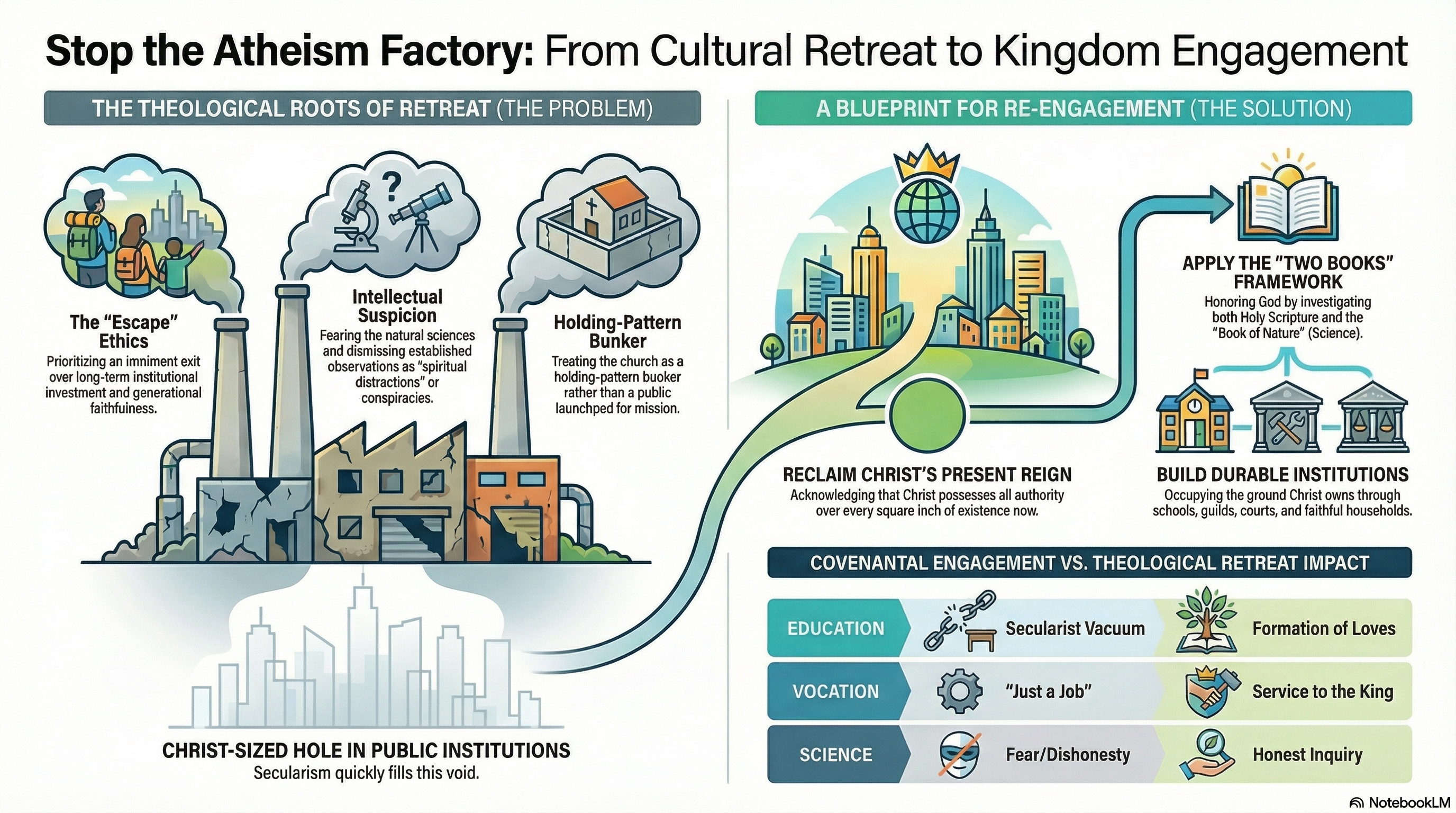
If Christ reigns now — and Scripture is emphatic that He does — then His church has no business retreating from the world He rules. Yet for the better part of a century, popular evangelical theology has trained Christians to do exactly that: to treat culture as enemy territory, to expect imminent escape rather than long obedience, and to view institutions as irredeemable distractions from "spiritual" work. The result is a vacuum. When Christians abandon schools, courts, arts, sciences, and civic life, the vacuum does not stay empty. It fills with whatever conviction is willing to show up. The atheism factory is not a laboratory in a university basement. It is the Christ-shaped Christ-sized hole left behind when the church walks away from the places where neighbors are formed.
This essay is a charitable but firm critique of how certain theological errors — especially those rooted in popular Dispensationalism — have contributed to this retreat. It is not a judgment on the sincerity of Dispensational believers. Many love Christ and evangelize boldly. But sincerity does not immunize theology from consequences. Bad theology produces bad formation, and bad formation de-Christianizes culture. The remedy is not cultural optimism or political ambition. It is confessional, covenantal, Word-ruled Christianity that worships reverently, thinks carefully, and occupies the ground Christ already owns.
1. Christ Reigns Now: The Exegetical Foundation
The case for cultural engagement does not begin with pragmatism or cultural strategy. It begins with Christology. If Jesus is Lord now — not merely in a future dispensation — then every domain of human life falls under His authority now, and His people are commissioned to bear witness in every one of them.
The Enthronement Texts
The New Testament is relentless on this point. Christ's present reign is not a theological inference drawn from ambiguous passages. It is the apostolic proclamation:
"Which he wrought in Christ, when he raised him from the dead, and set him at his own right hand in the heavenly places, Far above all principality, and power, and might, and dominion, and every name that is named, not only in this world, but also in that which is to come: And hath put all things under his feet, and gave him to be the head over all things to the church." (, KJV)
"Who hath delivered us from the power of darkness, and hath translated us into the kingdom of his dear Son." (, KJV)
"For he must reign, till he hath put all enemies under his feet. The last enemy that shall be destroyed is death." (, KJV)
"Wherefore God also hath highly exalted him, and given him a name which is above every name: That at the name of Jesus every knee should bow, of things in heaven, and things in earth, and things under the earth; And that every tongue should confess that Jesus Christ is Lord, to the glory of God the Father." (, KJV)
Peter's Pentecost sermon makes the connection explicit. David prophesied the Messiah's enthronement; Jesus fulfills it — not at some future date, but at His ascension:
"Therefore being a prophet, and knowing that God had sworn with an oath to him, that of the fruit of his loins, according to the flesh, he would raise up Christ to sit on his throne; He seeing this before spake of the resurrection of Christ… Therefore being by the right hand of God exalted… Therefore let all the house of Israel know assuredly, that God hath made that same Jesus, whom ye have crucified, both Lord and Christ." (, KJV)
And the Psalms anticipated it long before:
"The LORD said unto my Lord, Sit thou at my right hand, until I make thine enemies thy footstool. The LORD shall send the rod of thy strength out of Zion: rule thou in the midst of thine enemies." (, KJV)
"I will declare the decree: the LORD hath said unto me, Thou art my Son; this day have I begotten thee. Ask of me, and I shall give thee the heathen for thine inheritance, and the uttermost parts of the earth for thy possession." (, KJV)
What This Means for the Church
If Christ possesses "all power in heaven and in earth" (), then there is no neutral zone — no square inch of creation over which He does not say "Mine." Abraham Kuyper, the Dutch Reformed theologian and Prime Minister, captured the implication:
"There is not a square inch in the whole domain of our human existence over which Christ, who is Sovereign over all, does not cry, 'Mine!'" (Abraham Kuyper, Inaugural Address at the Free University of Amsterdam, 1880)
Kuyper was not innovating. He was restating what declares: "The earth is the LORD's, and the fulness thereof; the world, and they that dwell therein." And what the Great Commission assumes: that all nations are to be discipled — taught to observe all things Christ commanded — because all authority belongs to Him. The church that retreats from culture is the church that has functionally denied the scope of Christ's reign, whatever it professes on paper.
For the full exegetical case that Christ's kingdom is inaugurated now and consummated at His return — not postponed to a future dispensation — see Covenant Theology and the End Times and From Dispensationalism to Reformed Covenant Theology elsewhere in this collection.
2. Five Theological Errors That Feed Cultural Retreat
The retreat did not happen by accident. It was formed by a cluster of theological commitments — most of them sincere, many of them popular — that together train Christians to disengage. The following critique targets the ideas and their consequences, not the believers who hold them.
Error 1: Rapture-as-Escape Ethics
When the operative hope is an any-moment exit, long obedience becomes optional. Why invest in institutions that will be left behind? Why pursue generational faithfulness in education, law, or the arts if the clock is about to run out? The tendency is a Christianity that evangelizes urgently but discounts long-horizon cultural investment. To be fair, Dispensationalists have built durable institutions — Bible institutes, mission agencies, colleges — so the critique is not that they built nothing. It is that the framework's cultural posture and short time-horizon train believers away from patient, generational engagement with the institutions that form their neighbors.
But Jesus prayed the opposite:
"I pray not that thou shouldest take them out of the world, but that thou shouldest keep them from the evil. They are not of the world, even as I am not of the world. Sanctify them through thy truth: thy word is truth. As thou hast sent me into the world, even so have I also sent them into the world." (, KJV)
Christ does not extract His people from the world. He sends them into it — sanctified, protected, and commissioned. The posture is mission, not flight. The parable of the talents rebukes the servant who buried what was entrusted to him and waited for the master to return (). In the parable of the pounds, the nobleman's command is "Occupy till I come" () — in the parable's own sense, "do business" with what the master has entrusted until he returns. The posture it commends is trading, investing, and serving with what Christ has given, not hiding until He comes.
For a detailed treatment of why the pretribulational rapture does not hold up under exegesis, see The Rapture and the Day of the Lord in this collection.
Error 2: Two Peoples, Two Programs
A rigid Israel/Church separation fragments God's people into two tracks with two destinies. When the church is treated as a "parenthesis" — a pause in God's real program with Israel — then the church's cultural mandate evaporates. Why would a parenthetical people build lasting institutions?
But Scripture proclaims one olive tree, one new man, one people of God:
"For he is our peace, who hath made both one, and hath broken down the middle wall of partition between us; Having abolished in his flesh the enmity, even the law of commandments contained in ordinances; for to make in himself of twain one new man, so making peace." (, KJV)
"There is neither Jew nor Greek, there is neither bond nor free, there is neither male nor female: for ye are all one in Christ Jesus. And if ye be Christ's, then are ye Abraham's seed, and heirs according to the promise." (, KJV)
Paul's entire argument in Romans 9–11 is that the people of God have always been defined by election and faith, not by ethnicity: "For they are not all Israel, which are of Israel" (). The one olive tree of has Gentile branches grafted in and unbelieving Jewish branches broken off — not two separate trees growing side by side.
For the full treatment of the church's continuity with Israel and the one-people-of-God framework, see God's Chosen People: Election, Not Race and From Dispensationalism to Reformed Covenant Theology in this collection.
Error 3: Temple Nostalgia and the Sufficiency of the Cross
Popular Dispensational eschatology anticipates a rebuilt Jerusalem temple with restored animal sacrifices during a future millennial kingdom. Whatever the intention, this expectation directs hope backward — toward shadows that have been fulfilled — and dulls the sufficiency of Christ's once-for-all offering.
The author of Hebrews is unambiguous:
"By one offering he hath perfected for ever them that are sanctified." (, KJV)
"Now where remission of these is, there is no more offering for sin." (, KJV)
"For Christ is not entered into the holy places made with hands, which are the figures of the true; but into heaven itself, now to appear in the presence of God for us." (, KJV)
Jesus Himself announced the end of localized temple worship: "Woman, believe me, the hour cometh, when ye shall neither in this mountain, nor yet at Jerusalem, worship the Father… But the hour cometh, and now is, when the true worshippers shall worship the Father in spirit and in truth" (, KJV). And He identified His own body as the true temple: "Destroy this temple, and in three days I will raise it up… But he spake of the temple of his body" (, KJV).
To anticipate a return to shadows after the substance has come is to move backward through redemptive history. The Westminster Confession (7.5–6) teaches that the Covenant of Grace was administered under the law by "promises, prophecies, sacrifices, circumcision" and other types — all "fore-signifying Christ to come" — and that under the gospel, the same covenant is now administered "in the preaching of the Word, and the administration of the sacraments of Baptism and the Lord's Supper." The movement is from shadow to substance, not substance back to shadow.
Error 4: Sensational Timelines Over Sober Holiness
Prophecy in Scripture exists to reveal Christ and to produce holy living — not to generate speculative timelines, headline-matching, or bestselling fiction. Peter makes this explicit:
"But the day of the Lord will come as a thief in the night; in the which the heavens shall pass away with a great noise, and the elements shall melt with fervent heat, the earth also and the works that are therein shall be burned up. Seeing then that all these things shall be dissolved, what manner of persons ought ye to be in all holy conversation and godliness." (, KJV)
The aim of eschatological teaching is holiness, not charts. The repeated refrain across the New Testament is "watch and be ready" — which means sober living, faithful service, and moral seriousness, not date-setting or geopolitical speculation.
"Therefore be ye also ready: for in such an hour as ye think not the Son of man cometh." (, KJV)
"And every man that hath this hope in him purifieth himself, even as he is pure." (, KJV)
When prophecy conferences replace catechism classes, and when "what's happening in the Middle East" replaces careful exposition of Romans, the church forms spectators instead of disciples. The result is Christians who can name the ten horns of Daniel but cannot articulate the doctrine of justification.
For a sober, exegetical treatment of the eschatological passages most often sensationalized, see The Olivet Discourse, The Rapture and the Day of the Lord, Gog and Magog, and Revelation 20 and the Millennium in this collection.
Error 5: Anti-Creational Suspicion of Ordinary Callings
When culture is treated as enemy territory by default — as the domain of "the world" in exclusively negative terms — Christians lose the doctrine of vocation. They lose the conviction that a teacher, a nurse, a carpenter, a magistrate, a scientist, or an artist can serve God in those callings as genuinely as a pastor serves God in the pulpit.
But Scripture grounds human work in creation itself:
"And God blessed them, and God said unto them, Be fruitful, and multiply, and replenish the earth, and subdue it: and have dominion over the fish of the sea, and over the fowl of the air, and over every living thing that moveth upon the earth." (, KJV)
This is the cultural mandate — given before the Fall, rooted in the image of God, never revoked. The dominion commission means that tending creation, building civilization, and ordering human life under God's law are original design, not concessions to a fallen world. After the Fall, the mandate continues under the conditions of sin and grace:
"Seek the peace of the city whither I have caused you to be carried away captives, and pray unto the LORD for it: for in the peace thereof shall ye have peace." (, KJV)
"Whatsoever thy hand findeth to do, do it with thy might." (, KJV)
"And whatsoever ye do in word or deed, do all in the name of the Lord Jesus, giving thanks to God and the Father by him." (, KJV)
"And whatsoever ye do, do it heartily, as to the Lord, and not unto men; Knowing that of the Lord ye shall receive the reward of the inheritance: for ye serve the Lord Christ." (, KJV)
"I beseech you therefore, brethren, by the mercies of God, that ye present your bodies a living sacrifice, holy, acceptable unto God, which is your reasonable service. And be not conformed to this world: but be ye transformed by the renewing of your mind." (, KJV)
Paul does not say "withdraw from the world." He says be transformed and transforming — a living sacrifice in the midst of the world, not apart from it. The Reformers recovered this insight powerfully. Calvin taught that every lawful calling is a post assigned by God — a "station" in which the believer serves as Christ's representative. The Westminster Larger Catechism (Q141) includes among the duties of the Eighth Commandment: "truth, faithfulness, and justice in contracts and commerce between man and man; rendering to every one his due; restitution of goods unlawfully detained from the right owners thereof; giving and lending freely, according to our abilities, and the necessities of others; moderation of our judgments, wills, and affections concerning worldly goods." The Christian life is inescapably public.
3. How Retreat De-Christianizes Culture
When these five errors combine, they produce a distinct pattern: withdrawal from the institutions where neighbors are formed. The consequences are predictable and observable.
A. Shrinking Christ's Present Reign
If Jesus is thought to rule only later — in a future millennial kingdom — then His authority over present civic, intellectual, and cultural life is functionally denied. Christians lose confidence that Christ has anything to say about education, law, science, or the arts now. They concede those domains to whatever worldview is willing to claim them. The result is not neutrality. The result is a culture shaped by convictions other than Christ's.
B. Privatizing Faith
When the church is treated as a parenthesis, worship becomes a cul-de-sac rather than a launchpad. The gathered assembly on the Lord's Day is supposed to be the place where Christians are equipped and sent — "for the perfecting of the saints, for the work of the ministry, for the edifying of the body of Christ" (, KJV). But when the church is understood as a holding pattern until the rapture, the sending impulse dies. Faith becomes a private, interior experience with no public consequence.
Scripture describes the church in exactly opposite terms:
"But ye are a chosen generation, a royal priesthood, an holy nation, a peculiar people; that ye should shew forth the praises of him who hath called you out of darkness into his marvellous light." (, KJV)
"To the intent that now unto the principalities and powers in heavenly places might be known by the church the manifold wisdom of God." (, KJV)
The church is a display — a public demonstration of God's wisdom to the watching cosmos. It is not a bunker.
C. Abandoning the Institutions Where Loves Are Trained
Schools, guilds, courts, councils, charities, hospitals, and the arts are the places where human character is shaped. When Christians vacate these institutions, they abandon the very places where the next generation's convictions are formed. The result is a generation raised without Christian witness in the institutions that most powerfully shape their imaginations.
"Let your light so shine before men, that they may see your good works, and glorify your Father which is in heaven." (, KJV)
"I exhort therefore, that, first of all, supplications, prayers, intercessions, and giving of thanks, be made for all men; For kings, and for all that are in authority; that we may lead a quiet and peaceable life in all godliness and honesty." (, KJV)
"For he is the minister of God to thee for good. But if thou do that which is evil, be afraid; for he beareth not the sword in vain: for he is the minister of God, a revenger to execute wrath upon him that doeth evil." (, KJV)
Christians are called to pray for magistrates, to serve in civic life, and to recognize civil authority as a divine institution. The Belgic Confession (Article 36) teaches that God "has placed the sword in the hands of the government, to punish evil people and protect the good" and that "everyone — no matter who — ought to be subject to the government." The Westminster Confession (23.1) affirms that God "hath ordained civil magistrates, to be, under Him, over the people, for His own glory, and the public good." If the magistrate's office is a divine institution, then Christians ought to supply saints to serve in it — not flee from it.
D. Forgetting the Household and the Generations
God ordinarily grows His kingdom through faithful households and congregations, not through sudden ruptures in history. The covenant promise runs through families:
"And I will establish my covenant between me and thee and thy seed after thee in their generations for an everlasting covenant, to be a God unto thee, and to thy seed after thee." (, KJV)
"For the promise is unto you, and to your children, and to all that are afar off, even as many as the Lord our God shall call." (, KJV)
"And, ye fathers, provoke not your children to wrath: but bring them up in the nurture and admonition of the Lord." (, KJV)
"And these words, which I command thee this day, shall be in thine heart: And thou shalt teach them diligently unto thy children, and shalt talk of them when thou sittest in thine house, and when thou walkest by the way, and when thou liest down, and when thou risest up." (, KJV)
The rapture-any-moment mentality undermines generational thinking. Why catechize your children carefully if you expect to leave before they grow up? Why build a school or a library or a hospital that might serve the community for a hundred years? The covenantal alternative insists that the promises of God run through households, that parents are the primary catechists, and that the church must think in generations — planting trees whose shade it may never sit under.
For the full treatment of covenant households, infant baptism, and intergenerational faithfulness, see Westminster Covenant Theology: Covenants, Baptism, and the Table in this collection.
4. Science Under Sovereignty: God's World Deserves Honest Inquiry
One of the most damaging consequences of cultural retreat is intellectual dishonesty about God's creation. When Christians are taught to fear the natural sciences — or worse, to dismiss established observations with conspiratorial hand-waving — they produce a generation that associates Christianity with willful ignorance. That generation, when it encounters the evidence for an ancient cosmos, deep geological time, or the complexity of the biological world, concludes that it must choose between faith and honest inquiry. Many choose honest inquiry — and leave the church.
This is a tragedy, and it is entirely unnecessary.
Scripture Commands Investigation of God's Works
"The heavens declare the glory of God; and the firmament sheweth his handywork. Day unto day uttereth speech, and night unto night sheweth knowledge." (, KJV)
"The works of the LORD are great, sought out of all them that have pleasure therein." (, KJV)
"It is the glory of God to conceal a thing: but the honour of kings is to search out a matter." (, KJV)
"For the invisible things of him from the creation of the world are clearly seen, being understood by the things that are made, even his eternal power and Godhead; so that they are without excuse." (, KJV)
says the works of the LORD are sought out — investigated, examined, studied — by all who take pleasure in them. says it is the honour of kings to search out what God has concealed. Scientific investigation, properly understood, is an act of dominion and worship: receiving the testimony of God's creation and giving Him glory for what is found. To forbid this investigation, or to replace it with slogans and conspiracy theories, is to suppress the very testimony that Psalm 19 and Romans 1 say God has given.
The Two-Books Framework
The Reformed confessional tradition has always recognized that God reveals Himself through two books: Scripture (special revelation) and creation (general revelation). The Belgic Confession (Article 2) puts it plainly:
"We know God by two means: First, by the creation, preservation, and government of the universe, since that universe is before our eyes like a beautiful book in which all creatures, great and small, are as letters to make us ponder the invisible things of God… Second, He makes Himself known to us more openly by His holy and divine Word."
The Westminster Confession opens with the same doctrine (1.1): the "light of nature, and the works of creation and providence" truly manifest God's goodness, wisdom, and power — though they are not sufficient for saving knowledge, which comes through Scripture alone.
Both books are God's speech. God does not lie through His works any more than He lies through His Word. When apparent conflict arises between what Scripture teaches and what creation shows, the conflict lies in our interpretation of one book or the other — never in God's revelation itself. Scripture remains the supreme judge of all controversies of religion (WCF 1.10). But creation's testimony is genuine and must be received, not suppressed.
For the full development of this framework — including the confessional foundation, the critical distinction between revelation and interpretation, and a five-step practical method for reading the two books together — see The Two Books: Reading Scripture and Creation Together in this collection. For the application of that method to the question of creation's timing, see Genesis "Days" and Deep Time in a Reformed Covenant Reading.
What Intellectual Honesty Requires
The church must stop producing Christians who cannot tell the difference between:
- Established observations (starlight travel time, ice-core layering, radiometric convergence, plate tectonics) and theoretical models built on those observations.
- What Scripture asserts and what a particular tradition reads into Scripture.
- Genuine disagreement about interpretive questions and denial of reality posing as faithfulness.
Tell the truth. Correct errors. Refuse conspiratorial sloppiness.
"A false balance is abomination to the LORD: but a just weight is his delight." (, KJV)
"Thou shalt not bear false witness against thy neighbour." (, KJV)
"Lying lips are abomination to the LORD: but they that deal truly are his delight." (, KJV)
The Ninth Commandment binds the church's speech about the natural world just as surely as it binds speech about neighbors. The Larger Catechism (Q145) targets culpable deceit — "speaking untruth" and "outfacing and bearing down the truth" — not sincere error. A believer who holds a young earth out of conviction that the Confession's "in the space of six days" (WCF 4.1) requires it is not thereby a liar, however mistaken this essay judges that reading to be. The charge falls elsewhere: making confident public assertions about empirical questions — the age of the earth, geology, astronomy — that one has never examined and cannot defend is reckless speech, and recklessness with the truth discredits the gospel by association. This does not mean science overrules Scripture. It means Scripture rules doctrine and worship (), and that investigating God's world is an act of obedience, not a replacement for His Word.
Calvin himself taught this plainly:
"If we regard the Spirit of God as the sole fountain of truth, we shall neither reject the truth itself, nor despise it wherever it shall appear, unless we wish to dishonour the Spirit of God." (Institutes, II.ii.15)
The doctrine of common grace affirms that unbelievers, by God's restraining and enabling grace, can discover true things about the created order. A surgeon's unbelief does not invalidate his anatomy. A geologist's agnosticism does not make her rock samples lie. Dismissing all findings by unbelievers is not faithfulness; it is a denial of common grace and a dishonoring of the Spirit who is "the sole fountain of truth."
5. Recover Order: What Reverent Worship Looks Like
The Spirit is not the author of chaos. Cultural faithfulness begins in the gathered assembly — and many evangelical churches have traded reverent, Word-ruled worship for entertainment and disorder that leaves believers unequipped for serious engagement with the world.
"For God is not the author of confusion, but of peace, as in all churches of the saints… Let all things be done decently and in order." (, KJV)
What Must Change
Regulate worship by Scripture, not by preference. God commands what He desires in worship: the reading and preaching of the Word, prayer, the singing of psalms and hymns, and the administration of the sacraments of Baptism and the Lord's Supper. What He does not command, He does not authorize. This is the Regulative Principle — confessed in WCF 21.1 and grounded in texts like:
"What thing soever I command you, observe to do it: thou shalt not add thereto, nor diminish from it." (, KJV)
"But in vain they do worship me, teaching for doctrines the commandments of men." (, KJV)
"God is a Spirit: and they that worship him must worship him in spirit and in truth." (, KJV)
Order the use of gifts. Paul does not forbid spiritual gifts; he regulates them. Uninterpreted tongues must be silent: "If there be no interpreter, let him keep silence in the church; and let him speak to himself, and to God" (, KJV). Prophecy must be tested: "Let the prophets speak two or three, and let the other judge" (, KJV). The standard is edification, not spectacle: "Let all things be done unto edifying" (, KJV).
Drop will-worship. Paul warns against "a shew of wisdom in will worship, and humility, and neglecting of the body" (, KJV). Invented practices, no matter how sincere, are not authorized worship. The church's creativity belongs in obedience to what God commands, not in devising what He did not.
Preach the Word, not the headlines. "Preach the word; be instant in season, out of season; reprove, rebuke, exhort with all longsuffering and doctrine" (, KJV). Sensational prophecy timelines are not preaching. Topical series driven by cultural trends are not expository ministry. The church needs pastors who will open the text, explain its meaning, and apply it to conscience — week after week, book by book.
6. What to Build Instead
The alternative to retreat is not triumphalism. It is covenantal, public, ordered faithfulness — the ordinary means of grace, applied consistently across every domain of life.
A. Word-Ruled Ministry
"All scripture is given by inspiration of God, and is profitable for doctrine, for reproof, for correction, for instruction in righteousness: That the man of God may be perfect, throughly furnished unto all good works." (, KJV)
The Scriptures "throughly furnish" the church. Cultivate the Berean reflex: "These were more noble than those in Thessalonica, in that they received the word with all readiness of mind, and searched the scriptures daily, whether those things were so" (, KJV). Every claim — from the pulpit, from culture, from this essay — must be tested against the Word.
B. Covenant Clarity
From the Covenant of Works in Adam to the Covenant of Grace fulfilled in Christ, God's plan is one. The visible church embraces believers and their children, to whom the sign of initiation belongs (; ; ). Administer baptism and the Lord's Supper as means of grace and covenant seals. Fence the Table with pastoral care: "But let a man examine himself, and so let him eat of that bread, and drink of that cup" (, KJV).
C. Qualified Elders and Ordered Households
"For this cause left I thee in Crete, that thou shouldest set in order the things that are wanting, and ordain elders in every city, as I had appointed thee." (, KJV)
Homes must be catechetical outposts (; ). The church's formation strategy is not a program; it is households worshipping together, parents teaching their children, and elders equipping both.
D. Catechize Everyone
Ignorance breeds drift. Train members and children in sound doctrine with Scripture memory. The Westminster Shorter Catechism exists for this purpose. So do the Heidelberg Catechism and the Baptist Catechism. Use them. A church that does not catechize its young will lose them — not to atheism's arguments, but to its own negligence.
"The fear of the LORD is the beginning of knowledge: but fools despise wisdom and instruction." (, KJV)
"In whom are hid all the treasures of wisdom and knowledge." (, KJV)
E. Lord's Day Culture
"If thou turn away thy foot from the sabbath, from doing thy pleasure on my holy day; and call the sabbath a delight, the holy of the LORD, honourable; and shalt honour him, not doing thine own ways, nor finding thine own pleasure, nor speaking thine own words: Then shalt thou delight thyself in the LORD." (, KJV)
The Christian Sabbath is a public sign that Christ reigns and that time itself belongs to Him. The church gathered on the first day of the week (; ). Weekly Sabbath-keeping forms counter-cultural communities fit for sustained cultural faithfulness. It is the rhythm of grace that trains believers to trust God's provision rather than anxious productivity.
F. Vocation and Institution-Building as Neighbor-Love
"As we have therefore opportunity, let us do good unto all men, especially unto them who are of the household of faith." (, KJV)
"Be careful to maintain good works. These things are good and profitable unto men." (, KJV)
Encourage trades, arts, schools, charities, hospitals, and lawful civic service as Christian callings. The teacher who teaches well, the craftsman who builds honestly, the nurse who serves faithfully, the magistrate who judges justly — all of these are doing the work of the kingdom. They do not need to be "in ministry" to serve Christ. They are already in His service by virtue of their baptism and calling.
G. Public Honesty
"He that speaketh truth sheweth forth righteousness: but a false witness deceit." (, KJV)
"He that answereth a matter before he heareth it, it is folly and shame unto him." (, KJV)
Adopt a simple standard: no public claims without sources. Correct public errors publicly. Refuse to share conspiracy theories, medical misinformation, or political slander from the pulpit or in the church's name. The Ninth Commandment governs the church's public speech, and credibility, once destroyed, is not easily rebuilt.
7. Common Objections
1. "Isn't cultural engagement a distraction from the gospel?"
No — it is a consequence of the gospel. The Great Commission does not say "save souls and leave." It says "teach all nations… to observe all things whatsoever I have commanded you" (). The scope of Christ's commandments covers every domain of human life: how we work, how we treat neighbors, how we raise children, how we govern, how we steward creation. A gospel that has no implications for public life is a truncated gospel. The question is not whether Christians should be engaged in culture, but whether they will engage as Christ's people or as functional secularists.
2. "Aren't you just baptizing political activism?"
The call is not to political power but to faithful presence. The Reformers did not seek to impose Christianity by force; they sought to form Christians whose faith shaped every area of life — including civic life. There is a vast difference between theocratic coercion and ordinary Christians serving as teachers, nurses, artists, magistrates, and scientists out of conviction that Christ is Lord of all. The goal is not to "take over" culture but to be salt and light in it () — which requires being present, not absent.
3. "Dispensationalists are sincere believers who love Christ."
Agreed — and this essay says so explicitly. Sincerity is not in question. Theological consequences are. A sincere pilot with a faulty instrument reading will fly the plane into the ground. The question is not whether Dispensational believers love Jesus, but whether the theological framework they've inherited trains them for cultural faithfulness or cultural retreat. The argument of this essay is that the framework — especially in its popular forms — trains for retreat, and that the consequences are visible in the intellectual and institutional vacancy the church now faces.
4. "Doesn't this overestimate the church's cultural influence?"
The church does not control culture. It bears witness within it. The point is not that Christians can or should dominate institutions, but that their absence from institutions has consequences. Salt preserves by contact. Light illuminates by presence. When Christians withdraw, the preserving and illuminating influence withdraws with them. Secularization has many causes — intellectual, economic, technological — and no single explanation suffices; but the church's withdrawal is one contributing stream, and it is the one stream the church can actually repent of. The alternative is not guaranteed success; it is faithful obedience regardless of outcome.
5. "What about the doctrine of the spirituality of the church?"
The historic Reformed doctrine of the spirituality of the church means that the institutional church — the visible assembly with its officers and courts — does not meddle in civil governance or make pronouncements on matters outside its spiritual jurisdiction. It does not mean that individual Christians should be disengaged from civic life. The Westminster Confession distinguishes between the church's spiritual authority (WCF 30–31) and the magistrate's civil authority (WCF 23) precisely so that both institutions can function in their proper domains. Christians are called to serve in both.
Conclusion
The atheism factory runs on Christian absence. It runs on churches that trained believers to expect escape instead of mission, to fragment God's people instead of uniting them, to fear God's creation instead of investigating it, and to retreat from the institutions where the next generation's convictions are formed.
The remedy is not cultural optimism. It is not a political platform. It is the recovery of what the church has always confessed: that Christ reigns now, that His church is commissioned to bear witness in every domain, that faithful worship forms faithful people, and that the ordinary means of grace — Word, sacrament, prayer, catechesis, household worship, and vocation — are sufficient to sustain the church's witness across generations.
"The earth is the LORD's, and the fulness thereof; the world, and they that dwell therein." (, KJV)
"The works of the LORD are great, sought out of all them that have pleasure therein." (, KJV)
Christ has entrusted His people with gifts, callings, and ground to work until He returns.
Choose reverence over racket. Choose the King over the chart. Choose covenantal clarity over fragmentation. And re-engage the world Christ already rules.
Suggested Next Steps
- Read alongside and Psalm 110. Ask: if Christ possesses all authority now, what does that imply for the church's posture toward culture?
- Read The Two Books: Reading Scripture and Creation Together and Genesis "Days" and Deep Time in a Reformed Covenant Reading for the full faith-and-science framework.
- Begin catechizing your household with the Westminster Shorter Catechism or the Heidelberg Catechism — even if you start with one question per week.
- Identify one institution in your community — a school, a civic council, a charity, a trade guild — where faithful Christian presence is needed, and consider how you might serve there.
- Read From Dispensationalism to Reformed Covenant Theology for the full treatment of the hermeneutical shift from Dispensational to covenantal reading.
Audio Discussion
Stop the Atheism Factory
Audio Discussion
Stop the Atheism Factory
Infographic
Stop the Atheism Factory
Infographic
Stop the Atheism Factory