Essay
Christ Is King When Politics Makes You Bitter
A Christian Public Life essay on corruption, outrage, despair, and the discipline of hope
By Adam Malin Date: March 25, 2026
"Put not your trust in princes, nor in the son of man, in whom there is no help." (, KJV) "Why do the heathen rage, and the people imagine a vain thing?" (, KJV)
Thesis
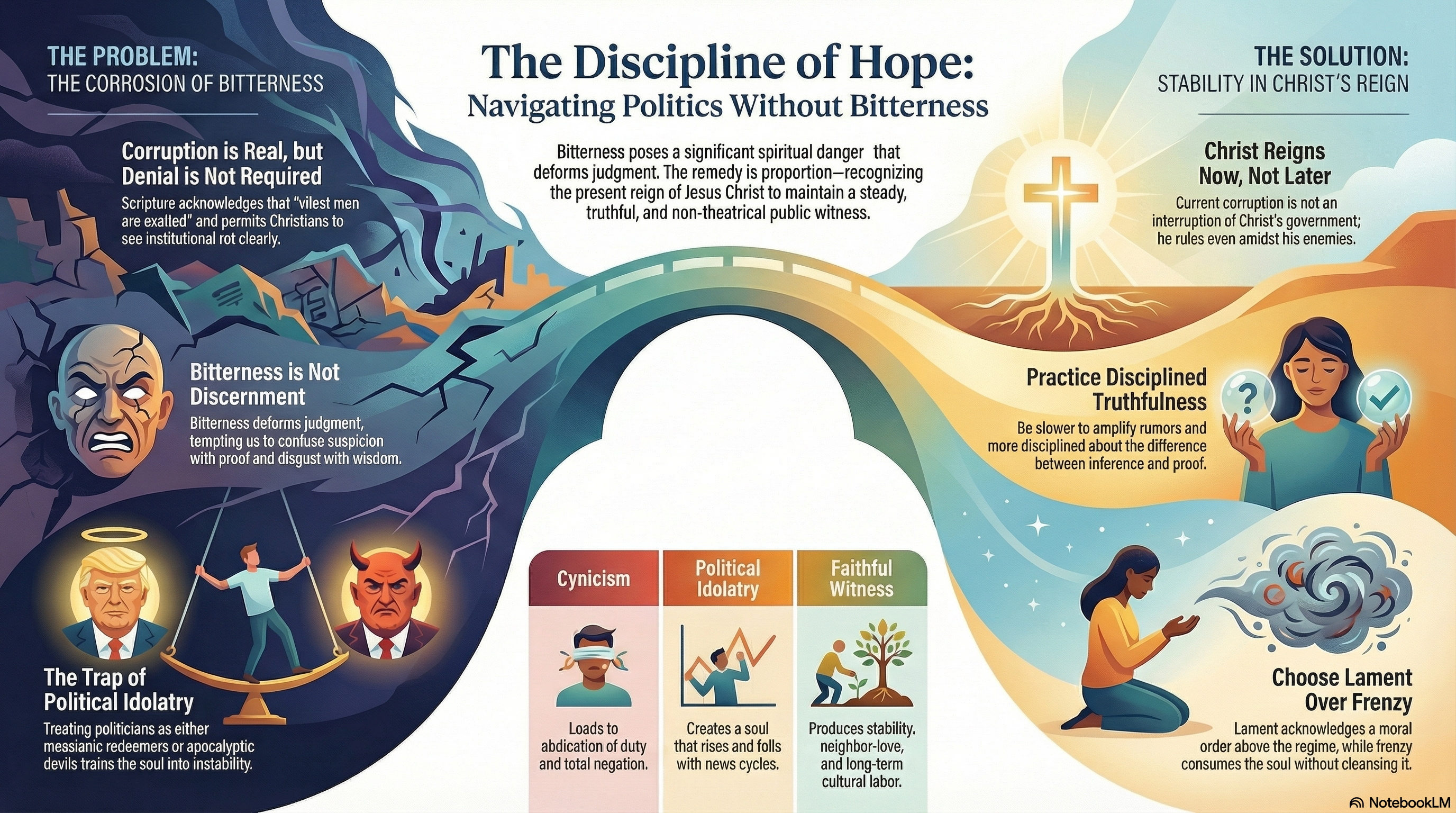
Political corruption is real. Public lies are real. Where propaganda moves markets, where compromise turns cynical, where much of what passes for statecraft is bribery by another name or rhetoric that feeds appetite for war, and where party becomes an idol, these are not imaginary problems. A Christian does not have to deny any of that, wherever it exists, in order to be spiritually healthy. But bitterness is still a spiritual danger, even when the grievance is justified. The Christian answer to political disgust is not naivete, not partisan fanaticism, and not despair. It is the steady confession that Christ reigns now, that princes are not saviors, and that truth-telling, sober judgment, neighbor-love, and patient public faithfulness remain our duty in a crooked age.
1. The Corruption Is Real, and Scripture Does Not Require Denial
The Bible is not sentimental about rulers, courts, or nations. It does not tell believers to pretend that public life is cleaner than it is.
"The wicked walk on every side, when the vilest men are exalted." (, KJV)
"A wonderful and horrible thing is committed in the land; The prophets prophesy falsely, and the priests bear rule by their means; and my people love to have it so." (, KJV)
"Your princes are rebellious, and companions of thieves: every one loveth gifts, and followeth after rewards." (, KJV)
Scripture already has categories for bribery, reward-seeking, manipulation, false witness, and power-serving religion. The modern world has new technologies and new media cycles, but it does not have a new human nature. Men still love gain. Men still flatter for advantage. Men still weaponize fear. Men still pretend to defend righteousness while serving themselves.
That means a Christian is not required to call corruption "statesmanship," propaganda "prudence," or opportunism "strategy." You are allowed to see the rot clearly.
That clarity matters, because false hope in political actors is one of the oldest forms of idolatry in public life.
2. But Bitterness Is Not the Same Thing as Discernment
Seeing corruption clearly is one thing. Letting corruption colonize your inner life is another.
Bitterness often disguises itself as realism. It tells you that because the system is compromised, despair is wisdom. It tells you that because many leaders are cynical, cynicism is maturity. It tells you that because public life is manipulated, trust itself is childish and hope itself is weakness.
Scripture does not speak that way.
"Cease from anger, and forsake wrath: fret not thyself in any wise to do evil." (, KJV)
"Fret not thyself because of evil men, neither be thou envious at the wicked." (, KJV)
"Be not overcome of evil, but overcome evil with good." (, KJV)
Bitterness is dangerous because it feels morally serious while quietly deforming judgment. It narrows the horizon. It tempts a man to speak before he knows, to assume hidden motives without sufficient warrant, to confuse suspicion with proof, and to let disgust become a substitute for wisdom.
That is not strength. It is corrosion.
3. Scripture Cuts the Nerve of Political Idolatry
The first remedy is not a better campaign. It is a lower view of princes and a higher view of Christ.
"Put not your trust in princes, nor in the son of man, in whom there is no help." (, KJV)
"It is better to trust in the LORD than to put confidence in princes." (, KJV)
"Cursed be the man that trusteth in man, and maketh flesh his arm, and whose heart departeth from the LORD." (, KJV)
The modern temptation is not only to support political leaders. It is to invest them with messianic weight. One side treats them as redeemers. The other side treats them as apocalyptic devils. Both errors make politics feel ultimate. Both train the soul into instability.
The Christian must refuse both.
If your peace rises and falls with the latest news cycle, your functional theology is already thinner than your stated theology. If one politician can give you hope that belongs to Christ, or one regime can steal hope that belongs to Christ, then the problem is no longer merely external.
4. Christ Reigns Now, Not Later
The deepest correction to political despair is not "things may improve." The deepest correction is that Christ is already enthroned.
"All power is given unto me in heaven and in earth." (, KJV)
"The LORD said unto my Lord, Sit thou at my right hand, until I make thine enemies thy footstool." (, KJV)
"For he must reign, till he hath put all enemies under his feet." (, KJV)
"And hath put all things under his feet, and gave him to be the head over all things to the church." (, KJV)
That means the age of corruption is not an age outside Christ's government. The age of propaganda is not an age outside Christ's government. The age of lobbyists, oligarchs, compromised rulers, and moral confusion is not an interruption of Christ's reign. It is one of the very settings in which His church is called to bear witness.
This does not make evil good. It does mean evil is not ultimate.
Christ is not waiting for permission to rule. He is ruling now, in the midst of His enemies. That fact should not make Christians passive. It should make them steady.
5. The Christian Cannot Retreat into Cynicism
Once a man sees how dishonest public life can be, the temptation is to retreat into total negation. Everything is fake. Everyone is bought. Nothing matters. Burn it down. Let it fail.
That reaction is understandable. It is also unstable and, in the long run, self-defeating.
"Ye are the salt of the earth... Ye are the light of the world. A city that is set on an hill cannot be hid." (, KJV)
"Occupy till I come." (, KJV)
"As thou hast sent me into the world, even so have I also sent them into the world." (, KJV)
The New Testament does not give the church a retreat ethic. It gives the church a witness ethic. Christians are not called to sanctify the regime, but neither are they called to surrender truth, justice, and neighbor-love just because rulers are compromised.
Cynicism often poses as courage. In practice it usually becomes abdication.
6. Civil Government Is Real, but It Is Not Redemptive
Scripture does not permit political idolatry. Neither does it permit political anarchy of the heart.
"For there is no power but of God: the powers that be are ordained of God." (, KJV)
"For he is the minister of God to thee for good." (, KJV)
"I exhort therefore, that, first of all, supplications, prayers, intercessions, and giving of thanks, be made for all men; For kings, and for all that are in authority." (, KJV)
Civil authority is a real institution of God for public order and the punishment of evil. That means Christians should care about justice, law, public truth, and peace. But the magistrate is not the church, the state is not the kingdom of God, and election results are not redemptive history.
Government can restrain evil. It cannot regenerate the human heart.
That simple distinction keeps a Christian from two opposite errors:
- expecting the state to save what only Christ can save
- treating public life as so worthless that justice no longer matters
Both errors are forms of confusion.
7. Public Lies Require Christians to Become More Truthful, Not More Reckless
When institutions lie, the Christian calling is not to become gullible. But neither is it to become careless.
"He that speaketh truth sheweth forth righteousness: but a false witness deceit." (, KJV)
"Wherefore putting away lying, speak every man truth with his neighbour." (, KJV)
"He that answereth a matter before he heareth it, it is folly and shame unto him." (, KJV)
This matters especially in the age of political spectacle. Once the soul is exhausted, it becomes easy to speak too quickly. The pattern is familiar: a rumor appears, motives are inferred, a hidden hand is assumed, and moral certainty arrives before evidence does. That pattern feels like resistance to propaganda, but it often becomes propaganda's mirror image.
The Christian must be harder to manipulate than that.
He should be slower to conclude, slower to amplify, slower to accuse, and more disciplined about the difference between suspicion, inference, probability, and proof. Not because evil is rare, but because truth is holy.
8. Lament Is Better Than Frenzy
One reason political bitterness becomes spiritually dangerous is that it often suppresses grief and replaces it with agitation.
But grief is not weakness. Lament is one of Scripture's appointed responses to public evil.
"Rivers of waters run down mine eyes, because they keep not thy law." (, KJV)
"Mine eye affecteth mine heart because of all the daughters of my city." (, KJV)
"The LORD is good unto them that wait for him, to the soul that seeketh him." (, KJV)
The man who laments still believes there is a moral order above the regime. He still believes that evil is evil because God is holy. He still believes judgment belongs to God and that mercy remains possible.
Frenzy does something else. It consumes the soul without cleansing it.
If political commentary is making you harder, colder, more suspicious, less prayerful, less patient, and less truthful, it is not disciplining you. It is discipling you.
9. Hope Is Not Optimism About the System
Christian hope does not require confidence that the next election will fix things, that the right coalition will hold, that the market will behave, or that corruption will soon lose its appetite.
Christian hope is anchored elsewhere.
"God is our refuge and strength, a very present help in trouble. Therefore will not we fear, though the earth be removed." (, KJV)
"Thou wilt keep him in perfect peace, whose mind is stayed on thee: because he trusteth in thee." (, KJV)
"Our conversation is in heaven; from whence also we look for the Saviour, the Lord Jesus Christ." (, KJV)
That does not make earthly responsibilities unreal. It puts them in order.
A Christian can work for justice without believing justice will be completed by Congress. A Christian can oppose war propaganda without believing history depends on his own vigilance. A Christian can tell the truth about corruption without becoming spiritually dependent on outrage.
That is freedom.
10. What Faithful Christian Public Life Looks Like
If politics has become spiritually exhausting, the answer is not withdrawal into numbness. It is disciplined, ordered faithfulness.
That means:
- worship that recenters the soul under God's Word
- prayer for rulers, and the honor Scripture commands toward them — "Honour the king" () — without veneration of rulers
- concern for justice without messianic politics
- truthfulness without impulsive accusation
- neighbor-love that remains active in public life
- long-term cultural labor rather than doom-addiction
- hope rooted in Christ's kingdom, not in political theater
The Christian public witness is strongest when it is least theatrical. It does not need hysteria to prove seriousness. It does not need slogans to prove courage. It does not need a permanent state of agitation to prove moral clarity.
It needs stability under the reign of Christ.
Objections and Replies
1. "Isn't this too soft? The corruption is extreme."
No. The essay does not deny corruption. It denies that spiritual deterioration is a faithful response to corruption. A man can be clear-eyed without being consumed.
2. "Doesn't refusing bitterness make you passive?"
No. Bitterness is not the same thing as action. Scripture calls Christians to truth, prayer, courage, justice, and endurance. Those require discipline, not emotional chaos.
3. "If Christ reigns now, why is public life still so crooked?"
Because Christ's present reign does not mean every enemy has already been subdued in history. It means history is moving toward His appointed end under His authority. The existence of rebellion is not evidence of Christ's absence.
4. "So should Christians stop caring about politics?"
No. Christians should care about justice, peace, truth, law, and neighbor-love. They should stop expecting politics to carry the emotional or redemptive weight that belongs only to Christ.
A Reformed Note on Method
This argument is not an attempt to privatize Christianity. It is an attempt to place public life under the ordinary Reformed grammar of providence, sin, vocation, and hope. The Westminster Standards do not teach political messianism. They teach God's providential rule over all things, the moral law's continuing authority, the legitimacy of the magistrate, and the church's duty to remain faithful in every age. The Confession states the magistrate's warrant plainly: "God, the supreme Lord and King of all the world, hath ordained civil magistrates, to be, under him, over the people, for his own glory, and the public good" (WCF 23.1). An office ordained by God for His glory and the public good can be honored, prayed for, and measured against that standard — without being worshiped when it flatters us or despaired over when it fails us.
That is enough. The Christian does not need a prophetic chart, a partisan savior, or a permanent state of outrage to explain his public duty. He needs Scripture, prayer, worship, patience, and the settled conviction that Christ is King.
Conclusion and Handoff
Political bitterness thrives when men expect too much from princes and too little from Christ. The answer is not naivete. The answer is proportion. Rulers matter, but they are not sovereign. Public lies matter, but they do not define reality. Corruption matters, but it is not final. Christ reigns now, and that fact is large enough to steady a soul in a dishonest age.
If you have grown tired, cynical, or spiritually frayed from the spectacle of politics, the call is not to pretend the spectacle is harmless. The call is to come back under the government of Christ, recover the discipline of truth, and refuse to let the system teach your heart how to see.
For the doctrinal foundation beneath this essay, read Covenant Theology and the End Times, Gog and Magog: Why Ezekiel 38–39 Must Not Be Read Through Modern Headlines, and Stop the Atheism Factory elsewhere in this collection. For a deeper examination of how dispensational theology has produced specific political harms, see Prophecy and Power.
Suggested Next Steps
- Read Psalm 2, Psalm 37, and Psalm 146 together. Ask what each psalm forbids and what each psalm commands.
- Audit your media habits for one week. Identify what increases truth, prayer, and patience, and what increases suspicion, agitation, and vanity.
- Read Romans 12-13 together. Notice how personal ethics, public ethics, and civil authority are held in one frame.
- Return to Stop the Atheism Factory and ask what long-term, non-theatrical faithfulness would look like in your own vocation and household.
Audio Discussion
Christ Is King When Politics Makes You Bitter
Infographic
Christ Is King When Politics Makes You Bitter