Essay
Prophecy and Power
Why Dispensationalism Is Not Biblical, and Why Its Political Fruit Has Become Morally Dangerous
By Adam Malin Date: April 6, 2026
"Beware of false prophets, which come to you in sheep's clothing, but inwardly they are ravening wolves. Ye shall know them by their fruits." (--16, KJV) "To do justice and judgment is more acceptable to the LORD than sacrifice." (, KJV)
Thesis
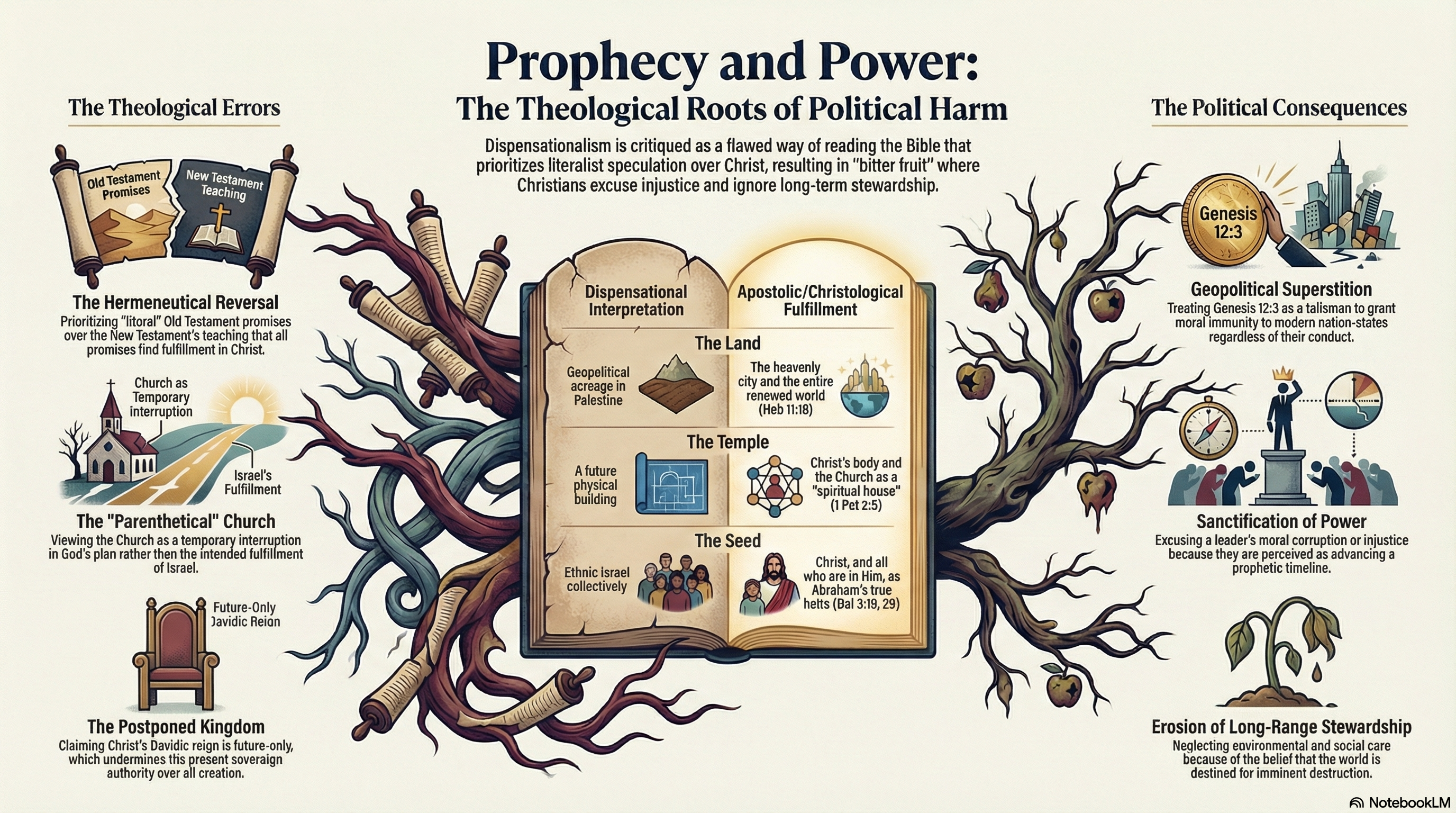
Dispensationalism is mistaken not merely at a few points of prophetic speculation but at the level of hermeneutic -- the way it reads the Bible. Its refusal of the apostolic, Christ-centered reading of the Old Testament has produced a division between Israel and the church that Scripture does not teach, a postponement of the kingdom that contradicts Christ's present reign, and a political theology that has trained many Christians to excuse injustice, sanctify unjust power, and trade long-term faithfulness for short-term prophetic excitement. The biblical alternative is not political quietism but covenantal faithfulness under Christ's present kingship, measured by the whole counsel of God.
Many sincere Christians hold dispensational views because they were taught to love the Bible, expect Christ's return, and honor God's promises. That sincerity should be acknowledged, and nothing in this essay is directed at the piety of individual believers who have been shaped by this tradition. But sincerity does not make a system biblical. A scheme may be earnest and still be wrong; it may promise certainty and yet misread the very Scriptures it claims to defend.
The error, as the thesis states, lies deeper than prophetic speculation: it lies in the hermeneutic itself, and that misreading has borne bitter fruit in public life.
The argument will proceed in five stages. First, that Scripture itself teaches a Christological hermeneutic that dispensationalism violates. Second, that dispensationalism's division of Israel and the church contradicts the New Testament's teaching on the one people of God. Third, that dispensationalism's doctrine of a postponed kingdom undermines the present reign of Christ. Fourth, that these theological errors have produced specific, documentable political harms. Fifth, that the biblical alternative is not political quietism but covenantal faithfulness under Christ's present kingship.
I. The Hermeneutical Error: How Shall We Read the Old Testament?
The question beneath every prophetic question is an interpretive question: How does the Old Testament relate to the New? Our Lord answered this question directly, repeatedly, and without ambiguity. On the road to Emmaus, the risen Christ did not hand His disciples a chart of future dispensations. He taught them to read the whole Old Testament as testimony to Himself:
"And beginning at Moses and all the prophets, he expounded unto them in all the scriptures the things concerning himself." (, KJV)
And again, in the upper room:
"These are the words which I spake unto you, while I was yet with you, that all things must be fulfilled, which were written in the law of Moses, and in the prophets, and in the psalms, concerning me. Then opened he their understanding, that they might understand the scriptures." (--45, KJV)
Note what Christ claims. Not some things, but "all things" written in the Law, the Prophets, and the Psalms -- the entire Old Testament canon -- concern Him and find their fulfillment in Him. This is not a marginal hermeneutical suggestion. It is the risen Lord's own interpretive rule, delivered after the resurrection and before the ascension, precisely to govern how His church would read its Bible.
The apostles followed this rule without deviation. Paul declares: "For all the promises of God in him are yea, and in him Amen, unto the glory of God by us." (, KJV) Every promise of God -- not merely the "spiritual" ones, not merely the ones about personal salvation -- finds its "yes" in Christ. Peter, preaching to Israel, identifies Jesus as the prophet like Moses (--23, citing ), the seed of Abraham in whom "all the kindreds of the earth" are blessed (), and the fulfillment of what "all the prophets from Samuel" had foretold (). The author of Hebrews opens his epistle by declaring that the God who "spake in time past unto the fathers by the prophets" has now spoken "in these last days" by His Son (--2), and then proceeds through the entire epistle to demonstrate that every Mosaic institution -- priesthood, sacrifice, temple, covenant -- has reached its telos in Christ.
The Westminster Confession of Faith articulates the rule that governs this apostolic practice: "The infallible rule of interpretation of Scripture, is the Scripture itself; and therefore, when there is a question about the true and full sense of any Scripture... it must be searched and known by other places that speak more clearly" (WCF 1.9). The clearer passage interprets the less clear. The New Testament, as the final and fullest revelation, governs our reading of the Old. The fulfillment interprets the promise; the substance interprets the shadow.
Dispensationalism reverses this order. Its central hermeneutical commitment is that Old Testament promises to Israel must be read "literally" -- that is, according to their pre-Christ, pre-apostolic, pre-fulfillment sense -- and that the New Testament may not reinterpret, expand, or transform their meaning. As Charles Ryrie stated, the sine qua non of dispensationalism includes "a clear distinction between Israel and the church" maintained by "a consistently literal interpretation" of Scripture. This means, in practice, that when the New Testament appears to apply Old Testament Israel-language to the church, dispensationalism must find a way to preserve the original referent unchanged. The hermeneutical tail wags the exegetical dog: the system's commitment to a certain kind of literalism precedes and controls its reading of the apostolic text.
But the apostles themselves did not read the Old Testament this way. Consider several decisive examples.
The land promise. God promised Abraham and his seed the land of Canaan (; 15:18--21). Dispensationalism insists this requires a future, literal, geopolitical fulfillment for ethnic Israel. But the author of Hebrews tells us that Abraham himself understood the promise more deeply: "By faith he sojourned in the land of promise, as in a strange country... for he looked for a city which hath foundations, whose builder and maker is God." (--10, KJV) Abraham was not ultimately looking for acreage in Palestine. He was looking for the heavenly city. The earthly land was a type; the heavenly country is the antitype. "But now they desire a better country, that is, an heavenly: wherefore God is not ashamed to be called their God: for he hath prepared for them a city." (, KJV) Paul confirms that the promise to Abraham was "that he should be the heir of the world" (, KJV) -- not merely of Canaan, but of the entire renewed creation. The land promise is not cancelled; it is fulfilled on a grander scale than the original hearers imagined.
The temple. Solomon built a magnificent temple, and the prophets promised a future, glorious temple (Ezekiel 40--48). Dispensationalism expects a literal rebuilt temple in a future millennial kingdom. But Jesus declared, "Destroy this temple, and in three days I will raise it up," and John explains: "he spake of the temple of his body" (, KJV). Christ Himself is the true temple where God and man meet. And the church, built on Christ, is likewise called a temple: "ye also, as lively stones, are built up a spiritual house, a holy priesthood, to offer up spiritual sacrifices, acceptable to God by Jesus Christ" (, KJV). Paul says to the Corinthian church: "Know ye not that ye are the temple of God, and that the Spirit of God dwelleth in you?" (, KJV) And in Ephesians, the church of Jew and Gentile together is "built upon the foundation of the apostles and prophets, Jesus Christ himself being the chief corner stone; in whom all the building fitly framed together groweth unto an holy temple in the Lord" (--21, KJV). Ezekiel's temple prophecy is not awaiting a physical building project. It has found its fulfillment in Christ and His body.
The priesthood and sacrifices. The Levitical priesthood offered continual sacrifices. Dispensationalism teaches that animal sacrifices will be resumed in a future millennial temple as "memorials." But the entire argument of Hebrews 7--10 is designed to demonstrate that Christ's priesthood after the order of Melchizedek has superseded the Levitical order permanently: "For the priesthood being changed, there is made of necessity a change also of the law" (, KJV). And Christ's sacrifice is unrepeatable and final: "By the which will we are sanctified through the offering of the body of Jesus Christ once for all" (, KJV). "For by one offering he hath perfected for ever them that are sanctified" (, KJV). To propose a return to animal sacrifices -- even as "memorials" -- is to propose what Hebrews rules out. Advocates of memorial sacrifices grant, of course, that such offerings would not atone; but the argument of Hebrews is not merely that repeated sacrifices cannot atone. It is that the whole shadow economy is finished now that the substance has come: "Now where remission of these is, there is no more offering for sin" (, KJV). If it is asked why the Lord's Supper may memorialize the cross while sacrifices may not, the answer is that the Supper is Christ's own appointed memorial in the new covenant, while restored blood offerings would re-erect the very Levitical order Hebrews declares obsolete and "ready to vanish away" (, KJV). The old sacrifices were "a shadow of good things to come, and not the very image of the things" (, KJV). To reinstate the shadow after the substance has come is not biblical fidelity. It is theological regression.
The seed of Abraham. God promised to bless all nations through Abraham's seed (; 22:18). Dispensationalism reads "seed" as ethnic Israel collectively and treats as a command to support the modern Israeli state. But Paul is explicit: "Now to Abraham and his seed were the promises made. He saith not, And to seeds, as of many; but as of one, And to thy seed, which is Christ" (, KJV). The seed is Christ. And those who are in Christ -- Jew and Gentile alike -- are Abraham's heirs: "And if ye be Christ's, then are ye Abraham's seed, and heirs according to the promise" (, KJV). The blessing-and-curse formula of cannot, on apostolic authority, be reduced to a geopolitical loyalty oath to a modern nation-state.
In sum, the New Testament consistently teaches that the Old Testament's promises regarding land, temple, priesthood, sacrifice, and seed reach their fulfillment in Christ and are applied to His people -- the one church composed of believing Jews and Gentiles. Dispensationalism's hermeneutic requires us to ignore, minimize, or bracket the apostolic interpretation of these texts in favor of a pre-fulfillment reading. That is not a minor methodological preference. It is a systematic refusal of the interpretive authority that Christ and His apostles exercised over the Old Testament.
II. The Ecclesiological Error: One People or Two?
The hermeneutical error produces an ecclesiological one. Because dispensationalism insists on reading Old Testament Israel-promises apart from their New Testament fulfillment, it must maintain a permanent distinction between Israel and the church. In classical dispensational theology, the church is a "parenthesis" -- an interruption in God's program for Israel, unforeseen by the Old Testament prophets, inserted after Israel's rejection of the kingdom and to be removed at the rapture so that God can resume His dealings with national Israel.
Scripture teaches precisely the opposite. The church is not a parenthetical interruption. It is the fulfillment of God's purpose for Israel, the ingathering of the nations that the prophets foresaw, and the one olive tree into which Gentile believers have been grafted.
Paul's argument in Ephesians 2--3 is among the most theologically dense in the New Testament, and it strikes directly at the dispensational division. Before Christ, Gentiles were "aliens from the commonwealth of Israel, and strangers from the covenants of promise, having no hope, and without God in the world" (, KJV). But now, "in Christ Jesus ye who sometimes were far off are made nigh by the blood of Christ. For he is our peace, who hath made both one, and hath broken down the middle wall of partition between us" (--14, KJV). Christ has abolished "the enmity, even the law of commandments contained in ordinances; for to make in himself of twain one new man, so making peace; and that he might reconcile both unto God in one body by the cross" (--16, KJV).
The language could not be plainer. Christ has made Jew and Gentile "one." He has broken down the "middle wall of partition." He has created "one new man" out of "twain." He has reconciled "both unto God in one body." To insist, after reading this passage, that God still maintains two permanently distinct peoples with two distinct programs and two distinct destinies is to contradict Paul's entire argument. The "mystery" that Paul says was hidden in other ages and is now revealed is precisely this: "that the Gentiles should be fellowheirs, and of the same body, and partakers of his promise in Christ by the gospel" (, KJV). Gentile believers are not a parenthetical addendum. They are fellow heirs, members of the same body, partakers of the same promise.
Paul's olive tree metaphor in Romans 11 confirms this unity. The tree is one; unbelieving branches have been broken off; believing Gentiles have been grafted in (--24). The tree is not replaced. The root is not destroyed. But neither is a second tree planted. There is one people of God, one covenant community, one root -- and both Jewish and Gentile believers share in it. Paul's hope for ethnic Israel's future salvation (--27) is not a hope for a separate dispensational program, but a hope that Israel will be grafted back into the same tree, saved by the same Redeemer, under the same covenant.
Peter, writing to Gentile Christians scattered across Asia Minor, applies to them the very language that God had spoken to Israel at Sinai: "But ye are a chosen generation, a royal priesthood, an holy nation, a peculiar people" (, KJV; cf. --6). These are not metaphors loosely borrowed. They are covenant titles transferred to the church because the church is the covenant people. Peter even says of these Gentile believers: "which in time past were not a people, but are now the people of God" (, KJV), echoing Hosea's prophecy about the restoration of Israel ().
The Westminster Confession captures this biblical unity: "The visible Church, which is also catholic or universal under the Gospel (not confined to one nation as before under the law), consists of all those throughout the world that profess the true religion, together with their children" (WCF 25.2). The church is not new in substance. It is the same covenant community, now expanded beyond the borders of one nation to encompass all nations -- exactly as God promised to Abraham.
III. The Eschatological Error: A Postponed Kingdom?
Dispensationalism teaches that Christ came to offer the Davidic kingdom to Israel, that Israel rejected it, and that God therefore "postponed" the kingdom until the millennium, inserting the church age as an interim measure. The kingdom, on this view, is primarily future -- a literal, earthly, political reign of Christ from Jerusalem over a restored national Israel.
The New Testament teaches that the kingdom has already been inaugurated in Christ's first coming, death, resurrection, and ascension.
Jesus began His public ministry with the announcement: "The time is fulfilled, and the kingdom of God is at hand: repent ye, and believe the gospel" (, KJV). The kingdom was not merely offered and then withdrawn. It was inaugurated. "But if I cast out devils by the Spirit of God, then the kingdom of God is come unto you" (, KJV). Jesus' miracles were not previews of a postponed kingdom; they were evidence that the kingdom had arrived in His person and power.
After the resurrection, Christ ascended to the right hand of the Father -- and that ascension was itself the enthronement that the Old Testament had promised. Peter preaches at Pentecost that David, "being a prophet, and knowing that God had sworn with an oath to him, that of the fruit of his loins, according to the flesh, he would raise up Christ to sit on his throne; he seeing this before spake of the resurrection of Christ" (--31, KJV). The Davidic throne promise is fulfilled not in a future millennium but in Christ's present session at the right hand of God. David's throne is occupied. The Davidic king reigns. Peter says so explicitly.
Paul tells the Colossians that the Father "hath delivered us from the power of darkness, and hath translated us into the kingdom of his dear Son" (, KJV). Believers have already been translated into the kingdom. It is not postponed. It is not future. It is a present reality in which every Christian participates by union with the reigning Christ.
Christ's own declaration after the resurrection seals the point: "All power is given unto me in heaven and in earth" (, KJV). Not some power. Not spiritual power only. Not power that will be given at some future date. All power, in heaven and in earth, now. The Great Commission proceeds from this claim: because Christ reigns now, His church is sent to disciple all nations now.
The kingdom will indeed be consummated at Christ's return, when every enemy will be put under His feet and death itself will be destroyed (--26). The church lives between the inauguration and the consummation, between the "already" and the "not yet." But the dispensational claim that the kingdom has been postponed -- that Christ is not now reigning on David's throne, that the kingdom promises are suspended until a future era -- contradicts the explicit teaching of Peter, Paul, and the Lord Himself.
The Westminster Larger Catechism asks, "How doth Christ execute the office of a king?" and answers: "Christ executeth the office of a king, in calling out of the world a people to himself, and giving them officers, laws, and censures, by which he visibly governs them" (WLC 45). Christ's kingship is not a future aspiration. It is a present exercise of sovereign rule over His church and over all creation.
IV. The Political Fruit: How Theological Error Produces Moral Harm
The theological errors traced above -- the refusal of Christological hermeneutics, the division of Israel and the church, the postponement of the kingdom -- are not merely academic. They have produced specific, identifiable, and serious moral consequences in public life. When the interpretive center shifts from Christ to prophetic speculation, political judgment follows the speculation rather than the law of God.
A. The Distortion of and Christian Zionism
If the Abrahamic promises are still directed primarily to ethnic Israel and the modern Israeli state, and if is a standing threat that God will curse any nation or person who does not "bless Israel," then political support for Israel becomes not a prudential judgment but a religious imperative immune from moral scrutiny. This is precisely what has happened.
Christian Zionism is not a fringe phenomenon. Britannica describes it as a religious and political movement deeply shaped by dispensationalism, one that has made support for Israel a central feature of modern American evangelical politics. Christian Zionists commonly appeal to and believe that by blessing Israel they themselves will be blessed by God. The problem is plain: a promise that Paul identifies as fulfilled in Christ and extended to all nations through Abraham's Seed () is re-routed into a superstitious foreign-policy axiom. The blessing promise is treated not as a theological truth to be understood Christologically but as a geopolitical talisman. Britannica explicitly notes that Christian Zionists interpret to mean that supporting Israel is imperative to receive God's blessing.
A recent Washington Post report described the appointment of Mike Huckabee as ambassador to Israel as the fruit of a long evangelical alliance rooted in biblical prophecy, and quoted his appeal to "the promises of Genesis" and the belief that the land belongs to the children of Israel. When theology trains Christians to think that criticism of a state may bring a divine curse, the result is not biblical fidelity. It is political superstition wearing religious clothing.
Yet Scripture itself evaluates nations -- including Israel -- by their conformity to God's moral law, not by their prophetic status. The Old Testament prophets thundered against Israel's sins precisely because Israel was God's covenant people: "You only have I known of all the families of the earth: therefore I will punish you for all your iniquities" (, KJV). Privilege did not exempt Israel from judgment; it intensified judgment. To suggest that the modern state of Israel is exempt from moral criticism because of is to contradict the prophets who spoke under that very covenant.
B. The Organization of Prophetic Lobbying
The distortion is not merely rhetorical; it is organized. Christians United for Israel publicly describes itself as the nation's largest pro-Israel organization, and in 2024 it organized an emergency Washington fly-in in which 250 ministry and community leaders met members of Congress to advocate for Israel aid; it then celebrated both House and Senate passage of that aid as being on "the right side of history and the Word of God."
That phrase -- "the Word of God" -- is the heart of the problem. The Word of God is being deployed not as a standard of justice by which policy is measured but as a slogan for geopolitical pressure. The church ceases to ask first, "What saith the Scripture?" in its full canonical, Christological sense, and instead asks, "How can prophecy be advanced?" That is not exegesis. It is eisegesis deployed as lobbying. It makes Scripture the servant of a political program rather than the judge of all programs.
The prophets knew the difference. Isaiah rebuked Israel for seeking alliances with Egypt rather than trusting God (). Jeremiah condemned the false prophets who cried "Peace, peace" when there was no peace (). The prophetic tradition does not authorize the church to become a lobbying arm for any nation-state. It authorizes the church to speak God's Word to every nation-state, calling for justice, mercy, and righteousness -- and to withhold its blessing from injustice, whoever commits it.
C. The Sanctification of War and the Silencing of Conscience
The same prophetic framework that immunizes Israel from moral criticism also dulls the church's capacity to lament injustice committed by Israel. AP reported that more than 1,400 evangelical Christians gathered in Jerusalem during the Gaza war to show solidarity with Israel even amid growing international criticism of Israel's conduct, and another AP report described evangelical "wartime volunteers" whose support was openly shaped by biblical prophecy.
To be clear: condemning Hamas's wickedness does not require sanctifying every Israeli military action. Justice is not a zero-sum game in which condemning one side's atrocity requires approving the other side's conduct. Yet when prophetic frameworks make one side seem divinely untouchable, civilian suffering is more easily minimized, Palestinian Christians are more easily ignored, and the church becomes less able to apply the Scripture it claims to uphold: "A false balance is abomination to the LORD: but a just weight is his delight" (, KJV). "He that justifieth the wicked, and he that condemneth the just, even they both are abomination to the LORD" (, KJV).
This is one of the most grievous senses in which dispensational politics actively supports evil: it gives spiritual cover to injustice by relocating moral judgment beneath prophetic enthusiasm. The Christian is taught to feel that weighing evidence, acknowledging civilian suffering, or questioning military conduct is tantamount to opposing God's prophetic plan. Conscience is not sharpened; it is sedated.
D. The Accommodation of Domestic Corruption
A similar moral softening can be observed in domestic politics. Pew found in April 2025 that white evangelicals were among Trump's strongest supporters: 72% approved of his job performance and 69% rated the ethics of his top officials as excellent or good. In January 2026, 69% still approved of his job performance, 58% supported all or most of his plans and policies, and 40% were extremely or very confident that he acts ethically in office -- far above the national average.
Not all of this can be attributed to dispensationalism alone. Cultural, racial, and partisan factors are also at work. But the broader pattern is telling and consistent: when a theological movement trains Christians to prioritize perceived prophetic or civilizational wins over the moral character of leaders and the justice of their policies, the predictable result is that character is downgraded and power is sacralized.
Scripture does not allow this exchange. The qualifications for civil rulers in the Old Testament are moral, not strategic: "Moreover thou shalt provide out of all the people able men, such as fear God, men of truth, hating covetousness" (, KJV). David's last words describe the ideal ruler: "He that ruleth over men must be just, ruling in the fear of God" (, KJV). The prophetic warning is absolute: "Woe unto them that call evil good, and good evil; that put darkness for light, and light for darkness" (, KJV). When Christians learn to excuse moral disorder in leaders because those leaders are perceived as friendly to prophetic causes -- whether Israel, religious liberty, or cultural conservatism -- they have traded the biblical standard for a pragmatic one. And pragmatism, unchecked by principle, inevitably slides into complicity.
E. The Erosion of Long-Range Stewardship
There is also evidence that end-times urgency weakens the church's commitment to long-range stewardship. Pew found that 39% of U.S. adults believe humanity is living in the end times, including 63% of evangelical Protestants, and that end-times believers are less likely than others to see climate change as an extremely or very serious problem; those with a premillennialist perspective expressed the lowest levels of concern. Another Pew report found evangelical Protestants were the least likely of major religious groups to view climate change as extremely or very serious.
Correlation is not causation, and not every premillennial Christian neglects environmental stewardship. But the theological logic is clear: if the world is destined for imminent destruction and the church is about to be raptured out of it, investment in the long-term health of creation and society becomes harder to motivate. Why plant trees your grandchildren will enjoy if the rapture will come before the trees bear fruit?
Yet Christ did not teach escape from the world. He taught faithfulness in it. "Occupy till I come" (, KJV). The dominion mandate of has not been rescinded. The earth is the Lord's (), and we are its stewards, not its spectators. "Ye are the salt of the earth... Ye are the light of the world" (--14, KJV). Salt preserves; light illuminates. Neither metaphor suggests withdrawal, escape, or indifference to the long-term health of the creation God has entrusted to us.
The Larger Catechism's exposition of the sixth commandment includes the duty to preserve our own life and the life of others by "a sober use of meat, drink, physic, sleep, labour, and recreations" (WLC 135) -- a principle that implies care for the conditions that sustain life across generations. The eighth commandment requires "an endeavour, by all just and lawful means, to procure, preserve, and further the wealth and outward estate of others, as well as our own" (WLC 141). Stewardship is not a concession to secularism; it is a requirement of the moral law.
F. A Distortion Not Confined to One Party
Honesty requires saying plainly that this failure mode is not the property of one political direction. Twentieth-century liberation theology committed the same error in mirror image: it read Exodus and the prophets as warrant for identifying God's kingdom with particular revolutionary programs, so that a temporal political struggle acquired the authority of redemptive history and its tactics became difficult to criticize from within. And the secularized form of the error survives wherever a policy agenda is announced to be "on the right side of history" -- an eschatological claim stripped of its eschatology, borrowing prophecy's finality to place a platform beyond ordinary moral scrutiny. The mechanism is identical in every case, left or right: once a program is fused with the certainty of God's purposes (or history's), conscience is sedated, opponents become enemies of providence, and the moral law no longer judges the program because the program has been seated above it. The critique of this essay falls on that mechanism wherever it appears; dispensationalism is examined here because it is the form of the error most influential among the Bible-believing churches this site addresses.
V. The Biblical Alternative: Covenantal Faithfulness Under Christ's Present Kingship
The alternative to dispensationalism is not political quietism or theological liberalism. It is the historic Reformed and covenantal understanding of Scripture: that Christ is the fulfillment of all God's promises, that the kingdom has been inaugurated and is advancing, that the church is the one covenant people of God drawn from every nation, and that our public ethic must be governed not by prophecy charts but by the whole counsel of God.
This means several things in practice.
First, the church must read the Bible Christologically. Every promise, every type, every shadow in the Old Testament finds its fulfillment in Christ. Land is fulfilled in the new creation. Temple is fulfilled in Christ's body and His church. Priesthood is fulfilled in Christ's intercession. Sacrifice is fulfilled at Calvary. The seed of Abraham is Christ, and those in Christ are Abraham's heirs. This is not allegory; it is the apostolic hermeneutic, taught by Christ Himself and practiced throughout the New Testament.
Second, the church must refuse to grant any nation-state the moral immunity that belongs to Christ alone. No earthly government -- not ancient Israel, not modern Israel, not the United States -- is exempt from the moral law of God. "Righteousness exalteth a nation: but sin is a reproach to any people" (, KJV). The church blesses the nations not by sanctifying their power but by proclaiming God's law and gospel to them. To bless a nation biblically is to call it to repentance and righteousness, not to provide cover for its sins.
Third, the church must judge leaders by the standard of God's law, not by their perceived usefulness to prophetic or civilizational agendas. "He hath shewed thee, O man, what is good; and what doth the LORD require of thee, but to do justly, and to love mercy, and to walk humbly with thy God?" (, KJV). A leader who serves prophetic interests but governs unjustly is not, by biblical standards, a leader to be endorsed. The fear of the Lord -- not the advancement of a prophetic timeline -- is the beginning of wisdom and the qualification for rule.
Fourth, the church must invest in long-term, intergenerational faithfulness. The kingdom of God is like a mustard seed that grows into a great tree (--32). It is like leaven that works through the whole lump (). These parables do not describe a kingdom postponed or a world abandoned. They describe a kingdom advancing gradually, pervasively, and irresistibly through history. The church is called to plant, build, teach, and disciple for the long term -- "for a thousand generations" (, KJV) -- not to live in a perpetual crouch of rapture expectation.
Fifth, the church must repent of every theology that makes it less truthful, less just, less discerning, and less conformed to Christ. "To do justice and judgment is more acceptable to the LORD than sacrifice" (, KJV). When our eschatology makes us more willing to excuse injustice, less able to lament suffering, more susceptible to propaganda, and more eager to align with power than with truth, that eschatology has borne fruit that our Lord taught us to evaluate: "By their fruits ye shall know them" (, KJV).
VI. Objections and Replies
Objection 1: Romans 11 still promises a future for ethnic Israel. Doesn't that vindicate the dispensational distinction?
Reply. --27 is read by many Reformed interpreters as promising a large ingathering of Jewish people, and this essay does not begrudge that hope; the author reads "all Israel" as the Israel of God — the whole elect, for "they are not all Israel, which are of Israel" (). On either reading, Paul's own metaphor is decisive: branches are grafted back into the same olive tree (--24), saved by the same Redeemer (), under the same covenant. The hope is not for a separate dispensational program but for inclusion in the one people of God by faith in Christ. That is precisely what covenant theology affirms and what dispensationalism, by insisting on two permanently distinct peoples, cannot accommodate without contradicting Paul's unifying argument.
Objection 2: Political engagement is not the same as theocratic lobbying. Many dispensationalists simply support Israel on prudential grounds.
Reply. Granted. Not every dispensationalist who supports Israel does so for prophetic reasons, and not every pro-Israel policy is theologically motivated. This essay critiques the system that weaponizes as a religious trump card against moral scrutiny, not the existence of prudential foreign-policy judgments. But the distinction must be maintained in practice, and the evidence in Section IV shows that the prophetic framing has, at scale, overridden the prudential one. When organizations invoke "the Word of God" to celebrate arms appropriations, the line between prudence and prophecy has already been erased.
Objection 3: You are judging a theology by its worst adherents. Every system has political abuses.
Reply. The critique is not that dispensationalism has bad adherents. Every tradition does. The critique is that dispensationalism's theological structure -- a permanent Israel/church distinction, a postponed kingdom, a hermeneutic that resists Christological fulfillment -- creates specific vulnerabilities to specific political distortions. The fruit is not accidental. When a system teaches that a modern nation-state occupies a unique prophetic role immune from the moral law's ordinary application, the political consequences are predictable and have been documented. Other theological systems may produce other errors; this one produces these.
Objection 4: The correlation between premillennialism and climate apathy does not prove causation. Economic and cultural factors explain the data better.
Reply. This objection has genuine force, and the essay acknowledges it explicitly: "Correlation is not causation." The claim is not that dispensationalism is the sole cause of environmental indifference, but that its theological logic -- imminent destruction, rapture escape, a world destined for burning -- makes long-term stewardship harder to motivate. When 63% of evangelical Protestants believe they are living in the end times, and end-times believers consistently express lower concern for environmental stewardship, the theological contribution to the pattern deserves examination even if it is not the only factor.
Objection 5: This essay is too political for a theology site. Shouldn't the church stay out of partisan disputes?
Reply. The church should indeed refuse to become a partisan organ. But the church cannot refuse to apply Scripture to public life without abandoning the prophetic tradition it claims to inherit. Isaiah, Jeremiah, Amos, and Micah named specific sins of specific rulers and nations. The question is not whether theology has political implications -- it always does -- but whether those implications are governed by the whole counsel of God or by prophetic speculation detached from the moral law. This essay argues for the former.
Objection 6: Progressive dispensationalism has already corrected many of these errors. You are attacking a straw man.
Reply. Progressive dispensationalism has indeed moved closer to covenant theology on several points -- the already/not-yet kingdom, the significance of the church in God's plan, the Christological reading of certain Old Testament texts. That progress is welcome and acknowledged. But progressive dispensationalism still maintains a future, geopolitical program for ethnic Israel distinct from the church's destiny, still expects a literal millennial temple, and still resists the full implications of the apostolic hermeneutic as articulated in this essay. The political consequences described in Section IV are not driven primarily by progressive dispensationalism's academic refinements but by the popular-level dispensational theology that still dominates pulpits, prophecy conferences, and lobbying organizations. The academic correction has not yet reached the pew, and the pew is where the political fruit grows.
Objection 7: You cite secular news sources (AP, Pew, Washington Post) to make theological arguments. Is that legitimate?
Reply. The theological arguments in Sections I--III and V rest entirely on Scripture and the Westminster Standards. The secular sources in Section IV serve a different and limited function: they document the public consequences of the theological errors already established from Scripture. This is the same method the prophets used: they proclaimed God's law and then pointed to observable violations of it. Amos did not need a prophetic oracle to know that Israel was oppressing the poor; the evidence was visible. Similarly, we do not need a proof-text to know that dispensational politics has produced organized lobbying, wartime rallies, and polling patterns -- we need only look. The theological judgment of those patterns, however, comes from Scripture alone.
A Note on Method
This essay makes an argument with two distinct layers, and the reader should be aware of both.
The theological case (Sections I--III, V) is built on Scripture and the Westminster Standards. The hermeneutical, ecclesiological, and eschatological arguments do not depend on secular sources, polling data, or current events. They would stand if Section IV did not exist.
The political-application case (Section IV) uses external evidence -- news reports, polling, organizational statements -- to document the real-world consequences of the theological errors established in the first three sections. This is not an appeal to secular authority over Scripture. It is an application of the biblical principle that a tree is known by its fruit (). The external evidence shows the fruit; the theological argument shows why the tree produced it.
The Westminster Confession affirms that "the light of nature, and the works of creation and providence, do so far manifest the goodness, wisdom, and power of God, as to leave men inexcusable" (WCF 1.1) -- and that general revelation, while insufficient for salvation, is real and observable. The same Confession insists that Scripture is the "supreme judge" in all controversies (WCF 1.10). Section IV observes what general revelation and common experience make plain; Sections I--III and V supply the scriptural judgment. The two layers are complementary, not competing.
Conclusion
The charge must be made plainly and without malice. Dispensationalism is not biblical because it refuses the apostolic rule that all Scripture culminates in Christ and that the shadow yields to the Substance. It divides what God has united -- Jew and Gentile in one body. It postpones what Christ has inaugurated -- the kingdom of God. And in its political form, it has too often become an engine of real harm: training Christians to bless war as such -- whatever a given conflict's merits on prudential grounds -- because prophecy is thought to require it, to excuse corruption, to privilege mythic prophecy over moral law, and to neglect long-term faithfulness for the thrill of apparent prophetic vindication.
That does not mean every dispensational Christian intends evil. But it does mean the system, as a system, has repeatedly furnished evil with religious legitimacy. The tree is known by its fruit. And when the fruit is a church that cannot distinguish between prophetic loyalty and political superstition, that blesses violence it should lament, that excuses corruption it should condemn, and that abandons stewardship it should embrace -- the tree must be examined.
The church must return to the simplicity and profundity of the apostolic gospel: Christ has come. Christ has died. Christ is risen. Christ reigns. Christ will come again. And until He does, we are called not to chart His coming but to obey His commands: to do justice, to love mercy, to walk humbly before our God, to disciple all nations, and to occupy faithfully until He comes.
"For other foundation can no man lay than that is laid, which is Jesus Christ." (, KJV)
Soli Deo Gloria.
Suggested Next Steps
- Read the theological foundation first. If the hermeneutical arguments in Sections I--III are new to you, work through From Dispensationalism to Reformed Covenant Theology and Exegesis First: Case Studies that Correct Dispensational Eisegesis in the Reading Scripture section before returning to this essay's political applications.
- Study the one-people-of-God texts directly. Read Romans 9--11, Ephesians 2--3, Galatians 3, and --10 in a single sitting with a KJV open. Ask: does Paul teach one people or two?
- Read the Westminster Confession chapters 1, 7, and 25 on Scripture's interpretation, the covenant of grace, and the church. These chapters supply the confessional backbone of the argument.
- Test the political-application claims yourself. Read the Pew, AP, and organizational sources cited in Section IV and evaluate whether the essay has represented them fairly. Honest theology demands honest engagement with evidence.
- Apply the "fruit" test to your own political theology. Ask: does my eschatology make me more or less able to lament injustice, evaluate leaders by God's moral law, and invest in long-term faithfulness? If it dulls any of those capacities, the tree deserves examination.
- Continue through the roadmap. For the pastoral response to political bitterness, see Christ Is King When Politics Makes You Bitter. For the eschatological case in detail, work through the Creation and Last Things section.
Essay Video
Prophecy and Power
Audio Discussion
Prophecy and Power
Infographic
Prophecy and Power