Essay
Genesis "Days" & Deep Time in a Reformed Covenant Reading
"In the beginning God created the heaven and the earth." (, KJV) "Through faith we understand that the worlds were framed by the word of God, so that things which are seen were not made of things which do appear." (, KJV)
Thesis
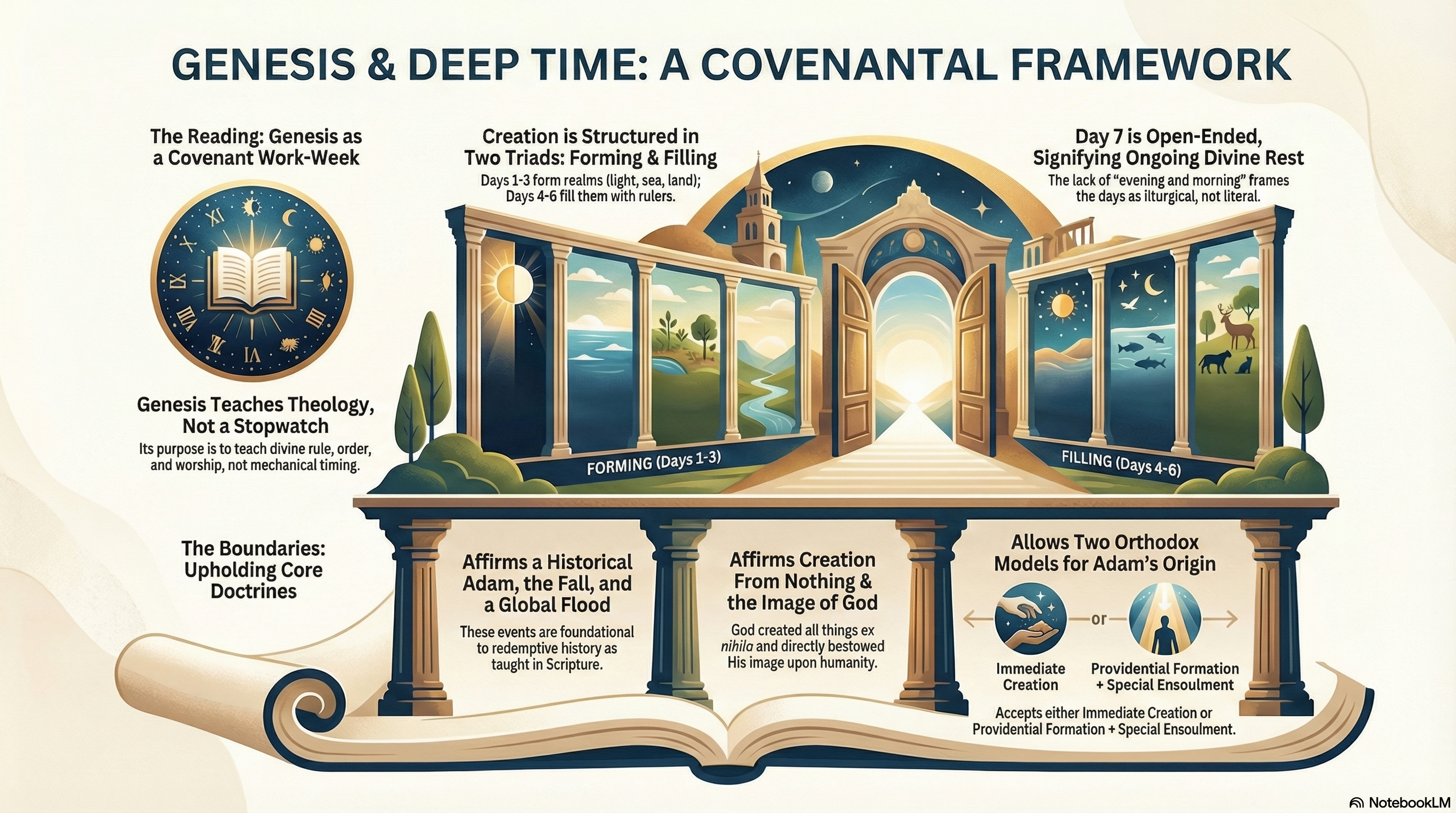
I affirm the inerrancy and sufficiency of Scripture. God created all things ex nihilo — "In the beginning God created the heaven and the earth" (); "Through faith we understand that the worlds were framed by the word of God" (). Read on its own terms, Genesis 1 is a covenantal work-week presentation — real divine acts arranged as six divine workdays culminating in Sabbath enthronement (; ; 31:13–17; Hebrews 4). The text's purpose is to teach rule, order, and worship, not to provide a mechanical stopwatch. Therefore, receiving an ancient cosmos as descriptive timing for God's handiwork does not threaten biblical authority (). Within these bounds we confess a historical Adam and Eve, the direct conferral of the image of God and breath of life (), Adam's federal headship and a real Fall (Romans 5; 1 Corinthians 15), and a global Flood (Genesis 6–9; ).
This essay applies the two-books method laid out in The Two Books: Reading Scripture and Creation Together — exegesis first, then synthesis with what creation shows us.
1) Method: Exegesis before Synthesis
We begin with exegesis — grammar, structure, and canonical context — before asking how Scripture relates to observations of creation. For the full rationale behind reading Scripture and creation together as two witnesses from the same God, see the Two Books essay in the Reading Scripture section.
- Two triads (forming → filling). Days 1–3 form realms (light/dark; sky/sea; land/vegetation). Days 4–6 fill them with rulers (luminaries; birds/fish; animals/humans). The symmetry teaches kingdom order and temple-cosmos themes.
- Open-ended Day 7. Unlike Days 1–6, Day 7 lacks "evening and morning." Hebrews treats God's rest as ongoing (). The cadence functions as liturgical brackets, not a time code.
- Sabbath telos. Exodus 20 grounds Israel's six-and-one rhythm in God's pattern; Exodus 31 calls the Sabbath a covenant sign.
Guardrails
- Science-off test: If modern science vanished, would this reading remain? Yes — because it arises from the text's own signals.
- Confession-on test: Historic Reformed confessions say God created "in the space of six days." Many subscribers understand that clause to mean ordinary days, and that reading has a serious claim to be what the divines themselves intended; it should be stated fairly before any alternative. The reading offered here takes the clause as safeguarding order and sequence rather than defining human clock-length — honoring the pattern, sequence, and Sabbath without imposing a metric the text does not specify. Readers should weigh both understandings of the clause; the question of the Assembly's intent is taken up in §7 below.
2) Confessional Boundaries (Reformed Covenant)
- Creation ex nihilo by the Triune God (; ).
- Six "days" as God's ordered work pattern, culminating in Sabbath rest (; ; 31:13–17).
- Historical Adam and Eve, the Fall, and a real, catastrophic Flood (; ; Genesis 6–9; ).
- Sabbath as covenant sign and archetype of eschatological rest (Psalm 95; Hebrews 3–4).
Implication: With these non-negotiables in place, believers may evaluate descriptive claims about timing in God's world without capitulating on theology or history.
3) What "Day" (yom) Is Doing in Genesis 1–2: A Cumulative Case
The question is not whether yom can mean a 24-hour day — it obviously can. The question is whether the text requires that meaning here. The following lines of evidence build a cumulative case that it does not.
Evidence 1: Yom carries multiple senses within Genesis 1 itself
In , God calls the light "Day" (yom) — meaning daylight, the bright portion of the cycle. But the same verse then says "the evening and the morning were the first day" — using yom to mean the entire work-period, including the darkness. Within a single verse, the word carries two distinct senses. Context governs.
Evidence 2: uses yom for the whole creation span
"These are the generations of the heavens and of the earth when they were created, in the day that the LORD God made the earth and the heavens." (, KJV)
Here yom summarizes the entire creation sequence — all six days — as a single "day." If the author intended yom to mean exclusively "24 hours" throughout, this summary would be incoherent. Instead, it signals that yom functions flexibly in this very context.
Evidence 3: uses yom idiomatically
"But of the tree of the knowledge of good and evil, thou shalt not eat of it: for in the day that thou eatest thereof thou shalt surely die." (, KJV)
Adam did not die within 24 hours of eating. He died at age 930 (). "In the day" here means "when" — an idiomatic temporal marker, not a clock specification. The same Hebrew construction appears in Genesis 1's creation narrative.
Evidence 4: Luminaries are not appointed until Day 4
"And God said, Let there be lights in the firmament of the heaven to divide the day from the night; and let them be for signs, and for seasons, and for days, and years." (, KJV)
The sun and moon — the instruments that define and measure solar days — are not created until Day 4. Days 1–3 proceed without them. If the "days" were ordinary solar days measured by the earth's rotation relative to the sun, the absence of the sun for three of them is a problem. The text's own sequence indicates that the "days" are structured by God's acts, not by solar mechanics.
The 24-hour reading has a serious rebuttal here, and it deserves to be stated in its strongest form: light itself is created on Day 1 ("Let there be light"), and the evening-and-morning cycle runs from the first day onward. On that view, Day 4 does not need to create light or the day–night alternation at all; it creates the luminaries that will thereafter carry a cycle already in motion, and Days 1–3 could be ordinary days measured by the alternation of the light God Himself supplied before the sun. That reply is coherent, and it clears the 24-hour reading of any charge of internal contradiction. But notice what it does not answer. The argument being made here is not that Days 1–3 were impossible without the sun; it is that the narrative's ordering is topical rather than chronometric. On Day 4 the luminaries are appointed as the timekeepers — "and let them be for signs, and for seasons, and for days, and years" () — installed to govern the very units the narrative has been counting since Day 1, and to "rule" the day and the night (). A chronometric log would not appoint its measuring instruments three days into the count. A topical work-week presentation would — because its interest is rule, order, and worship, not clock calibration. Both readings can account for the data; the question is which one the text's own arrangement commends, and the appointment of the timekeepers on Day 4 is the text's own signal that the week is God's workweek pattern, not a stopwatch record.
Evidence 5: "Evening and morning" as bounded work-phases
The refrain "and the evening and the morning were the nth day" is a merism — a literary device that names the boundaries to indicate the whole (like "searched high and low" means "searched everywhere"). It marks the close of one divine work-phase and the opening of the next. It is a structuring formula, not a time-measurement report.
Evidence 6 (Capstone): Day 7 has no "evening and morning"
This is the strongest single piece of evidence. Every one of Days 1–6 concludes with "and the evening and the morning were the nth day." Day 7 does not. The formula is deliberately omitted. The author of Hebrews draws out the implication:
"For he that is entered into his rest, he also hath ceased from his own works, as God did from his. Let us labour therefore to enter into that rest, lest any man fall after the same example of unbelief." (, KJV)
God's seventh-day rest is ongoing. It did not end after 24 hours. Believers are still invited to enter it. If Day 7 is not a 24-hour period — and Hebrews 4 makes clear it is not — then the "evening and morning" formula is not functioning as a strict time code for the other six days either. It is a literary and liturgical device marking bounded phases of God's creative work.
Conclusion
No single point here is decisive in isolation. Together, they form a cumulative case: yom is flexible within the chapter, the author uses it to span the whole creation in , the luminaries that define solar days are not present until Day 4, the refrain functions as literary structure rather than time measurement, and Day 7's open-endedness — confirmed by the New Testament — removes the last basis for insisting on 24-hour days as the text's required meaning. Genesis presents analogical workdays — God's archetypal pattern grounding our weekly rhythm — without requiring human-length solar days.
4) Providence & Means: God's Two Ways of Working
God acts extraordinarily (miracles) and ordinarily (providence). "The lot is cast into the lap; but the whole disposing thereof is of the LORD" (). If He orders lots and kings, He may govern biological processes without ceasing to be Creator.
Scripture itself warns against assuming that God's time and human time are interchangeable:
"For a thousand years in thy sight are but as yesterday when it is past, and as a watch in the night." (, KJV)
"But, beloved, be not ignorant of this one thing, that one day is with the Lord as a thousand years, and a thousand years as one day." (, KJV)
Peter's context is eschatological — he is answering scoffers who say the Lord delays His coming — but the principle he invokes is broader: God's relationship to time is not ours. A "day" in God's reckoning is not bound by the clock that governs human experience. This does not prove that the creation days are long ages; it simply removes the assumption that they must be 24 human hours. The text must determine its own meaning — and as shown above, the text's own signals point to analogical workdays, not solar-day specifications.
5) Adam, Dust, and the God-Breathed Image
God formed man of the dust and breathed life so that man became a living soul (). Humanity alone bears the imago Dei () with a royal-priestly vocation.
What the Confession requires — and where it leaves room
The Westminster Confession (4.2) states:
"After God had made all other creatures, he created man, male and female, with reasonable and immortal souls, endued with knowledge, righteousness, and true holiness, after his own image; having the law of God written in their hearts, and power to fulfil it."
The Westminster Larger Catechism (Q17) teaches:
"After God had made all other creatures, he created man male and female; formed the body of the man of the dust of the ground, and the woman of the rib of the man, endued them with living, reasonable, and immortal souls; made them after his own image."
Notice what these statements bind: that God created man, that man possesses a reasonable and immortal soul, that the soul bears God's image in knowledge, righteousness, and holiness, and that Adam is historical and federal head. They specify the result — image-bearing, ensouled, covenantally constituted humanity — not the biological mechanism by which the body was formed. The language "formed the body of the man of the dust of the ground" echoes without elaborating on what "of the dust" entails in natural terms. One element, however, must be stated honestly: the catechism's parallel clause — "and the woman of the rib of the man" — resists any providential-process account, for no ordinary natural process forms a woman from a man's rib; Eve's formation must be received as special creation on any model.
Both the PCA Creation Study Committee Report (2000) and the OPC report on creation have acknowledged the legitimacy of multiple views on the duration of the creation days while insisting on the non-negotiable historicity of Adam and the Fall.
Two models
Within these confessional bounds, two models have been proposed that aim to preserve every theological requirement:
-
Immediate/Special Creation: God specially creates an original pair directly and confers the image. This is the most traditional reading and remains fully confessional.
-
Providential Formation + Special Ensoulment: God providentially forms the human body over time through ordinary means — what science might observe as natural processes — and, at a real historical moment, directly confers the rational soul, the imago Dei, and installs Adam as federal head under the Covenant of Works.
In both models, Adam is historical, the Fall is real, the image is bestowed by God's direct act (not emergent from biology), and Adam stands as the covenantal representative whose sin brings death to all men (; ). The second model distinguishes the historical Adam from any pre-Adamic hominids, who would have been creatures without the divine image or federal standing.
The two models do not stand on equal confessional footing. Model 1 is uncontroversial confessionally. Model 2 is held by some in confessional churches, but several Reformed courts have judged evolutionary or mediate formation of Adam's body to be out of accord with the Standards, and candidates and officers in those bodies are bound accordingly. The confessional boundaries define what must be true of Adam; whether Model 2 stays within them is itself a matter of live ecclesiastical dispute, not a settled liberty.
6) Old-Earth as Theological Synthesis (Special + General Revelation)
After exegesis, we turn to God's other book. The two-books method (see the Reading Scripture section) teaches us to receive creation's testimony as genuine divine speech while holding Scripture's theological claims as normative. What does creation say about timing?
The testimony of creation
The following lines of evidence are independent of each other — each stands on its own, using different physical systems and methods. Their convergence across unrelated disciplines is the strongest argument: for all of them to be wrong, multiple unrelated natural constants and processes would all have to be mistaken in exactly the same coordinated way.
Starlight travel time. The Andromeda galaxy is approximately 2.5 million light-years from Earth. Light travels at a fixed, measurable speed — approximately 186,000 miles per second. The light arriving from Andromeda tonight left that galaxy 2.5 million years ago. Deep-field observations from the Hubble and James Webb telescopes reveal galaxies whose light has traveled over 13 billion years to reach us. This is not theoretical modeling; it is direct measurement of distance and the known speed of light. Young-universe proposals — such as light created already "in transit" — require that God fabricated a detailed history of events (supernovae, galaxy collisions, stellar evolution) that never occurred. This makes God the author of a false record in His own creation, which contradicts and the two-books doctrine.
Stellar lifecycles. Across the night sky, we observe stars at every stage of their existence: stellar nurseries where new stars are forming (the Eagle Nebula's "Pillars of Creation"), main-sequence stars burning steadily (our sun), red giants expanding as they exhaust their fuel (Betelgeuse), and the remnants of stars that have already died (the Crab Nebula, produced by a supernova recorded by Chinese and Arab astronomers in 1054 AD). These stages take millions to billions of years. The Hertzsprung-Russell diagram — plotting stellar luminosity against temperature — shows the full lifecycle laid out across observed stellar populations. We are watching God's providence unfold across eons.
Supernova 1987A. On February 23, 1987, a star exploded in the Large Magellanic Cloud — a satellite galaxy approximately 168,000 light-years from Earth. Astronomers observed the light from the explosion arriving at Earth in 1987, meaning the light traveled for 168,000 years. But the confirmation goes further: neutrinos from the same explosion were detected by instruments in Japan, the United States, and the Soviet Union hours before the visible light arrived, exactly as physics predicts (neutrinos escape the collapsing core before the shockwave reaches the surface). This is not a theoretical model; it is a single observed event whose distance, light travel time, and neutrino signature all cohere. The universe is testifying to its own age through events we can watch in real time.
Cosmic microwave background radiation. The CMB is a faint glow of microwave radiation that fills the entire sky uniformly, with a temperature of approximately 2.7 Kelvin. It is the afterglow of the early universe — the point at which matter cooled enough for light to travel freely. The CMB's existence, temperature, and tiny fluctuations (mapped in extraordinary detail by the COBE, WMAP, and Planck satellites) match the predictions of a universe approximately 13.8 billion years old. No known alternative explanation accounts for the CMB's uniformity, spectrum, and anisotropy pattern.
Ice cores. The EPICA Dome C core drilled in Antarctica contains approximately 800,000 annual layers, each marked by summer-winter oscillation in oxygen-isotope ratios. The GISP2 core from Greenland extends to approximately 110,000 years. These are not theoretical estimates; they are countable annual layers, like tree rings, verified by matching volcanic ash deposits to independently dated eruptions at the expected depths.
Radiometric convergence. Multiple independent radioactive decay systems — uranium-lead, potassium-argon, rubidium-strontium, samarium-neodymium — yield concordant ages for the same rock samples using completely different elements and decay rates. The oldest known terrestrial mineral crystals (zircons from Jack Hills, Western Australia) date to approximately 4.4 billion years by uranium-lead analysis. The strength of this evidence lies in convergence: for the ages to be wrong, multiple unrelated physical constants would all have to be wrong in exactly the same coordinated way — which is not a simpler explanation than accepting the results.
Dendrochronology. Bristlecone pine chronologies in the American Southwest extend continuously to approximately 10,000 years through overlapping sequences of living and dead wood. When calibrated against radiocarbon dating, the two independent methods confirm each other. Each tree ring is a literal annual growth layer, countable and cross-verifiable.
Plate tectonics. GPS satellites measure continental drift in real time: the Atlantic Ocean is widening at approximately 2.5 centimeters per year. Running that rate backward over the ocean's current width yields approximately 200 million years — consistent with radiometric dating of basalt at the Mid-Atlantic Ridge. Magnetic striping on the ocean floor records periodic reversals of Earth's magnetic field frozen into cooling rock, providing an independent geological clock.
This is creation speaking — and what it says is consistent across every independent line of evidence. Starlight, stellar lifecycles, supernovae, the cosmic microwave background, ice cores, radiometrics, tree rings, and plate tectonics all point in the same direction using completely unrelated physical systems. The convergence is the testimony.
What this means theologically
Receiving this testimony does not rewrite Genesis, because Genesis proclaims who created and why — questions that creation cannot answer on its own. Creation tells us what God's works look like when examined closely, including their timing. Thus:
- No need for strained fixes (e.g., light created "in transit," accelerated nuclear decay, or an "appearance of age" that implies divine deception).
- Vast ages can be understood as God's ordinary providence operating in a "very good" world — the same providence by which He governs lots, kings, and sparrows (; ).
- Scripture retains normative authority for theology and history; nature offers descriptive testimony about timing as God's handiwork ().
"The works of the LORD are great, sought out of all them that have pleasure therein." (, KJV)
7) Common Objections
1. "What about death before the Fall?"
This is the most common objection, and it deserves careful treatment.
"Wherefore, as by one man sin entered into the world, and death by sin; and so death passed upon all men, for that all have sinned." (, KJV)
Paul's argument is precise: sin entered through Adam, and death through sin, and death spread to all men (eis pantas anthropous). The scope of the death Paul describes is explicitly human. He does not say "death passed upon all creatures." The entire argument of is about the parallel between Adam and Christ as federal heads of humanity — not as representatives of the entire biological world.
is sometimes cited: creation "groaneth and travaileth in pain together until now." But note that creation was subjected to futility "in hope" (v. 20) — this futility is connected to the redemptive arc leading to the "glorious liberty of the children of God" (v. 21). Paul is describing creation's present bondage and its future liberation, not making a statement that no animal ever died before Adam sinned.
gives green herbs as food to animals, but this is a provision, not a comprehensive statement that all animals were herbivorous. The text does not address carnivory or animal death directly. specifies the curse: the ground is cursed for Adam's sake, and Adam will return to dust. The theological weight of the Fall is human death and the curse on the ground — not the absence of all biological death in the pre-Fall creation.
Many orthodox Reformed theologians have held that animal death before the Fall is consistent with Scripture's teaching, while insisting that human death is the wages of sin (). B.B. Warfield — the Princeton theologian who formulated the classic defense of biblical inerrancy — wrote plainly that the question of the age of the earth and the means of creation are not settled by Scripture:
"The question of the antiquity of man has of itself no theological significance. It is to theology, as such, a matter of entire indifference how long man has existed on earth." (B.B. Warfield, "On the Antiquity and the Unity of the Human Race," 1911)
Charles Hodge, Herman Bavinck, and the authors of the PCA Creation Study Report all held compatible positions. What the Westminster Assembly itself intended by "in the space of six days" is debated among Reformed historians: David Hall has argued at length that the divines meant ordinary days, while Robert Letham and others read the clause as chiefly targeting Augustine's view of instantaneous creation rather than fixing the days' duration. That historical question remains open. What can be said with confidence is that several Reformed denominations today (including the PCA and OPC, per their study reports) allow ministers to hold multiple views of the days, while others require the ordinary-day reading.
2. "Does the analogical-day reading undermine inerrancy?"
No. Inerrancy binds us to what the text intends to assert. If the intent is a work-week analogy that grounds Sabbath observance and teaches kingdom order, then reading it that way is fidelity, not evasion. The Chicago Statement on Biblical Inerrancy (Article XIII) explicitly states: "We deny that it is proper to evaluate Scripture according to standards of truth and error that are alien to its usage or purpose." Reading Genesis 1 as a scientific chronology is precisely the kind of alien standard the statement warns against.
3. "What about ?"
"For in six days the LORD made heaven and earth, the sea, and all that in them is, and rested the seventh day: wherefore the LORD blessed the sabbath day, and hallowed it." (, KJV)
This is the strongest proof text for 24-hour days, and it deserves a direct answer.
grounds the Fourth Commandment in God's creation pattern. The command says: Israel should work six days and rest on the seventh, because God worked six days and rested on the seventh. The question is whether the analogy requires identical duration — that God's days and Israel's days are the same length — or whether it requires identical pattern — that the six-and-one rhythm of work and rest is the structural point.
Three considerations favor pattern over duration:
First, the analogy is between pattern, not clock time. Israel's workday is approximately 12 hours. No one claims God's creative work on each "day" lasted exactly 12 hours. The analogy works because of the structure (six units of work, one of rest), not because of identical measurement.
Second, if requires identical duration for the work-days, it equally requires identical duration for the rest-day. But teaches that God's seventh-day rest is ongoing — believers today are still invited to enter it. If Day 7 is not 24 hours, the duration argument for Days 1–6 loses its foundation.
Third, the context is covenantal and liturgical. identifies the Sabbath as a sign of the covenant between God and Israel. The purpose of is to ground Israel's weekly calendar in God's archetypal work-pattern — to sanctify the rhythm of labor and rest as a covenantal institution. That pattern is real and historical; the precise duration of God's workdays is not the point being established.
4. "Isn't this just accommodating science?"
Not if the interpretive move is made from the text outward. The analogical/framework reading stands on literary features internal to Genesis (the two triads, the missing Day 7 formula, the flexible uses of yom, the Day 4 problem). These features were noted by theologians long before modern geology existed. Scientific descriptions of deep time then speak to timing, not theology — the descriptive testimony of creation received under Scripture's normative authority.
5. "What about the Flood?"
Scripture teaches a global judgment in Noah's day and an abiding Noahic covenant (Genesis 6–9; ). The theological claims — universal judgment, covenant faithfulness, typological anticipation of final judgment () — are non-negotiable. Peter explicitly uses the Flood as a type of the coming final judgment: "the world that then was, being overflowed with water, perished: But the heavens and the earth, which are now, by the same word are kept in store" ().
What is at stake theologically is the universality of the judgment and the faithfulness of the Noahic covenant — not a particular geological reconstruction of the event. The Hebrew word for "earth" (eretz) can refer to the whole globe or to a region (as in "the land of Egypt," "the land of Canaan"). Some Reformed scholars have noted that "all the earth" in Genesis may describe the inhabited world known to the narrator — a universal judgment on all humanity — without requiring that every square mile of the planet's surface was simultaneously submerged. Others hold to a geographically global flood. Both positions preserve the theological claims: God judged the entire human race, saved Noah's family by grace through the ark, and established an everlasting covenant with all flesh. The confession does not hinge on any one post-Flood geological model.
6. "Do genealogies fix the earth's age?"
Biblical genealogies often telescope to trace covenant lineage, not to yield exhaustive chronologies. Matthew 1 omits known kings from 1 Chronicles. Genesis 5 and 11 may do the same. The genealogies establish covenantal continuity from Adam to Abraham to Christ; they were not designed as a chronometric tool for calculating the age of the earth.
8) Payoffs
- Confidence: Scripture's authority stands; we need not fear telescopes or microscopes.
- Worship: A cosmos proclaiming God's glory across eons enlarges praise ().
- Sabbath & vocation: God's six-and-one pattern dignifies labor and rest (; 31:13–17).
- Gospel clarity: A real Adam and the real Christ remain the backbone of redemptive history (Romans 5; 1 Corinthians 15).
Appendix A — KJV Passages to Memorize
- — "In the beginning God created the heaven and the earth."
- — "And the LORD God formed man of the dust of the ground, and breathed into his nostrils the breath of life; and man became a living soul."
- — "For in six days the LORD made heaven and earth, the sea, and all that in them is, and rested the seventh day: wherefore the LORD blessed the sabbath day, and hallowed it."
- — "The heavens declare the glory of God; and the firmament sheweth his handywork."
- — "The lot is cast into the lap; but the whole disposing thereof is of the LORD."
- — "Wherefore, as by one man sin entered into the world, and death by sin; and so death passed upon all men, for that all have sinned."
- — "The first man is of the earth, earthy: the second man is the Lord from heaven."
- — "But, beloved, be not ignorant of this one thing, that one day is with the Lord as a thousand years, and a thousand years as one day."
- — "Whereby the world that then was, being overflowed with water, perished."
Appendix B — Two-Models Language (for mixed audiences)
Within the Reformed Covenant boundaries above: creation ex nihilo (; ); a real Adam and Eve in God's image (); God's special act of breathing life (); a Covenant of Works and the Fall with death through Adam (Romans 5); salvation in the last Adam, Jesus Christ (1 Corinthians 15). On the mechanism of human biological origins, Scripture binds us to a historical Adam under God's special action; Christians have differed over whether God formed the human body immediately (special creation of an original pair) or mediately (providentially over time) with special appointment/ensoulment of Adam and Eve — though the mediate view has been ruled out of bounds by some Reformed courts, and Eve's formation from Adam's rib is special creation on any account. In all cases, the imago Dei is directly conferred by God, Adam's federal headship is real, and the Fall is historical.
Conclusion
The analogical/framework interpretation, read through a Reformed Covenant lens, is a robust and confessional way to affirm everything Genesis teaches and to receive what the heavens and earth describe about deep time. This is exegesis first, then synthesis — Scripture and nature speaking in harmony, to the glory of the one Creator and Redeemer.
"The works of the LORD are great, sought out of all them that have pleasure therein." (, KJV)
A Word on Unity
Within the Reformed churches, the length of the creation days is an in-house difference among brothers who confess the same Creator, the same ex nihilo creation, the same historical Adam, the same Fall, and the same Christ. The PCA and OPC study committees both concluded that a range of views can be held in good faith within the Standards. If you remain persuaded of the ordinary-day reading, nothing in this essay asks you to surrender anything the confession requires — only to receive a brother who reads the days analogically as standing inside the same confession, not outside it. "Let every man be fully persuaded in his own mind" (, KJV). Paul's charity in disputable matters binds both directions: no contempt from the one side, no judgment from the other (). What is not disputable among us is the Creator, the covenant, and the Christ.
Where the Story Goes Next
Creation is where the Bible's story begins; the rest of this section traces where it ends. The same method applied here to the first things — exegesis first, genre honored, Scripture interpreting Scripture — governs the reading of the last things. Continue with Covenant Theology and the End Times, which lays out the framework the remaining essays apply: Christ reigns now, and His kingdom will be consummated at His return.
Suggested Next Steps
- Read :3 in one sitting, marking the forming days (1–3) against the filling days (4–6) — and noting what Day 7 lacks.
- Read alongside . Ask: does the Sabbath command require identical duration, or identical pattern?
- Read the PCA Creation Study Committee Report (2000) to see the range of views a confessional court judged to be in good faith.
- Revisit The Two Books: Reading Scripture and Creation Together for the method this essay applies.
- Proceed to Covenant Theology and the End Times to begin the last-things walkthrough.
Essay Video
Genesis "Days" & Deep Time in a Reformed Covenant Reading
Audio Discussion
Genesis "Days" & Deep Time in a Reformed Covenant Reading
Infographic
Genesis "Days" & Deep Time in a Reformed Covenant Reading