Essay
The Two Books: Reading Scripture and Creation Together
A Reformed Method for Holding General and Special Revelation in Harmony
By Adam Malin Date: March 24, 2026
"The heavens declare the glory of God; and the firmament sheweth his handywork. Day unto day uttereth speech, and night unto night sheweth knowledge." (, KJV) "For the invisible things of him from the creation of the world are clearly seen, being understood by the things that are made, even his eternal power and Godhead; so that they are without excuse." (, KJV)
Thesis
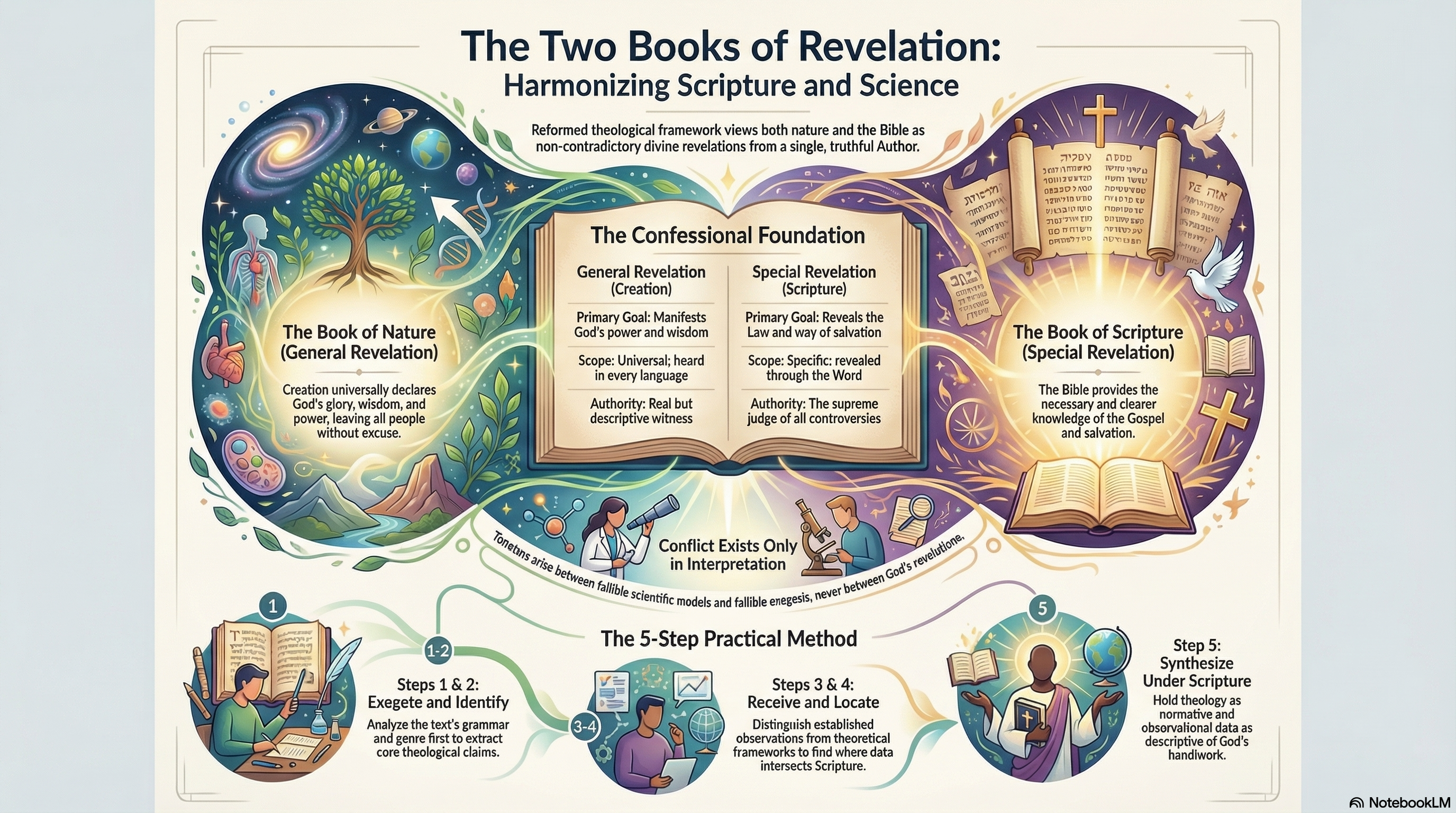
God reveals Himself through two books: Scripture (special revelation) and creation (general revelation). Both are infallible as revelation, because God does not lie. Both require fallible human interpretation. When apparent conflict arises between what Scripture teaches and what creation shows, the problem lies not in God's speech but in our reading of one book or the other — or both. Scripture remains the supreme judge of all controversies of religion (WCF 1.10), and creation's testimony is genuine divine speech that a faithful reader receives rather than suppresses. This essay lays out the confessional foundation for that conviction and a practical method for reading the two books together.
1. The Confessional Foundation
The "two books" doctrine is not an accommodation to modern science. It is confessional Reformed orthodoxy, grounded in Scripture itself.
Psalm 19: One Psalm, Two Witnesses
Psalm 19 is God's own outline of the doctrine. The first six verses address creation's witness:
"The heavens declare the glory of God; and the firmament sheweth his handywork. Day unto day uttereth speech, and night unto night sheweth knowledge. There is no speech nor language, where their voice is not heard." (, KJV)
Creation is speaking — really speaking — about God. This is not metaphor stretched past its meaning. The verbs are active: the heavens declare, the firmament shows, day utters speech. The scope is universal: there is no speech nor language where their voice is not heard.
But the Psalm does not stop there. Beginning at verse 7 it turns to the written Word:
"The law of the LORD is perfect, converting the soul: the testimony of the LORD is sure, making wise the simple." (, KJV)
So within one inspired Psalm you have creation-witness and Scripture-witness — two modes of revelation from the same God. Creation reveals His power and wisdom; Scripture reveals His law, His gospel, and the knowledge necessary for salvation.
: Real Knowledge, Not Mere Suggestion
Paul teaches the same doctrine with a sharper edge:
"For the wrath of God is revealed from heaven against all ungodliness and unrighteousness of men, who hold the truth in unrighteousness; Because that which may be known of God is manifest in them; for God hath shewed it unto them. For the invisible things of him from the creation of the world are clearly seen, being understood by the things that are made, even his eternal power and Godhead; so that they are without excuse." (, KJV)
Paul's argument requires that creation communicates real knowledge — not vague impressions, but truth sufficient to leave men "without excuse." If creation did not speak truly, the accusation would be unjust. But God is just, and creation does speak truly.
The Westminster Confession (1.1)
The Westminster divines codified this doctrine in the opening sentence of the Confession:
"Although the light of nature, and the works of creation and providence, do so far manifest the goodness, wisdom, and power of God, as to leave man inexcusable; yet are they not sufficient to give that knowledge of God, and of his will, which is necessary unto salvation."
Two things are affirmed simultaneously: (1) the light of nature and God's works truly reveal Him, and (2) they are not sufficient for saving knowledge. Both affirmations matter. The first means creation's testimony is real revelation. The second means Scripture is necessary revelation. Neither cancels the other.
The Belgic Confession (Article 2)
The Belgic Confession is even more explicit:
"We know God by two means: First, by the creation, preservation, and government of the universe, since that universe is before our eyes like a beautiful book in which all creatures, great and small, are as letters to make us ponder the invisible things of God… Second, He makes Himself known to us more openly by His holy and divine Word."
Creation is a "beautiful book" written by God. Scripture is the clearer and fuller revelation. Both are genuine witnesses. Both demand to be read.
Additional Scripture: Creation's Witness Is Pervasive
The two-books testimony is not confined to Psalm 19 and Romans 1. Scripture returns to it repeatedly:
"He hath made the earth by his power, he hath established the world by his wisdom, and hath stretched out the heavens by his discretion." (, KJV)
"Lift up your eyes on high, and behold who hath created these things, that bringeth out their host by number: he calleth them all by names by the greatness of his might, for that he is strong in power; not one faileth." (, KJV)
Psalm 104 is an extended meditation on God's work in creation — water, wind, mountains, springs, beasts, birds, the sea — all testifying to the Creator's wisdom: "O LORD, how manifold are thy works! in wisdom hast thou made them all: the earth is full of thy riches" (). Job 38–41 records God Himself appealing to creation as witness: the foundations of the earth, the storehouses of snow, the habits of the wild goat, the strength of Leviathan — all presented as evidence of divine wisdom that Job must receive rather than dismiss. And Paul tells the pagans at Lystra that God "left not himself without witness, in that he did good, and gave us rain from heaven, and fruitful seasons, filling our hearts with food and gladness" () — creation's testimony is a witness that even those without Scripture receive.
The breadth of this biblical testimony — Psalms, prophets, wisdom literature, apostolic preaching — confirms that the two-books doctrine is not a narrow inference from one or two verses. It is a pervasive biblical theme.
Augustine: The Literal Meaning of Genesis
The two-books instinct predates the Reformation by over a millennium. Augustine of Hippo, in De Genesi ad Litteram (c. 415 AD), warned Christians against making confident scientific claims on the basis of Scripture and then being embarrassed when those claims prove false:
"Usually, even a non-Christian knows something about the earth, the heavens, and the other elements of this world… and this knowledge he holds to as being certain from reason and experience. Now, it is a disgraceful and dangerous thing for an infidel to hear a Christian, presumably giving the meaning of Holy Scripture, talking nonsense on these topics." (De Genesi ad Litteram, I.19.39)
Augustine was not undermining Scripture's authority. He was insisting that Christians must not attribute to Scripture claims it does not make, lest they bring the faith into disrepute. His concern was exegetical honesty — the same concern that drives the two-books method.
Calvin: The Theater of Glory
John Calvin, in the Institutes (I.v.1), calls creation "this most glorious theater" — the theatrum gloriae Dei. God displays His attributes in every corner of the natural world. But Calvin also insists (I.vi.1) that sinful man needs the "spectacles" of Scripture to read the book of nature rightly. Without Scripture, we suppress the truth (). With Scripture, we read creation as what it is: the handiwork of the God who also speaks in the Word.
Francis Bacon: The Two Books as Method
Francis Bacon — a devout Christian and the father of the modern scientific method — articulated the two-books principle explicitly in The Advancement of Learning (1605):
"Let no man… think or maintain, that a man can search too far or be too well studied in the book of God's word, or in the book of God's works; divinity or philosophy; but rather let men endeavour an endless progress or proficience in both."
Bacon held that studying creation was a religious duty precisely because creation is God's handiwork. He warned against two equal errors: neglecting Scripture for philosophy, and neglecting creation for a narrow reading of Scripture. The modern scientific enterprise, at its origin, was driven by the conviction that both books deserve to be read.
Warfield and Bavinck: The Princeton and Dutch Reformed Tradition
The two-books doctrine was not abandoned by the great Reformed theologians of the modern era. B.B. Warfield, the Princeton theologian and champion of biblical inerrancy, wrote explicitly about the relationship between Calvin's doctrine of creation and the testimony of the natural world:
"Calvin's doctrine of creation is, if we have understood it aright, for all its brevity, a very rich and suggestive one. The act of creation itself he ascribed to the decree of God and found its account in the bare fiat of God. But he carefully distinguishes between the originating act and the subsequent ordering of the world." (B.B. Warfield, "Calvin's Doctrine of the Creation," 1915)
The quotation itself shows Warfield's account of Calvin's doctrine: creation by the bare fiat of God, followed by God's providential ordering of the world. On the separate question of the earth's age, Warfield held that Scripture's authority and an ancient earth were fully compatible — not as a concession, but because, on his exegesis, Scripture does not fix the earth's age. Herman Bavinck, the leading Dutch Reformed dogmatician, taught the same: general and special revelation cannot contradict each other because they share the same divine Author. Both men insisted on inerrancy; both received creation's testimony about age without embarrassment.
The point is not that creation and Scripture are equal in authority. It is that both are real — both are God's speech, and God cannot contradict Himself.
2. The Critical Distinction: Revelation vs. Interpretation
This is the key that keeps the whole framework honest:
- God's revelation in creation is true. God does not lie through His works.
- God's revelation in Scripture is true. God does not lie through His Word.
- Our interpretation of creation (scientific models, reconstructions, theoretical frameworks) can be mistaken.
- Our interpretation of Scripture (exegesis, harmonizations, systematic deductions) can be mistaken.
When an apparent conflict appears, the conflict is always between human interpretations — never between God's revelations. The history of the church proves the point. The church once read "the world also is stablished, that it cannot be moved" () and "the sun riseth" () as cosmological claims about a stationary earth. They were not wrong to trust Scripture. They were wrong about what Scripture was asserting. The text describes the sun's daily course from a terrestrial perspective; it does not teach geocentric physics. When observational evidence made this clear, the church corrected its exegesis — not its doctrine of Scripture. This was not a defeat for biblical authority; it was the two-books method working exactly as it should — creation's testimony prompting a more careful reading of what Scripture actually claims.
The same principle operates wherever Scripture and creation appear to disagree. The question is never "Is Scripture true?" (it is). The question is: "Have I correctly identified what Scripture is claiming in this passage, and have I correctly read the evidence from creation?"
3. Scripture as Supreme Judge
The two-books framework does not place Scripture and creation on equal footing. Scripture holds a unique authority:
"The supreme judge by which all controversies of religion are to be determined, and all decrees of councils, opinions of ancient writers, doctrines of men, and private spirits, are to be examined, and in whose sentence we are to rest, can be no other but the Holy Spirit speaking in the Scripture." (WCF 1.10)
Scripture is the norming norm for theology. Creation does not overrule Scripture's theological claims. When Scripture says God created all things, that God made man in His image, that Adam fell, that death entered through sin — these are theological affirmations that stand on the authority of the Holy Spirit speaking in the text. No observational finding can overturn them.
But this cuts both ways. If Scripture is the supreme judge, then we must be careful to let Scripture say what it actually says — and not attribute to it claims it does not make. Reading a modern scientific framework into Genesis is as much an error as reading Genesis out of the canon. The supreme authority of Scripture demands honest exegesis: what is this passage asserting, in its grammar, genre, and canonical context?
This is where the practical method begins.
4. The Practical Method: Five Steps
When a question involves both Scripture and the natural world — creation's timing, the age of the earth, the origin of species, the structure of the cosmos — the following method keeps a Reformed reader both faithful and honest.
Step 1: Exegete the Text
Begin with Scripture. What does the passage assert in its grammar, genre, literary context, and canonical setting? Do not begin with the scientific question. Let the text speak first. If the passage is poetry (Psalm 104), treat it as poetry. If it is narrative (Genesis 1–2), identify what the narrative form is doing. If it is law (), ask what the legal context demands. Exegesis before synthesis.
Step 2: Identify the Theological Claim
What is the passage teaching — about God, about humanity, about sin, about redemption, about the created order? This is the load-bearing content. Genesis 1 teaches that God is Creator, that He made all things by His Word, that He ordered creation purposefully, that He made man in His image, and that He rested and sanctified the seventh day. These are theological claims.
Step 3: Receive the Observational Data
What does creation actually show through careful, repeatable investigation? Distinguish between established observations (the measured light of distant stars, present isotopic ratios, counted ice-core layers, measured continental drift rates) and the framework-dependent inferences drawn from them — including the age estimates those observations are commonly taken to imply, as well as particular cosmological models and evolutionary reconstructions. Observations are what creation says. Inferences and frameworks are human interpretation of what creation says — and like exegesis, they can be revised.
Step 4: Locate the Intersection
Where does the text's claim overlap with the observational domain? Many biblical claims have no observational intersection at all. "God is sovereign" is not an empirical claim. "God created man in His image" is a theological claim about dignity and relation, not a claim about biological mechanism. Where there is genuine intersection — the timing of creation, the age of the earth, the reality of a global flood — both witnesses speak to the same question and both deserve to be heard.
Step 5: Synthesize Under Scripture's Authority
Where intersection exists, hold the theological claim as normative and the observational data as descriptive. Scripture tells us who created, why, and what it means. Creation tells us what the works look like when examined closely. If tension remains after careful exegesis and careful observation, acknowledge the limit of current understanding on one or both sides. Do not resolve the tension by silencing either witness. God speaks in both.
5. What This Method Rules Out
Three errors fall outside the boundaries of this framework:
Concordism forces Scripture to say what modern science says, or forces science to say what a particular reading of Scripture demands. It treats Genesis as a science textbook or treats scientific papers as exegetical commentary. Both distortions collapse the distinction between the two books and their respective domains.
Fideism dismisses creation's testimony as irrelevant, deceptive, or beneath notice. But God is not a deceiver. Psalm 19 says the heavens declare. Romans 1 says creation clearly shows. To refuse creation's testimony is to refuse God's own speech.
Scientism treats empirical investigation as the only source of real knowledge. But and WCF 1.1 affirm knowledge that comes through creation but is not reducible to laboratory measurement — knowledge of God's "eternal power and Godhead." And Scripture itself is a knowledge source that no empirical method can access. The two-books framework affirms that reality is wider than what a microscope can see.
Common Objections
1. "This is just accommodating science."
No. The method begins with exegesis and holds Scripture as supreme judge. It receives creation's testimony because Scripture itself commands it (Psalm 19, Romans 1). Accommodation would mean letting a scientific consensus override a clear textual claim. This method does the opposite: it asks what the text actually claims before comparing. If exegesis yields a clear, non-negotiable assertion — God created ex nihilo, Adam is historical, the Fall is real — that assertion stands regardless of what any model proposes. But if exegesis reveals that a passage is not asserting what we assumed (as with geocentrism), then correction is faithfulness, not capitulation.
2. "General revelation is suppressed by sinful man (). How can we trust science?"
The suppression Paul describes in Romans 1 is theological — men know God exists through creation and refuse to honor Him. It does not mean that empirical observation is universally unreliable. The doctrine of common grace affirms that unbelievers, by God's restraining and enabling grace, can discover true things about the created order. Calvin himself taught this plainly:
"If we regard the Spirit of God as the sole fountain of truth, we shall neither reject the truth itself, nor despise it wherever it shall appear, unless we wish to dishonour the Spirit of God." (Institutes, II.ii.15)
The Canons of Dort (III/IV.4) affirm that after the Fall, "there remain in man… some notions about God, natural things, and the difference between what is moral and immoral, and a regard for virtue and outward order." The fields of medicine, navigation, agriculture, and engineering all depend on this reality. A surgeon's unbelief does not make his anatomy wrong. The suppression is of the theological conclusion ("therefore glorify God"), not of the observational data ("the bone is connected here").
Moreover, itself presupposes that creation communicates truly. Paul's argument is that men suppress the truth — real knowledge that creation genuinely delivers. If creation's testimony were unreliable, there would be nothing to suppress and no ground for the accusation. The very passage used to question creation's witness actually depends on creation being a faithful witness.
3. "Doesn't this make Scripture subject to science?"
Only if you confuse revelation with interpretation. The method subjects interpretations of both books to scrutiny. Scripture's revelation remains the supreme judge. When observational evidence prompts a reexamination of our exegesis, the result is not that science has overruled Scripture. The result is that one witness has prompted us to read the other more carefully — which is exactly what should happen when both witnesses come from the same God.
The geocentrism correction is the clearest historical example. No orthodox Christian today believes the church was wrong to hold Scripture's authority; the church was wrong about what Scripture was asserting on that particular question. The same principle applies whenever creation's testimony pressures an exegetical assumption.
4. "Didn't the Fall corrupt creation so that it no longer speaks truly?"
The Fall subjected creation to futility (), but it did not turn creation into a liar. Psalm 19 was written after the Fall — and it declares that the heavens still declare God's glory and the firmament still shows His handiwork. was written to describe the post-Fall world — and Paul says creation still clearly shows God's eternal power. If the Fall had destroyed creation's capacity to testify truthfully, these passages would be meaningless. The two-books doctrine is a post-Fall doctrine: it describes how the world works now, under the curse, by the sustaining providence of God who "upholdeth all things by the word of his power" (). Creation groans — but it does not deceive.
A Note on Reformed Method
The two-books framework is not an innovation. It is not a concession to modernity. It is confessional Reformed orthodoxy: the Westminster Confession opens with it (1.1), the Belgic Confession names it (Article 2), Calvin builds on it (Institutes I.v–vi), and the Psalms teach it (Psalm 19; Psalm 104). The practical method outlined here simply makes that confessional conviction operational — giving the reader a repeatable process for holding both books open at the same time.
One clause deserves honest mention. The same Confession says that God created all things "in the space of six days" (WCF 4.1), and confessional Reformed bodies do not read that clause identically: some hold that it fixes the days as ordinary days, while others — including the study committees of the OPC and the PCA — have judged that more than one understanding of the days lies within confessional bounds. The detailed treatment of that question belongs to the Genesis Days essay later in the walkthrough; the method claims of this essay stand on either reading.
Every Reformed Christian already practices this method implicitly. When you take medicine, you trust creation's testimony about how the body works. When you plant crops, you trust creation's testimony about soil and seasons. When you navigate by the stars, you trust creation's testimony about the positions and distances of celestial objects. The only question is whether you will extend that trust to the testimony of creation when the topic turns to origins — or whether you will treat that particular domain as the one place where God's handiwork cannot be believed.
Conclusion
God cannot contradict Himself. If He speaks truly in Scripture — and He does — and if He speaks truly in creation — and He does — then any apparent contradiction is a signal to examine our interpretations, not to silence either witness. The two-books method does not weaken biblical authority; it strengthens it by refusing to attribute to Scripture claims it does not make, and by receiving creation's testimony as what it is: the speech of the same God who inspired the Word.
The walkthrough now turns from the reading of God's two books to the reading of His covenants: From Dispensationalism to Classic Reformed Covenant Theology traces the whole journey from a system of divided peoples and postponed promises to the one covenant of grace fulfilled in Christ. The question of the creation days themselves is treated later in the walkthrough, in Genesis Days and Deep Time, where the principles laid out here — exegesis first, theological claims as normative, observational data as descriptive, synthesis under Scripture's authority — do the heavy lifting.
"The works of the LORD are great, sought out of all them that have pleasure therein." (, KJV)
Suggested Next Steps
- Read Psalm 19 as a single psalm, noting the transition from creation's voice (vv. 1–6) to the law of the LORD (vv. 7–11). Ask: what is the relationship between these two sections?
- Read Genesis 1–2 using the five-step method. Identify the theological claims before asking any scientific questions.
- Continue the walkthrough with From Dispensationalism to Classic Reformed Covenant Theology. The first full application of this framework comes later in the series, in Genesis Days and Deep Time.
Audio Discussion
The Two Books: Reading Scripture and Creation Together
Infographic
The Two Books: Reading Scripture and Creation Together