Essay
God’s Chosen People: Election, Not Race
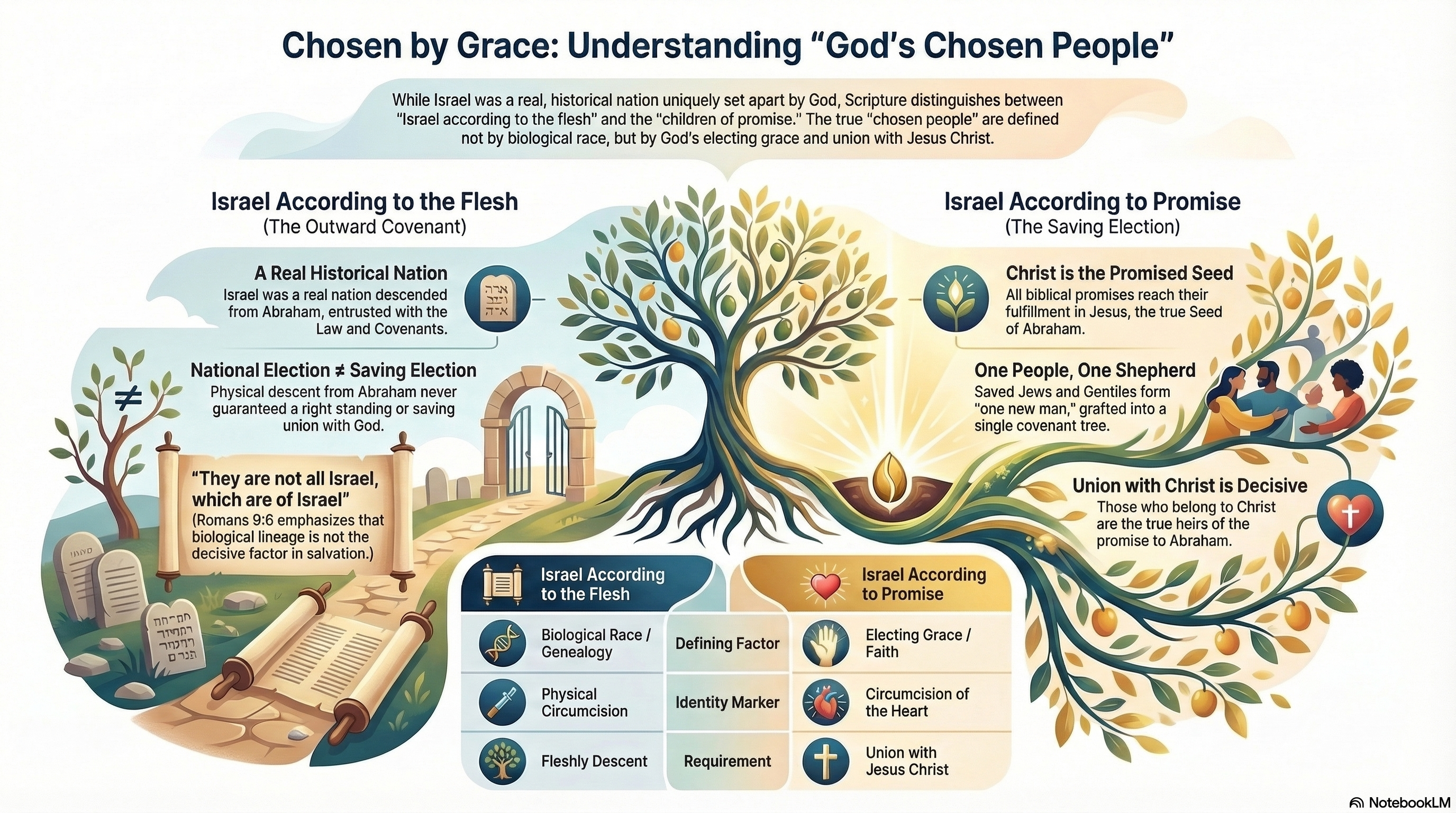
“They which are the children of the flesh, these are not the children of God: but the children of the promise are counted for the seed.” (, KJV)
“And if ye be Christ’s, then are ye Abraham’s seed, and heirs according to the promise.” (, KJV)
The phrase “God’s chosen people” is often used carelessly. In popular speech it is treated as though it simply means a biological race, a bloodline, or a permanent ethnic category carrying saving privilege in itself. Scripture does not speak that way. The Bible absolutely teaches that Israel was a real historical nation, specially set apart by God in the progress of redemption. But Scripture just as clearly teaches that the saving people of God are not defined by fleshly descent. They are defined by God’s electing grace in Christ.
That distinction matters. If it is missed, people begin to speak as though race carries redemptive power, as though genealogy can do the work of grace, or as though political loyalties deserve a sacred status they do not possess. But if the Bible’s own categories are allowed to govern, the picture becomes clear: God chose Israel outwardly as a covenant nation in history, yet the true heirs of promise have always been the elect united to the Messiah by grace through faith.
Thesis
Scripture teaches two things that must never be confused.
First, God chose Israel outwardly as a real covenant nation in history. He gave to them the covenants, the law, the temple service, the promises, and from them Christ came according to the flesh.
Second, that outward national election was never identical to saving election. The saving people of God were always the children of promise, the remnant according to election, the sheep given by the Father to the Son.
Therefore, when Christians speak in the fullest redemptive sense about “God’s chosen people,” they should mean the elect in Christ, not an ethnic group considered merely according to race.
1. Israel Was Truly Chosen in History
Any faithful treatment of this subject must begin by rejecting caricature. Israel was not imaginary. Israel was not merely a metaphor for the church in the Old Testament. Israel was a real nation, descended from Abraham, Isaac, and Jacob, set apart by God in history for covenant privilege and redemptive purpose.
“For thou art an holy people unto the LORD thy God: the LORD thy God hath chosen thee to be a special people unto himself, above all people that are upon the face of the earth. The LORD did not set his love upon you, nor choose you, because ye were more in number than any people; for ye were the fewest of all people: But because the LORD loved you, and because he would keep the oath which he had sworn unto your fathers, hath the LORD brought you out with a mighty hand, and redeemed you out of the house of bondmen, from the hand of Pharaoh king of Egypt.” (, KJV)
“Who are Israelites; to whom pertaineth the adoption, and the glory, and the covenants, and the giving of the law, and the service of God, and the promises; Whose are the fathers, and of whom as concerning the flesh Christ came, who is over all, God blessed for ever. Amen.” (, KJV)
Those verses are decisive. God really did choose Israel as a covenant people in the administration of redemptive history. The law, the temple service, the promises, and the Messiah according to the flesh all came through that nation. Any view that denies Israel’s real historical place in God’s plan is not biblical.
But that is not yet the whole question. The issue is not whether Israel was chosen outwardly in history. The issue is whether outward national election is the same thing as saving election. Scripture’s answer is no.
2. Fleshly Descent Never Guaranteed Saving Status
The Bible repeatedly destroys the idea that physical descent from Abraham, by itself, makes a man right with God.
John the Baptist confronted precisely that presumption:
“And think not to say within yourselves, We have Abraham to our father: for I say unto you, that God is able of these stones to raise up children unto Abraham.” (, KJV)
Our Lord said the same thing even more sharply in John 8. The Jews appealed to Abrahamic descent, but Jesus refused to let biological connection replace spiritual reality:
“They answered and said unto him, Abraham is our father. Jesus saith unto them, If ye were Abraham's children, ye would do the works of Abraham.” (, KJV)
“Jesus said unto them, If God were your Father, ye would love me: for I proceeded forth and came from God; neither came I of myself, but he sent me.” (, KJV)
“Ye are of your father the devil, and the lusts of your father ye will do. He was a murderer from the beginning, and abode not in the truth, because there is no truth in him. When he speaketh a lie, he speaketh of his own: for he is a liar, and the father of it.” (, KJV)
A word of care is required here. Jesus is addressing specific unbelieving interlocutors in a first-century dispute — men who were seeking to kill Him () — not Jews as a people. This verse has been wickedly abused in church history to slander the Jewish people, and Christians must repudiate that abuse without qualification.
That is devastating to every racialized notion of covenant privilege. Here were men who really were Abraham’s descendants according to the flesh. Yet Christ tells them that their spiritual fatherhood is not determined by their bloodline, but by their relation to Himself and to the truth of God.
Paul says the same in Romans:
“For he is not a Jew, which is one outwardly; neither is that circumcision, which is outward in the flesh: But he is a Jew, which is one inwardly; and circumcision is that of the heart, in the spirit, and not in the letter; whose praise is not of men, but of God.” (, KJV)
And Moses had already established the principle long before:
“Circumcise therefore the foreskin of your heart, and be no more stiffnecked.” (, KJV)
“And the LORD thy God will circumcise thine heart, and the heart of thy seed, to love the LORD thy God with all thine heart, and with all thy soul, that thou mayest live.” (, KJV)
So the issue is not complicated. Outward Israel was real. Circumcision was real. Genealogy was real. But none of those realities, considered in themselves, ever guaranteed saving union with God. From the start, the Bible pressed past the flesh to the heart.
3. Scripture Explicitly Distinguishes Israel According to the Flesh from Israel According to Promise
This is not merely an implication. Paul states it directly.
“Not as though the word of God hath taken none effect. For they are not all Israel, which are of Israel: Neither, because they are the seed of Abraham, are they all children: but, In Isaac shall thy seed be called. That is, They which are the children of the flesh, these are not the children of God: but the children of the promise are counted for the seed.” (, KJV)
That text must govern the entire discussion. Paul is answering the question of whether God’s word has failed in light of widespread Jewish unbelief. His answer is not, “God’s word cannot fail because all ethnic Israelites remain savingly chosen.” His answer is the opposite: the word has not failed because Scripture never taught that all who belong to Israel outwardly belong to Israel savingly.
Paul distinguishes:
- Israel according to the flesh
- the children of promise
- the true seed counted by God
That means race cannot be the final category. Biological descent is real, but it is not decisive. The decisive category is promise, and promise comes to fulfillment in Christ.
This is one of the most important points in the whole debate. If is allowed to speak plainly, then every simplistic claim that “God’s chosen people” means an ethnic class in the saving sense immediately collapses.
4. Not All Israelites Were Elect Unto Salvation
Once Paul’s distinction is grasped, another conclusion follows necessarily: not all Israelites were elect unto salvation.
Paul says this with exactness:
“Even so then at this present time also there is a remnant according to the election of grace.” (, KJV)
“What then? Israel hath not obtained that which he seeketh for; but the election hath obtained it, and the rest were blinded.” (, KJV)
And he had already cited Isaiah to the same effect:
“Esaias also crieth concerning Israel, Though the number of the children of Israel be as the sand of the sea, a remnant shall be saved.” (, KJV)
A remnant is not the whole. The election obtained it; the rest were blinded. Therefore the nation as nation cannot be identical with the elect as elect.
This preserves two truths at once.
First, Israel was genuinely chosen outwardly and historically.
Second, saving election was narrower than national privilege.
That is exactly how the Bible speaks. To flatten those two things into one is to make Scripture less precise than it actually is.
5. Saving Election Is Grounded in Christ, Not in Race
The deepest reason race cannot be the defining category of God’s chosen people is that saving election is grounded in Christ Himself, before any man ever appears in history.
Paul writes:
“According as he hath chosen us in him before the foundation of the world, that we should be holy and without blame before him in love: Having predestinated us unto the adoption of children by Jesus Christ to himself, according to the good pleasure of his will.” (, KJV)
And Christ says:
“All that the Father giveth me shall come to me; and him that cometh to me I will in no wise cast out.” (, KJV)
The order matters. The elect are chosen in Christ. They are given to Christ. They come through Christ. Scripture does not say that men are savingly elect because they belong to a certain race and are therefore later attached to Christ. It says the opposite: election is Christ-centered from the start.
That is why outward covenant privilege, however real, can never be identical with saving election. National Israel belongs to history. Election belongs to God’s eternal purpose in His Son. The two are related in redemptive history, but they are not the same thing.
6. The Elect Have Always Been Saved by Christ, Never by Race
The saving people of God have never been redeemed by ethnicity, ceremony, or national status. They have always been redeemed by the Messiah.
Abraham himself was justified by faith:
“And he believed in the LORD; and he counted it to him for righteousness.” (, KJV)
Paul explains the Abrahamic promise in explicitly gospel terms:
“And the scripture, foreseeing that God would justify the heathen through faith, preached before the gospel unto Abraham, saying, In thee shall all nations be blessed.” (, KJV)
Hebrews says the fathers lived and died in faith:
“These all died in faith, not having received the promises, but having seen them afar off, and were persuaded of them, and embraced them, and confessed that they were strangers and pilgrims on the earth.” (, KJV)
And Christ said of Abraham:
“Your father Abraham rejoiced to see my day: and he saw it, and was glad.” (, KJV)
Old Testament believers were not saved by belonging to the right ethnicity. They were saved by the promised Christ, apprehended by faith through promise, type, shadow, and prophecy. New Testament believers are saved by the same Christ now openly revealed in the gospel.
So the continuity of Scripture is not racial continuity. The continuity is Christological continuity. The elect in every age are saved by the same Mediator.
7. Christ Is the Promised Seed, and Therefore the Promises Are Centered in Him
The question “Who are God’s chosen people?” cannot be answered rightly unless Christ stands at the center. Paul does not allow the promises to terminate in race as such. He takes the Abrahamic promise directly to Christ:
“Now to Abraham and his seed were the promises made. He saith not, And to seeds, as of many; but as of one, And to thy seed, which is Christ.” (, KJV)
And then he gives the controlling principle:
“For all the promises of God in him are yea, and in him Amen, unto the glory of God by us.” (, KJV)
That is why the New Testament can read Israel’s calling and destiny through Christ Himself. Matthew applies , originally spoken of Israel, to Jesus:
“And was there until the death of Herod: that it might be fulfilled which was spoken of the Lord by the prophet, saying, Out of Egypt have I called my son.” (, KJV)
Christ is not merely one more Israelite inside the story. He is the faithful fulfillment of Israel’s calling. He is the true Seed, the true Son, the true Servant, the true Heir. If the promises are concentrated in Him, then participation in the promises must be by union with Him, not by race considered apart from Him.
This is one of the central errors in ethnicized theology: it attempts to handle covenant promise without making Christ the decisive interpretive center. Paul will not permit that move.
8. Therefore, All Who Are in Christ Are Abraham’s Seed and Heirs of the Promise
Once Christ is seen as the promised Seed, Paul’s next conclusion follows with full force:
“For ye are all the children of God by faith in Christ Jesus. For as many of you as have been baptized into Christ have put on Christ.” (, KJV)
“There is neither Jew nor Greek, there is neither bond nor free, there is neither male nor female: for ye are all one in Christ Jesus. And if ye be Christ's, then are ye Abraham's seed, and heirs according to the promise.” (, KJV)
This is not vague spiritual language. It is covenantal language. Those who are Christ’s are Abraham’s seed. Paul does not say that Gentiles become Abraham’s seed by race. He says they become Abraham’s seed by union with Christ.
Philippians says the same:
“For we are the circumcision, which worship God in the spirit, and rejoice in Christ Jesus, and have no confidence in the flesh.” (, KJV)
And so does Ephesians:
“But now in Christ Jesus ye who sometimes were far off are made nigh by the blood of Christ. For he is our peace, who hath made both one, and hath broken down the middle wall of partition between us.” (, KJV)
“Having abolished in his flesh the enmity, even the law of commandments contained in ordinances; for to make in himself of twain one new man, so making peace.” (, KJV)
“And that he might reconcile both unto God in one body by the cross, having slain the enmity thereby.” (, KJV)
“Now therefore ye are no more strangers and foreigners, but fellowcitizens with the saints, and of the household of God.” (, KJV)
“And are built upon the foundation of the apostles and prophets, Jesus Christ himself being the chief corner stone; In whom all the building fitly framed together groweth unto an holy temple in the Lord.” (, KJV)
That is not two peoples. That is one new man, one body, one household, one temple, one peace, one access through Christ.
And Christ Himself says:
“And other sheep I have, which are not of this fold: them also I must bring, and they shall hear my voice; and there shall be one fold, and one shepherd.” (, KJV)
The Bible is not moving toward two redeemed peoples with parallel destinies. It is moving toward one flock under one Shepherd, one body under one Head, one people in the one Mediator.
9. The Church Bears the Covenant Titles of God’s People Because It Is United to Christ
The New Testament does not hesitate to apply Israel’s covenant language to the church in Christ.
Peter writes to believers and says:
“But ye are a chosen generation, a royal priesthood, an holy nation, a peculiar people; that ye should shew forth the praises of him who hath called you out of darkness into his marvellous light.” (, KJV)
“Which in time past were not a people, but are now the people of God: which had not obtained mercy, but now have obtained mercy.” (, KJV)
That is covenant identity language. Peter is not teaching that ethnicity has become irrelevant in every historical sense. He is teaching something far more important: the people of God are now openly identified in relation to Christ, and therefore the covenant honors belong to His body.
This is not replacement by human theory. It is apostolic application. The church does not seize titles that do not belong to it. The apostles, by the Spirit, identify the church as the holy nation and priestly people because the church is joined to the true Israelite, the true Seed, the true cornerstone, Jesus Christ.
10. Romans 11 Does Not Teach Two Saving Peoples
Many people appeal to Romans 11 as though it overturns everything already said. It does not. Romans 11 completes the argument this essay has been making from the beginning: Israel, in the sense that matters before God, has always been defined by election, not descent.
As I read it, "all Israel" in names the Israel of God — the whole company of the elect, Jew and Gentile together, gathered in the very manner Paul has just described: a remnant according to grace, the fulness of the Gentiles grafted in, natural branches restored by faith. This is the reading prepares from the start — "they are not all Israel, which are of Israel" — for the term was never finally about bloodline; the true Israel was always the children of promise (). It is also Calvin's reading. Many Reformed interpreters take "all Israel" instead as a large ingathering of Jewish people before the end — the Puritans prayed for it, and that hope is welcome, not begrudged. But on either reading the substance is identical, and Paul states that substance in covenantal rather than racial terms:
“For I would not, brethren, that ye should be ignorant of this mystery, lest ye should be wise in your own conceits; that blindness in part is happened to Israel, until the fulness of the Gentiles be come in. And so all Israel shall be saved: as it is written, There shall come out of Sion the Deliverer, and shall turn away ungodliness from Jacob: For this is my covenant unto them, when I shall take away their sins. As concerning the gospel, they are enemies for your sakes: but as touching the election, they are beloved for the fathers' sakes. For the gifts and calling of God are without repentance.” (, KJV)
Paul’s controlling image is not two trees. It is one olive tree.
“And if some of the branches be broken off, and thou, being a wild olive tree, wert graffed in among them, and with them partakest of the root and fatness of the olive tree.” (, KJV)
“Well; because of unbelief they were broken off, and thou standest by faith. Be not highminded, but fear.” (, KJV)
“And they also, if they abide not still in unbelief, shall be grafted in: for God is able to graft them in again.” (, KJV)
“For if thou wert cut out of the olive tree which is wild by nature, and wert graffed contrary to nature into a good olive tree: how much more shall these, which be the natural branches, be graffed into their own olive tree?” (, KJV)
That is decisive. Jews who are saved are not saved on a separate redemptive track. They are grafted back into the same olive tree. Gentiles do not become a second tree. They are grafted into the same covenant root. The standing principle is the same for both: faith in Christ, not fleshly descent.
So even if one holds that Romans 11 anticipates a future large-scale ingathering of ethnic Jews, it still does not teach that race itself is the saving category. It teaches the opposite. Jews, like Gentiles, are saved only by the Redeemer, only through faith, only within the one people of God.
11. Why This Matters Now
This is not a remote academic dispute. It bears directly on how Christians think, speak, and act in the world.
If race is allowed to function as a redemptive category, several distortions follow:
- election is confused with ethnicity
- Christ is displaced from the center of covenant identity
- unbelief is treated lightly when attached to a favored bloodline
- political agendas begin to borrow sacred language they do not deserve
- the church loses clarity about what the people of God actually are
The political point is no abstraction: whenever a modern state, party, or movement claims for itself the standing of God’s covenant people, the language of election is being pressed into service Scripture never assigns it — a temptation that has appeared, in different forms, on more than one side of modern politics.
But if Scripture’s own categories are kept in place, the matter becomes clear again:
- not flesh, but promise
- not race, but grace
- not genealogy, but union with Christ
- not two redeemed peoples, but one flock under one Shepherd
Only then can Christians speak with theological precision and moral sobriety.
Objections and Replies
The argument above provokes several serious objections. Each deserves to be stated in its strongest form and answered from the text.
Objection 1: The two-track reading — “Israel and the church are two peoples with two programs.”
This is the classic dispensationalist position, held today by many Christian Zionists, and its strongest form is not careless. It reasons that God made unconditional land and kingdom promises to Abraham’s physical descendants, that those promises cannot fail, and that Romans 11 itself says of Israel after the flesh, “as touching the election, they are beloved for the fathers’ sakes. For the gifts and calling of God are without repentance” (, KJV). Therefore, the argument runs, national Israel retains a distinct covenant standing alongside the church — two peoples, two tracks.
But the reply comes from the very chapter cited. Paul’s image is one olive tree, not two. Whatever mercy Romans 11 holds out — and I read its “all Israel” as the completed Israel of God, the elect from every nation — it is never a separate program for a separate people; wherever unbelieving branches are restored, they are grafted back “into their own olive tree” (, KJV) — the same root, by the same faith, into the same tree into which believing Gentiles have already been grafted. And “the gifts and calling of God are without repentance” guarantees exactly what has already defined: God’s unfailing electing purpose, which runs through promise, not through flesh. God keeps every promise He made — and He keeps them in Christ, the Seed to whom they were made (). A reading that requires two redeemed peoples must set aside the one olive tree, the one new man, and the one flock that the apostles themselves describe.
Objection 2: The kinist claim — “Covenant standing runs in bloodlines.”
A second error approaches from the opposite direction. Kinism, and every racialized theology like it, argues that because God dealt with Abraham’s family and with the nations as lineages, bloodline itself is a covenantal category — so that some races or ancestries carry a standing before God that others do not. Its strongest appeal is that the Old Testament really is full of genealogies, and the covenant promise really was to Abraham “and thy seed.”
The reply is that the Old Testament itself refuses this conclusion. Moses demanded the circumcision of the heart, not merely of the flesh (; 30:6). John the Baptist told covenant children that “God is able of these stones to raise up children unto Abraham” (, KJV). And Paul locates the terminus of “thy seed” not in a bloodline at all, but in a person: “And to thy seed, which is Christ” (, KJV). Kinism repeats the precise presumption Jesus dismantled in John 8 — flesh doing the work of grace — merely with a different bloodline in view. Against every such claim the apostle writes:
“Where there is neither Greek nor Jew, circumcision nor uncircumcision, Barbarian, Scythian, bond nor free: but Christ is all, and in all.” (, KJV)
Objection 3: “You are erasing Israel’s historical dignity.”
If the saving people of God are the elect in Christ rather than an ethnic class, is Israel’s place in redemptive history being denied?
No. Not at all. The whole point is to preserve biblical precision. Scripture honors Israel’s real historical privilege:
“Much every way: chiefly, because that unto them were committed the oracles of God.” (, KJV)
“Who are Israelites; to whom pertaineth the adoption, and the glory, and the covenants, and the giving of the law, and the service of God, and the promises.” (, KJV)
And Scripture also teaches that Christ came from them according to the flesh, that the fathers belong to them, and that the salvation of Jewish people — branches grafted back into their own olive tree — should be longed for and prayed for.
What must be denied is not Israel’s historical dignity. What must be denied is the false conclusion that historical dignity equals saving status. The Bible itself refuses that conclusion.
Objection 4: The replacement charge — “You are replacing Israel with the church.”
Some who press this charge argue exegetically and in good faith, so it deserves an exegetical answer. Paul’s own figure supplies one: Gentile believers are grafted into Israel’s olive tree, partaking “of the root and fatness of the olive tree,” and are commanded, “Boast not against the branches” (, KJV) — the church is not planted as Israel’s replacement but joined to Israel’s promises. And the apostles themselves make Christ the interpretive center of those promises: Paul makes Christ the center. Matthew makes Christ the center. Peter makes Christ the center.
The question is not whether one thing is mechanically swapped for another. The question is whether the promises reach their appointed fulfillment in the Messiah and in those united to Him.
Paul says the Seed is Christ.
Paul says all the promises are yes and amen in Him.
Paul says those who are Christ’s are Abraham’s seed.
Paul says there is one olive tree.
Paul says there is one new man.
Peter says the church is the chosen generation and holy nation.
Christ says there is one flock and one Shepherd.
That is not arbitrary replacement. That is inspired fulfillment.
To insist that promise must finally terminate in race rather than in Christ is not a higher view of Scripture. It is a lower one, because it refuses to let the apostles interpret the promise as they actually do.
Objection 5: “But calls unbelieving Israel ‘beloved.’ The elect are never the gospel’s enemies — so God must maintain a standing covenant with the nation as such.”
This is the strongest single verse for a two-peoples reading, and it deserves a careful answer: “As concerning the gospel, they are enemies for your sakes: but as touching the election, they are beloved for the fathers’ sakes.” (, KJV)
First, notice what the dual description proves. No individual can be at once an enemy of the gospel and savingly beloved; a lineage viewed under two aspects can. Paul is doing in this verse exactly what he did in and 11:7 — distinguishing Israel as covenant-bearing people from Israel as elect. The verse does not break the inner-and-outer distinction this essay has traced; it runs on it. And Scripture already contains this kind of corporate election to privilege and vocation that is not election to salvation: “The LORD did not set his love upon you, nor choose you, because ye were more in number than any people” (, KJV) — spoken to a nation of whom most fell in the wilderness (). Israel’s privileges are real and remain: the adoption, the glory, the covenants, the oracles, the fathers, and “of whom as concerning the flesh Christ came” (, KJV). Privilege-election is not saving election, and ’s “beloved” is the first kind.
Second, read the verse by its own ground, the very next line: “For the gifts and calling of God are without repentance.” (, KJV) What God will not revoke is His calling — His electing purpose running through that lineage. The cash value is stated earlier in the chapter: “Even so then at this present time also there is a remnant according to the election of grace.” (, KJV) “Beloved for the fathers’ sakes” means the God of Abraham keeps covenant with Abraham by continuing to draw Abraham’s children to Abraham’s faith. Luke’s canticles say the advent of Christ is itself that promise kept: “To perform the mercy promised to our fathers, and to remember his holy covenant; the oath which he sware to our father Abraham.” (, KJV)
Third, observe the symmetry of the two “for-the-sakes.” “Enemies for your sakes” is instrumental — the hardening served the Gentile ingathering (). “Beloved for the fathers’ sakes” is instrumental the same way — the belovedness serves the promise’s continuation. Neither phrase assigns saving status; both describe roles in one unfolding purpose, and the chapter lands both groups in the same place: “For God hath concluded them all in unbelief, that he might have mercy upon all.” (, KJV) One economy of mercy, entered one way — which is why the doxology that follows praises one unsearchable plan, not two.
A Reformed Note on Method
The reading defended here is not a private theory. It is classic Reformed covenant theology as summarized in the Westminster Standards: there is one covenant of grace, “differently administered” under the law and under the gospel, yet one and the same in substance (WCF 7.5-6); and that covenant was made with Christ as the second Adam, and in Him with all the elect as His seed (WLC 31). The confessional language is received here as a faithful summary of the exegesis presented above — Romans 9, Romans 11, Galatians 3, Ephesians 2, 1 Peter 2 — not as an authority over Scripture. Scripture remains the supreme judge, and Christians who read these passages differently in good faith are answered from the text, not dismissed by the confession.
Conclusion
Israel according to the flesh was real. God truly chose that nation outwardly in history. The covenants, the law, the fathers, the temple service, and the Messiah according to the flesh all came through that people.
But Scripture never teaches that fleshly descent, by itself, defines the saving people of God. From the beginning, the children of promise were distinguished from the children of the flesh. Not all who were of Israel were Israel. A remnant was saved according to the election of grace. Christ is the promised Seed, and all who belong to Him are Abraham’s seed and heirs according to the promise.
So when we ask, in the fullest Christian sense, “Who are God’s chosen people?” the biblical answer is plain:
God’s chosen people are the elect in Christ, gathered from Jew and Gentile alike, saved by grace through faith, and united forever to the one Redeemer.
And that answer immediately raises the next question. If the people of promise were always defined by election rather than descent, what of the land that was promised to that people? That is where the walkthrough turns next: From Canaan to the New Earth: The Land Promise Fulfilled and Enlarged. Beyond it stands the deepest question of all — who is this electing God? — taken up in The Trinity: One God in Three Persons.
One word remains, and it is personal. If the people of God were a race, the question of your standing would have been settled at your birth, and nothing could change it. Because they are the elect in Christ, the door is not closed by your ancestry — and it is not secured by it either. No bloodline, heritage, or church membership will stand in for faith. But the promise is open, and it is plain:
“And if ye be Christ’s, then are ye Abraham’s seed, and heirs according to the promise.” (, KJV)
Come to Christ, and the oldest promise in redemptive history is yours.
Suggested Next Steps
- Read Romans 9-11 and Galatians 3 in one sitting, watching Paul’s own categories at work: flesh, promise, remnant, seed, one olive tree.
- Continue to From Canaan to the New Earth to see how the promise of place is fulfilled and enlarged, then to The Trinity: One God in Three Persons to see who the electing God is.
- For the covenant framework standing behind this essay, revisit From Dispensationalism to Classic Reformed Covenant Theology.
- Pray for the salvation of Jewish friends and neighbors, as Paul prayed (), and for the ingathering of every nation into the one olive tree.
Essay Video
God’s Chosen People: Election, Not Race
Audio Discussion
God’s Chosen People: Election, Not Race
Infographic
God’s Chosen People: Election, Not Race