Essay
The Trinity: One God in Three Persons
“Go ye therefore, and teach all nations, baptizing them in the name of the Father, and of the Son, and of the Holy Ghost.” (, KJV)
“The grace of the Lord Jesus Christ, and the love of God, and the communion of the Holy Ghost, be with you all. Amen.” (, KJV)
Thesis
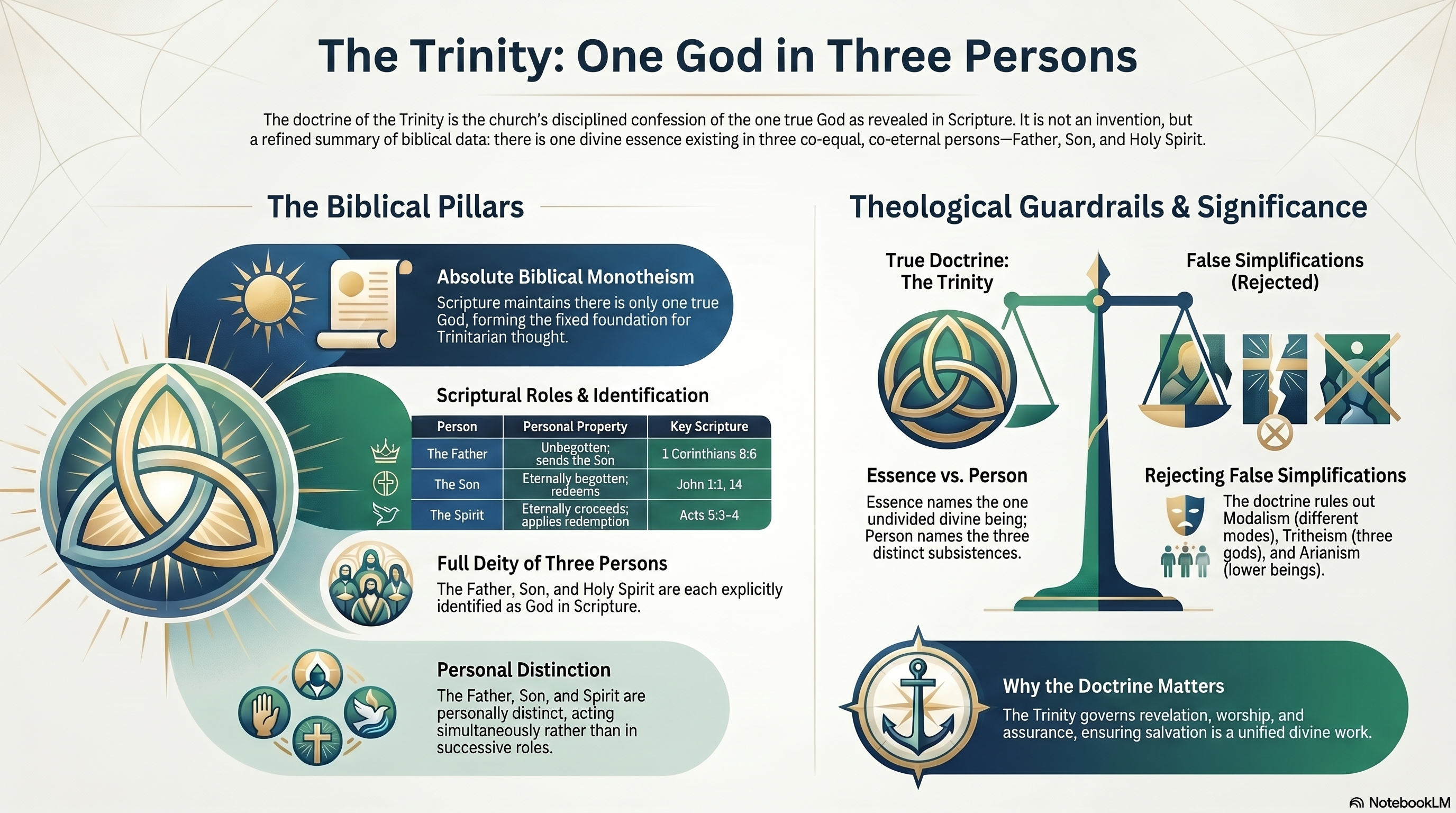
The doctrine of the Trinity is not an extrabiblical burden laid on top of Christianity. It is the church's disciplined confession of the one true God as He is revealed in Holy Scripture. The Bible teaches that there is only one God, that the Father is God, that the Son is God, that the Holy Spirit is God, and that the Father, the Son, and the Holy Spirit are personally distinct. The church did not invent a new God. She developed more exact language to confess the biblical witness under doctrinal pressure.
That is why the Trinity matters. If God were merely one person appearing in different roles, then the Father did not truly send the Son, the Son did not truly pray to the Father, and the Spirit is not truly another Comforter. If Father, Son, and Spirit were three separate gods, then biblical monotheism would be destroyed. The doctrine of the Trinity protects the scriptural revelation of God exactly where false simplifications always begin to distort it.
The Christian confession therefore stands plainly: there is one God in three persons, the same in substance, equal in power and glory (WSC Q.6). This is not irrational contradiction. It is the church speaking carefully where Scripture requires careful speech.
1) There is only one true God
The doctrine begins here. Christianity is not tritheism. The Bible does not teach three gods, but one.
“Hear, O Israel: The LORD our God is one LORD.” (, KJV)
“I am the LORD, and there is none else, there is no God beside me.” (, KJV)
“There is one God.” (, KJV)
This is the fixed foundation. Whatever else Scripture teaches about the Father, the Son, and the Spirit must be understood within absolute biblical monotheism. The church did not move beyond the confession that God is one; she learned to confess the Father, the Son, and the Holy Spirit within that one divine identity.
So the Trinity does not weaken monotheism. It guards it while refusing to flatten the rest of biblical revelation.
2) The Father is God
This is the least disputed point, but it must still be stated because the doctrine is cumulative.
“Grace be unto you, and peace, from God our Father, and from the Lord Jesus Christ.” (, KJV)
“To us there is but one God, the Father, of whom are all things.” (, KJV)
Scripture plainly names the Father as God. He sends the Son (), speaks from heaven concerning the Son (), and sends the Spirit in the Son's name (). The Father is not merely "the divine part" of God while the Son and Spirit are something less. He is truly God.
But the biblical data does not stop with the Father. The same Scriptures that affirm the Father’s deity also present the Son and the Spirit in divine relation, divine action, and divine honor.
3) The Son is God
The New Testament does not present Jesus as a mere creature, prophet, or exalted angelic being. The one and the same Son is truly God and truly man.
“In the beginning was the Word, and the Word was with God, and the Word was God.” (, KJV)
“And the Word was made flesh, and dwelt among us.” (, KJV)
“Unto the Son he saith, Thy throne, O God, is for ever and ever.” (, KJV)
“In him dwelleth all the fulness of the Godhead bodily.” (, KJV)
Jesus receives divine names, divine honor, divine works, and divine prerogatives. He forgives sins (). He receives worship (; ). He exercises authority over life, judgment, and the final resurrection (). He is confessed by Thomas, "My Lord and my God" ().
This is why the deity of Christ cannot be reduced to a loose title of honor. does not merely place the Word near God; it teaches that the Word shares the divine nature while remaining personally distinct from the Father. The Son does what only God can do and receives what belongs only to God.
At the same time, the Son is not the Father. He is with God, sent by God, loved by God, and speaks to God. The doctrine of the Trinity is therefore already taking shape: one God, yet the Son is divine and personally distinct from the Father. As incarnate, He is one and the same Christ, in two natures, without confusion, change, division, or separation.
4) The Holy Spirit is God
The Holy Spirit is not an impersonal force or mere divine energy. He speaks, teaches, sends, comforts, wills, knows, and can be grieved. Scripture treats Him as personal and divine.
“Why hath Satan filled thine heart to lie to the Holy Ghost... thou hast not lied unto men, but unto God.” (, KJV)
“The Spirit searcheth all things, yea, the deep things of God.” (, KJV)
“But all these worketh that one and the selfsame Spirit, dividing to every man severally as he will.” (, KJV)
“And grieve not the holy Spirit of God, whereby ye are sealed unto the day of redemption.” (, KJV)
The Spirit performs divine works. He gives life (). He regenerates (). He inspired the prophets (). He distributes gifts as He wills (). He is named alongside the Father and the Son in baptism and blessing (; ).
If the Spirit were not God, these texts would become incoherent. Scripture does not allow us to treat Him as a mere instrument or abstract power. The Holy Spirit is truly God.
Second Corinthians 3:17 remains an important text, but it must be used carefully. Paul there closely identifies the Lord's liberating new-covenant presence with the Spirit's ministry, but the verse is exegetically difficult and should not be treated as a simplistic collapse of the Son and the Spirit into one person.
5) The Father, the Son, and the Holy Spirit are personally distinct
This is where many errors begin. Once the deity of the Son and the Spirit is admitted, some try to preserve divine unity by saying that Father, Son, and Spirit are only three names or modes for one divine person. But Scripture does not permit that solution.
The Father speaks to the Son:
“This is my beloved Son, in whom I am well pleased.” (, KJV)
The Son prays to the Father:
“Father, glorify thou me with thine own self with the glory which I had with thee before the world was.” (, KJV)
The Son promises another Comforter:
“I will pray the Father, and he shall give you another Comforter.” (, KJV)
At Christ's baptism, the Son stands in the water, the Spirit descends like a dove, and the Father speaks from heaven (). That scene powerfully refutes modalism because the three are simultaneously present and personally related. The persons are not one person acting three parts in succession. They are really distinct.
Yet that distinction does not divide the Godhead into three beings. The persons are distinct, but the divine essence is one.
6) What the doctrine means: one essence, three persons
The classical Christian language is careful because it is trying to say no more and no less than Scripture requires.
There is one divine essence, being, or nature. God is one.
There are three personally distinct subsistences: Father, Son, and Holy Spirit. These are not three parts of God, three percentages of God, or three separate gods. Each person is fully and truly God, and yet God is one.
The Father is unbegotten. The Son is eternally begotten of the Father. In Western and Reformed confessional theology, the Holy Spirit eternally proceeds from the Father and the Son. The original Nicene-Constantinopolitan wording says the Spirit proceeds from the Father, while later Western and Reformed confessions state the procession from the Father and the Son. Those distinctions do not describe inequality or creaturehood. They describe the personal relations by which the three are distinguished without dividing the one divine being.
This is why Christians do not say:
- one God and three gods
- one person and three persons in the same respect
- one essence divided into three parts
Instead, Christians say one God in three persons. Essence names the one simple, undivided divine being; person names the three distinct subsistences, distinguished by their incommunicable personal properties. That is classical Trinitarian language, not the modern idea of three separate psychological selves.
That language does not remove mystery, but it does remove contradiction. The church is not saying one and three in the same respect. She is distinguishing essence and person because Scripture forces her to do so.
7) Common errors the doctrine rules out
A) Modalism
Modalism says God is one person who appears sometimes as Father, sometimes as Son, and sometimes as Spirit. This destroys the real personal relations revealed in Scripture. The Father did not merely pretend to send the Son. The Son did not merely pretend to pray. The Spirit is not merely another costume.
B) Tritheism
Tritheism says Father, Son, and Spirit are three distinct gods. This destroys biblical monotheism. Scripture never allows that conclusion. The church confesses one divine essence, not three divine beings.
C) Arianism and all forms of subordinationism
These errors say the Son or the Spirit is not fully God, but some lower or derived divine being. Scripture does not permit that either. The Son is worshiped, named as God, and does the works of God. The Spirit is lied to as God, searches the deep things of God, wills sovereignly, and gives life as only God can.
D) Unitarian simplification
The recurring temptation is always the same: simplify God so that the doctrine feels easier. But every simplification comes at the cost of biblical revelation. The Trinity is not difficult because the church was careless. It is difficult because Scripture reveals a depth in God that shallow systems cannot contain.
8) Why the Trinity matters
The doctrine is not an abstract math problem. It matters because it governs the whole Christian faith.
A) It matters for revelation
The Father is revealed by the Son through the Spirit. If the Son is not truly God, then He cannot perfectly reveal the Father. If the Spirit is not truly God, then the Spirit cannot be the divine agent of illumination and union with Christ.
“No man knoweth the Son, but the Father; neither knoweth any man the Father, save the Son, and he to whomsoever the Son will reveal him.” (, KJV)
B) It matters for salvation
Salvation is the work of the triune God. The triune God works inseparably in all divine acts, though Scripture fittingly appropriates election to the Father, redemption to the Son, and the application of redemption to the Spirit. If Christ is not truly God, His mediation is not of infinite worth. If the Spirit is not truly God, regeneration and indwelling collapse into creaturely help rather than divine power.
“According as he hath chosen us in him before the foundation of the world.” (, KJV)
“In whom we have redemption through his blood.” (, KJV)
“After that ye believed, ye were sealed with that holy Spirit of promise.” (, KJV)
C) It matters for worship
Christians are baptized into the one name of the Father, and of the Son, and of the Holy Ghost (). That singular "name" is a major triadic datum, though it should be read as part of the whole scriptural pattern rather than made to bear every later metaphysical distinction by itself. Christians pray to the Father, through the Son, by the Spirit (). Christian worship is irreducibly trinitarian because Christian salvation is irreducibly trinitarian.
D) It matters for assurance
The believer does not rest on a vague deity, but on the God who has revealed Himself as Father, Son, and Spirit in the gospel. Assurance is strengthened when we see that redemption is not a loosely coordinated plan, but the unified work of the triune God.
9) The doctrine was confessed more precisely over time, but not invented over time
Some object that the word Trinity does not appear in the Bible and that the formal language of one essence and three persons came later. That is true as to vocabulary, but false as an argument against the doctrine.
The word incarnation does not appear in Scripture either, but the truth does. The word canon is later than the biblical books, but the reality is earlier. In the same way, the church used more exact language over time because heresies forced clarity. Nicaea and Constantinople did not invent a new God. They gave increasingly exact, churchly language to the scriptural confession of the Father, Son, and Holy Spirit in response to heresy and controversy.
Doctrinal development in that sense is not invention ex nihilo. It is disciplined confession under pressure.
10) Objections and replies
Objection 1: “The word Trinity is not in the Bible.”
That is true, but it does not decide the question.
The word incarnation is not in the Bible either, yet the truth is plainly there. The real question is whether Scripture teaches the realities that later doctrinal language is trying to summarize. In this case it does: one God, Father, Son, and Holy Spirit each truly divine, and the three personally distinct.
So the issue is not whether the later label appears in the text. The issue is whether the label faithfully summarizes the text.
Objection 2: “The Trinity is contradictory.”
It would be contradictory if Christians said God is one person and three persons in the same respect, or one essence and three essences in the same respect. But that is not what the doctrine says.
The doctrine says one divine essence and three persons. Essence and person are not identical categories. So the church is not saying one and three in the same respect. She is distinguishing carefully because Scripture forces her to do so.
That does not remove mystery, but it does remove contradiction.
Objection 3: “The Trinity was invented at Nicaea.”
No. Nicaea did not invent a new God. It gave more exact language to the scriptural confession of the Son's deity in response to Arian distortion. Constantinople did the same for the Holy Spirit.
The historical reality is not invention, but doctrinal refinement under pressure. The church's language became more exact because the alternatives were corrupting the biblical witness.
Objection 4: “Jesus said the Father is greater than He, and He did not know the day of His return. Doesn’t that prove the Son is a lesser God?”
This is the strongest form of the subordinationist case, and it appeals to Christ's own words:
“Ye have heard how I said unto you, I go away, and come again unto you. If ye loved me, ye would rejoice, because I said, I go unto the Father: for my Father is greater than I.” (, KJV)
“But of that day and that hour knoweth no man, no, not the angels which are in heaven, neither the Son, but the Father.” (, KJV)
The texts are real, and they must not be explained away. But the question is in what respect these things are said. The answer lies in a distinction the doctrine of the incarnation already requires: the difference between the Son's divine nature and His voluntary state of humiliation as the incarnate Mediator.
“Who, being in the form of God, thought it not robbery to be equal with God: But made himself of no reputation, and took upon him the form of a servant, and was made in the likeness of men: And being found in fashion as a man, he humbled himself, and became obedient unto death, even the death of the cross.” (, KJV)
Paul says both things in one breath: the Son is equal with God in His divine nature, and He made himself of no reputation, taking the form of a servant. The Westminster Confession summarizes the result: the Son of God took upon Him man's nature, "so that two whole, perfect, and distinct natures, the Godhead and the manhood, were inseparably joined together in one person" (WCF 8.2). In , then, the incarnate Mediator — the sent servant, on the night before His death — speaks of the Father's greater station, not a greater essence: the sender is greater than the one sent in office, not in being. The same Gospel records "I and my Father are one" (, KJV) and Thomas's unrebuked confession, "My Lord and my God" (, KJV). John cannot be teaching in one chapter what he refutes in the others.
yields to the same distinction. According to His human nature, the Son truly increased in wisdom (), hungered, wearied, and — in His estate of humiliation — did not know the day. According to His divine nature, He knows all things (). What is proper to one nature is not transferred to the other, yet both are truly predicated of the one person.
Even — “then shall the Son also himself be subject unto him that put all things under him, that God may be all in all” (KJV) — describes the economic subjection of the Mediator delivering up His completed kingdom, not an ontological inferiority in the Godhead. The subordinationist reading proves only what the church has always confessed: that the Son truly became man and truly took the place of a servant. It cannot reach His divine nature, which Scripture guards on every page where He is worshiped, confessed as God, and does the works of God.
11) The proper posture: reverence without retreat
The Trinity humbles the mind, but it does not excuse doctrinal laziness. Christians should not pretend the doctrine is easy. Neither should they retreat from it because it is difficult.
God is not less than our reason can handle, but more than our reason can master. That is exactly what we should expect if the living God has truly revealed Himself.
So the right response is not embarrassment, but reverence. We say what Scripture says, deny what Scripture denies, and refuse both rationalist reduction and mystical vagueness.
Reformed note on method
This essay is intentionally confessional. It does not pretend to stand above the church's historic doctrine as though every reader must rebuild the Trinity from scratch without help. The Reformed method is to let Scripture remain the supreme judge while also receiving the church's creedal and confessional language as faithful, disciplined summaries of what Scripture teaches.
That is why this essay appeals directly to the biblical text while also using language such as essence, person, eternal generation, and procession. Those terms are not authorities over Scripture. They are tools forged in the church's long labor to speak scripturally and avoid error.
Conclusion
The doctrine of the Trinity is the church’s confession of the God who is actually revealed in the Bible.
Scripture teaches:
- there is one God
- the Father is God
- the Son is God
- the Holy Spirit is God
- the Father, the Son, and the Holy Spirit are personally distinct
That is why the church confesses one God in three persons.
The Trinity is therefore not a philosophical burden laid on top of Scripture. It is the necessary shape of biblical faithfulness. Remove it, and the gospel itself begins to unravel. Keep it, and the glory of God shines more fully: the Father sends the Son, the Son accomplishes redemption, and the Spirit applies it, all in the one undivided work of the one true and living God.
“For through him we both have access by one Spirit unto the Father.” (, KJV)
“The grace of the Lord Jesus Christ, and the love of God, and the communion of the Holy Ghost, be with you all.” (, KJV)
Suggested next steps
- Read John 1, John 14–17, , , and 2 Corinthians 13 in one sitting.
- Compare this essay with Theology Proper & Christology in Reformed Covenant Perspective to see how the Trinity grounds later doctrinal claims.
- If the deity of Christ is still the main sticking point, revisit Is Jesus Christ Really Who He Said He Is?.
- If the larger doctrinal question is how the triune God saves, continue to Salvation Is of the LORD: A Case for Embracing Calvinism.
- To see how the doctrine shapes the practice of prayer and worship, read The Name of God and Biblical Prayer.
Essay Video
The Trinity: One God in Three Persons
Audio Discussion
The Trinity: One God in Three Persons
Infographic
The Trinity: One God in Three Persons