Essay
Is Jesus Christ Really Who He Said He Is?
All Scripture citations are from the King James Version (KJV).
"Prove all things; hold fast that which is good." () "These were more noble… and searched the scriptures daily, whether those things were so." ()
TL;DR
Claim. Jesus of Nazareth did not present Himself as a mere moral teacher. In word and deed, He claimed divine prerogatives, accepted divine honor, identified Himself as the promised Christ, and foretold that God would publicly vindicate Him — supremely by the resurrection.
Method. Exegesis first: read Jesus's claims in context, track how His hearers (especially His enemies) understood Him, and let Scripture interpret Scripture — promise to fulfilment in Christ.
Payoff. If Jesus is truly "Lord and Christ" (), then the only sane response is repentance and faith, and a willing submission to His Word in the ordinary means of grace (the preached Word, prayer, and the sacraments in Christ's church).
Thesis
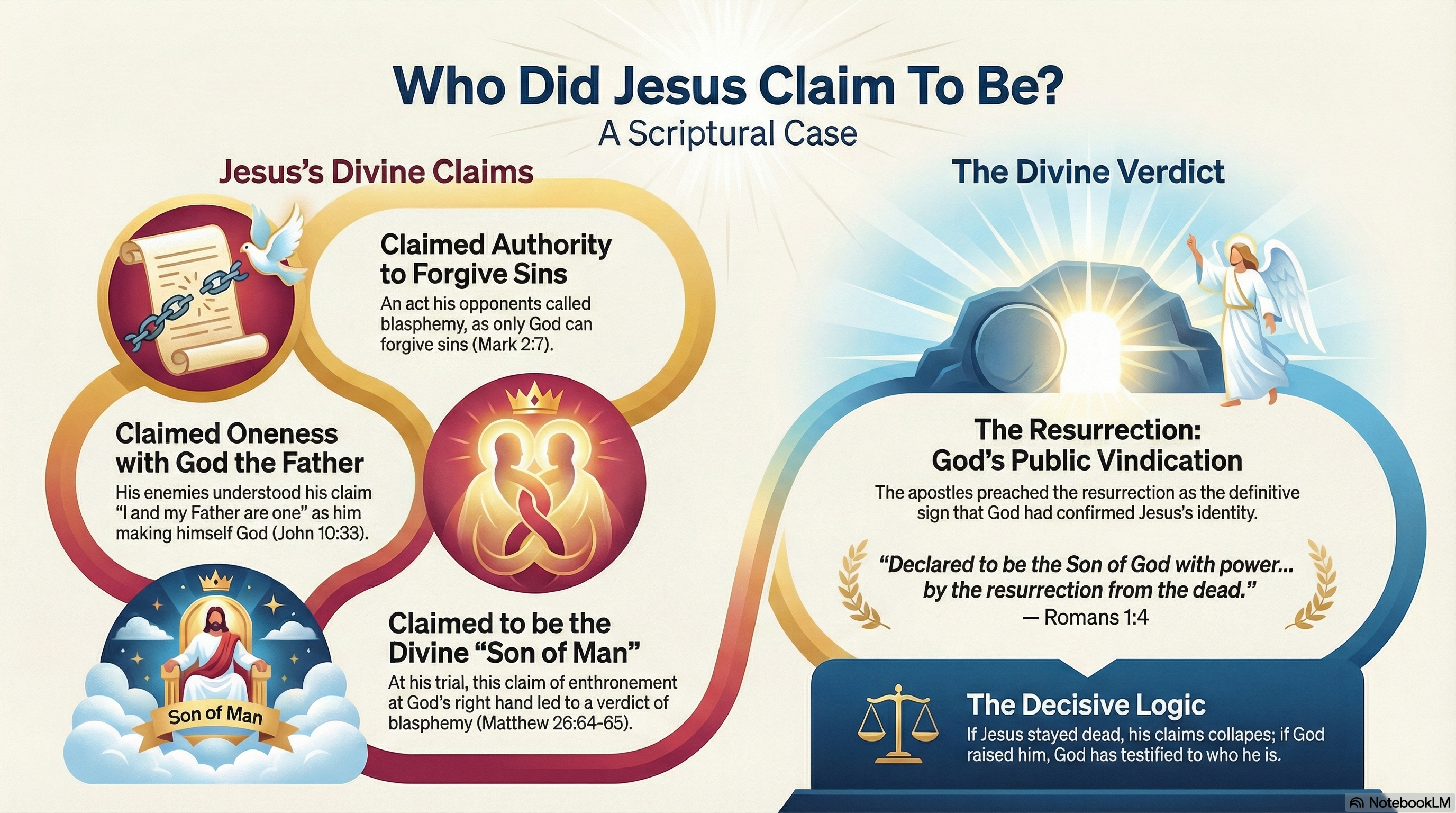
Having established that Jesus is a real figure of history, the next question is identity: Is Jesus Christ really who He said He is? The Gospels present Jesus claiming divine authority (forgiving sins, ruling the Sabbath, judging mankind), divine identity (oneness with the Father; "I am"), and messianic fulfilment (Christ; Daniel's Son of man). The apostles then preach the resurrection as the Father's public verdict: "declared to be the Son of God with power… by the resurrection from the dead" ().
This essay works through the evidence in five movements: what Jesus claimed, how His enemies understood those claims, how the earliest apostolic witness confirms them, why the resurrection is the hinge of it all, and what the claims require of us.
1) The Question Isn't "What Do Later Christians Say?"
It's this:
- What did Jesus claim — by His words and deeds?
- How did His contemporaries understand Him (especially opponents)?
- What did the earliest apostolic witness proclaim as God's confirmation of those claims?
This is "apologetic through catechesis": we teach what Scripture says, and we defend it by careful reading — because truth can bear examination.
2) A Summary Grid of Jesus's Identity Claims
| Claim Cluster | What Jesus Does/Says | Key KJV Anchors | How Hearers Respond |
|---|---|---|---|
| Divine prerogative | Forgives sins | "blasphemies" (God alone forgives) | |
| Divine authority over God's day | Lord of the Sabbath | Pharisees take counsel to destroy Him () | |
| Divine role as Judge | Judgment committed to the Son; equal honor | Implies equality of honor with the Father | |
| Divine unity with the Father | "I and my Father are one." | "makest thyself God" (blasphemy charge) | |
| The divine Name | "Before Abraham was, I am." | ; cf. | Violent reaction (seen as blasphemy) |
| Receiving worship | Thomas: "My Lord and my God." | Jesus accepts — does not rebuke | |
| Messianic fulfilment | "Thou art the Christ…" affirmed | Jesus receives the confession as God-revealed | |
| Daniel 7 Son of man | Enthroned at God's right hand; coming in clouds | ; | Explicit "blasphemy" verdict |
| Public vindication | Predicts resurrection; apostles proclaim it | ; ; | God's public declaration of Jesus's identity |
3) Jesus Claimed Divine Prerogatives
A) Authority to Forgive Sins
When Jesus forgives the paralytic, the scribes react immediately:
"Why doth this man thus speak blasphemies? who can forgive sins but God only?" ()
Jesus does not back away from the implication. Instead, He heals the man and says:
"But that ye may know that the Son of man hath power on earth to forgive sins…" ()
The scribes are correct that sins, in the final sense, are against God; only God can forgive them. Jesus's response is not, "You misunderstood me." It is: "You're going to know I have this authority." The healing is the visible sign that confirms the invisible claim.
B) Lord of the Sabbath
Jesus claims authority over the Sabbath itself:
"For the Son of man is Lord even of the sabbath day." ()
The Sabbath is a holy ordinance rooted in creation () and enshrined in the moral law (). Under Moses it also functioned as a covenant sign between God and Israel (). For Jesus to call Himself "Lord" of the Sabbath is to locate final authority for its meaning and application in Himself — a claim that only makes sense if He stands on the divine side of the Creator-creature distinction.
C) The Judge of All, Worthy of Equal Honor with God
Jesus teaches that final judgment belongs to Him, and that the honor due to the Father is equally due to the Son:
"For the Father judgeth no man, but hath committed all judgment unto the Son: That all men should honour the Son, even as they honour the Father." ()
This is not merely "Jesus is important." Judgment of all humanity is a divine office. And "even as" is not "somewhat like" — it is a claim to the same quality and degree of honor. In a Jewish monotheistic context, this is breathtaking.
4) Jesus Identified Himself with God Directly
A) Unity with the Father
Jesus states:
"I and my Father are one." ()
His opponents interpret this as a divine claim:
"For a good work we stone thee not; but for blasphemy; and because that thou, being a man, makest thyself God." ()
Hostile interpretation is not automatically correct — but here it is decisive evidence of how Jesus's words landed in real time. If Jesus meant something harmless, this reaction makes no sense. And Jesus does not correct them by saying, "I didn't mean that." He presses the point further ().
B) The Divine Name: "I Am"
Jesus says:
"Verily, verily, I say unto you, Before Abraham was, I am." ()
He does not say "Before Abraham was, I was" — which would be a claim to mere preexistence. He says "I am," using language that echoes the divine self-revelation at the burning bush:
"And God said unto Moses, I AM THAT I AM: and he said, Thus shalt thou say unto the children of Israel, I AM hath sent me unto you." ()
The crowd understands exactly what He is claiming. Their response is to pick up stones () — the prescribed punishment for blasphemy. They are not confused; they are outraged.
C) Jesus Accepts Worship
After the resurrection, Thomas sees the risen Christ and responds:
"And Thomas answered and said unto him, My Lord and my God." ()
Jesus does not rebuke him. He accepts the confession.
This is extraordinary when you compare it to how every other faithful figure in Scripture responds to worship:
- Peter, when Cornelius falls at his feet: "Stand up; I myself also am a man." ()
- The angel, when John falls to worship: "See thou do it not: for I am thy fellowservant… worship God." ()
Apostles refuse worship. Angels refuse worship. Jesus receives it. Either He is God, or He is committing the very sin that every other faithful creature in Scripture rejects. There is no middle ground.
5) Jesus Claimed to Fulfil the Old Testament as the Christ and Son of Man
A) Jesus Receives the Confession "Thou Art the Christ"
Peter says:
"Thou art the Christ, the Son of the living God." ()
Jesus responds:
"Blessed art thou, Simon Barjona: for flesh and blood hath not revealed it unto thee, but my Father which is in heaven." ()
Jesus treats this confession as heaven-given truth — not as an overstatement needing correction. He does not say "That's too strong" or "I'm only a prophet." He says the Father Himself revealed it.
B) The Trial: Daniel 7 and the Blasphemy Verdict
Before the high priest, Jesus makes His most explosive claim:
"Thou hast said: nevertheless I say unto you, Hereafter shall ye see the Son of man sitting on the right hand of power, and coming in the clouds of heaven." ()
The response is unambiguous:
"Then the high priest rent his clothes, saying, He hath spoken blasphemy…" ()
To understand why the high priest tears his robes, you must understand what Jesus is quoting. describes a figure who receives universal and everlasting dominion from the Ancient of Days:
"I saw in the night visions, and, behold, one like the Son of man came with the clouds of heaven, and came to the Ancient of days, and they brought him near before him. And there was given him dominion, and glory, and a kingdom, that all people, nations, and languages, should serve him: his dominion is an everlasting dominion, which shall not pass away, and his kingdom that which shall not be destroyed." ()
This is not a claim to be a human king. The figure in Daniel 7 receives universal worship ("all people, nations, and languages, should serve him") and an indestructible kingdom — attributes that belong to God alone. Jesus applies this passage to Himself, adds that He will sit "on the right hand of power" (i.e., enthroned beside God), and the council hears exactly what He means. Their verdict is not confusion. It is "blasphemy" — because only God occupies that seat.
6) The Triune God and the Mediator: Why These Claims Are So Weighty
Jesus is not presented as a religious genius whom later followers promoted beyond His station. Scripture presents one God who reveals Himself as Father, Son, and Holy Ghost, and presents Jesus as the eternal Son who took on human nature to bring sinners to God.
"Go ye therefore, and teach all nations, baptizing them in the name of the Father, and of the Son, and of the Holy Ghost:" ()
John opens his Gospel by placing Christ's identity before anything else:
"In the beginning was the Word, and the Word was with God, and the Word was God." () "And the Word was made flesh, and dwelt among us…" ()
Isaiah prophesied a child who would bear divine titles:
"For unto us a child is born, unto us a son is given: and the government shall be upon his shoulder: and his name shall be called Wonderful, Counsellor, The mighty God, The everlasting Father, The Prince of Peace." ()
And Paul states the matter with crystalline directness:
"For in him dwelleth all the fulness of the Godhead bodily." ()
"Who being the brightness of his glory, and the express image of his person, and upholding all things by the word of his power, when he had by himself purged our sins, sat down on the right hand of the Majesty on high." ()
When Jesus receives divine honor, speaks of unity with the Father, and claims final judgment, the issue is not mere "status." It is the revelation of who God is and how God saves through His Christ.
7) The Early Apostolic Witness: High Christology from the Beginning
A common secular claim is that Jesus was a simple teacher whose followers gradually elevated Him to divine status over centuries. The evidence runs directly against this.
The Pre-Pauline Creed
Paul summarizes the earliest Christian preaching — a formula he "received," meaning it was already circulating before he wrote it down:
"For I delivered unto you first of all that which I also received, how that Christ died for our sins according to the scriptures; And that he was buried, and that he rose again the third day according to the scriptures:" ()
Most scholars — including non-Christian ones — date this creed to within a few years of the crucifixion. It is not a late legend. It is the earliest recoverable Christian confession.
Paul Places Jesus Inside Israel's Monotheism
Paul, a trained Pharisee steeped in Jewish monotheism, restructures the Shema ( — "Hear, O Israel: the LORD our God is one LORD") to include Christ:
"But to us there is but one God, the Father, of whom are all things, and we in him; and one Lord Jesus Christ, by whom are all things, and we by him." ()
This is not a pagan borrowing or a late theological development. It is a Jewish monotheist placing Jesus on the Creator side of reality — and doing so in a letter written in the early 50s, roughly twenty years after the crucifixion.
The Carmen Christi:
Many scholars believe is a pre-Pauline hymn — a piece of early Christian worship that Paul quotes:
"Who, being in the form of God, thought it not robbery to be equal with God: But made himself of no reputation, and took upon him the form of a servant, and was made in the likeness of men: And being found in fashion as a man, he humbled himself, and became obedient unto death, even the death of the cross. Wherefore God also hath highly exalted him, and given him a name which is above every name: That at the name of Jesus every knee should bow, of things in heaven, and things in earth, and things under the earth; And that every tongue should confess that Jesus Christ is Lord, to the glory of God the Father." ()
Notice what this hymn assumes: Christ was "in the form of God" and "equal with God" before the incarnation. He chose to take the form of a servant. God then exalted Him and gave Him the Name above every name — at which every knee bows. The phrase "every knee should bow" is a direct allusion to , where it is Yahweh Himself to whom every knee bows.
This is not a later church council imposing deity on a reluctant tradition. It is the earliest layer of Christian worship confessing Jesus as divine.
8) The Resurrection: The Hinge of Everything
The resurrection is not one claim among many in the Christian message. It is the hinge on which every other claim turns. If Jesus stayed dead, His self-claims collapse and Christianity is a tragic delusion. If God raised Him, then God Himself has publicly testified who Jesus is.
Jesus Foretells It
Jesus treats His coming resurrection as a public sign:
"Destroy this temple, and in three days I will raise it up." () "But he spake of the temple of his body." ()
The Apostles Stake Everything on It
Peter preaches the resurrection as God's decisive act:
"Whom God hath raised up, having loosed the pains of death: because it was not possible that he should be holden of it." ()
And he draws the conclusion:
"Therefore let all the house of Israel know assuredly, that God hath made that same Jesus, whom ye have crucified, both Lord and Christ." ()
Paul frames the resurrection as divine declaration:
"And declared to be the Son of God with power… by the resurrection from the dead." ()
Clarifying point: does not mean the eternal Son only "became Lord" after rising. Rather, it proclaims God's public verdict and royal installation of the crucified Jesus as the promised Messiah-King — His identity and office openly vindicated before the world.
The Evidence in Brief
A full evidential case for the resurrection warrants its own essay, and a dedicated essay in this walkthrough — Did Jesus Rise from the Dead? — makes it. Here it is enough to name the facts any explanation must account for: the tomb was empty, and no authority ever produced a body; the risen Christ appeared to named witnesses, including "above five hundred brethren at once; of whom the greater part remain unto this present" () — an open invitation to verification; the disciples who fled at Jesus's arrest () were, within weeks, proclaiming His resurrection in the same city where He was killed, at the cost of their lives; and hostile witnesses — Paul the persecutor, James the unbelieving brother — were converted by appearances of the risen Lord (). Weighing these facts against every alternative explanation is the burden of the next essay; here they stand as the outline of the case.
Paul's Own Summary
Paul is blunt about the stakes:
"And if Christ be not risen, then is our preaching vain, and your faith is also vain." ()
Christianity does not hedge on this point. It places everything on the resurrection and dares you to investigate.
9) The "Mere Teacher" Option Does Not Exist
A popular modern idea holds that Jesus was a great moral teacher but not God. This position is comfortable but incoherent. It does not survive contact with what Jesus actually said.
A man who claims authority to forgive sins, who says He and the Father are one, who identifies Himself with the divine "I AM," who accepts worship, who claims He will judge all humanity, and who promises to rise from the dead — this man is not leaving the door open for "admirable rabbi."
The options narrow to three:
- He is who He claimed to be — the eternal Son of God incarnate, worthy of worship and obedience.
- He knew His claims were false and made them deliberately — which makes Him a fraud of monstrous proportions, not a good teacher.
- He sincerely believed these claims but was wrong — which makes Him delusional on a scale that is incompatible with His moral teaching, His composure under trial, and the movement He founded.
"Great teacher but not God" is the one option His claims do not permit. He claimed too much for that.
10) Common Objections Answered
Objection 1: "Jesus never claimed to be God."
This objection assumes Jesus must use a modern formula ("I am God, second person of the Trinity") to count as claiming deity. But in a first-century Jewish setting, divine prerogatives and divine honor are the categories that matter.
- Jesus claims authority to forgive sins — provoking "blasphemies" language ().
- He claims that all must honor the Son "even as" the Father ().
- He uses the divine Name — "Before Abraham was, I am" (; cf. ).
- He accepts worship from Thomas: "My Lord and my God" ().
- His enemies explicitly interpret His words as "makest thyself God" ().
The text does not present Jesus as merely "misunderstood." It presents Him as making claims that demand a verdict.
Objection 2: "Those divine claims are only in John — a late, theological Gospel."
Even if one grants (for the sake of argument) that John emphasizes Jesus's identity more explicitly, the claim clusters are present across the Gospels:
- Forgiving sins and the blasphemy charge: Mark ().
- "Lord of the sabbath day": Matthew ().
- The trial claim — Son of man enthroned and coming in clouds: Matthew ().
John gives bright, concentrated beams; the Synoptics give the same sun through a slightly different lens. The same Jesus stands behind both.
Moreover, the earliest high Christology in the New Testament does not come from John at all — it comes from Paul, whose letters predate all four Gospels. The Carmen Christi hymn () confesses Christ as "in the form of God" and "equal with God," and applies Yahweh's own title to Him. restructures the Jewish Shema to include Christ as Lord through whom all things exist. These are not late developments. They are the earliest surviving Christian texts.
Objection 3: "'Son of God' just means 'king,' not God."
Scripture can use "son" language in more than one way, yes. But the decisive issue is how Jesus's Sonship functions in context:
- Jesus claims divine honor: "honour the Son, even as they honour the Father" ().
- His opponents call it blasphemy and interpret it as making Himself God ().
- The trial language ties Messiah/Sonship to enthronement at God's right hand and coming in clouds — the Daniel 7 figure who receives universal worship (; ).
- The author of Hebrews calls the Son "the brightness of his glory, and the express image of his person" ().
A merely human "king" claim does not explain "blasphemy" as the verdict. The texts press beyond that.
Objection 4: "The resurrection is legend — a myth that grew over time."
The apostolic preaching places the resurrection at the center, not the margin:
- "Whom God hath raised up…" ()
- "God hath made that same Jesus… both Lord and Christ" ()
- "declared to be the Son of God with power… by the resurrection" ()
The claim appears in the earliest recoverable stratum of Christian tradition (the pre-Pauline creed of ), is attested by named, living witnesses whom Paul challenges his readers to consult, and is proclaimed publicly in the same city where Jesus was killed — within weeks, not centuries. This is not the profile of a legend that grew gradually.
Objection 5: "Jesus was just an apocalyptic prophet whose followers reinterpreted His death."
This is the dominant secular scholarly position (Schweitzer, and more recently Ehrman). It holds that Jesus expected an imminent end of the world, was crucified, and His disappointed followers gradually constructed a theology of resurrection and divinity to cope with His death.
The problem is that this theory has to explain too many things away:
- It must explain why the disciples, after watching their leader die the most shameful death in the Roman world, did not simply disperse — as every other failed messianic movement did.
- It must explain why they immediately began proclaiming Him as risen and divine, rather than as a martyred prophet to be avenged.
- It must explain the pre-Pauline creed (), which places the resurrection claim within a few years of the crucifixion — too early for legendary development.
- It must explain Paul's personal acquaintance with Peter and James the Lord's brother () — eyewitnesses who could have corrected any fabrication.
- It must explain why Jews, fiercely monotheistic, began worshiping a crucified man as God within a generation.
"They made it up" does not explain the data. "They were deluded" does not explain the empty tomb and the hostile conversions. The resurrection best accounts for the evidence — the next essay weighs these alternatives in detail.
Objection 6: "Miracles aren't historical."
Often this is not an argument from evidence but an argument from a closed worldview: "miracles can't happen, therefore miracles didn't happen." This is circular reasoning dressed as skepticism.
Scripture's posture is different: God made heaven and earth; therefore God can act within His creation. If the resurrection is true, then the miracle category has already been crossed, and Jesus's other mighty works become coherent as signs of His identity — which is exactly how the Gospels present them.
A Reformed Note on Method
This essay has leaned at points on evidential arguments — the scholarly dating of the pre-Pauline creed, historical reasoning about how movements behave, the improbability of legend. Those arguments are legitimate, and they are strong. But as Reformed Christians (Westminster), we do not rest the identity of Christ on the verdicts of historians. The authority of Scripture "dependeth not upon the testimony of any man, or Church; but wholly upon God (who is truth itself) the author thereof" (WCF 1.4), and the supreme judge in all controversies of religion "can be no other but the Holy Spirit speaking in the Scripture" (WCF 1.10).
External evidence therefore serves ministerially, not magisterially. It clears away false excuses, shows that faith is not credulity, and confirms that the confession of Jesus as Lord belongs to the earliest witness, not to later legend. But the historian can only show that the claim is early and the witnesses were in earnest. It is Scripture, applied by the Spirit, that brings a sinner to say with Thomas, "My Lord and my God."
11) What This Requires of Us
Jesus's identity claims do not leave room for a merely "admiring" response. He did not come to be appreciated. He came to be trusted, obeyed, and worshiped. If He is Lord, then He is Lord of you and me.
Scripture's invitation is clear and personal:
"But these are written, that ye might believe that Jesus is the Christ, the Son of God; and that believing ye might have life through his name." ()
And Scripture is equally exclusive about salvation:
"Neither is there salvation in any other: for there is none other name under heaven given among men, whereby we must be saved." () "I am the way, the truth, and the life: no man cometh unto the Father, but by me." ()
Practical Next Steps
-
Read one Gospel straight through (KJV). Mark (fast, action-oriented) or John (directly focused on identity).
-
Read Acts 2 and Romans 1–5 (KJV). Watch how the apostles connect Jesus's resurrection to His Lordship and to justification.
-
Join the church's worship on the Lord's Day. Sit under the preaching of the Word, and begin learning Christ through the ordinary means of grace — Word, prayer, and sacraments.
-
Speak with a faithful pastor or elder. Bring your sharpest objections and "prove all things" with an open Bible (; ).
Handoff in the Walkthrough
- Previous: Is Jesus Christ a Historical Figure? — establishing that Jesus of Nazareth is a real figure of history.
- Next: Born of the Virgin, Son of David: Why Jesus Is the Promised Messiah — how the identity Jesus claimed answers to the Messiah the prophets promised.
Essay Video
Is Jesus Christ Really Who He Said He Is?
Audio Discussion
Is Jesus Christ Really Who He Said He Is?
Infographic
Is Jesus Christ Really Who He Said He Is?