Essay
Did Jesus Rise from the Dead?
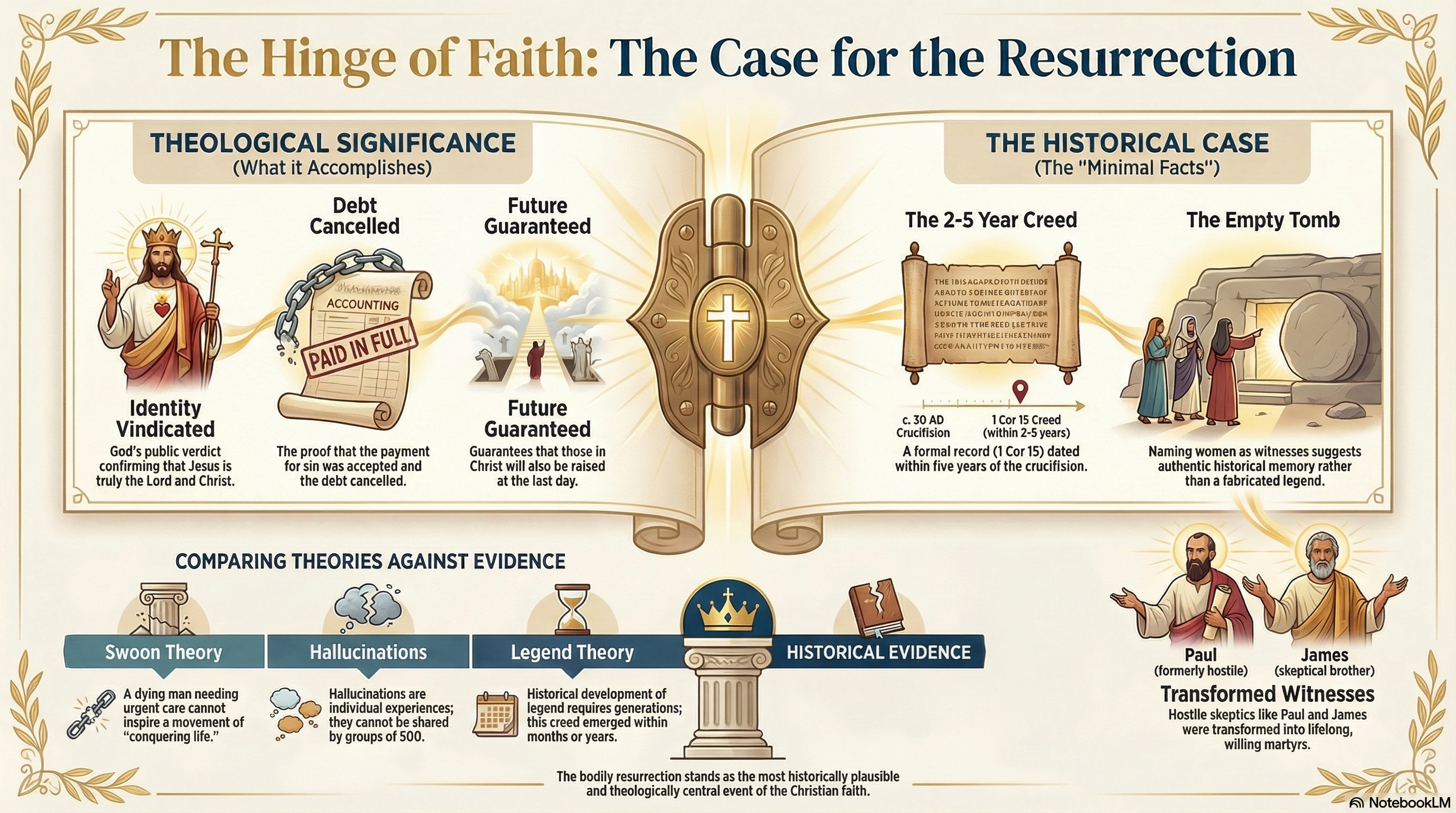
A historically grounded, exegetically driven case for the bodily resurrection of Jesus Christ — the event on which everything else in Christianity stands or falls.
"And if Christ be not risen, then is our preaching vain, and your faith is also vain." (, KJV) "But now is Christ risen from the dead, and become the firstfruits of them that slept." (, KJV)
Thesis
The bodily resurrection of Jesus Christ is not a peripheral doctrine or a later legend. It is the hinge of the entire Christian faith — the event by which God the Father publicly vindicated His Son's identity, secured the justification of His people, and guaranteed the future resurrection of all who are in Christ. The historical evidence for this event is remarkably strong by the standards of ancient history: an early, datable creed places the proclamation within years of the crucifixion; multiple independent lines of testimony converge on the empty tomb and post-mortem appearances; and no naturalistic alternative has satisfactorily explained the origin of the Christian movement.
This essay presents the case in three movements: what Scripture teaches about the resurrection's meaning, what the historical evidence demands, and why every alternative explanation fails.
Part I: What Scripture Teaches
The previous essay in this walkthrough ("Is Jesus Christ Really Who He Said He Is?") established that Jesus claimed divine identity and staked His credibility on the resurrection. This section does not repeat that ground. Instead, it addresses a question the previous essay raised but did not fully answer: what does the resurrection accomplish?
1) The Resurrection Vindicates Jesus's Identity
The apostles do not merely report that Jesus rose. They preach the resurrection as the Father's public verdict on everything Jesus claimed:
"This Jesus hath God raised up, whereof we all are witnesses." (, KJV)
"Therefore let all the house of Israel know assuredly, that God hath made that same Jesus, whom ye have crucified, both Lord and Christ." (, KJV)
"And declared to be the Son of God with power, according to the spirit of holiness, by the resurrection from the dead." (, KJV)
Without the resurrection, the crucifixion is simply another Roman execution of a failed claimant. With it, the cross becomes the atoning sacrifice of the Son of God — because God Himself has testified who Jesus is by raising Him.
2) The Resurrection Secures Justification
The resurrection is not only about Jesus's identity. It is directly tied to the believer's standing before God:
"Who was delivered for our offences, and was raised again for our justification." (, KJV)
Christ's death pays the penalty for sin. His resurrection is the receipt — the Father's declaration that the payment has been accepted and the debt is cancelled. Without the resurrection, there is no assurance that the cross accomplished what it was meant to accomplish. Paul is blunt about the stakes:
"And if Christ be not raised, your faith is vain; ye are yet in your sins." (, KJV)
3) The Resurrection Unites the Believer to Christ
Paul teaches that believers are united to Christ in both His death and His resurrection:
"Therefore we are buried with him by baptism into death: that like as Christ was raised up from the dead by the glory of the Father, even so we also should walk in newness of life. For if we have been planted together in the likeness of his death, we shall be also in the likeness of his resurrection." (, KJV)
This is not metaphor. The resurrection is the ground on which the believer's new life stands. Because Christ rose, those who are "in Christ" have already passed from death to life in principle — and will pass from death to life in body at the last day.
4) The Resurrection Guarantees the Believer's Future Hope
"But now is Christ risen from the dead, and become the firstfruits of them that slept. For since by man came death, by man came also the resurrection of the dead. For as in Adam all die, even so in Christ shall all be made alive." (, KJV)
"Blessed be the God and Father of our Lord Jesus Christ, which according to his abundant mercy hath begotten us again unto a lively hope by the resurrection of Jesus Christ from the dead, To an inheritance incorruptible, and undefiled, and that fadeth not away, reserved in heaven for you." (, KJV)
Christ's resurrection is the "firstfruits" — the first sheaf of the harvest that guarantees the full crop will follow. This is not wishful thinking; it is a promise sealed by a public, historical event.
Part II: The Historical Evidence
The Approach: Minimal Facts
The argument presented here follows what scholars call the minimal facts approach, developed most rigorously by Gary Habermas (see The Case for the Resurrection of Jesus, Kregel, 2004, with Michael Licona). The method deliberately restricts itself to facts that meet two criteria:
- They are well-evidenced by standard historical methods.
- They are accepted by the large majority of scholars who have published on the subject — including skeptics, agnostics, and atheists.
This means the argument does not assume biblical inerrancy or divine inspiration as a premise. It works from common ground. If the resurrection can be demonstrated from facts that even non-Christian scholars accept, then the case is far stronger than one that depends on prior theological commitments.
As Reformed Christians, we do believe Scripture is inspired and inerrant. But we also believe that God raised His Son in real, public history — and that the evidence is strong enough to bear examination on its own terms.
One clarification before we begin. Not everything presented below meets the strict minimal-facts bar. The empty tomb and the shift to Sunday worship, in particular, fall short of the near-unanimous scholarly consensus the method requires, so they are offered here as supporting corroboration rather than as minimal facts. The facts that do meet the bar — the early creed, the appearance experiences, the transformation of the disciples, and the hostile conversions — are sufficient on their own to carry the argument.
Luke himself states the matter directly:
"To whom also he shewed himself alive after his passion by many infallible proofs, being seen of them forty days, and speaking of the things pertaining to the kingdom of God." (, KJV)
"Many infallible proofs" — Luke is not asking for blind faith. He is pointing to evidence.
Fact 1: The Pre-Pauline Creed ()
The earliest and most important piece of evidence is a creedal formula that Paul "received" and "delivered" to the Corinthians:
"For I delivered unto you first of all that which I also received, how that Christ died for our sins according to the scriptures; And that he was buried, and that he rose again the third day according to the scriptures: And that he was seen of Cephas, then of the twelve: After that, he was seen of above five hundred brethren at once; of whom the greater part remain unto this present, but some are fallen asleep. After that, he was seen of James; then of all the apostles." (, KJV)
Why this is so significant:
Paul wrote 1 Corinthians around AD 53–55. But this is not Paul's own composition — he says he "received" it, using the technical rabbinic language for formal transmission of tradition (paralambanō / paradidōmi). Most scholars trace his reception of this creed to his visit to Jerusalem described in , approximately three years after his conversion, which itself occurred within one to three years of the crucifixion (dated ~AD 30–33).
This places the origin of the creed within roughly two to five years of the events it describes.
The scholarly consensus on this dating is remarkably broad:
- Hans Conzelmann (not a conservative) called it "the oldest tradition of all" and agreed it predates Paul (1 Corinthians, Hermeneia, 1975).
- Joachim Jeremias identified Semitic features in the creed pointing to a very early Aramaic-speaking origin (The Eucharistic Words of Jesus, 1966).
- James D.G. Dunn dates the tradition to within months of the crucifixion (Jesus Remembered, Eerdmans, 2003, pp. 854–855).
- Bart Ehrman (agnostic) accepts the early dating of this creed, even while denying the resurrection (How Jesus Became God, HarperOne, 2014).
This is not a legend that developed over centuries. It is a formal proclamation — naming specific, living witnesses — circulating within the lifetimes of the people it names. Notice that Paul adds: "of whom the greater part remain unto this present" (). He is inviting his readers to verify the claim. You do not issue that invitation unless the witnesses are real and their testimony can withstand scrutiny.
Supporting Evidence: The Empty Tomb
All four Gospels report that on the third day after the crucifixion, the tomb in which Jesus had been laid was found empty (; ; ; ). Because scholarly support here is strong but not near-unanimous, the empty tomb is presented as corroboration alongside the minimal facts, not as one of them.
Several features of the empty tomb narratives point toward historicity rather than invention:
Women as the first witnesses. In first-century Jewish culture, women were not regarded as reliable legal witnesses. Josephus records that women's testimony was not accepted in court (Antiquities 4.8.15). If the early Christians were fabricating a resurrection story to convince their contemporaries, they would never have chosen women as the primary witnesses. That the Gospels unanimously name women as the first to find the tomb empty is a powerful mark of authentic memory — it is the kind of embarrassing detail that real history preserves and legend smooths away.
The Jewish authorities never produced the body. The early Christian proclamation of the resurrection took place publicly, in Jerusalem, within weeks of the crucifixion. The Jewish and Roman authorities had every motive and every means to end the movement by producing Jesus's corpse. They did not. Instead, Matthew records that they circulated an alternative explanation — that the disciples stole the body () — which is itself evidence that the tomb was known to be empty. You do not need to explain away an empty tomb unless the tomb is, in fact, empty.
The burial by Joseph of Arimathea. Jesus was buried not by His disciples (who had fled) but by Joseph of Arimathea, a member of the Sanhedrin — the same council that had condemned Jesus. This is an unlikely invention: early Christians would have little reason to create a sympathetic council member. The burial tradition is independently attested in the pre-Pauline creed ("he was buried") and in all four Gospels.
The conspiracy of silence. Perhaps most telling is what the opponents of Christianity did not say. The earliest Jewish counter-argument was not "the tomb was still occupied" — it was "the disciples stole the body" (). This concedes the empty tomb while disputing its cause. And the pattern continued for centuries. Justin Martyr records in his Dialogue with Trypho (~155 AD) that Jewish interlocutors were still circulating the stolen-body theory — not claiming the tomb was full. Later hostile traditions (the Toledot Yeshu) likewise assume the tomb was empty and attempt to explain it away. In other words, even centuries of sustained, motivated opposition to Christianity never produced a counter-claim that the body remained in the tomb. The silence is deafening — and it is evidence.
Scholarly support. Gary Habermas, after surveying over 3,400 scholarly publications on the resurrection (1975–present), reports that approximately 75% of scholars who have written on the subject — including many who are not Christians — accept the empty tomb as historical (Journal for the Study of the Historical Jesus 3, no. 2, 2005: 135–153).
Fact 2: The Post-Resurrection Appearances
The creed in 1 Corinthians 15 lists multiple, independent appearances of the risen Christ:
- Cephas (Peter) — individually
- The Twelve — as a group
- Above five hundred brethren at once — most of whom Paul says are still alive and can be consulted
- James — the brother of Jesus, who was a skeptic during His ministry ()
- All the apostles — a broader group
- Paul himself — last of all ()
The Gospels add further details: the appearances involved physical interaction (eating, touching wounds), occurred over a period of forty days (), and took place in multiple locations (Jerusalem, Galilee, the road to Emmaus).
These are not vague spiritual impressions. They are reported as encounters with a bodily risen person, by named individuals, in public settings, over an extended period. Luke records Jesus Himself drawing the distinction:
"Behold my hands and my feet, that it is I myself: handle me, and see; for a spirit hath not flesh and bones, as ye see me have." (, KJV)
Even scholars who reject the resurrection acknowledge that the appearances were real experiences. Gerd Lüdemann, an atheist New Testament scholar, concedes: "It may be taken as historically certain that Peter and the disciples had experiences after Jesus's death in which Jesus appeared to them as the risen Christ" (The Resurrection of Jesus, Fortress Press, 1994, p. 80). Bart Ehrman agrees that the disciples genuinely believed they encountered the risen Jesus (How Jesus Became God, 2014).
The question is not whether the disciples had these experiences. The question is what caused them.
Fact 3: The Transformation of the Disciples
The men who fled at Jesus's arrest (), who denied knowing Him under pressure (), who hid behind locked doors for fear () — these same men, within weeks, were publicly proclaiming His resurrection in the same city where He had been killed, at the cost of their freedom and their lives.
Peter, who denied Jesus three times to a servant girl, stood before the same council that had condemned Jesus and declared:
"Be it known unto you all, and to all the people of Israel, that by the name of Jesus Christ of Nazareth, whom ye crucified, whom God raised from the dead, even by him doth this man stand here before you whole." (, KJV)
When ordered to stop preaching, the apostles responded:
"We ought to obey God rather than men. The God of our fathers raised up Jesus, whom ye slew and hanged on a tree." (, KJV)
Something happened to these men between Friday evening and Sunday morning that transformed them from cowards into witnesses willing to die. The resurrection is the explanation they gave. No alternative has accounted for this transformation.
Fact 4: The Conversion of Hostile Witnesses
Two of the most important early Christians were not followers of Jesus during His ministry — they were opponents.
Paul. Before his conversion, Paul (then Saul) was a Pharisee actively persecuting the church:
"For ye have heard of my conversation in time past in the Jews' religion, how that beyond measure I persecuted the church of God, and wasted it." (, KJV)
He claims to have encountered the risen Christ directly:
"And last of all he was seen of me also, as of one born out of due time." (, KJV)
Paul's conversion is historically undisputed. He went from destroying the church to planting churches across the Roman Empire, enduring imprisonment, beatings, shipwrecks, and eventual execution. This is not the profile of a man who invented a story.
James. During Jesus's ministry, His own brothers did not believe in Him:
"For neither did his brethren believe in him." (, KJV)
Yet after the resurrection, James appears as a leader of the Jerusalem church (; ; 2:9) and was eventually martyred for his faith. The creed in reports a specific resurrection appearance to James — and this appearance is the best explanation for why a skeptical sibling became a pillar of the church.
Supporting Evidence: The Birth of the Church and the Shift to Sunday Worship
Perhaps the most overlooked pieces of evidence are the simple facts that Christianity exists and that it worships on Sunday. Like the empty tomb, these are offered as corroboration alongside the minimal facts rather than as minimal facts themselves.
The emergence of the church. Within twenty years of the crucifixion, a movement proclaiming a crucified and risen Messiah had spread across the Roman Empire. This movement arose in a Jewish context where crucifixion was a sign of God's curse (; ) and where a dead Messiah was a failed Messiah. Every other messianic movement in Jewish history either dissolved when its leader died or carried on without claiming he had conquered death. The followers of Bar Kokhba did not proclaim his resurrection. The party of Judas the Galilean persisted — Josephus links his family line to the continuing "fourth philosophy" — yet no one proclaimed Judas alive. Christianity is the exception — and it is the exception because its earliest adherents believed something had happened that reversed the verdict of the cross.
The shift to Sunday. The earliest Christians were Jews. The Sabbath — Saturday — was the divinely instituted day of rest, rooted in creation and the fourth commandment. Yet within the first generation, Christians began gathering on "the first day of the week" (; ) — the day of the resurrection. John calls it "the Lord's day" (). For devout Jews to shift their sacred day of assembly is extraordinary. Something of supreme significance must have happened on a Sunday to warrant it.
N.T. Wright, in his landmark study The Resurrection of the Son of God (Fortress Press, 2003), argues that neither Jewish resurrection hope — which expected a general resurrection at the end of history, not the resurrection of a single individual in the middle of history — nor pagan beliefs about the afterlife — which denied bodily resurrection — can account for the specific shape of early Christian belief. The origin of Christianity requires a historical cause adequate to produce the effect. The bodily resurrection of Jesus is the only candidate.
A Note on the Gospel Accounts: Divergence as Evidence
A thoughtful reader will notice that the four resurrection narratives differ in their details. Who went to the tomb first? How many angels were present? What happened next? These variations are sometimes cited as evidence against the resurrection.
In fact, the variations argue for authenticity rather than against it. A word of precision first: the four Gospels are not four wholly unrelated compositions — most scholars hold that Matthew and Luke drew on Mark, so the Synoptics cannot simply be counted as three independent witnesses. But the resurrection testimony does not rest on a single chain. It reaches us through genuinely distinct streams: Mark's narrative, John's largely independent account, and the pre-Pauline creed Paul received — each carrying the same core claim.
Within and across those streams, the accounts converge on the core facts: Jesus was buried, the tomb was found empty on the third day, women were the first to discover it, and the risen Christ appeared to His disciples. They diverge on exactly the kind of secondary details that separate tellings handle differently — sequence, number, exact words spoken. Anyone who has studied eyewitness testimony — in law, in journalism, in historiography — knows that honest witnesses typically agree on the central event while diverging on peripheral details; if four witnesses gave identical testimony in a courtroom, the judge would suspect collusion. This pattern of firm agreement on the core with untidy edges fits authentic early testimony far better than late, coordinated invention.
Part III: Why the Alternative Explanations Fail
Clearing the Philosophical Ground: Hume and Miracles
Before examining specific alternatives, we need to address the philosophical objection that stands behind many of them. The Scottish philosopher David Hume (1711–1776) argued that testimony for a miracle can never be sufficient to establish it, because a miracle is by definition a violation of natural law, and our uniform experience of nature will always outweigh any testimony to the contrary.
Hume's argument has been enormously influential. It is also deeply flawed.
First, it is circular. Hume defines "uniform experience" as experience in which miracles do not occur — and then uses that definition to conclude that miracles cannot occur. But the question at issue is precisely whether the experience is truly uniform. If Jesus rose from the dead, then our experience is not uniform — and Hume's principle has assumed its own conclusion.
Second, it proves too much. If we adopted Hume's principle consistently, we could never establish any genuinely unprecedented event — not just miracles, but any unique occurrence in history. The first confirmed case of any phenomenon (a new disease, a previously unknown species, a novel physical effect) would be ruled out by "uniform experience" against it. This is not rational caution; it is a priori closed-mindedness.
Third, it confuses probability with evidence. The question is not "How probable is a resurrection in general?" but "Given this specific body of evidence — the creed, the tomb, the appearances, the conversions, the birth of the church — what is the best explanation?" Hume's argument ignores the evidence and fixates on prior probability. But historians do not evaluate events by asking whether they are common. They evaluate events by asking whether the evidence is sufficient to establish them. The evidence for the resurrection is extraordinary — which is exactly what an extraordinary event should produce.
The Christian does not ask anyone to believe in miracles in the abstract. The Christian points to specific, datable, well-attested evidence and asks: what explains this?
With that ground cleared, every alternative to the resurrection must explain the same set of facts: the early creed, the empty tomb, the appearances, the transformation of the disciples, the hostile conversions, and the emergence of the church. No alternative has done this.
Alternative 1: The Disciples Stole the Body
This is the oldest counter-explanation — Matthew records that the Jewish authorities circulated it (). It fails for several reasons:
- It does not explain the appearances. Even if the tomb were emptied by theft, the disciples still claimed to have seen and touched the risen Christ over a period of forty days.
- It does not explain the conversion of Paul or James, neither of whom was part of the original disciple group and neither of whom had any motive to participate in a conspiracy.
Most critically, this theory requires the disciples to have knowingly died for a claim they knew to be false. A common objection here is: "People die for false beliefs all the time — Islamic martyrs, cult members, political zealots." This is true but irrelevant. Those people die for beliefs they sincerely hold but received secondhand. The apostles were not in that position. They were claiming to have personally seen, touched, and eaten with the risen Christ. They were not dying for a belief about an event they heard about from someone else. They were dying for an event they claimed to have directly witnessed. Liars do not make martyrs — not when the lie offers nothing but suffering and death as a reward.
Alternative 2: The Authorities Moved the Body
If the authorities (Jewish or Roman) had moved the body, they could have ended the Christian movement instantly by producing it when the disciples began preaching. They never did. The silence of the authorities is itself evidence that they did not possess the body.
Alternative 3: The "Swoon" Theory (Jesus Survived the Crucifixion)
This theory proposes that Jesus did not actually die on the cross but merely lost consciousness, revived in the tomb, and appeared to the disciples.
This is medically implausible. Roman crucifixion was a professional execution method carried out by soldiers who faced penalties for botching it. The Gospels record that the soldiers confirmed Jesus's death before releasing the body. John adds a specific detail: a soldier pierced Jesus's side with a spear, and "forthwith came there out blood and water" (). Modern medicine recognizes this as consistent with post-mortem pericardial or pleural effusion — the separation of clotted blood and clear serum that can occur after death. The diagnosis cannot be certain at two thousand years' distance, but John records the detail as eyewitness observation (), and its medical significance would not have been understood by a first-century author — which makes it read as unstudied reporting consistent with actual death, not a crafted proof.
Beyond the medical question, the swoon theory has a fatal logical problem. A man who had been scourged to the point of collapse, nailed to a cross for hours, pierced with a spear, and sealed in a tomb without food, water, or medical attention would not — upon somehow reviving — have inspired his followers to proclaim Him the conquering Lord of life and death. He would have needed urgent care, not a pulpit. The nineteenth-century skeptic David Friedrich Strauss, who rejected the resurrection, nevertheless demolished this theory on exactly these grounds.
Alternative 4: The Hallucination Theory
This is the most popular modern alternative. It proposes that the disciples experienced grief-induced hallucinations that they mistook for encounters with the risen Christ. Gerd Lüdemann is the most prominent advocate of a version of this theory.
It fails on multiple points:
- Hallucinations are individual, subjective experiences. They are generated internally by the brain of the person experiencing them — they are not external events that multiple people can perceive simultaneously. As clinical psychologist Gary Collins observed in his assessment of the hallucination theory (cited in Habermas and Licona, The Case for the Resurrection of Jesus, Kregel, 2004, pp. 105–106), hallucinations are "individual occurrences. By their very nature only one person can see a given hallucination at a time." They cannot be shared across groups of different sizes, at different times, in different locations. Yet the creed lists appearances to individuals (Peter, James, Paul), small groups (the Twelve), and a crowd of over five hundred — spanning weeks and multiple locations. No known psychological mechanism produces this pattern.
- It does not explain the empty tomb. Hallucinations do not move bodies. If the disciples merely hallucinated appearances, the body would still be in the tomb — and the authorities could have produced it.
- It does not explain the conversion of Paul. Paul was not a grieving follower hoping to see Jesus again. He was a hostile persecutor — the opposite of the emotional predisposition that hallucination theory typically requires.
- It does not explain the conversion of James. James was a skeptic during Jesus's ministry (). He had no grief motive and no expectation of seeing his brother alive.
- It does not explain the physicality of the reported appearances. The Gospels describe Jesus eating fish (), inviting Thomas to touch His wounds (), and appearing over forty days in sustained, interactive encounters. This does not fit the clinical profile of a hallucination, which is typically brief, fleeting, and non-interactive.
Alternative 5: The "Legend" Theory
This theory holds that the resurrection story developed gradually over decades or centuries, evolving from vague spiritual claims into concrete bodily resurrection narratives.
The pre-Pauline creed demolishes this theory. A formal, datable proclamation of bodily resurrection — with named, living witnesses — was circulating within two to five years of the crucifixion. That is not enough time for legend to develop, especially in a culture where the named witnesses are still alive to confirm or deny the claims. A point often drawn from the classical historian A.N. Sherwin-White is that even in the ancient world, legend needed something like two generations to displace a solid core of historical fact (Roman Society and Roman Law in the New Testament, Oxford, 1963). However one weighs that generalization, the interval here is not generations but a handful of years.
Alternative 6: The "Spiritual Resurrection" Theory
Some propose that the disciples believed in a purely spiritual or metaphorical resurrection — that Jesus's "spirit" lived on in some non-physical sense — and that the bodily resurrection stories were later additions.
This does not fit the evidence:
- The earliest creed () includes "he was buried, and… he rose again." The burial-then-rising sequence implies that the same body which was buried is the body which rose. If the resurrection were purely spiritual, the burial detail would be pointless.
- Paul argues explicitly for bodily resurrection in , using the analogy of a seed that dies and is raised in a transformed body. He is arguing against those who deny bodily resurrection — which means the apostolic position was clear, and it was bodily.
- The Gospels describe the risen Christ as physical: He eats, He is touched, He shows His wounds. Luke records Him saying: "Behold my hands and my feet, that it is I myself: handle me, and see; for a spirit hath not flesh and bones, as ye see me have." (, KJV)
- The Jewish context matters. In Second Temple Judaism, "resurrection" (anastasis) meant bodily resurrection — the raising of the physical person. A purely spiritual survival after death was not what Jews meant by the word. When the early Christians proclaimed that Jesus had been raised, their Jewish hearers would have understood a bodily claim. If the apostles meant something else, they chose the worst possible word for it.
Alternative 7: The "Wrong Tomb" Theory
Proposed by Kirsopp Lake in 1907, this theory suggests that the women went to the wrong tomb on Sunday morning, found it empty, and mistakenly concluded Jesus had risen.
This theory has gained almost no scholarly traction, and for good reason:
- Joseph of Arimathea, who owned the tomb and buried Jesus in it, knew which tomb it was. If there were any confusion, he could have corrected it immediately.
- The Jewish and Roman authorities could have visited the correct tomb and produced the body, ending the movement before it began.
- It does not explain the appearances. Even if the women visited the wrong tomb, that does not account for the disciples claiming to have seen, touched, and eaten with the risen Christ over forty days.
- It does not explain the conversion of Paul or James, neither of whom was involved in the discovery of the tomb.
The wrong tomb theory explains one fact (the women's report of an empty tomb) by introducing a coincidence, and then leaves every other fact unexplained.
A Note from an Unlikely Witness
One of the most striking affirmations of the resurrection's historicity comes from outside Christianity altogether. Pinchas Lapide (1922–1997), an Orthodox Jewish New Testament scholar, concluded that Jesus's bodily resurrection was a genuine historical event — while remaining a practicing Jew. In The Resurrection of Jesus: A Jewish Perspective (Augsburg, 1983), Lapide argued that the evidence for the resurrection is strong enough to be accepted as history, even though he did not draw the Christian conclusion from it.
Lapide's position is unusual, and most Jewish scholars do not follow him. But his work demonstrates that the historical evidence for the resurrection can compel assent even from someone with no theological motive to affirm it.
A Reformed Note on Faith and Evidence
As Reformed Christians, we do not believe that historical evidence produces saving faith. Faith is a gift of God, worked by the Holy Spirit through the Word:
"So then faith cometh by hearing, and hearing by the word of God." (, KJV)
The Westminster Confession of Faith teaches that the authority of Scripture "dependeth not upon the testimony of any man, or Church; but wholly upon God (who is truth itself) the author thereof: and therefore it is to be received, because it is the Word of God" (WCF 1.4).
Why, then, present historical evidence at all? Because the same Confession continues: "We may be moved and induced by the testimony of the Church of God" and by other arguments, to hold Scripture in "high and reverential esteem" — but our "full persuasion and assurance of the infallible truth and divine authority thereof, is from the inward work of the Holy Spirit bearing witness by and with the Word in our hearts" (WCF 1.5).
Historical evidence does not replace the Spirit's work. But it serves a legitimate function: it removes false excuses for unbelief, it confirms that Christianity is not built on myth, and it demonstrates that the apostolic testimony bears the marks of authentic, early, eyewitness report. God raised His Son in real history — under named rulers, in an identifiable city, before witnesses who could be questioned — because the gospel is not a fable. It is news.
"For we have not followed cunningly devised fables, when we made known unto you the power and coming of our Lord Jesus Christ, but were eyewitnesses of his majesty." (, KJV)
Conclusion
The resurrection of Jesus Christ is the best-attested miracle in human history. The evidence converges from multiple independent lines: a creed datable to within years of the event, an empty tomb that neither friends nor enemies could explain away, appearances to individuals, groups, and crowds — including hostile witnesses — the transformation of cowards into martyrs, and the explosive birth of a movement that should have died with its founder but instead conquered an empire.
Every alternative explanation — theft, swoon, hallucination, legend, spiritual metaphor — fails to account for the full scope of the evidence. The resurrection succeeds where all alternatives fail: it explains the empty tomb, the appearances, the conversions, the worship, and the existence of the church.
But the resurrection is not merely a historical puzzle to be solved. It is the Father's declaration that Jesus is who He claimed to be — the Son of God, the Lord of the living and the dead, the one in whom sinners find forgiveness and the promise of their own resurrection.
"I am the resurrection, and the life: he that believeth in me, though he were dead, yet shall he live: And whosoever liveth and believeth in me shall never die." (, KJV)
The question is not whether the evidence is sufficient. It is whether you will trust the One whom God raised from the dead.
Suggested Reading
- 1 Corinthians 15 (KJV) — Paul's own case, in his own words. Start here.
- Timothy Keller, The Reason for God (Dutton, 2008), chapters 13–14 — a concise, accessible treatment of the resurrection evidence from a Reformed pastor. The best starting point if you are new to this material.
- Gary Habermas and Michael Licona, The Case for the Resurrection of Jesus (Kregel, 2004) — the clearest presentation of the minimal facts approach. Habermas also maintains a library of freely available articles at garyhabermas.com.
- N.T. Wright, The Resurrection of the Son of God (Fortress Press, 2003) — the most comprehensive scholarly treatment of the resurrection evidence (817 pages). Not light reading, but definitive.
- Pinchas Lapide, The Resurrection of Jesus: A Jewish Perspective (Augsburg, 1983) — an Orthodox Jewish scholar's case for the resurrection as historical event.
- A.N. Sherwin-White, Roman Society and Roman Law in the New Testament (Oxford, 1963) — a classical historian's study often cited on the slow tempo of legendary development in ancient sources.
Handoff in the Walkthrough
- Previous: Born of the Virgin, Son of David — the promised Messiah whose claims the resurrection vindicates.
- Next: The Canon of Scripture: Received, Not Created — now that the person of Christ is established, learn how the church received the book that bears witness to Him.
Suggested Next Steps
- Read 1 Corinthians 15 straight through (KJV). Write down every claim Paul makes and every piece of evidence he cites.
- Read the four resurrection accounts side by side: Matthew 28, Mark 16, Luke 24, John 20–21. Note where they converge (core event) and where they diverge (peripheral details) — and consider what that pattern tells you about independent testimony.
- Read Acts 2–5 (KJV). Watch how the apostles preach the resurrection publicly, in Jerusalem, before hostile audiences.
- If you are wrestling with doubt, bring your hardest questions to a faithful pastor or elder. Test all things by Scripture (; ).
Essay Video
Did Jesus Rise from the Dead?
Audio Discussion
Did Jesus Rise from the Dead?
Infographic
Did Jesus Rise from the Dead?