Essay
Reading the KJV with Confidence
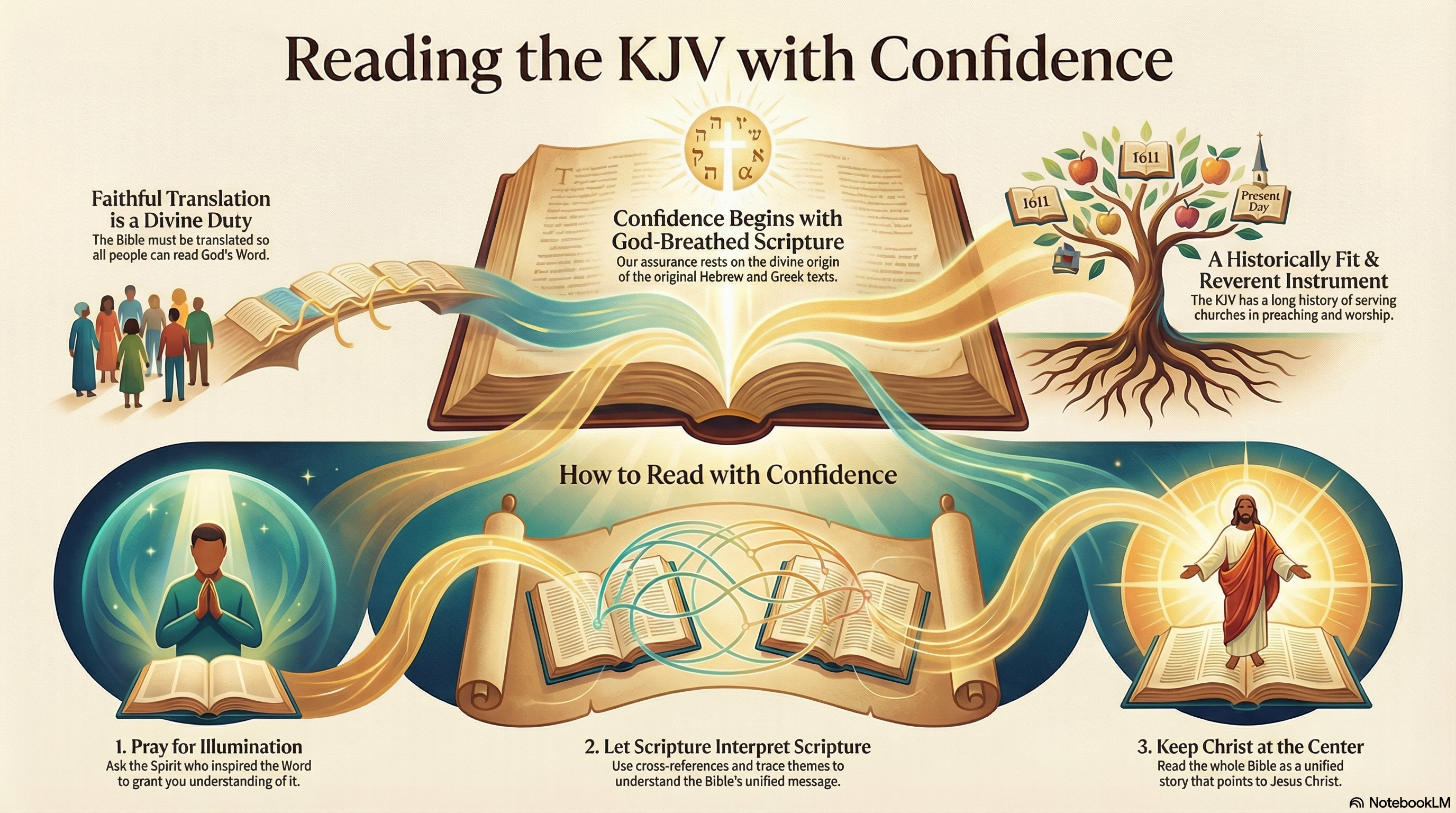
A covenantal guide showing why English-speaking Christians may read the King James Version with settled assurance under the doctrine of Scripture confessed by the Reformed churches.
"All scripture is given by inspiration of God, and is profitable for doctrine, for reproof, for correction, for instruction in righteousness: That the man of God may be perfect, throughly furnished unto all good works." (, KJV)
"The words of the LORD are pure words: as silver tried in a furnace of earth, purified seven times. Thou shalt keep them, O LORD, thou shalt preserve them from this generation for ever." (, KJV)
Thesis
The previous essays established that Jesus Christ is a real figure of history, that He claimed to be the divine Son of God, and that God vindicated those claims by raising Him bodily from the dead. If all of that is true, then the next question is urgent: where do we hear His voice today? The answer is Scripture — and the question for English-speaking Christians is whether we can trust the Bible in our hands.
The King James Version is a faithful English translation of the authentic Hebrew and Greek Scriptures that God inspired and, by His singular providence, preserved through the ordinary transmission of the church. It rests on a Greek text — the Textus Receptus — that represents the broad stream of manuscripts received, copied, and used by Christians from the earliest centuries through the Reformation. The reader who opens a KJV is not holding a relic of a bygone era. He is holding a reliable witness to the God-breathed originals — and he may read it with confidence for doctrine, worship, and life. And because no disputed reading between the great textual traditions touches any article of the Christian faith, that confidence does not wait upon the outcome of any manuscript debate.
1) God-Breathed Words: The Foundation of Confidence
Confidence in any Bible translation begins not with the translation itself but with what Scripture is. The Word of God is not a human product that must be authenticated by scholars. It is God-breathed, self-authenticating, and confirmed to the believer by the inward testimony of the Holy Spirit.
Scripture declares its own nature:
"For the prophecy came not in old time by the will of man: but holy men of God spake as they were moved by the Holy Ghost." (, KJV)
"Sanctify them through thy truth: thy word is truth." (, KJV)
"For verily I say unto you, Till heaven and earth pass, one jot or one tittle shall in no wise pass from the law, till all be fulfilled." (, KJV)
"The scripture cannot be broken." (, KJV)
The Westminster Confession of Faith (1.4–5) summarizes the church's reception of this self-witness: the authority of Scripture "dependeth not upon the testimony of any man, or Church; but wholly upon God (who is truth itself) the author thereof." The believer's "full persuasion and assurance of the infallible truth and divine authority thereof, is from the inward work of the Holy Spirit bearing witness by and with the Word in our hearts."
This means that confidence in reading the Bible does not ultimately depend on resolving every textual question. It rests on what God has said about His own Word — and on the Spirit's testimony that seals it.
2) Preservation: What God Promised and What History Confirms
Scripture does not merely claim to be inspired. It claims to be preserved:
"The words of the LORD are pure words: as silver tried in a furnace of earth, purified seven times. Thou shalt keep them, O LORD, thou shalt preserve them from this generation for ever." (, KJV)
"The grass withereth, the flower fadeth: but the word of our God shall stand for ever." (, KJV)
"Heaven and earth shall pass away, but my words shall not pass away." (, KJV)
"Being born again, not of corruptible seed, but of incorruptible, by the word of God, which liveth and abideth for ever." (, KJV)
A note of honesty on the first of these texts: in , some interpreters take "them" to refer not to the "words" of verse 6 but to the persecuted poor of verse 5, and the Hebrew allows either reading. Psalm 12 should therefore not carry the argument alone. The doctrine of preservation rests on the united witness of these passages and, confessionally, on God's "singular care and providence" (WCF 1.8).
The Westminster Confession confesses this preservation explicitly: the Old Testament in Hebrew and the New Testament in Greek "being immediately inspired by God, and, by His singular care and providence, kept pure in all ages, are therefore authentical" (WCF 1.8).
The question is: through what means did God keep His Word pure? The Reformed answer is: through the ordinary providence of the church's faithful copying, reading, and transmission of the text across generations. This is not a miraculous dictation to a single manuscript. It is the quiet, providential work of God ensuring that His Word was never lost, never corrupted beyond recovery, and never unavailable to His people.
This is exactly what history shows.
3) The Settled Center: No Doctrine Hangs on a Disputed Reading
Before examining manuscripts, settle the point that governs everything else: the differences between the great textual traditions of the New Testament do not place a single article of the Christian faith in doubt. This is not a partisan claim; it is affirmed by careful scholars on both sides of the textual debate.
Test it against the two most famous disputed passages — the hardest cases, not the easiest.
The long ending of Mark (16:9–20) is printed in the KJV and bracketed in most modern translations. Suppose, for argument's sake, it were removed entirely. What happens to the resurrection? Nothing. "He is not here: for he is risen, as he said" (, KJV) still stands — with Luke 24, John 20–21, and the creed Paul delivered "first of all" (, KJV) beside it. The resurrection rests on the united witness of the whole New Testament, not on one contested paragraph.
The Comma Johanneum () names the Father, the Word, and the Holy Ghost as one. Suppose it were absent. What happens to the Trinity? Nothing. "In the beginning was the Word, and the Word was with God, and the Word was God" (, KJV); "My Lord and my God" (, KJV); "the great God and our Saviour Jesus Christ" (, KJV); the one baptismal name of Father, Son, and Holy Ghost () — the deity of Christ and the triunity of God are woven through the entire canon.
Run the same test on every disputed reading and the result is the same. This is why B. B. Warfield — old Princeton's great defender of the inspiration and inerrancy of Scripture — could work from the modern critical text throughout his career and see no threat to any doctrine in it. Whatever else the manuscript debates decide, they decide nothing about the faith.
Notice what follows. For five centuries, rival textual traditions have been edited by rival scholars on rival principles — Erasmus, Stephanus, and Beza from the church's received stream; Westcott, Hort, and their successors from the earliest survivors — and the Bibles that result teach the same faith. One Lord, one gospel, one way of salvation, whichever edition is opened. If the transmission of Scripture had been genuinely corrupt, five centuries of that comparison would have exposed it. Instead the critical text functions as a hostile witness confirming the verdict: God's Word has come down to us intact. The manuscript debate, so often wielded to unsettle believers, is in fact one of the strongest evidences that there was no corruption to find.
This is the frame in which the Westminster Confession's words are to be read: the Scriptures, "by His singular care and providence, kept pure in all ages" (WCF 1.8). Providence is not a text-critical method, and this essay will not pretend it can adjudicate individual readings. What providence explains is the outcome the evidence displays — a text so faithfully transmitted that rival editing across five centuries cannot make it teach two faiths. The Confession grounds trust; the facts above are what that trust looks like when tested.
4) The Textual Basis: The Textus Receptus and the Majority Text
The King James Version's New Testament was translated from the Textus Receptus (TR) — a printed Greek text compiled primarily from Byzantine-family manuscripts. Understanding what this text is, where it came from, and why it matters is essential for reading the KJV with informed confidence.
What is the Textus Receptus?
The term "Textus Receptus" ("Received Text") comes from the preface of the 1633 Elzevir edition of the Greek New Testament, which stated: "Textum ergo habes, nunc ab omnibus receptum" — "You therefore have the text now received by all." The name stuck, and it refers broadly to the family of printed Greek editions that began with Desiderius Erasmus in 1516 and continued through the editions of Robert Estienne (Stephanus, 1550) and Theodore Beza (1598), the latter being the primary basis for the KJV translators.
Erasmus compiled his text from the best Greek manuscripts available to him — primarily Byzantine manuscripts held in libraries across Europe. His work was not done in a vacuum. He consulted with scholars, compared readings, and in subsequent editions (1519, 1522, 1527, 1535) corrected and refined the text. Stephanus and Beza continued this work, incorporating additional manuscript evidence.
The Byzantine Majority
The manuscripts behind the Textus Receptus belong overwhelmingly to what scholars call the Byzantine text-type — the form of the Greek New Testament that was copied, read, and transmitted by Greek-speaking Christians from the earliest centuries through the fall of Constantinople (1453) and beyond.
The sheer numerical dominance of this text-type is striking. Of the approximately 5,800 surviving Greek New Testament manuscripts, the vast majority — roughly 80–90% — belong to the Byzantine tradition. This is not accidental. These are the manuscripts that the Greek-speaking church actually used in its worship, preaching, and catechesis century after century. They represent not an isolated textual tradition but the mainstream transmission of the New Testament.
The significance of this majority is debated among scholars. Those who favor the modern critical text (primarily the Nestle-Aland/UBS editions behind most contemporary translations) argue that the Byzantine text represents a later, standardized recension. Those who favor the Majority Text or the TR argue that the numerical dominance reflects the faithful transmission of the original text through the church's continuous use — exactly the kind of providential preservation that the Westminster Confession describes.
How the Byzantine Text Relates to Older Witnesses
A common objection is that the oldest surviving manuscripts — particularly Codex Vaticanus (B, 4th century) and Codex Sinaiticus (ℵ, 4th century) — tend toward the Alexandrian text-type, and that older automatically means better.
This assumption deserves scrutiny:
Age does not equal accuracy. A manuscript is old because it survived — often because it was stored in a dry climate (Egypt) and not used. The Byzantine manuscripts, by contrast, were used until they wore out and were replaced by fresh copies. The very fact that fewer early Byzantine manuscripts survive may reflect not neglect but active use — copies were read, worn, and replaced, while unused manuscripts sat undisturbed in Egyptian libraries and monasteries.
The earliest evidence is mixed, not monolithic. The papyri of the second and third centuries do not present a clean divide between rival text-types; the early textual landscape was fluid, and readings later characteristic of the Byzantine tradition appear within it. The tidy story of a late, invented Byzantine text is tidier than the evidence.
The Church Fathers witness to Byzantine readings in early centuries. Patristic citations are a crucial — and often underappreciated — line of evidence. When a Church Father quotes a New Testament passage, he is citing the text as it existed in his time and region. Many distinctively Byzantine readings appear in patristic writers well before the supposed fourth-century Byzantine recension:
-
: "God was manifest in the flesh." The TR and KJV read theos ("God") where the Alexandrian text reads hos ("He who"). Some defenders of the reading find possible allusions to theos in writers as early as the late second century, though the earliest unambiguous citations come from the fourth century onward: Gregory of Nyssa (Against Eunomius 2.8), Chrysostom (homilies on 1 Timothy), and Theodoret of Cyrus all cite "God was manifest in the flesh" as the received text. The reading is supported by the overwhelming majority of Greek manuscripts. The difference between theos (ΘΣ) and hos (ΟΣ) in uncial script amounts to a single horizontal stroke — a scribal variation easily introduced — and the patristic and manuscript weight favors the traditional reading.
-
Cyprian (c. 200–258) uses language in De Unitate Ecclesiae (ch. 6) that may reflect an early form of the Comma Johanneum tradition () — the Trinitarian clause preserved in the KJV. The textual history of this passage is genuinely complex: the earliest Greek manuscript evidence for the full Comma is late, and no patristic writer before the fourth century quotes it verbatim. The first clear Latin witness is Priscillian (c. 380), and by the sixth century the Comma was widely received in the Western church. The passage was universally included in the Latin Vulgate tradition and was accepted without controversy by the Reformers. Honest readers should acknowledge the complexity here while noting that the Comma's doctrinal content — the Trinitarian witness — is established beyond dispute across dozens of other passages.
-
John Chrysostom (c. 347–407), whose homilies on the New Testament are among the most extensive patristic commentaries in existence, consistently uses a text that aligns with the Byzantine tradition. His sermons — preached in Antioch and Constantinople to ordinary congregations — reflect the text the Greek church was actually reading in worship.
-
Basil of Caesarea (c. 330–379) cites the traditional long ending of Mark (), which is included in the KJV but bracketed or footnoted in most modern translations based on Vaticanus and Sinaiticus. The long ending is attested by Irenaeus (Against Heresies 3.10.6, citing ), by the vast majority of Greek manuscripts, and by the early versions (Old Latin, Syriac, Coptic).
-
Augustine (354–430) explicitly addresses the question of textual reliability and directs that Latin copies be corrected against the Greek, giving preference to copies from the more careful and learned churches (On Christian Doctrine 2.15) — an appeal to the church's mainstream transmission rather than to isolated exemplars.
These are not marginal figures. They are the pillars of patristic theology, and their citations show that the text underlying the KJV was not a late invention but was known and used across the early church.
What This Means for the KJV Reader
The Textus Receptus is not a perfect critical reconstruction of the autographs. No printed text is. But it is a faithful representative of the Greek text that the church received, read, and transmitted across centuries — the text that shaped the theology, worship, and catechesis of Greek-speaking Christianity. When the KJV translators took up this text in 1611, they were not working from an obscure or idiosyncratic manuscript tradition. They were translating the text that the church had actually used.
The Old Testament: The Masoretic Text
The KJV's New Testament rests on the Textus Receptus. Its Old Testament rests on the Masoretic Text (MT) — the Hebrew text preserved and transmitted by Jewish scribes known as the Masoretes (c. 6th–10th centuries AD).
The Masoretes did not compose or alter the text. They inherited an already ancient tradition of careful copying and added a system of vowel pointing, accent marks, and marginal notes (masorah) to ensure its precise pronunciation and transmission. Their scribal practices were extraordinarily meticulous: they counted the letters, words, and verses of each book; they identified the middle letter and middle word of each book; they recorded how many times rare forms occurred. Any scroll that contained errors was corrected or buried — never used in worship.
This painstaking preservation was not a human innovation. It was the fulfillment of God's entrustment of Israel with "the oracles of God" (). The Jews received, guarded, and transmitted the Old Testament Scriptures — and God's providence ensured that their stewardship was faithful.
The discovery of the Dead Sea Scrolls (1947–1956) dramatically confirmed the accuracy of the Masoretic tradition. The Great Isaiah Scroll (1QIsa^a), dated to approximately 150 BC, is over a thousand years older than the oldest previously known Masoretic manuscript — and yet the two texts are remarkably close. The differences are overwhelmingly minor: spelling variations, occasional word order, a handful of variant readings. The substance of the text is the same. A millennium of hand-copying had preserved the text with extraordinary fidelity.
"The grass withereth, the flower fadeth: but the word of our God shall stand for ever." (, KJV)
The KJV reader who opens to Isaiah is reading a faithful English rendering of the same Hebrew text that was read in the synagogues before Christ, preserved by Jewish scribes for centuries after, and confirmed by ancient manuscripts buried in desert caves for two thousand years.
5) The KJV Translation: Why It Was Made and How It Was Done
The Translators and Their Method
The King James Version was produced by approximately 47 scholars organized into six translation companies — two at Westminster, two at Oxford, and two at Cambridge. These were not freelance writers. They were churchmen: pastors, professors of Hebrew and Greek, theologians steeped in the original languages and in the prior English translation tradition (Tyndale, Coverdale, the Geneva Bible, the Bishops' Bible).
Their method was rigorous and corporate. Each company translated its assigned books independently, then submitted its work to the other companies for review. Disagreements were resolved by committee deliberation, and particularly difficult passages were referred to the broader body of scholars. The result was not the work of one man's judgment but the collective labor of dozens of learned men, checked and cross-checked against each other.
The translators themselves, in their preface ("The Translators to the Reader"), disclaimed perfection while affirming faithfulness. Their stated aim was not to make a new translation from scratch, nor to make a bad one good — but "to make a good one better, or out of many good ones, one principal good one." They understood their work as standing in a line of faithful English translations, refining what had come before.
Fitness for Worship and Memory
The KJV was deliberately shaped for public reading. Its translators understood that Scripture would be heard aloud in churches, memorized by families, and recited in prayer. The result is a translation whose cadences serve proclamation and retention in a way that few modern translations match.
This is not nostalgia. It is a practical observation: the KJV's syntax closely follows the Hebrew and Greek originals, preserving parallelisms, clause structures, and intertextual echoes that help the reader trace connections across the canon. When Paul alludes to Isaiah, or when Jesus quotes Deuteronomy, the KJV's consistent rendering often makes the connection audible in a way that dynamic-equivalence translations obscure.
"So they read in the book in the law of God distinctly, and gave the sense, and caused them to understand the reading." (, KJV)
"Let the word of Christ dwell in you richly in all wisdom; teaching and admonishing one another in psalms and hymns and spiritual songs, singing with grace in your hearts to the Lord." (, KJV)
6) A Covenantal Lens: Why Preservation Matters for Redemptive History
If God made promises through Moses, confirmed them through the prophets, fulfilled them in Christ, and commissioned apostles to write them down — then the loss or corruption of that written testimony would mean the failure of the covenant itself. Preservation is not a bare abstraction. It is providence in service of Christ's mediatorial kingdom. But the covenant cannot fail:
"The scripture cannot be broken." (, KJV)
"For all the promises of God in him are yea, and in him Amen, unto the glory of God by us." (, KJV)
Not one covenant promise fails, nor does the written testimony that heralds the Mediator fail. Within this stream of providence, the King James Version stands as a faithful English witness to the Christ-centered voice of Moses, the Prophets, the Psalms, and the Apostles.
7) What Confidence Means — and Does Not Mean
Affirmation. Confidence means that the King James Version faithfully renders the authentic Scriptures God immediately inspired in Hebrew and Greek; therefore it may be safely used for doctrine, worship, and life. The reader who opens this Bible is hearing the voice of God mediated through faithful translation — not a distorted echo of it.
Denial. Confidence does not ascribe a new inspiration to any English edition, nor confine God's speech to one historical dialect. The KJV translators themselves would have rejected "KJV-Onlyism" — the claim that the English translation is itself inspired or superior to the Greek and Hebrew originals. As the Westminster Confession teaches, authority resides in the God-breathed originals; translations possess authority derivatively, insofar as they convey God's words faithfully (WCF 1.8).
Scripture declares the enduring authority of every "jot" and "tittle" () and the permanence of God's Word (). These promises apply to what God breathed out — the original-language Scriptures — and translations participate in that authority to the degree that they faithfully render those originals. By the apostolic rule — Scripture interpreting Scripture — the church submits every human product to the touchstone of the God-breathed text (; ).
And a word said plainly. A Christian reading the English Standard Version, the New American Standard, or the New King James is holding a trustworthy Bible. Those translations render, faithfully and reverently, a Greek and Hebrew text that teaches the same faith this essay has confessed — as the settled center of section 3 demonstrates. The thesis of this essay is confidence in your KJV, not suspicion of your neighbor's Bible. KJV-Onlyism — the claim that God's Word in English exists only in one seventeenth-century translation and that all others are corruptions — is rejected here without qualification. It is a position the KJV translators themselves disavowed in their preface, and one that cannot survive their own stated principles.
8) How to Read the KJV with Confidence Today
-
Seek illumination in prayer. Wisdom is asked of God, who giveth liberally (). The Spirit who gave the Word grants understanding of the Word (; ).
-
Keep the covenant storyline in view. Christ is the center; the law, the prophets, and the psalms speak of Him and are fulfilled in Him (; ). Read types and shadows unto their substance in Christ (; ).
-
Use helps without supplanting Scripture. Marginal notes, concordances, and a trustworthy dictionary serve clarity, but the text rules all. Scripture was read "distinctly," the sense was given, and understanding followed (; ).
-
Let Scripture interpret Scripture. Follow cross-references and trace themes across the covenants; contend for the once-delivered faith by canonical comparison (Jude 3; Hebrews 8–10; ).
-
Learn the KJV's distinctive vocabulary. A small number of archaic words are easily learned and often preserve a useful precision — see the short table of "false friends" under Objection 2 below. The second-person forms (thee/thou = singular, ye/you = plural) make a grammatical distinction that modern English has lost but that the original languages maintain.
-
Attend to public and private reading. Give attendance to reading in the congregation and to reading at home; both receive promise (; ; ).
-
Hide the Word in the heart. Memorization and meditation fortify holiness and comfort (; ).
-
Walk in the light received and seek further light. Be doers of the Word; present light guides the next step while further clarity is prayerfully pursued (; ).
"The law of the LORD is perfect, converting the soul: the testimony of the LORD is sure, making wise the simple." (, KJV)
9) Objections Answered
Objection 1: "The KJV is based on inferior manuscripts. Modern translations use older, better texts."
This objection rests on the assumption that the two oldest major codices — Vaticanus and Sinaiticus — are automatically superior because they are older. But as discussed above, age of survival is not the same as accuracy of transmission. A manuscript is old because it survived — usually a matter of dry climate and disuse. Why any particular copy went unused cannot now be known; survival by itself tells us nothing about the quality of its text.
The Byzantine manuscripts were the working texts of the Greek church for over a millennium. They were copied, corrected, and replaced precisely because they were in active use. The Textus Receptus, compiled from this living stream of transmission, represents the text the church actually read — not the text that sat unused on a shelf in the Vatican library or a monastery in the Sinai desert.
Moreover, the critical text behind modern translations is not a manuscript. It is a scholarly reconstruction — an eclectic text assembled by editors (primarily Westcott and Hort in the 19th century, and their successors in the Nestle-Aland tradition) who selected readings from various manuscripts according to their own text-critical principles. The reader of an ESV or NIV is not reading "the oldest manuscripts." He is reading the judgment calls of modern editors about which readings to prefer. The same must be said honestly of the Textus Receptus: Erasmus, Stephanus, and Beza were also editors making judgment calls. Every printed Greek text is an edited text. The real question is not "edited or unedited?" but which editorial principles are sound — those that follow the church's received, mainstream transmission, or those that privilege a small number of early survivors against it.
This does not mean modern translations are worthless. Many are produced by capable scholars and serve readers well. But the claim that they rest on a self-evidently superior text, while the KJV rests on an inferior one, is a significant oversimplification.
Objection 2: "Isn't the language too old to understand?"
Some terms are archaic, but the difficulty is smaller than its reputation — and it is better answered with help than with argument. The KJV's handful of "false friends" (words that look modern but carry an older sense) can be learned in an afternoon:
| KJV word | It means | Example |
|---|---|---|
| prevent | go before, precede | "shall not prevent them which are asleep" () |
| conversation | conduct, manner of life | "let your conversation be as it becometh the gospel of Christ" () |
| let | hinder, restrain | "he who now letteth will let" () |
| charity | love | "and have not charity" () |
| quick | living, alive | "the word of God is quick, and powerful" () |
| meat | food of any kind | "I have meat to eat that ye know not of" () |
| suffer | allow, permit | "Suffer little children… to come unto me" () |
Beyond such words, the structure is clear and the cadences are remarkably durable. The KJV was written in a consciously elevated but accessible English, and its syntax has shaped English prose — and English-speaking Christianity — for over four hundred years.
The thee/thou distinction, far from being an obstacle, is a genuine advantage: it preserves the singular/plural distinction of the original languages. When Jesus says "I say unto thee" (singular) versus "I say unto you" (plural), the KJV tells you something that modern translations cannot.
The entrance of God's words gives light to the simple (). With ordinary helps — a dictionary, a concordance, patient use — readers adjust quickly and profit greatly ().
Objection 3: "What about passages that differ between the KJV and modern translations?"
The differences between the KJV and modern critical-text translations fall into several categories:
Passages present in the KJV but absent or bracketed in modern translations. The most notable include the long ending of Mark (16:9–20), the Pericope Adulterae (:11), the Comma Johanneum (), and the doxology of the Lord's Prayer (). For the long ending of Mark, the Pericope Adulterae, and the doxology, the reading preserved in the KJV has substantial manuscript support, patristic attestation, and a long history of reception in the church's worship. The Comma Johanneum is the exception, as noted earlier: its Greek manuscript support is late, and its warrant rests not on manuscript weight but on its long reception in the Latin tradition and on the church's confidence in God's providential preservation (WCF 1.8). For the other passages, the decision to remove or bracket them in modern translations reflects editorial judgment, not settled fact.
Word-level differences. Many differences involve a single word or phrase — "God" versus "He who" in , for example. These differences are real but they do not typically alter the doctrinal substance of the passage. The deity of Christ, for instance, does not depend on alone — it is established across dozens of passages.
No essential doctrine is affected. This is the crucial point, argued at length in section 3 above. The differences between the TR and the critical text, while real and worth studying, do not alter any article of the Christian faith. A reader who trusts the KJV is not believing a different gospel than a reader who trusts the ESV; he is reading a text with a somewhat different set of editorial judgments about which Greek readings to follow — and the doctrinal content is the same.
Objection 4: "If other translations are trustworthy too, why the KJV specifically?"
Because trustworthiness settles whether a translation may be used; it does not settle which one to build a life — and a church's shared memory — upon. The reasons for preferring the KJV are honest preferences, openly stated: grounded, never mandated.
- Formal equivalence. The KJV renders word-for-word wherever English allows, preserving the parallelisms, repetitions, and cross-canon echoes of the originals. When Jesus quotes Deuteronomy, or Paul cites Isaiah, the reader can hear it.
- A single, stable, public text. The KJV is revised by no committee and owned by no publisher. A verse memorized in childhood is the same verse at the graveside; a congregation quotes it in unison across generations. It is why this collection can print a quotation in bold and know it will not drift.
- The church's inheritance. Four centuries of English preaching, catechesis, hymnody, and martyr-testimony are carried in its cadences. To read the KJV is to read with the communion of saints who read it before us.
- A register fit for the Word. Its consciously elevated English signals what is being read: not casual prose, but the oracles of God.
None of these reasons requires another translation to be bad. They are the reasons a church might sing the same psalter for centuries — not because other tunes are false, but because a common, stable, weighty inheritance serves the Word's dwelling richly in a people ().
Objection 5: "The KJV translators weren't inspired — why treat their work as special?"
They should not be treated as inspired, and the best advocates of the KJV do not make that claim. The KJV translators themselves disavowed it. What they produced was a faithful, careful, corporately reviewed translation of the received text — and its endurance across four centuries of English-speaking Christianity is itself a providential testimony to its quality.
The question is not whether the KJV is inspired. The question is whether it is faithful. And the answer, tested by four hundred years of use in preaching, catechesis, and devotion, is yes.
Objection 6: "What about other books some Bibles include?"
The Lord identified the Hebrew canon as law, prophets, and psalms (). Israel was entrusted with those oracles (). The church receives the sixty-six books as God-breathed; other writings — the Apocrypha, the Deuterocanonical books — may be historically useful, but they do not bind faith or life (; ). The Westminster Confession is explicit: "The books commonly called Apocrypha, not being of divine inspiration, are no part of the canon of the Scripture, and therefore are of no authority in the Church of God, nor to be any otherwise approved, or made use of, than other human writings" (WCF 1.3).
10) A Reformed Note on Translation and Authority
As Reformed Christians, we hold that the authority of Scripture resides in the God-breathed originals — the Hebrew Old Testament and the Greek New Testament. No translation, however faithful, is itself inspired. The Westminster Confession is clear: the originals are "authentical," and "in all controversies of religion, the Church is finally to appeal unto them" (WCF 1.8).
Why, then, is translation not a concession but a duty? Because the same Confession continues: "these original tongues" are "not known to all the people of God, who have right unto, and interest in the Scriptures, and are commanded, in the fear of God, to read and search them." Therefore Scripture must be "translated into the vulgar language of every nation unto which they come, that, the Word of God dwelling plentifully in all, they may worship Him in an acceptable manner" (WCF 1.8; cf. ; ).
Translation is an act of obedience to the Great Commission. It is the church's duty to render God's Word into the language of every people, so that the Word may dwell richly in all (). The KJV is the English church's principal fulfillment of this duty — tested by centuries of use, shaped for public worship, and grounded in the received text of the church's continuous tradition.
"For whatsoever things were written aforetime were written for our learning, that we through patience and comfort of the scriptures might have hope." (, KJV)
11) Conclusion
The King James Version is not a museum piece. It is a living instrument of God's Word — the translation that has shaped more English-speaking theology, worship, hymnody, and devotion than any other. It rests on the Hebrew Masoretic text and the Greek Textus Receptus — the broad stream of the church's manuscript tradition in both testaments, attested by the Church Fathers, received by the Reformers, confirmed by the Dead Sea Scrolls and the overwhelming majority of surviving Greek manuscripts.
To read it with confidence is not to claim perfection for a human product. It is to trust the God who breathed out His Word, who promised to preserve it, and who has — through the quiet providence of faithful copying, translating, and preaching — kept that promise across two millennia.
"Thy word is a lamp unto my feet, and a light unto my path." (, KJV)
Open the Book. Read it. Trust the voice you hear in it. It is the voice of the living God, who speaks through prophets and apostles and above all through His Son — the Christ whom this entire walkthrough has been leading you to know.
Suggested Reading
- "The Translators to the Reader" — the KJV translators' own preface, freely available online. Essential reading for anyone who wants to understand the translators' humility, method, and convictions in their own words.
- Edward F. Hills, The King James Version Defended (Christian Research Press, 1956) — the classic academic defense of the Textus Receptus from a Reformed and providentialist perspective. Hills was a Harvard- and Yale-trained textual scholar; his argument is careful and well-informed.
- Jakob van Bruggen, The Ancient Text of the New Testament (Premier Printing, 1976) — a concise Dutch Reformed case for the Byzantine text as the authentic text of the church.
- Maurice Robinson and William Pierpont, The New Testament in the Original Greek: Byzantine Textform (Chilton Book Publishing, 2005) — the leading modern scholarly edition of the Majority Text, with a substantial introduction arguing the case for Byzantine priority.
- Garnet Howard Milne, Has the Bible Been Kept Pure? The Westminster Confession of Faith and the Providential Preservation of Scripture (Christian Focus, 2017) — a careful engagement with WCF 1.8 and what "kept pure in all ages" means for textual confidence. Directly relevant to this essay's confessional argument.
- The Westminster Confession of Faith, Chapter 1 — the confessional foundation for everything this essay has argued.
Handoff in the Walkthrough
- Previous: "The Canon of Scripture: Received, Not Created" — how the church received the canon whose translation this essay defends.
- Next: "The Bible in 66 Short Sections" — a guided overview of the entire canon, book by book.
Suggested Next Steps
- Read the KJV preface ("The Translators to the Reader"). It is freely available online and reveals the translators' own humility, method, and convictions.
- Begin a month-long plan through Genesis–Deuteronomy (highlights), Psalms, Isaiah (highlights), John, Romans, Hebrews, and James, reading with Christ-centered, covenantal expectation ().
- Keep a brief list of archaic words to look up and a running chain of cross-references that link law, prophets, psalms, Gospel, and epistle (; ).
- Each week share one verse with another believer and discuss how it bears witness to Christ and summons obedience (; ).
- If textual questions arise, study them honestly — but remember that the question "Which manuscript tradition is best?" is ultimately a question about God's providence, not about human cleverness. Trust the God who promised to preserve His Word.
Essay Video
Reading the KJV with Confidence
Audio Discussion
Reading the KJV with Confidence
Infographic
Reading the KJV with Confidence