Essay
Is Jesus Christ a Historical Figure?
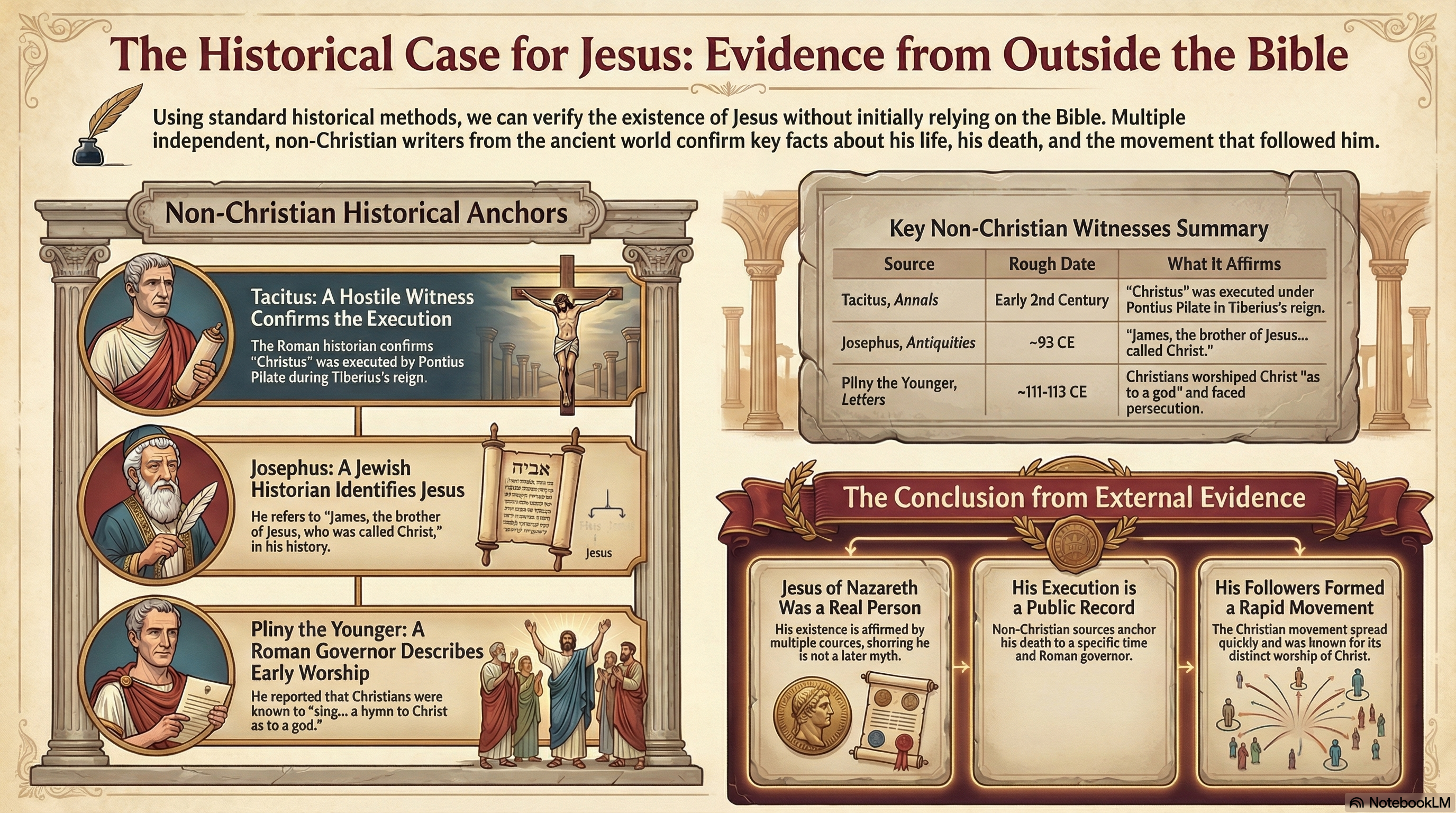
A two-layer, Reformed introduction to the question "Did Jesus really exist?"—using standard historical method and key non-Christian sources, while keeping Scripture (KJV) as the church's final authority.
"Prove all things; hold fast that which is good." (, KJV) "For we have not followed cunningly devised fables…" (, KJV)
Thesis
Using ordinary historical reasoning—without assuming inspiration up front—we can responsibly conclude that Jesus of Nazareth was a real first-century Jewish man, that He was executed under Pontius Pilate, and that within decades His followers had spread widely and were publicly devoted to Him, even to the point of worshiping Him "as to a god." (Wikisource)
This is not a controversial conclusion among professional historians. No serious ancient historian today—Christian, Jewish, agnostic, or atheist—denies that Jesus existed. Bart Ehrman, an agnostic New Testament scholar, devoted an entire book (Did Jesus Exist?, 2012) to demonstrating that the evidence for Jesus's historicity is overwhelming by the standards of ancient history. The question is not whether Jesus lived, but who He was—which is the subject of the next essay in this walkthrough.
Why This Question Matters
Some people are not yet asking, "Is Christianity true?" They are stuck at an earlier question:
- "Was Jesus even a real person?"
- "Is He history, or legend?"
- "Did the movement start from something concrete, or from myth-making?"
Answering this does not prove every Christian claim. But it clears the ground: Christianity is not a tale floating in midair. It is rooted in time, place, rulers, trials, and public events—the kind of things historians can examine.
What Historians Mean by "Historical Figure"
When historians evaluate whether an ancient person existed, they apply criteria like:
- Multiple independent sources — especially if they are not all sympathetic to the subject
- Early attestation — the closer to the events, the stronger the testimony
- Coherence with known history — do the people, places, and political realities check out?
- Criterion of embarrassment — do the sources record details that would have been inconvenient or damaging to the movement's own cause?
- Explanatory power — does "this person existed" explain the surviving evidence better than "this person was invented"?
Jesus passes every one of these tests, as we will see.
Layer 1: The External Anchors (Non-Christian Sources)
The following sources were written by men who had no interest in promoting Christianity. Several were openly hostile to it. That hostility is what makes their testimony so valuable: they confirm basic facts about Jesus and His movement precisely because they are trying to explain, govern, or mock it—not defend it.
Evidence Grid
| Source | Approximate Date | What It Affirms | Why It Matters |
|---|---|---|---|
| Tacitus, Annals 15.44 | ~116 CE (Britannica) | "Christus" executed under Pontius Pilate in Tiberius's reign; movement spread from Judaea to Rome | A hostile Roman senator anchors Jesus to specific rulers and a public execution |
| Josephus, Antiquities 20.9.1 | ~93 CE (Britannica) | "James, the brother of Jesus, who was called Christ" | A Jewish historian identifies Jesus through a passing reference to his brother—incidental and therefore hard to dismiss |
| Pliny the Younger, Letters 10.96–97 | ~112 CE (Georgetown) | Christians worship Christ "as to a god"; moral commitments; persecution under Roman law | A Roman governor describes a public movement centered on the worship of a named individual |
| Suetonius, Life of Claudius 25.4 | ~121 CE | Jews expelled from Rome over disturbances "at the instigation of Chrestus" | Likely garbled reference to Christ; confirms the movement's early presence in Rome (cf. ) |
| Mara bar Serapion, letter to his son | Late 1st–early 2nd c. | Refers to the Jews executing their "wise king," after which their kingdom was taken away | A pagan Stoic philosopher treats Jesus as a historical sage—comparable to Socrates and Pythagoras—without any Christian agenda |
| Lucian of Samosata, The Death of Peregrinus | ~170 CE | Mocks Christians and their "crucified sophist" whom they worship | A satirist assumes as background fact that Christianity's founder was a real man who was crucified |
1) Tacitus (Annals 15.44): Jesus Tied to Pilate and Tiberius
Tacitus, a Roman senator and historian widely regarded as one of antiquity's most reliable writers, explains Nero's scapegoating of Christians after the fire of Rome in AD 64. In doing so, he identifies the origin of their name:
"Christus, from whom the name had its origin, suffered the extreme penalty during the reign of Tiberius at the hands of one of our procurators, Pontius Pilatus, and a most mischievous superstition, thus checked for the moment, again broke out not only in Judaea, the first source of the evil, but even in Rome…" (Wikisource)
Three things to notice. First, Tacitus names both the Roman governor (Pilate) and the emperor (Tiberius), anchoring the execution in a specific political context that can be independently verified. Second, he calls Christianity a "mischievous superstition"—this is not a friendly witness. Third, he notes that the movement was temporarily "checked" by the execution but then "broke out" again—a rebound Tacitus does not explain, though a Christian reader may hear in it an echo of the apostles' own account ().
Tacitus is writing roughly 80 years after the crucifixion. That may sound late, but consider: our earliest surviving source for the British queen Boudicca is also Tacitus, writing about 50 years after her revolt. No one questions Boudicca's existence.
2) Josephus (Antiquities 20.9.1): Jesus Referenced Through James
Flavius Josephus, a first-century Jewish historian who worked under Roman patronage, describes the illegal execution of a man named James:
"…the brother of Jesus, who was called Christ, whose name was James…" (Bible Study Tools)
This reference is incidental—Josephus is not writing about Jesus; he is writing about James and identifies which "Jesus" he means by adding the qualifier "who was called Christ." This is exactly how historians expect real people to surface in ancient texts: not as the subjects of set-piece biographies, but as assumed background knowledge that the author expects the reader to recognize. (Britannica)
A note on Josephus and tampering. Josephus has a second, longer passage about Jesus in Antiquities 18.3.3 (the Testimonium Flavianum), which contains language that most scholars believe was altered or expanded by later Christian copyists. Britannica distinguishes the two: Book XX calls Jesus the "so-called Christ," while Book XVIII shows clear signs of tampering. (Britannica) That is precisely why the Book XX reference is the sturdier anchor—it is a casual aside, not a theological statement, and there is no plausible motive for a Christian copyist to invent a passing reference to "James, the brother of Jesus."
3) Pliny the Younger (Letters 10.96–97): Early Worship and Public Pressure
Pliny, the Roman governor of Bithynia-Pontus, writes to Emperor Trajan around 112 CE asking how to handle Christians. He reports the results of his interrogations:
"…they were accustomed to meet on a fixed day before dawn and sing responsively a hymn to Christ as to a god, and to bind themselves by a solemn oath not to commit any wicked deed…" (Georgetown)
Pliny is not admiring these people. He is a Roman administrator trying to determine whether their behavior constitutes a criminal offense. His letter confirms several things simultaneously: that Christians were publicly identifiable, that they worshiped Christ as divine, that they met regularly, and that their numbers were large enough to cause concern for the governor of a Roman province—all within about 80 years of the crucifixion. (Georgetown)
4) Suetonius, Mara bar Serapion, and Lucian: Confirming the Pattern
These three additional sources are briefer but reinforce the same picture.
Suetonius (Life of Claudius 25.4, ~121 CE) records that Emperor Claudius expelled Jews from Rome because of disturbances "at the instigation of Chrestus"—almost certainly a garbled reference to Christ, and one that aligns with Luke's report in that Aquila and Priscilla had left Rome because "Claudius had commanded all Jews to depart."
Mara bar Serapion, a pagan Stoic philosopher writing to his son (late 1st or early 2nd century), lists three examples of peoples who were punished for killing their wise men: the Athenians killed Socrates, the Samians killed Pythagoras, and the Jews killed their "wise king"—after which "their kingdom was abolished." The unnamed "wise king" is almost certainly Jesus; Mara treats him as a historical figure in the same category as Socrates, without any Christian theological interest.
Lucian of Samosata (~170 CE), a Greek satirist, mocks Christians for worshiping a "crucified sophist" and following his laws. Lucian is hostile and dismissive—but he takes for granted that the founder of Christianity was a real man who was really crucified.
What We Can Responsibly Conclude from Layer 1
From these external anchors—none of them Christian, several openly hostile—a historically cautious conclusion looks like this:
- Jesus of Nazareth existed as a real person, not a symbol or a literary invention.
- He was executed under Pontius Pilate during the reign of Tiberius, in the province of Judaea.
- His followers rapidly formed a recognizable public movement that spread beyond Palestine and was visible in Rome within a generation.
- These followers worshiped Christ as divine ("as to a god") early enough for Roman administrators to take notice and respond with legal force.
This does not yet prove the resurrection or any doctrinal claim. But it powerfully resists the notion that Jesus is a late mythical invention. The evidence for His existence is, in fact, comparable to—and in breadth of independent attestation, often stronger than—the evidence for many ancient figures whose historicity no one disputes, such as Hannibal, Arminius, and Boudicca.
The Criterion of Embarrassment
One of the most telling indicators that the Gospel accounts are rooted in real history rather than invention is what scholars call the criterion of embarrassment: the early Christians preserved details about Jesus that actively damaged their own cause. Invented heroes do not come with built-in liabilities.
Consider:
-
Jesus was baptized by John. This implies that Jesus submitted to a rite of repentance administered by someone else—an awkward fact for a movement claiming He was sinless and superior to John. Matthew's Gospel even records the discomfort: John protests, "I have need to be baptized of thee, and comest thou to me?" (, KJV). If Christians invented the story, they would never have included this detail.
-
Jesus was crucified. In the Roman world, crucifixion was the most shameful form of execution, reserved for slaves and criminals. Paul himself acknowledges the rhetorical problem: "But we preach Christ crucified, unto the Jews a stumblingblock, and unto the Greeks foolishness." (, KJV). No one invents a god who dies the death of a slave.
-
Jesus came from Nazareth in Galilee. Galilee was a rural backwater; Nazareth was an obscure village. The Gospel of John preserves the skepticism: "Can there any good thing come out of Nazareth?" (, KJV). A fabricated Messiah would have come from Jerusalem, or at least from a city of reputation.
-
Jesus's own family initially doubted Him. Mark records that His relatives thought He was out of His mind (), and John states plainly that "neither did his brethren believe in him" (, KJV). A movement inventing a divine founder does not invent skeptical siblings.
These embarrassments are evidence for historicity, not against it. Real history is messy and inconvenient. Myths are clean.
Layer 2: The Earliest Christian Sources
Once someone accepts that Jesus existed, the next honest question is: What do the earliest sources say He was like—and what did He claim?
Paul: One Degree of Separation
Paul's letters are among the earliest surviving Christian writings—most scholars date 1 Thessalonians and Galatians to the late 40s or early 50s, roughly 15–20 years after the crucifixion. But what makes Paul's testimony extraordinary is not just its earliness; it is his personal contact with eyewitnesses.
In , Paul writes that he went up to Jerusalem and spent fifteen days with Cephas (Peter) and also met "James the Lord's brother." This puts Paul within one degree of separation from Jesus Himself—personally acquainted with Jesus's closest disciple and Jesus's own sibling—within approximately three to five years of the crucifixion.
This is virtually unprecedented in ancient history. For most figures of antiquity, our earliest source is written generations or centuries after the fact by someone who never met anyone who knew the subject. With Jesus, we have a literate contemporary who personally knew the eyewitnesses and who staked his life on what they told him.
The Pre-Pauline Creed:
Paul's earliest preaching centers on a public death and a proclaimed resurrection. In 1 Corinthians 15, he passes on a formula that most scholars believe predates his own letters—a creedal statement circulating in the earliest Christian community:
"For I delivered unto you first of all that which I also received, how that Christ died for our sins according to the scriptures; And that he was buried, and that he rose again the third day according to the scriptures:" (, KJV)
Paul says he "received" this — it was handed to him, likely during those early visits with Peter and James. The creed names witnesses (Cephas, the Twelve, five hundred brethren, James, all the apostles, and finally Paul himself). It is not a vague spiritual claim; it is a list of named people who can be questioned — and Paul says most of them are still alive when he writes ().
From a Reformed standpoint, we gladly say more: the New Testament is not merely early testimony; it is God-breathed Scripture (). For the full case for trusting the text we have received, see Reading the KJV with Confidence. But even at the seeker level, the historical weight of this evidence is formidable.
Addressing the Mythicist Claim Directly
The "Christ myth" theory — the claim that Jesus never existed and was constructed from pagan dying-and-rising god myths — circulates widely online but has virtually no support among professional historians of antiquity, including non-Christian ones.
The theory fails for several reasons:
-
The proposed parallels do not hold up under scrutiny. The "dying-and-rising god" category has been challenged by scholars of comparative religion (most notably Jonathan Z. Smith). The figures typically cited — Osiris, Attis, Adonis — differ from Jesus in fundamental ways: none of them are placed in a datable historical setting, executed by a named Roman official, and proclaimed as risen by named eyewitnesses within a generation.
-
The Jewish context makes pagan borrowing implausible. First-century Palestinian Jews were fiercely resistant to pagan religious influence. The idea that devout Jews would construct their Messiah from Greco-Roman myths runs against everything we know about Second Temple Judaism's relationship to paganism.
-
The evidence must be explained, not dismissed. The mythicist must account for Tacitus, Josephus, Pliny, and the pre-Pauline creed — plus Paul's personal acquaintance with Peter and James — without positing a historical Jesus. No mythicist proposal has done this convincingly.
-
Professional consensus is overwhelming. Ehrman (agnostic), E.P. Sanders (secular), Geza Vermes (Jewish) — scholars from every ideological background affirm Jesus's historicity. As Ehrman writes: "The view that Jesus existed is held by virtually every expert on the period."
Common Objections (and Calm Replies)
Objection 1: "These sources are too late to be reliable."
None of the non-Christian sources were written during Jesus's lifetime. But this is entirely normal for ancient history. Our best sources for Alexander the Great (Arrian, Plutarch) were written 400+ years after his death. Tacitus writing about Jesus 80 years later is, by ancient standards, remarkably close.
More importantly, the non-Christian sources provide independent confirmation of facts already attested by earlier Christian writings (Paul's letters, the Gospels). The question is not whether Tacitus alone would suffice, but whether the combined testimony — Christian and non-Christian, early and later — converges on a coherent picture. It does. (Wikisource)
Objection 2: "These writers just repeated what Christians told them."
Even if some information reached Tacitus or Pliny through Christian reports, the question becomes: what were Christians publicly saying early enough to be widely known, and why did hostile officials care?
Pliny is not admiring Christians; he is trying to govern and punish them. Tacitus is not flattering them; he is explaining a scapegoating campaign and calls their faith a "superstition." Their willingness to record basic facts about Jesus and His movement — execution under Pilate, origin in Judaea, rapid spread, worship of Christ — reflects the public visibility of claims that were already well established. (Georgetown)
Objection 3: "Josephus is corrupted, so we can't trust him."
A careful approach agrees that the Book XVIII paragraph (Testimonium Flavianum) shows signs of Christian editorial expansion. But the Book XX reference to "James, the brother of Jesus, who was called Christ" is far harder to dismiss. It is incidental, it has no theological content, and there is no clear motive for a Christian copyist to invent it. Britannica distinguishes the two: Book XX uses the distancing phrase "so-called Christ"; Book XVIII contains language that reads as a Christian confession. (Britannica)
Objection 4: "There is no archaeology for Jesus — so He didn't exist."
This is an argument from silence, and it cuts nothing. As Bart Ehrman observes:
"The reality is that we don't have archaeological records for virtually anyone who lived in Jesus's time and place." (HISTORY)
We have no artifacts for the vast majority of people in the ancient world — including most Roman governors and Jewish religious leaders. The absence of a personal artifact for a Galilean teacher from an obscure village is exactly what we would expect, not evidence of non-existence.
It is worth noting that the Pilate Stone, discovered at Caesarea Maritima in 1961, confirmed the existence of Pontius Pilate — a figure whose historicity some had questioned. Archaeology has a way of catching up.
A Brief Reformed Note on Method
As Reformed Christians (Westminster), we do not build the authority of Christ on Tacitus or Pliny. Scripture is the supreme judge of all religious controversy (WCF 1.10).
But it is entirely proper to observe:
- The Christian faith is not irrational credulity; it is rooted in public events that can be examined.
- God's redemption happened in real history — under named rulers, in identifiable places, at datable times.
- Even outsiders confirm enough to show that Jesus is not a literary invention.
The external evidence does not create faith. But it removes a false excuse for unbelief. And that is a legitimate use of historical reasoning in the service of the gospel.
"And ye shall know the truth, and the truth shall make you free." (, KJV)
Conclusion
The question "Did Jesus exist?" is one of the easiest questions in ancient history to answer. Six non-Christian sources written within 150 years of His death confirm His existence, His execution under Pilate, the rapid spread of His movement, and the early worship of Him as divine. The earliest Christian writings put us within one degree of personal separation from Jesus Himself, through a literate contemporary who met the eyewitnesses.
No comparable figure in antiquity is supported by this breadth of independent testimony and still seriously doubted.
But the most important question remains — and it is the one that actually matters for your life:
- If Jesus existed, who is He?
- What did He claim?
- What explains the resurrection proclamation, the worship of Christ, and the birth of the church?
That is the purpose of the next document.
Handoff in the Walkthrough
- Next: Is Jesus Christ Really Who He Said He Is? — from historicity to the claims Jesus actually made about Himself.
Suggested Next Steps
- Read one Gospel straight through (KJV): Mark (fast) or John (clear on identity).
- Read (KJV) and note the stated aim: orderly witness and assurance.
- Read 1 Corinthians 15 (KJV) and write down what the earliest preaching claimed.
- If you are connected to a local church, bring your hardest questions to a faithful pastor or elder and test all things by Scripture (; ).
Essay Video
Is Jesus Christ a Historical Figure?
Audio Discussion
Is Jesus Christ a Historical Figure?
Infographic
Is Jesus Christ a Historical Figure?