Essay
Theology Proper & Christology in Reformed Covenant Perspective
“I am the LORD, and there is none else, there is no God beside me.” (, KJV)
“Who being the brightness of his glory, and the express image of his person, and upholding all things by the word of his power, when he had by himself purged our sins, sat down on the right hand of the Majesty on high.” (, KJV)
Thesis
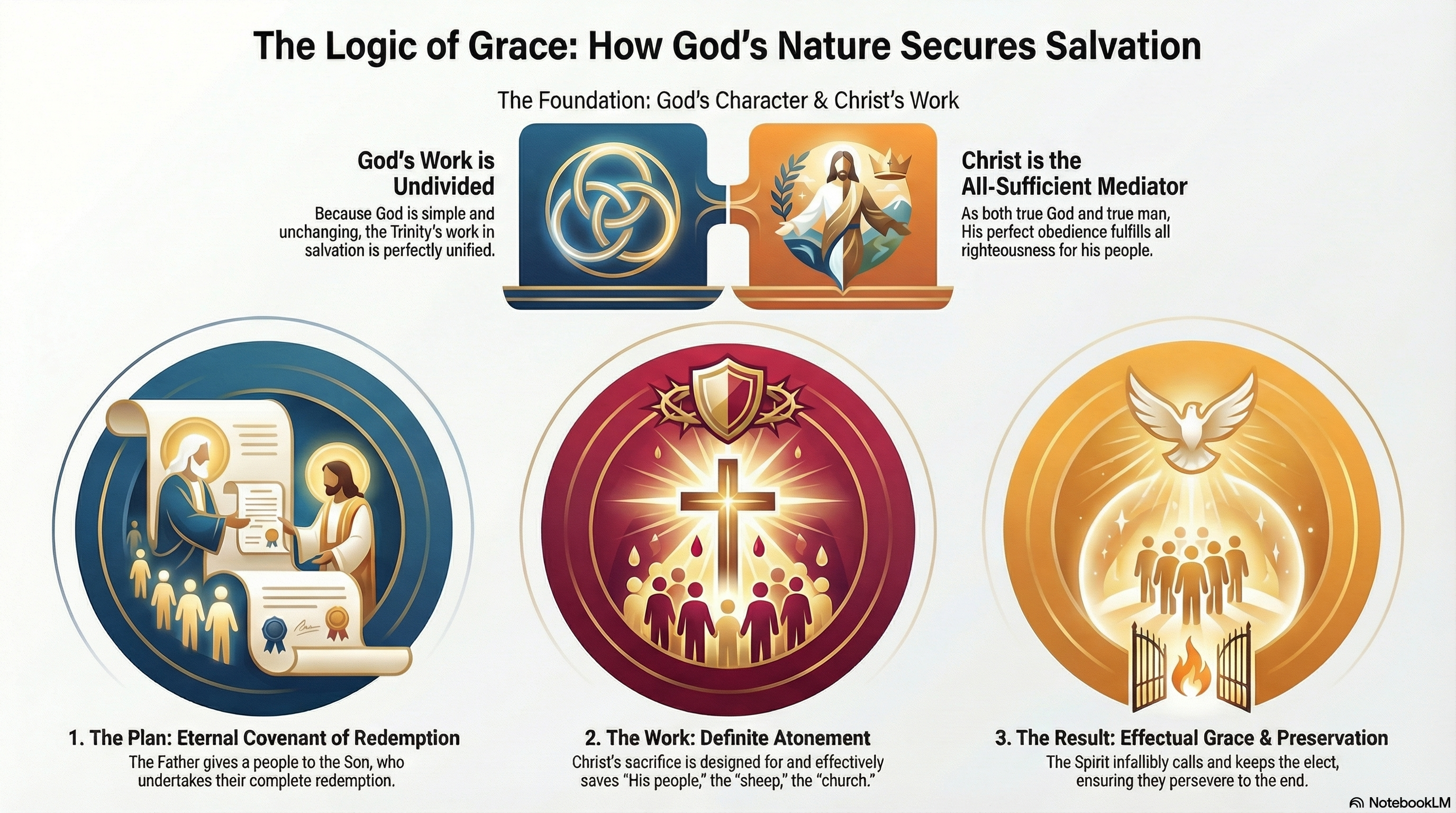
Westminster soteriology rests on theology proper and Christology, not on a detachable system. The one simple God acts indivisibly in redemption: the Father elects, the Son redeems, and the Spirit effectually applies salvation to the same people (; ; ). That is why the New Covenant gives what it promises rather than merely offering possibilities (; ). The fuller covenant case is argued elsewhere; what follows lays open the doctrinal engine under it — who God is, who the Mediator is, and why salvation is therefore certain for everyone He undertakes to save.
I. Theology Proper — Who God Is
1) God’s Being: Spirit, One, Simple
Spirit & Unity. Scripture declares: “God is a Spirit: and they that worship him must worship him in spirit and in truth” (). The Shema establishes the unity of the Godhead: “Hear, O Israel: The LORD our God is one LORD” (). The apostolic witness maintains both truths together—one God in three Persons, of one substance, power, and eternity (; ; compare Westminster Confession of Faith II.3).
Simplicity (no competing attributes). Scripture teaches that God is without parts and passions and therefore without inner conflict (; compare Westminster Confession of Faith II.1). His counsel and goodness are one undivided perfection: “My counsel shall stand, and I will do all my pleasure” (); He “worketh all things after the counsel of his own will” (); and “a God of truth and without iniquity, just and right is he” (). Therefore the divine decree never clashes with divine goodness; what He wills, He wisely and holily wills.
Covenantal implication. Because the undivided God acts indivisibly, the same electing counsel of the Father is the scope of the Son’s atonement and the Spirit’s application (; ; ). Salvation is therefore secured by God’s covenant purpose, not suspended on autonomous human will (; ).
2) Aseity, Eternity, Omnipresence, Omniscience, Omnipotence
Aseity. Scripture denies all creaturely dependence in God: “Neither is worshipped with men’s hands, as though he needed any thing” (). He has “life in himself” ().
Eternity. God is “from everlasting to everlasting” () and “the King eternal, immortal, invisible” ().
Omnipresence. No creature can flee His presence: “Whither shall I go from thy spirit? or whither shall I flee from thy presence?” (). “Do not I fill heaven and earth? saith the LORD” ().
Omniscience. “God… knoweth all things” (); “all things are naked and opened unto the eyes of him” ().
Omnipotence. He is “the Almighty God” (), and “with God all things are possible” ().
Doctrinal synthesis. These incommunicable perfections, confessed by the Church, ground providence and grace: the immutable, most holy God freely decrees whatsoever comes to pass without becoming the author of sin (; ; Westminster Confession of Faith III.1), upholds and orders all things (; Westminster Confession of Faith V.1), and infallibly brings His covenant to its consummation in Christ the Mediator (; ; Westminster Confession of Faith VIII.1, 5).
Hermeneutic note: this essay assumes the apostolic reading argued more fully in the covenant essays: promise reaches fulfillment in Christ, and shadow yields to substance (; ; ). That framework explains why the grace promised is the grace effectually given. For the method itself, see Apostolic Hermeneutic; for the soteriological application, see Salvation Is of the LORD.
3) Immutability and Impassibility
Immutability. Scripture declares the unchangeableness of God’s being and counsel: “I am the LORD, I change not” (); “with whom is no variableness, neither shadow of turning” (). The apostolic witness names “the immutability of his counsel” as the ground of strong consolation to the heirs of promise (). The same certainty is confessed in the Mediator: “Jesus Christ the same yesterday, and to day, and for ever” (; ).
Impassibility (not subject to creaturely fluctuation). God is not a man to lie or repent (; ). Such texts exclude volatility and creaturely passions in God, while maintaining the Creator–creature distinction: men are “of like passions” (), but God is not. When Scripture speaks of God “repenting” (e.g., ), it speaks after the manner of men to reveal a true change in His works ad extra, not a change in His being or decree; texts that ascribe immutability interpret the anthropopathic language (; ; ).
Clarification. Love, mercy, justice, and wrath are perfections of God’s simple, unchanging being, not fluctuating moods (; ). Impassibility denies creaturely changeability, not divine affection. By this immutability the covenant promises stand sure: “the gifts and calling of God are without repentance” (); He will “not turn away from them, to do them good” (). Thus the New Covenant’s efficacy flows from who God is ().
4) Moral Perfections
“The LORD, The LORD God, merciful and gracious, longsuffering, and abundant in goodness and truth” (). “There is none holy as the LORD” (). He is “a God of truth… just and right is he” (). “God is love” (), and “God is light, and in him is no darkness at all” (). These perfections are harmonized in the cross, where God is “just, and the justifier of him which believeth in Jesus” (). By the apostolic method, the Servant’s substitution satisfies justice and secures mercy for the elect (; ).
5) The One Will of God: Decree and Command
One will, two respects. Scripture distinguishes without dividing: the decretive (secret) will and the preceptive (revealed) will. “The secret things belong unto the LORD our God: but those things which are revealed belong unto us… that we may do all the words of this law” (). God “declaring the end from the beginning… My counsel shall stand” (); He “worketh all things after the counsel of his own will” (; ; ). Yet He commands what is right and holds creatures responsible (; ).
God not author of sin; compatibilism affirmed. God “cannot be tempted with evil, neither tempteth he any man” (). Nevertheless, Scripture asserts both meticulous providence and genuine human agency: Christ was delivered up “by the determinate counsel and foreknowledge of God,” and yet “ye… have taken, and by wicked hands have crucified and slain” (; see also ). Joseph’s brothers “meant evil,” but “God meant it unto good” (). Even the casting of the lot is disposed by the LORD (). By covenantal continuity, the same decree includes the effectual means—new heart and perseverance—so that what God commands in the New Covenant He also causes (; ; ; ).
6) The Holy Trinity and Inseparable Operations
The Church is baptized “in the name of the Father, and of the Son, and of the Holy Ghost” (). The Son declares, “I and my Father are one” (); “what things soever he [the Father] doeth, these also doeth the Son likewise” (); “the Father that dwelleth in me, he doeth the works” (). The apostolic pattern ascribes diverse operations in one and the same divine act—“diversities of gifts, but the same Spirit… the same Lord… the same God which worketh all in all” ().
Apostolic and covenantal upshot. The external works of the Trinity are indivisible and ordered: from the Father, through the Son, by the Spirit (). Election, redemption, and application are therefore one work with distinct personal properties: the Father chose a people, the Son redeemed them, and the Spirit seals them unto the inheritance (; ).
II. Christology — Who the Mediator Is
1) One Person, Two Natures (True God and True Man)
Definition. The church confesses, summarizing Scripture, that the eternal Son assumed a true human nature, so that the one Person, Jesus Christ, subsists in “two whole, perfect, and distinct natures, the Godhead and the manhood” (WCF 8.2), united “without confusion, without change, without division, without separation” (Definition of Chalcedon, A.D. 451).
Deity. “The Word was God” (); “Christ came, who is over all, God blessed for ever” (); “in him dwelleth all the fulness of the Godhead bodily” (); “God was manifest in the flesh” ().
Humanity. “The Word was made flesh” (); He “likewise took part of the same” (); “in all things it behoved him to be made like unto his brethren” (); He “increased in wisdom and stature” (). The apostolic writers therefore confess one Mediator who is true God and true Man ().
Covenantal import. As the last Adam and federal Head, He fulfills the covenant of works on behalf of His people and mediates the covenant of grace as its Surety (; ; 9:15).
2) Two Wills (Dyothelitism) in Perfect Harmony
Scripture distinguishes the natural human will of Christ from the divine will, yet without personal division: “Not my will, but thine, be done” (). The incarnate Son came “not to do mine own will, but the will of him that sent me” (), fulfilling the prophetic word, “Lo, I come… to do thy will, O God” (). Thus the human will of Christ is impeccably aligned to the divine will, ensuring an obedience competent to redeem.
3) Communicatio Idiomatum (Predication to the Person)
Because properties are predicated of the Person subsisting in two natures, Scripture can say, “the church of God, which he hath purchased with his own blood” (), and that rulers “crucified the Lord of glory” (). This does not confuse or change the natures (; ; ); rather, it ascribes the work to the one Person who acts according to either nature as fitting.
Guardrail. What is proper to one nature is not transferred to the other; yet the Person is the common subject of all the Mediator’s acts.
4) The Extra Calvinisticum (The Son Never Confined)
In the incarnation the eternal Son truly inhabits the assumed humanity, yet is never circumscribed by it according to His divine nature. Even as He walked on earth, “by him all things consist” () and He was “upholding all things by the word of his power” (). Thus He can say the “Son of man… is in heaven” (). The apostolic method thereby preserves the infinity of the Logos while confessing the reality of the flesh.
5) Christ’s Priestly Office: Sacrifice and Intercession Coextensive
Scripture unites oblation and intercession in one priestly work for one people: “It is Christ that died… who also maketh intercession for us” (); “he ever liveth to make intercession for them” (). The same “them” are those for whom the offering was made: “by his own blood… having obtained eternal redemption for us” (); “by one offering he hath perfected for ever them that are sanctified” ().
Extent defined by covenant election. The Scriptures delimit the priestly scope: “he shall save his people from their sins” (); “the good shepherd giveth his life for the sheep… I lay down my life for the sheep” (); “Christ also loved the church, and gave himself for it” (). In His High Priestly prayer, the Mediator intercedes not for the world indiscriminately but for those given Him by the Father (). By covenantal coherence, sacrifice and intercession are coextensive, establishing definite atonement and effectual application.
6) Active and Passive Obedience
Active obedience (law-keeping for His people). Being “made under the law” (), the second Adam rendered perfect, personal, and perpetual obedience. Thus “by the obedience of one shall many be made righteous” (). He fulfilled all righteousness () and was “without sin” ().
Passive obedience (suffering the curse for His people). He became “obedient unto death, even the death of the cross” (). “The LORD hath laid on him the iniquity of us all… by his knowledge shall my righteous servant justify many; for he shall bear their iniquities” (). He was “made a curse for us” () and “made… to be sin for us… that we might be made the righteousness of God in him” ().
Result: full righteousness imputed, full guilt removed. The righteousness of Christ is counted to believers for justification, while their sins are imputed to Christ and borne away (; 4:5–8; ). Thus the covenant of grace provides not only pardon but a positive title to life in the Second Adam, in accord with the Westminster doctrine of justification and the perseverance of the saints (; ).
III. Covenant Theology—The Logic Engine of Soteriology
1) The Covenant of Redemption (Pactum Salutis)
Scripture identifies an eternal counsel wherein the Father gives a people to the Son, the Son undertakes their redemption, and the Spirit applies that purchased salvation. “All that the Father giveth me shall come to me… of all which he hath given me I should lose nothing” (). The Mediator therefore gives eternal life to those given Him (; see also ). This intra-trinitarian pact appears in promise and fulfillment: “Lo, I come… to do thy will, O God” (; ); “it pleased the LORD to bruise him… he shall see of the travail of his soul, and shall be satisfied” (). As Surety of the covenant, Christ secures the inheritance for those given Him (; ).
2) Federal Headship: Adam and Christ
The covenantal structure of Scripture sets two representatives before mankind. In Adam, sin and death enter for all he represents; in Christ, righteousness and life are secured for all He represents. “By one man sin entered into the world, and death by sin… so by the obedience of one shall many be made righteous” (). “For as in Adam all die, even so in Christ shall all be made alive” (; see also ). This federal headship explains imputation: Adam’s guilt to his seed, Christ’s righteousness to His seed (; ).
3) New-Covenant Efficacy (not mere offer)
The New Covenant, established in Christ’s blood, effectually gives what it promises to its heirs. God writes His law within, grants saving knowledge, and decisively forgives sins: “I will put my law in their inward parts… I will forgive their iniquity” (); “A new heart also will I give you… and cause you to walk in my statutes” (). Christ identifies His death as the covenant-making act: “This cup is the new testament in my blood” (). The apostolic exposition confirms efficacy: “I will put my laws into their mind” (), and “by one offering he hath perfected for ever them that are sanctified” (; see 10:15–18). Thus the gospel is freely offered to all (; ), while the covenant promises are effectually bestowed upon the elect (; ).
4) Calling, Faith, and Preservation Flow from Who God Is and Who Christ Is
Effectual calling arises from the Father’s sovereign drawing, grounded in the Son’s redemption and applied by the Spirit: “No man can come to me, except the Father which hath sent me draw him… except it were given unto him of my Father” (). Regeneration and faith are of God: believers are “born… of God” (), and “as many as were ordained to eternal life believed” (). The same logic secures preservation: “They shall never perish, neither shall any man pluck them out of my hand” (); believers are “kept by the power of God through faith unto salvation” (; see also ; ; Jude 24). The doctrines of grace follow from who God is and who Christ is, not from a later theological add-on.
Foreknowledge as fore-love. In , “whom he did foreknow” identifies the objects of God’s prior love and choice; the same persons are predestinated, called, justified, and glorified. The biblical usage confirms a relational knowing—“You only have I known of all the families of the earth” ()—and guards against reading bare foresight of human acts into the text (; ).
IV. Scope and Effect — A Reader’s Map for “All/World” and the Free Offer
Scope (breadth). Scripture often uses “all” and “world” to denote all kinds without exception of nation, rank, or class. “There went out a decree from Caesar Augustus, that all the world should be taxed” ()—the Roman world in its breadth, not every individual. Prayer is urged “for kings, and for all men,” because God “will have all men to be saved”—that is, men of every station and sort—and Christ “gave himself a ransom for all” () — though other confessional Reformed interpreters read these verses instead as God’s revealed will expressed in the free offer of the gospel, a reading equally within the Reformed pale. By the apostolic method, the promised blessing extends beyond Israel to the nations: Christ will “draw all men” (all kinds, Jew and Gentile) unto Himself (; compare ; ; 7:9).
Effect (efficacy). The same Scripture that proclaims global scope asserts definite efficacy: the Mediator actually saves His people. “He shall save his people from their sins” (). “The good shepherd giveth his life for the sheep” (); those sheep hear His voice and are kept to the end (). Death and intercession are coextensive: those for whom He died are those for whom He intercedes and whom He secures (; ; 9:12, 24–28; ). “By one offering he hath perfected for ever them that are sanctified” ().
Sincere offer. The gospel is freely and truly offered to all without distinction. “Whosoever believeth in him should not perish” (). “Whosoever will, let him take the water of life freely” (). The call is universal and sincere (), while the coming is certain for those given by the Father: “All that the Father giveth me shall come to me” (). Thus Scripture preserves both the well-meant offer to every hearer and the effectual grace that brings the elect infallibly to Christ.
V. Romans 9—Mercy and Hardening on God’s Purpose
Thesis. The chapter vindicates the faithfulness of God’s word by distinguishing between Israel after the flesh and the Israel of promise: “They are not all Israel, which are of Israel” (). Election is unconditional: before birth or works, “that the purpose of God according to election might stand,” it was said, “The elder shall serve the younger… Jacob have I loved, but Esau have I hated” ().
Divine freedom and justice. God announces His sovereign liberty: “I will have mercy on whom I will have mercy” (). Consequently, salvation is “not of him that willeth, nor of him that runneth, but of God that sheweth mercy” (). God hardens judicially whom He will (), yet creaturely guilt remains: the same section upholds human responsibility even as it magnifies sovereign grace (compare ; ).
Potter and clay; vessels of mercy. The apostolic argument silences murmuring: “Nay but, O man, who art thou that repliest against God?” (). God endures “vessels of wrath fitted to destruction” to make known “the riches of his glory on the vessels of mercy, which he had afore prepared unto glory” (). The result is a remnant according to election, including the calling of the Gentiles (; 11:5–7). Thus Romans 9 grounds salvation in God’s purpose, not in human will, and establishes the doctrines of unconditional election and effectual grace.
VI. Doctrine to Life — Assurance, Duty, Invitation
Assurance. The immutability of God’s purpose and the completeness of Christ’s work secure believers. “If God be for us, who can be against us?” (). None can lay anything to the charge of God’s elect; the risen Christ intercedes (). The Shepherd’s hand guarantees perseverance (); believers are “kept by the power of God through faith unto salvation” (; ).
Duty. The same decree appoints the means. Christ commands, “Go ye into all the world, and preach the gospel to every creature” (). Faith comes by hearing the Word preached (). The ministerial pattern embraces toil “for the elect’s sakes” as the ordained instrument of gathering Christ’s sheep (; ). In the church, the sacraments confirm the promise to faith as covenant signs (; ; compare ).
Invitation. The warrant to come is the command and promise of God. “Him that cometh to me I will in no wise cast out” (). Therefore every hearer is summoned to repent and believe the gospel today (; ), assured that Christ receives all who come and that all whom the Father gave will certainly come.
Objections and Replies
The claim that sacrifice and intercession are coextensive — that Christ died for those the Father gave Him and actually saves them — meets four principal prooftexts for a universal atonement. Each deserves its strongest form and a textual answer.
Objection 1: — “Jesus prays for future believers. Doesn’t that widen the intercession?”
The objection notes that the very prayer used above to prove definite scope () goes on to say:
“Neither pray I for these alone, but for them also which shall believe on me through their word.” (, KJV)
If the intercession expands to take in future believers, perhaps the priestly work is wider than “those given.”
Reply. The verse widens the prayer beyond the apostles then present — not beyond the Father’s gift. The future believers of are themselves among the given ones, gathered in every generation through the apostolic word: “All that the Father giveth me shall come to me” (, KJV). Far from loosening the link between intercession and gift, the verse shows the given company reaching across history by ordained means, exactly as and describe. The controlling contrast of the prayer stands untouched: “I pray not for the world, but for them which thou hast given me” (, KJV).
Objection 2: — “the whole world”
“And he is the propitiation for our sins: and not for ours only, but also for the sins of the whole world.” (, KJV)
The objection is strong precisely because propitiation is a strong word: it means wrath actually turned away, not a mere possibility of pardon. And John says “the whole world.”
Reply. The strength of the word decides the question. If Christ has actually propitiated the wrath of God for every individual without exception, no wrath remains for anyone, and universalism follows — which John himself denies (). The phrase answers a different question: whether propitiation belongs to John’s believing circle only. Not for ours only, John says, but for the whole world — every nation, not each head. John has already written in exactly this idiom: Jesus died “not for that nation only, but that also he should gather together in one the children of God that were scattered abroad” (, KJV); the redeemed are purchased “out of every kindred, and tongue, and people, and nation” (, KJV). The propitiation is worldwide in scope and effectual in nature — which is precisely the Reformed position.
Objection 3: — “taste death for every man”
“But we see Jesus, who was made a little lower than the angels for the suffering of death, crowned with glory and honour; that he by the grace of God should taste death for every man.” (, KJV)
Reply. The next verses name the “every man” in view. The death tasted is for those the passage immediately calls sons, brethren, and given children: God is “bringing many sons unto glory” (, KJV); Christ “is not ashamed to call them brethren” (, KJV); and He says, “Behold I and the children which God hath given me” (, KJV) — for He took hold not of angels but of “the seed of Abraham” (, KJV). Read in its own flow, teaches that Christ tasted death for every one of the many sons — a statement of the breadth of the redeemed family, Jew and Gentile, not a headcount of the race.
Objection 4: — “denying the Lord that bought them”
“But there were false prophets also among the people, even as there shall be false teachers among you, who privily shall bring in damnable heresies, even denying the Lord that bought them, and bring upon themselves swift destruction.” (, KJV)
If Christ “bought” men who finally perish, the purchase of the cross would seem wider than the saved.
Reply. Peter is speaking the covenantal language of profession. His comparison is explicit: as false prophets arose “among the people” — Israel, the nation the LORD had redeemed outwardly — so false teachers will arise in the church. Of that nation Moses had said, “is not he thy father that hath bought thee?” (, KJV), yet a generation of the bought people perished in unbelief. The false teachers stand in the same position: men under the Lord’s outward ownership, professing His purchase within the visible church, whose “swift destruction” proves that no effectual propitiation was applied to them. Where Scripture speaks of the purchase of the cross in its saving effect, the object is the church: “the church of God, which he hath purchased with his own blood” (, KJV).
In each case the pattern is the same: the breadth texts declare the scope of redemption — all nations, all kinds, the whole world — while the effect texts declare its design — His people, His sheep, His church. Scripture affirms both without contradiction, and the Reformed reading is simply the refusal to sacrifice either.
Key Terms (brief, reader-friendly)
- Simplicity. Scripture teaches that God is without parts or inner tension; His attributes are one in His essence, so His counsel and goodness are undivided (; ; ).
- Impassibility. God does not change or undergo creaturely passions; His holy love, truth, and justice are constant perfections of His unchanging being (; ; ; ; ).
- Dyothelitism. In the one Person of Christ there are two natural wills—divine and human—in perfect harmony, the human will invariably consenting to the divine (; ; ).
- Communicatio idiomatum. Predication is to the Person of the incarnate Son (e.g., “the church of God… purchased with his own blood”), without confusing or changing the divine and human natures (; ; ; ).
- Inseparable operations. The Trinity acts undividedly toward creation and redemption—from the Father, through the Son, by the Spirit—while the personal properties remain distinct (; ; ; ).
These terms serve as a study companion to John 6; Romans 8–9; Hebrews 7–10; and Jeremiah 31 with Ezekiel 36.
Conclusion
Theology proper and Christology are not preliminary chapters to be hurried past on the way to soteriology. They are its engine. The God who is simple, immutable, and almighty does not attempt; He accomplishes. The Mediator who is true God and true man does not make salvation possible; He saves His people from their sins. Because the Father’s election, the Son’s oblation and intercession, and the Spirit’s application are one indivisible work, the covenant of grace cannot fail at any link — and the gospel may be offered freely to every hearer, because the God who commands the coming is the God who gives it. The point is simple: the God confessed in theology proper is the God who saves effectually in Christ, unto “the praise of the glory of his grace” (, KJV).
The next essay takes up the same doctrines from the other end — beginning not from the being of God and reasoning down to salvation, but from the Bible’s clearest explanations of salvation and reasoning up: Salvation Is of the LORD: A Case for Embracing Calvinism.
Suggested Next Steps
- Read John 6, John 10, and John 17 in one sitting, tracing the given ones from the Father’s gift to the Son’s keeping.
- Read Hebrews 7–10 to see sacrifice and intercession as one priestly work for one people.
- Continue to Salvation Is of the LORD: A Case for Embracing Calvinism for the full positive case for the doctrines of grace.
- Revisit The Trinity: One God in Three Persons for the doctrine of God this essay presupposes at every step.
- Use the Key Terms above as a study companion alongside Jeremiah 31 and Ezekiel 36, watching how the New Covenant promises what the triune God then performs.
Essay Video
Theology Proper & Christology in Reformed Covenant Perspective
Audio Discussion
Theology Proper & Christology in Reformed Covenant Perspective
Infographic
Theology Proper & Christology in Reformed Covenant Perspective