Essay
The Name of God and Biblical Prayer
“After this manner therefore pray ye: Our Father which art in heaven, Hallowed be thy name.” (, KJV)
“For through him we both have access by one Spirit unto the Father.” (, KJV)
Thesis
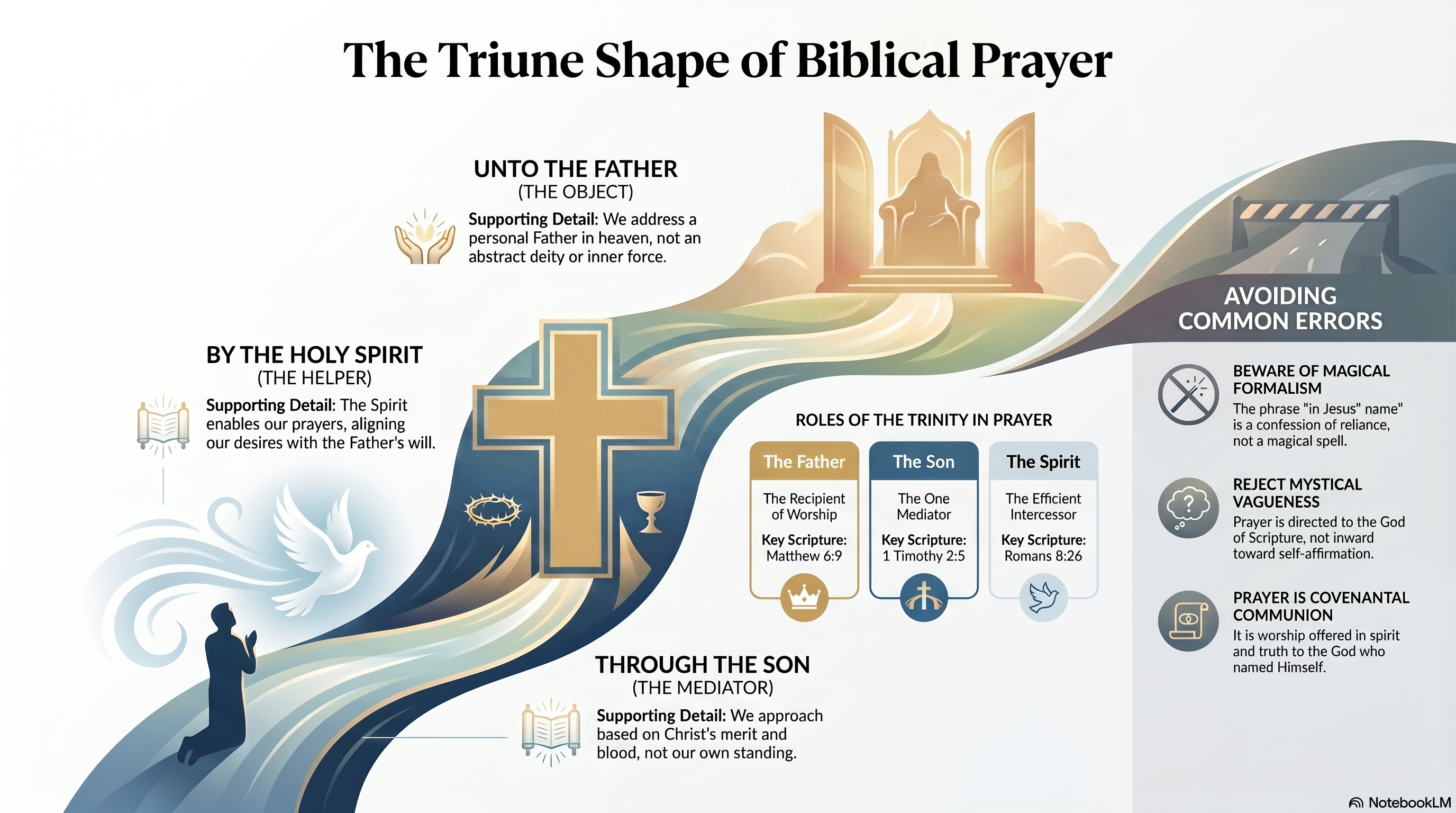
Christian prayer is not vague spirituality, and it is not a technique. It is covenantal communion with the one true God, addressed to Him as He has actually named Himself. The ordinary biblical pattern is plain: we pray to the Father, through the Son, by the Holy Spirit. The single clearest summary stands in — access unto the Father, through Christ, by one Spirit.
This essay builds directly on The Trinity: One God in Three Persons. If God truly is one God in three persons, then the way we approach Him is not arbitrary. The triune shape of God determines the triune shape of prayer.
Two errors must be avoided at once. The first is magical formalism, which treats the syllables of God's name, or the phrase "in Jesus' name," as a spell that compels an answer. The second is mystical vagueness, which empties prayer of its object and turns it inward, into self-affirmation, manifestation, or private revelation detached from Scripture. Against both, the Bible teaches that the name matters because the God who bears the name matters. We must address the true God as He has revealed Himself, in the way He has appointed, on the ground He has provided.
1) The name of God is His revealed self, not a magic word
In Scripture, a name is not a label chosen by men. God's name is His own self-disclosure — who He is, how He has bound Himself to His people, and what He is like.
“And God said unto Moses, I AM THAT I AM... this is my name for ever, and this is my memorial unto all generations.” (, KJV)
“The name of the LORD is a strong tower: the righteous runneth into it, and is safe.” (, KJV)
“And they that know thy name will put their trust in thee.” (, KJV)
To know God's name is to know God as He has made Himself known. That is why the third commandment guards the name so seriously:
“Thou shalt not take the name of the LORD thy God in vain.” (, KJV)
The point is not superstition about pronunciation. The point is reverence toward the God whose character the name expresses. This already rules out treating prayer as word-magic. Jesus condemns exactly that instinct:
“But when ye pray, use not vain repetitions, as the heathen do: for they think that they shall be heard for their much speaking.” (, KJV)
So the question of prayer is never merely which sounds do I make? It is whom am I addressing, and on what basis do I come? The name matters because it identifies the true God and distinguishes Him from every idol and every projection of the religious self.
2) We pray to the Father
The Lord Jesus, teaching His disciples how to pray, does not direct them to an abstract deity or to the inner self. He directs them to the Father.
“After this manner therefore pray ye: Our Father which art in heaven, Hallowed be thy name.” (, KJV)
“And in that day ye shall ask me nothing. Verily, verily, I say unto you, Whatsoever ye shall ask the Father in my name, he will give it you.” (, KJV)
Paul follows the same pattern:
“For this cause I bow my knees unto the Father of our Lord Jesus Christ.” (, KJV)
The ordinary Christian posture, then, is personal: communion with the Father. This is not deism, where God is distant and unmoved, and it is not mysticism, where the divine is a force to be tapped. It is a child speaking to a Father who is in heaven and whose name is holy.
3) We come through the Son, the one Mediator
We do not approach the Father on our own standing. We come through Jesus Christ, and through Him alone.
“For there is one God, and one mediator between God and men, the man Christ Jesus.” (, KJV)
“Jesus saith unto him, I am the way, the truth, and the life: no man cometh unto the Father, but by me.” (, KJV)
“Having therefore, brethren, boldness to enter into the holiest by the blood of Jesus.” (, KJV)
This is what "in Jesus' name" actually means. It is not a verbal seal stamped onto our own desires to make them effective. To pray in Christ's name is to approach God on the basis of Christ's person, blood, righteousness, priesthood, and authority — to ask the Father to receive us because we come under the merit and mediation of His Son.
The Westminster Larger Catechism states this with great precision. To pray in the name of Christ, it says, is not by bare mentioning of his name, but by drawing our boldness, our strength, and our hope of acceptance from Christ and His mediation (WLC 180). That single clarification dismantles magical formalism. A man may say the word "Jesus" a hundred times and not pray in Jesus' name at all, if he denies or ignores Christ's mediation. And a believer who is truly resting on Christ prays in His name even when the closing formula is unspoken, because he is genuinely relying on the Mediator.
4) We pray by the Holy Spirit
We do not even pray rightly out of our own resources. The Spirit Himself enables and carries our prayer.
“Praying always with all prayer and supplication in the Spirit, and watching thereunto with all perseverance.” (, KJV)
“Likewise the Spirit also helpeth our infirmities: for we know not what we should pray for as we ought: but the Spirit itself maketh intercession for us with groanings which cannot be uttered.” (, KJV)
The Spirit's role is not decorative. He is the efficient helper of prayer, applying Christ's redemption, illuminating the Word, conforming our desires to the Father's will, and granting the very affections that true prayer requires. We pray by the Spirit; and through the Spirit the Father ministers grace, comfort, conviction, and strength back to us.
5) The triune shape of prayer, in one verse
Put the three together and the structure is unmistakable:
“For through him we both have access by one Spirit unto the Father.” (, KJV)
Through Him — Christ, the Mediator. By one Spirit — the Holy Ghost, the helper. Unto the Father — the God to whom we come.
This is one of the clearest Trinitarian texts in Scripture, and it is a text about prayer. The shape of Christian access to God is irreducibly trinitarian because the God of Christian prayer is the triune God. A safe and doctrinally clear opening therefore sounds like this:
Heavenly Father, I come to Thee in the name of the Lord Jesus Christ, by the help of the Holy Ghost.
That is not vain ritual. It is worship that knows exactly to whom it speaks and on what ground it stands.
6) May we pray directly to the Son?
Yes. The ordinary pattern is Fatherward prayer through Christ, but Scripture also models direct address to the Son, and this is not idolatry. It is worship offered to one who is truly God.
Stephen, dying, prays:
“And they stoned Stephen, calling upon God, and saying, Lord Jesus, receive my spirit.” (, KJV)
Paul pleads with the Lord concerning his thorn, and the Lord answers:
“And he said unto me, My grace is sufficient for thee: for my strength is made perfect in weakness.” (, KJV)
And the final prayer of Scripture is addressed to Christ:
“He which testifieth these things saith, Surely I come quickly. Amen. Even so, come, Lord Jesus.” (, KJV)
Because the Son is fully God, He may be directly invoked, trusted, and worshiped. Direct prayer to Jesus is an act of devotion to God the Son.
7) May we pray to the Holy Spirit? Yes — more cautiously
The same logic holds for the Spirit, with one honest qualification. Because the Holy Spirit is fully God (see the Trinity essay), He is worthy of worship and may be addressed. A prayer such as "Holy Spirit, illumine Thy Word, convict me of sin, and help me pray as I ought" is entirely orthodox.
The caution is not about the Spirit's deity or rank. It is about biblical pattern. Scripture's ordinary language is that we pray by the Spirit far more than to the Spirit. The Spirit's characteristic ministry in prayer is to bring us to the Father through the Son — not to serve as a separate access-route around Christ's mediation. The danger to avoid is treating the Spirit as a detachable spiritual power, a private channel of revelation or experience apart from Christ and the Word. The Spirit never bypasses Christ; He glorifies Christ and leads us to the Father.
So the default structure remains Fatherward: Father, through Jesus Christ my Mediator, by Thy Holy Spirit, help me pray according to Thy will. Direct address to the Spirit is permitted; it simply should not displace the ordinary covenantal order.
8) Why the name matters: against mysticism and the religious self
Here the practical concern comes into focus. Much of what passes for "spirituality" is not prayer to the true God at all. Manifestation, positive confession, manipulating spiritual forces, and the cultivation of self-focused affirmations are not biblical prayer. They are a turning inward — the self addressing the self, or addressing an undefined "universe" — dressed in religious language.
The Bible's God is not vague. He has a name, and that name is finally given its fullest covenant form in the gospel:
“Blessed be the God and Father of our Lord Jesus Christ, who hath blessed us with all spiritual blessings in heavenly places in Christ.” (, KJV)
This phrase is wonderfully clarifying. The true God is not an abstract deity behind all religions. He is the God and Father of our Lord Jesus Christ — the Father, the Son, and the Holy Ghost. To pray to Him is to pray to the One who has revealed Himself in Christ, not to a deity remade in the image of my own desires.
This is why intent and object are decisive. Biblical prayer is covenantal worship and petition directed to the true God, in repentance, reverence, faith, and submission to His will. The mystic's inward projection and the believer's prayer may even use overlapping vocabulary, but they are not addressed to the same God. Jesus locates true worship precisely:
“God is a Spirit: and they that worship him must worship him in spirit and in truth.” (, KJV)
In spirit — by the Holy Spirit, from the heart, not mere technique; interpreters divide over whether "spirit" here names the human spirit or the Holy Spirit, but on either reading the point stands: true worship is inward and God-wrought, not a matter of place or performance. In truth — according to God as He has actually revealed Himself, not as we imagine Him.
9) The two errors named directly
A) Magical formalism
This error treats "in Jesus' name" as an incantation, as though the words themselves bind God to grant the request. Scripture forbids it. Christ Himself warns against vain repetitions (), and the Larger Catechism insists that praying in His name is not by bare mentioning of it. The phrase is not a key that turns a lock. It is a confession that we come only through the Mediator.
B) Mystical self-focus
This error keeps the posture of prayer but loses its object. It becomes affirmation, visualization, or the pursuit of private impressions treated as fresh revelation. It seeks to manipulate reality or to deify the self. But prayer that does not address the true God, on the ground of Christ, is not Christian prayer at all, however sincere or intense it feels.
The Reformed answer threads between both. Correct syllables alone do not make prayer true — but neither does sincerity directed at a false conception of God. What makes prayer true is that it is offered to the true God, in the name of Christ, by the help of the Spirit.
10) Objections and replies
Objection 1: "If the exact words don't matter, then wording is irrelevant."
Not quite. The Lord is not fooled by formulas, and He is not deaf to His children because they worded something imperfectly. A sincere believer truly relying on Christ prays acceptably even without ending every sentence with a set phrase. But this does not make the object of prayer indifferent. It matters enormously whom you address and on what ground you come. Wording is not a magic mechanism, yet words still confess realities — and confessing the true God, through Christ, is exactly what biblical prayer does.
Objection 2: "Praying to the Father through the Son sounds like the Son is lesser."
No. The order of approach reflects the persons' distinct roles in redemption, not inequality of nature. The Son and the Spirit are fully God (see the Trinity essay), which is precisely why direct prayer to the Son is legitimate worship. The triune order — to the Father, through the Son, by the Spirit — describes how the one God has appointed access, not a ladder of dignity.
Objection 3: "Insisting on Christ's mediation is narrow and exclusive."
It is narrow in the sense that Christ Himself made it narrow: no man cometh unto the Father, but by me (). But this narrowness is mercy, not cruelty. There is one mediator () because sinners need a real one, and God has provided Him at infinite cost. The exclusivity of the way is the security of the access.
Reformed note on method
This essay follows the Westminster Standards closely because they state the doctrine of prayer with unusual care. The Shorter Catechism defines prayer as the offering up of our desires to God, for things agreeable to His will, in the name of Christ, with confession of sin and thankful acknowledgment of His mercies (WSC 98). The Larger Catechism adds that this offering is made by the help of his Spirit (WLC 178), that we are to pray to God alone (WLC 179), that to pray in Christ's name is not the bare mentioning of it but reliance on His mediation (WLC 180), that we pray in no other name because we have no access without a mediator (WLC 181), and that the Spirit helps our infirmities by enabling us to understand and to pray as we ought (WLC 182). The Confession likewise teaches that prayer, to be accepted, is to be made in the name of the Son, by the help of his Spirit, according to his will (WCF 21.3).
These standards are not authorities over Scripture. They are disciplined summaries of it. Scripture remains the supreme judge; the Standards are received here as faithful, time-tested expressions of what the Bible teaches about how the people of God draw near.
Conclusion
The name by which we pray shapes our intent, and it can mark the difference between worshiping the living God and addressing an idol of our own making — including the idol of the self that mysticism so easily enthrones. But the safeguard is not superstition about exact wording. It is the truth that prayer is directed to the true God, who has named Himself.
So pray reverently and simply to the Father. Come only through Jesus Christ, your Mediator and High Priest. Depend on the Holy Spirit to help you pray rightly. Do not trust in formulas, in mystical impressions, in self-affirmation, or in spiritual techniques. Trust in Christ, submit to Scripture, and seek God's glory above your own will.
“For through him we both have access by one Spirit unto the Father.” (, KJV)
“Surely I come quickly. Amen. Even so, come, Lord Jesus.” (, KJV)
Suggested next steps
- Read , , , and in one sitting, watching for the triune shape of access to God.
- Revisit The Trinity: One God in Three Persons to see how the doctrine of God grounds the practice of prayer.
- Continue to Why Presbyterian Worship Does Not Center on Altar Calls to see how the same convictions shape corporate worship, not only private prayer.
- As a practical exercise, take one written prayer of your own and test it: To whom is it addressed? Through whom do I come? By whose help do I pray? Revise it until the answer is plainly Father, Son, and Holy Ghost.
Essay Video
The Name of God and Biblical Prayer
Audio Discussion
The Name of God and Biblical Prayer
Infographic
The Name of God and Biblical Prayer