Essay
Why Presbyterian Worship Does Not Center on Altar Calls
A Reformed, Christ-centered case for understanding the Lord's Day assembly as covenantal worship ordered by Scripture, not as a revival meeting engineered for visible decisions.
All Scripture citations are from the King James Version (KJV).
"Prove all things; hold fast that which is good." () "God is a Spirit: and they that worship him must worship him in spirit and in truth." ()
TL;DR
Claim. Presbyterian worship does not ordinarily center on altar calls, not because it is indifferent to evangelism, but because it believes the Lord's Day gathering is a covenantal meeting with God, ordered by Scripture, and centered on the ordinary means of grace Christ has appointed for the gathering and perfecting of His people.
Method. Exegesis first: examine what Scripture teaches about worship, the sufficiency of the preached Word, and the nature of conversion, then measure the altar-call practice against that standard.
Payoff. If God saves sinners through the means He has appointed, chiefly the Word, prayer, and the sacraments, then the church does not need to invent techniques to make the gospel effective. Reverent, Scripture-governed worship is not anti-evangelistic. It is evangelistic by proclamation, trusting God to give the increase.
Thesis
In many evangelical settings, the climax of the Lord's Day service is the altar call: a public invitation to walk forward, make a decision, or visibly respond to the preaching. For many Christians, that feels normal, almost essential. So when someone visits a Presbyterian church and does not see that pattern, the question naturally arises: Why not?
This essay argues that the absence of altar calls in historic Presbyterian worship is not a deficiency but a theological conviction. It flows from three interlocking principles:
- The Lord's Day assembly is a covenantal meeting with God, governed by His Word, not a religious rally shaped by whatever technique seems most effective.
- God ordinarily saves and sanctifies His people through the means He Himself has appointed: the preaching of the Word, prayer, and the sacraments, not through revival methods or engineered moments of public decision.
- Conversion is the sovereign work of the Holy Spirit, not the product of atmosphere, emotional momentum, or public pressure. The distinction between Spirit-worked conviction and externally induced response must be guarded, not blurred.
None of this means Presbyterians are indifferent to the salvation of sinners. It means they believe the gospel should be preached boldly, sinners should be called urgently, and conversions should be sought prayerfully, but all through the ordinary means God Himself has appointed.
1) The Lord's Day Assembly Is First of All a Meeting with God
Historic Presbyterianism understands the Lord's Day gathering primarily as the assembled people of God coming before Him in worship. The service is not meant to be reshaped around whatever technique appears most emotionally effective. It is meant to be governed by what Scripture teaches is fitting for the church.
This conviction is rooted in explicit biblical warrant.
"God is a Spirit: and they that worship him must worship him in spirit and in truth." ()
"Let all things be done decently and in order." ()
The apostolic command is not merely "Let all things be done." It is "Let all things be done decently and in order." Worship has a discipline. It has boundaries. It must be governed by truth, by what God has revealed, not by what we find most stirring.
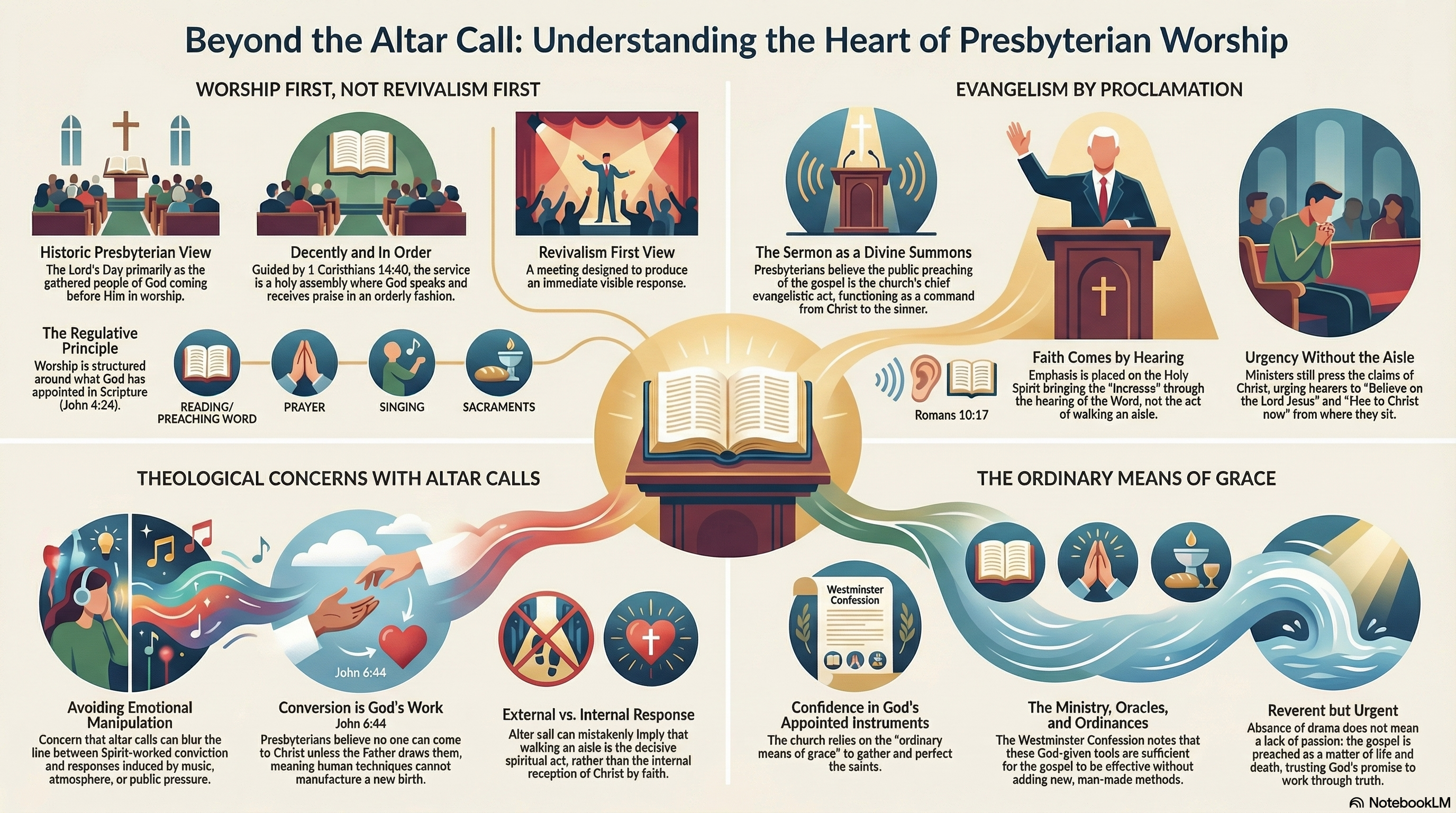
The Westminster Confession of Faith states this principle clearly: God alone is Lord of the conscience, and His worship must be ordered by His Word. This is sometimes called the regulative principle of worship: the church may not introduce into public worship whatever seems helpful or effective, but must limit its worship to what Scripture commands or warrants.
This immediately distinguishes a Presbyterian service from a revival meeting. A revival meeting is ordinarily organized around pressing for an immediate outward response. A Presbyterian service is ordinarily organized around the stated worship of the triune God through His appointed ordinances.
2) The Shape of Worship Is Not Arbitrary
One of the most overlooked differences between Presbyterian worship and revivalist worship is structural. Presbyterians generally believe that the Lord's Day service has a biblical shape, a covenantal order that reflects how God deals with His people.
A) The Covenantal Pattern
In broad terms, historic Christian worship has often been understood as moving through a covenantal progression:
| Movement | What Happens | Scriptural Root |
|---|---|---|
| Call | God summons His people into His presence | ; |
| Cleansing | The congregation confesses sin and receives the comfort of the gospel | ; |
| Consecration | God speaks through the reading and preaching of His Word | ; |
| Communion | God communes with His people in prayer, thanksgiving, and, where administered, the Lord's Supper | ; |
| Commission | God blesses His people and sends them into the world | ; |
This is not a man-made invention. It reflects the pattern of how sinners, reconciled through Christ, are brought near to God. We do not approach Him on our own terms. He tells us how to come.
B) Sacrificial Echoes
Some theologians have also connected this movement to the sacrificial pattern of the Old Testament, particularly the sequence of approach, atonement, ascent, fellowship, and blessing that appears in Levitical worship (Leviticus 1-7; ). The burnt offering, the sin offering, the peace offering, the fellowship meal: these are not arbitrary. They embody a theology of access. God teaches Israel how to draw near.
In Christ, those shadows are fulfilled:
"Having therefore, brethren, boldness to enter into the holiest by the blood of Jesus, By a new and living way, which he hath consecrated for us, through the veil, that is to say, his flesh." ()
The movement of worship is upward toward communion with God through Christ, not forward toward a platform. That is why a Presbyterian service is structured as a service of divine summons and response, not as a progression toward a climactic altar call.
3) Confidence in the Ordinary Means of Grace
At the heart of the Presbyterian view lies confidence in what the Westminster Standards call the ordinary means of grace: the instruments God uses to bring sinners to Christ and strengthen His people.
"So then faith cometh by hearing, and hearing by the word of God." ()
"For after that in the wisdom of God the world by wisdom knew not God, it pleased God by the foolishness of preaching to save them that believe." ()
The Westminster Shorter Catechism (Q. 88) identifies the outward means by which Christ communicates the benefits of redemption as "his ordinances, especially the Word, sacraments, and prayer; all which are made effectual to the elect for salvation." The Westminster Confession adds that the visible church has been given "the ministry, oracles, and ordinances of God, for the gathering and perfecting of the saints" (WCF 25.3).
A) The Word Preached Is Itself a Divine Summons
Presbyterian worship is not less evangelistic than revivalist worship. It is evangelistic by proclamation. The preached gospel is not merely instructional; it is also a divine summons. Christ is set forth, and sinners are commanded to come to Him:
"Come unto me, all ye that labour and are heavy laden, and I will give you rest." ()
"Repent ye, and believe the gospel." ()
"Ho, every one that thirsteth, come ye to the waters, and he that hath no money; come ye, buy, and eat; yea, come, buy wine and milk without money and without price." ()
A faithful minister should press the claims of Christ on the conscience, call sinners to repentance, warn the careless, comfort the broken, and trust the Holy Spirit to give the increase. The gospel invitation is present wherever Christ is preached faithfully. The difference is that Presbyterian worship refuses to identify that invitation with a walk to the front.
B) The Sacraments Seal What the Word Proclaims
The Lord's Supper is not a footnote. Where it is administered, it is part of the climax of worship, God communing with His people at His Table. The movement of the service leads not to an anxious walk down an aisle, but to the Table where Christ feeds His flock:
"The cup of blessing which we bless, is it not the communion of the blood of Christ? The bread which we break, is it not the communion of the body of Christ?" ()
C) Prayer Is the Church's Breath
Corporate prayer, confession, intercession, thanksgiving, is a central ordinance, not filler between musical sets. The congregation brings its needs before the throne of grace together:
"Let us therefore come boldly unto the throne of grace, that we may obtain mercy, and find grace to help in time of need." ()
These three, Word, sacraments, and prayer, are the means Christ has appointed. Presbyterian confidence rests not in heightened atmosphere, but in God's promise to work through what He has instituted.
4) The Theological Problems with Altar Calls
The Presbyterian hesitation about altar calls is not rooted in hostility toward earnest evangelistic appeal. Many ministers who use altar calls sincerely desire the salvation of souls. The concern is theological and pastoral.
A) Altar Calls Can Blur the Nature of Conversion
An altar call can easily communicate things Scripture does not teach:
- It may suggest that walking an aisle is the decisive spiritual act, conflating a physical movement with the new birth.
- It may imply that an immediate visible response is a reliable index of true conversion.
- It may place undue confidence in atmosphere, music, repetition, and public pressure.
Scripture locates saving faith in the heart, not in a visible step:
"That if thou shalt confess with thy mouth the Lord Jesus, and shalt believe in thine heart that God hath raised him from the dead, thou shalt be saved. For with the heart man believeth unto righteousness; and with the mouth confession is made unto salvation." ()
The call is to believe in the heart, not to perform a visible ceremony that may or may not correspond to inward reality.
B) Conversion Is the Sovereign Work of the Spirit
Presbyterians are cautious about altar calls because they believe conversion is the work of God, not the product of technique:
"No man can come to me, except the Father which hath sent me draw him: and I will raise him up at the last day." ()
"The wind bloweth where it listeth, and thou hearest the sound thereof, but canst not tell whence it cometh, and whither it goeth: so is every one that is born of the Spirit." ()
"So then it is not of him that willeth, nor of him that runneth, but of God that sheweth mercy." ()
If no arrangement of emotional momentum can create the new birth, if only the Holy Spirit can do that, then methods designed to produce an immediate visible response must be handled with extreme care. The danger is not earnestness. The danger is blurring the line between Spirit-worked conviction and externally induced response.
C) The Altar Call Is Not a Biblical Ordinance
This point is straightforward but important. Scripture nowhere commands, models, or warrants a practice in which hearers are urged to come forward to a platform as the decisive act of response to the gospel.
- Jesus says, "Come unto me" (), but He is calling for faith, not for a physical step toward a stage.
- Peter at Pentecost says, "Repent, and be baptized every one of you" (), but the response he calls for is repentance and the sacrament of baptism, not walking an aisle.
- Paul preaches at Athens (), and some believe, some mock, and some want to hear more. There is no altar call.
The altar call as a regular practice is traceable to revivalist methods of the 18th and 19th centuries, particularly to Charles Finney's "anxious bench." Whatever good motives attended its origin, it was a human innovation, not a scriptural ordinance. And the regulative principle of worship presses the question: By what warrant does the church introduce into its stated worship a practice Scripture has not appointed?
5) A Summary Grid: Revivalist vs. Covenantal Worship Logic
| Feature | Revivalist Worship | Covenantal (Presbyterian) Worship |
|---|---|---|
| Primary goal | Produce an immediate visible response | Gather, cleanse, feed, and send God's people |
| Climax of service | The altar call after the sermon | Communion with God through Word, sacrament, and prayer |
| Direction of movement | Forward to a platform | Upward toward God through Christ |
| Confidence placed in | Tends to rest in atmosphere, music, and emotional momentum | God's promise to work through His appointed means |
| View of conversion | Identified, or closely associated, with a visible act of decision | A sovereign work of the Spirit received by faith, which may or may not include a visible moment |
| Evangelistic method | Invitation system | Proclamation of Christ and the call to repentance and faith |
| Governing principle | Risks defaulting to whatever seems most effective | What Scripture warrants for worship |
6) What Happens Instead of an Altar Call?
In a Presbyterian church, a faithful minister should still press the claims of Christ on every conscience. He should still call sinners to repentance. He should still urge unbelievers not to delay. He should still preach Christ crucified and risen as the only hope of salvation.
But instead of saying, "Come to the front now," he will more often say, in effect:
Believe on the Lord Jesus Christ. Repent of your sins. Flee to Christ now, where you are. Seek Him while He may be found.
"Seek ye the LORD while he may be found, call ye upon him while he is near: Let the wicked forsake his way, and the unrighteous man his thoughts: and let him return unto the LORD, and he will have mercy upon him; and to our God, for he will abundantly pardon." ()
He may invite hearers to speak with him privately after the service, to receive further instruction, to request prayer, or to begin the process of joining the church. But the emphasis stays on Christ received by faith, not on a public act of walking forward.
That is not a small difference. It reflects an entirely different understanding of what public worship is for and how God ordinarily works through it.
7) Common Objections Answered
Objection 1: "If you don't give an altar call, how will people respond?"
The same way sinners have always responded to the gospel: by the Holy Spirit's work, through hearing the Word preached.
"So then faith cometh by hearing, and hearing by the word of God." ()
The assumption behind this objection is that without an engineered mechanism, the gospel will not "land." But that assumption undermines confidence in the very means God has appointed. The question is not, "Will people respond?" It is, "Do we trust God to work through His own ordinances?"
For eighteen centuries the church proclaimed the gospel without altar calls. Were there no conversions? Augustine was converted while reading Romans 13. The Philippian jailer cried, "What must I do to be saved?" without an invitation system (). The three thousand at Pentecost were "pricked in their heart" by the preaching (). God works through truth, not through technique.
Objection 2: "But altar calls show we're serious about evangelism."
Sincerity is not in question. The question is method, and whether method matters.
A church that preaches Christ crucified, calls sinners to repent, administers the sacraments faithfully, and prays for the conversion of the lost is doing what the apostles did. A church that adds a man-made response mechanism to the end of the service is doing something the apostles never did. The more evangelistic question is not "Did we give an altar call?" but "Did we preach Christ faithfully?"
Objection 3: "People need a moment to act, a decision point."
Scripture presents faith as the response God works in the heart, not as a product of a staged moment:
"For by grace are ye saved through faith; and that not of yourselves: it is the gift of God: Not of works, lest any man should boast." ()
The concern is not that people should delay. The concern is that identifying faith with a visible act, walking an aisle or raising a hand, can produce false assurance in those who performed the act but were never truly converted, and false despair in those who were genuinely converted but did not perform the act in the prescribed emotional moment.
Faithful preaching already provides the "decision point." Christ is offered. Sinners are commanded to believe. The moment of faith is between the soul and God. The church does not need to manufacture it.
Objection 4: "Doesn't the absence of altar calls make services cold and intellectual?"
Reverence is not indifference. Order is not coldness. Simplicity is not unbelief.
A Presbyterian minister ought to preach with real earnestness because eternity is at stake. He ought to plead with sinners because the gospel is a matter of life and death. But he does so with confidence that God works through truth, not through manipulation; through the gospel itself, not through ceremonial pressure:
"For I am not ashamed of the gospel of Christ: for it is the power of God unto salvation to every one that believeth." ()
The gospel is "the power of God unto salvation," not the altar call, not the atmosphere, not the emotional swell. Paul's confidence is in the gospel itself, and Presbyterian worship shares that confidence.
Objection 5: "Finney's methods brought revival. Don't results prove the method?"
This objection assumes that visible results validate whatever method produced them. But Scripture does not teach that pragmatism governs worship.
Finney's "new measures" were controversial in his own day. Asahel Nettleton and other Reformed ministers objected that the anxious bench produced excitement without substance, and that many who came forward fell away. Finney himself is often reported to have lamented, late in life, that large numbers of those counted as converts in his meetings had not persevered, an admission consistent with the sober assessments in his own later writings.
More importantly, the question is not "Did it appear to work?" but "Did God appoint it?" Nadab and Abihu offered "strange fire" before the LORD, fire "which he commanded them not" (). The fire was real; it was also unauthorized. God's response was not approval.
The church's mandate is not to do whatever produces visible results. It is to do what Christ has commanded:
"Teaching them to observe all things whatsoever I have commanded you." ()
Objection 6: "Scripture commands public confession. Why not a public act of response?"
This is the strongest objection, because it rests on explicit texts. Christ says:
"Whosoever therefore shall confess me before men, him will I confess also before my Father which is in heaven." ()
And Paul writes:
"For with the heart man believeth unto righteousness; and with the mouth confession is made unto salvation." ()
Faith, on this argument, is not meant to stay private. If confession before men is commanded, why object to a public act of response at the close of the sermon?
The premise is granted entirely: Scripture does command public confession, and a church that never asks anyone to own Christ openly has failed. The question is what form that confession takes. In both texts, confessing Christ before men is a whole-life public owning of Him — and the Reformed order supplies exactly the public confessions Scripture appoints. Baptism publicly marks a person out as Christ's. Profession of faith before the congregation publicly owns Him. Church membership publicly binds a believer to His body. And the confession of is made above all where it costs something: before hostile men, under pressure, in the world, across a lifetime — not in the safest room the believer will ever stand in, among people already applauding the decision. No one who is baptized, professes faith, joins the church, and confesses Christ before a watching world has evaded public confession by declining to walk an aisle.
The remaining question is one of worship, and here the Reformed distinction between elements and circumstances must be applied honestly. The Westminster Confession teaches that worship's substance is limited to what God has instituted (WCF 21.1), while acknowledging that "some circumstances concerning the worship of God, and government of the church, common to human actions and societies," are "to be ordered by the light of nature, and Christian prudence, according to the general rules of the Word" (WCF 1.6). So an announcement that inquirers may speak with the elders after the service is a circumstance — legitimate, prudent, and no violation of anything. What this essay opposes is something else: installing a physical response as the climactic, quasi-sacramental element of the service, a stated ordinance of worship that Scripture never appointed. The line is not between public and private religion. It is between the confessions God has instituted and a ceremony men have added.
8) The Climax of Worship Is Not the Aisle, but Communion with God
This is the central theological point, and it is worth stating with maximum clarity.
In a revivalist service, the emotional and practical climax comes after the sermon, when hearers are urged to come forward. The gravity of the service pulls toward a human act, a visible step by a sinner toward a platform.
In a Presbyterian understanding, the climax of worship is not a man stepping toward the front. The climax is God bringing His people near to Himself through Christ.
God calls His people into His presence. They confess their sins and receive the comfort of the gospel. He consecrates them through the reading and preaching of His Word. He receives their prayers and thank offerings. And, where the Lord's Supper is administered, He communes with them at His Table. Then He blesses and sends them out.
"Draw nigh to God, and he will draw nigh to you." ()
The center of gravity in Presbyterian worship is not the anxious question, "How can we get people to make a visible move right now?" It is the covenantal reality: How does God ordinarily gather, cleanse, feed, and send His people?
The service is therefore not built around the altar call, but around the means by which the risen Christ actually ministers to His church. And those means are not silent or inert. The word of God is "quick, and powerful, and sharper than any twoedged sword" ().
9) A Brief Reformed Note on Church History
The altar call in its familiar form is a relatively recent innovation. While the church has always urged sinners to repent and believe, the practice of inviting hearers to come forward to a "mourner's bench" or "anxious bench" as a standard element of public worship emerged primarily in the context of 18th- and 19th-century American revivalism.
For the first eighteen centuries of Christian worship, from the apostolic church, through the patristic era, through the Reformation, through the Puritans, there were no altar calls. The church baptized converts, catechized inquirers, preached the gospel, and administered the Lord's Supper. That was the ordinary pattern. And under that ordinary pattern, God built His church from a handful of disciples in Jerusalem to a worldwide body spanning every continent and culture.
This does not automatically prove that altar calls are wrong. But it does show that the church grew and flourished, explosively, without them. The ordinary means of grace are not inadequate. They are divinely sufficient.
10) What This Requires of Us
The difference between revivalist worship and covenantal worship is not merely a matter of taste or tradition. It reflects different convictions about what worship is, how God ordinarily works, and where the church's confidence should rest.
If the Lord's Day assembly is a covenantal meeting with God, ordered by Scripture, and centered on the means Christ has given His church, then it should look like that. It should move through call, cleansing, consecration, communion, and commission. It should center on the faithful preaching of the Word, the right administration of the sacraments, and the prayers of the congregation. And it should trust God to work through what He has appointed.
The gospel invitation should still ring out with urgency:
"Behold, now is the accepted time; behold, now is the day of salvation." ()
But that urgency belongs to the gospel itself, not to a method grafted onto it. The call is to come to Christ, not to a platform.
Conclusion
So why does Presbyterian worship not ordinarily center on altar calls?
Because Presbyterianism believes the Lord's Day gathering is chiefly for the worship of God, ordered by Scripture, and centered on the means Christ has given His church. It is not anti-evangelistic. It is anti-manipulative. It believes the gospel should be preached boldly, sinners should be called urgently, and conversions should be sought prayerfully, but all through the ordinary means God Himself has appointed.
The center of Presbyterian worship is not the anxious production of a visible decision. It is the confident administration of Christ's appointed worship, in which God Himself speaks by His Word, communes with His people at His Table, and sends them out under His blessing.
And because worship is understood as a God-ordered meeting with God, call, cleansing, consecration, communion, and commission, it is not surprising that the service does not revolve around an altar call. The altar call assumes the climax of worship is a man walking forward. Scripture teaches that the climax of worship is God drawing near to His people through His Son, by His Spirit, in the means He has ordained.
"For where two or three are gathered together in my name, there am I in the midst of them." ()
Practical Next Steps
- Read Psalm 95, Isaiah 6, and (KJV). Notice the pattern: God summons, God cleanses, God speaks, God sends. Worship has an order because drawing near to God has an order.
- Read (KJV). Trace the argument from Israel's need, through the preached Word, to the conclusion: "Faith cometh by hearing, and hearing by the word of God."
- Read the Westminster Shorter Catechism, Questions 88-91. Understand what the Reformed tradition means by the "ordinary means of grace" and why this concept shapes worship.
- Attend a Presbyterian Lord's Day service. Sit under the preaching of the Word and observe the covenantal structure: call, confession, consecration, communion, commission. Ask a pastor or elder to explain the order of worship.
- Bring your hardest questions to a faithful pastor or elder and test all things by Scripture (; ).
Handoff in the Walkthrough
- This essay belongs in the Church, Worship, and Public Life stage of the roadmap, after the covenantal framework has been established.
- Related topics: the regulative principle of worship, the ordinary means of grace, covenant theology and the visible church, the sacraments. For the covenant theology of baptism and the Lord's Supper, see Westminster Covenant Theology: Covenants, Baptism, and the Table. For the covenantal framework that shapes this worship, see From Dispensationalism to Reformed Covenant Theology.
Essay Video
Why Presbyterian Worship Does Not Center on Altar Calls
Audio Discussion
Why Presbyterian Worship Does Not Center on Altar Calls
Infographic
Why Presbyterian Worship Does Not Center on Altar Calls